Image source: wikiart.org
Introduction
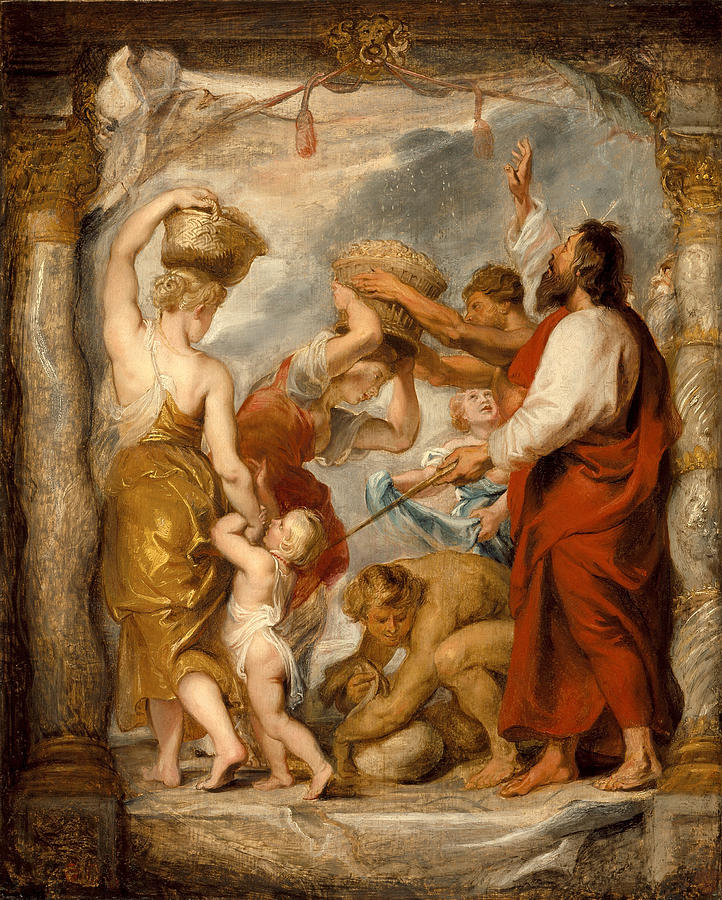
“The Israelites Gathering Manna in the Desert” by Peter Paul Rubens transforms a brief biblical episode into a swirling, theatrical spectacle filled with human emotion and divine generosity. Within a vertical architectural frame, a crowd of figures presses forward to receive the mysterious bread from heaven. Women balance heavy baskets, children stretch their arms, a man crouches to collect the miraculous flakes, and a commanding figure in red—traditionally identified as Moses—gestures upward toward the unseen source.
Rubens’s painting is not simply an illustration of a scriptural story. It is an exploration of dependence, gratitude, and abundance, rendered with the dynamic movement and sensual brushwork that define Baroque art. The composition invites the viewer to step into the crowd, to feel the weight of the baskets and the urgency of hunger, and to recognize in the falling manna a symbol of divine care that speaks across centuries.
Biblical and Historical Context
The subject comes from the Book of Exodus. After leaving Egypt, the Israelites wander in the wilderness and soon face the harsh reality of having no food. They complain and despair, fearing that they will die in the desert. In response, God promises to “rain bread from heaven” to sustain them. Each morning, the people find a fine, flakelike substance on the ground—manna—which they gather and grind into nourishment.
For Jewish and Christian traditions alike, this episode embodies the faithfulness of God, who sustains his people in their need. In Christian theology, manna also foreshadows the Eucharist, the sacramental “bread from heaven” that nourishes the soul. When Rubens chose this theme, he was working in a Catholic environment shaped by the Counter-Reformation, where images of divine provision and Eucharistic symbolism were especially meaningful.
Rubens would have known earlier depictions of the manna miracle, but he gives the story his own distinctive stamp. Instead of emphasizing the vast crowds described in Scripture, he focuses on a dense cluster of figures, bringing the miracle down to the scale of a family or small community. In doing so, he invites viewers to imagine how divine generosity touches individuals in their everyday struggles.
Composition and Narrative Structure
The painting is framed by painted columns and an ornate upper border, like a sculpted niche opening onto a dramatic scene. This illusionistic frame sets the event apart, as if the viewer peers through a marble portal into sacred history. It also emphasizes the vertical axis of the composition: from the rocky ground where people stoop to gather manna, up through the raising of baskets, and further upward toward the sky from which the blessing descends.
At the center of the scene, a woman bends under the weight of a basket she lifts high, while another woman at left strides forward with a full load balanced on her head. Their strong diagonals and swirling draperies generate a sense of continuous motion. A naked child clings to the golden-clad woman’s leg, stretching toward the bounty in front of them. In the lower right, a man crouches to pick up manna from the ground, his muscular back revealing Rubens’s deep study of the human body.
On the far right stands Moses, identifiable by his commanding gesture and staff. He wears a deep red garment and looks up toward the heavens, acknowledging God as the true source of the miracle. Around him, assistants and onlookers stretch their arms toward the falling manna, their faces a mixture of wonder and eagerness.
The crowd forms a swirling oval that keeps the viewer’s eye rotating through the scene. No figure is completely isolated; arms and glances connect them in a web of relationships. The result is a narrative that feels instantaneous and ongoing—a snapshot of one morning’s gathering that also evokes the daily repetition of the miracle.
The Figure of Moses and the Theme of Leadership
Moses is not centrally placed in the painting, yet his presence is indispensable. Rubens positions him slightly to the right, turned in three-quarter view, so that his body is part of the crowd but his gaze leads beyond it. His red robe contrasts with the paler garments around him, making him visually prominent even as he stands at the edge of the group.
His raised arm, pointing upward, becomes a crucial line in the composition. It directs attention to the invisible source of manna above the architectural frame, reminding viewers that the people do not feed themselves by their own effort alone. The gesture also suggests prayerful acknowledgment; Moses functions as mediator between God and the people, receiving the promise and instructing the community how to respond.
By not placing Moses on a pedestal or separating him physically from the others, Rubens underscores a particular understanding of leadership. Moses is among his people, close enough to touch them and to share their need. His feet, like theirs, rest on the rough stone. Yet his expression shows awareness of a divine horizon that they might not fully see. This dual perspective—part of the crowd yet oriented toward heaven—embodies the biblical role of the prophet and lends the painting a subtle moral depth.
Women, Children, and Everyday Life
One of the striking aspects of Rubens’s interpretation is the prominence of women and children. The foreground is dominated by female figures, their bodies draped in flowing golds, whites, and soft blues. These women carry the baskets, organize the gathering, and guide the children. Their presence introduces the reality of domestic life into the sacred narrative.
The woman at left, with her back turned and basket on her head, stands with a confident stride that reveals the strength needed to sustain a wandering family. Her golden garment shimmers in the light, turning her into a visual anchor for the composition. The small child clinging to her hip, rendered with tender detail, conveys dependence and trust. This intimate interaction grounds the miracle in the concerns of daily survival: feeding children, carrying provisions, managing household needs.
At the center, another woman bends forward, her body nearly folded in two under the weight of a basket lifted above her head. Her pose is one of effort and determination, but her face remains serene. She appears almost sculptural, reminiscent of classical caryatids who bear architectural weight, suggesting that these women literally uphold the life of the community.
By focusing on these figures, Rubens shifts attention from abstract theology to lived experience. The manna miracle is not only about divine power; it is also about the labor of human hands that gather, carry, and share the gift. The viewer senses the bustling energy of camp life, the urgency to collect enough before the sun melts the flakes, and the quiet heroism of those who manage the everyday logistics of survival.
Gesture, Movement, and Human Emotion
The painting is alive with gesture. Arms point, hands grasp, bodies twist and bend. Rubens choreographs these movements to express not only physical action but emotional states.
There is wonder in the upward-reaching arms of those at the center, a response to the rain of manna falling from above. Their open hands evoke gratitude and astonishment: they receive something they did not sow or earn. The crouching man in the foreground expresses a different feeling—perhaps anxiety or urgency. He bends low, intent on collecting as much as he can, suggesting the human impulse to secure security in uncertain times.
Children’s gestures bring another emotional layer. The little one at left touches the woman’s garment, eyes lifted toward the baskets. This mix of curiosity and dependence gives the scene tenderness. It reminds viewers that the miracle sustains not only the strong but also the vulnerable.
Moses’s gesture, as noted, combines authority and worship. His outstretched arm is less grasping than indicating, as if he is teaching the crowd to look beyond the immediate gift to the giver. The contrast between his composed gesture and the bustling movements of the others reflects the tension between hurried need and contemplative faith.
Light, Color, and Atmosphere
Rubens’s color palette in this work is rich yet controlled. Warm golds and deep reds dominate the figures, contrasted with soft creams and subtle blues. These hues are set against a more neutral stone architecture and a subdued sky, which allows the human forms to glow.
Light seems to fall from above and slightly to the right, illuminating shoulders, backs, and baskets while leaving some faces in partial shadow. This directional light reinforces the idea that the manna descends from heaven. Highlights on baskets and extended arms create sparkling accents that guide the eye across the composition.
The texture of Rubens’s brushwork adds to the sense of physicality. Draperies are painted with vigorous, sweeping strokes that suggest both the weight of fabric and the movement of the figures. Flesh is modelled with softer, more blended touches, producing the characteristic Rubensian glow. The stone frame is rougher, with visible marks that distinguish its solidity from the living bodies within.
Atmospherically, the painting feels warm and dense, as if the desert air presses close around the group. There is no vast open vista of landscape; the scene feels enclosed by the architectural frame and the crowd itself. This intimate spatial arrangement intensifies the viewer’s feeling of proximity to the action, almost as if one stands just outside the frame, ready to stretch out a hand for manna as well.
Symbolism of Manna and Bread
The biblical manna carries profound symbolic meaning, which Rubens subtly explores. In the story, manna appears each morning but cannot be hoarded; any extra kept overnight spoils. This teaches the people to depend daily on God’s provision rather than on their own stockpiles.
Rubens hints at this daily rhythm by showing the people in mid-gathering, baskets being filled but not yet carried away. Their urgent yet ordered activity suggests both need and trust. The falling manna, though rendered as small flecks, is central to the painting’s meaning. It represents sustenance that is both literal and spiritual: the bread that keeps bodies alive and the sign of a God who listens to complaints and responds with mercy.
For Christian viewers, especially in the time of Rubens, manna would also evoke the Eucharist. The bread of the desert foreshadows the sacred bread of the altar. The way the figures gather manna with outstretched hands echoes the posture of receiving communion. The painted architectural frame, reminiscent of an altar surround, reinforces this sacramental reading. By linking the ancient miracle with contemporary worship, Rubens’s painting becomes a meditation on thanksgiving and trust that transcends the specific story.
Baroque Theatricality and Painted Architecture
The illusionistic frame is more than a decorative border; it participates in the drama. Rubens paints columns, pedestals, and a carved upper ornament that mimic a real architectural setting. This device, known as a quadro riportato or framed picture within a picture, was popular in Baroque interiors, where paintings interacted with stucco and stone decorations.
Here the frame functions like a stage proscenium, emphasizing the theatrical nature of the scene. The crowd of Israelites becomes a troupe of actors performing sacred history before the viewer. The hanging tassels and gilded ornament at the top suggest ceremonial festivity, as if the miracle were being re-enacted in a grand church or palace hall.
At the same time, the painted architecture blurs the line between the viewer’s space and the biblical world. The stone plinth at the bottom seems almost to project into our realm, inviting us to step across it. Rubens thus uses Baroque illusionism to turn the viewer into a participant. The manna falls not only on the desert floor but, symbolically, into the space where the painting is displayed.
Spiritual Meaning and Viewer Experience
Beyond its historical and artistic interest, the painting speaks to enduring spiritual concerns. It portrays a community facing scarcity and uncertainty, sustained by a gift they did not anticipate. Rubens does not downplay the labor involved in gathering, carrying, and sharing the manna, but he shows that labor suffused with gratitude and wonder.
For viewers, the image can evoke questions about their own sources of security. Do they trust in their own ability to hoard and control, like the crouching figure intent on scraping up every flake? Or do they stand with open hands and upturned faces, recognizing dependence on a generosity beyond themselves?
The presence of women and children makes the message more immediate. The miracle is not a distant theological principle; it is about families eating, children growing, and communities surviving in difficult places. Rubens’s sensual, fleshy figures remind us that spirituality is not disembodied. Divine care touches hunger, fatigue, and the weight of daily tasks.
By placing Moses among the people yet oriented toward the sky, the painting also reflects on leadership and faith. True guidance, Rubens suggests, involves both solidarity with human need and attentiveness to a higher source of wisdom.
Legacy and Interpretation
“The Israelites Gathering Manna in the Desert” showcases many hallmarks of Rubens’s genius: robust figures in complex poses, rich color harmonies, a dynamic composition, and a deep engagement with biblical themes. It likely functioned as a preparatory work or modello for a larger commission, yet even in this form it stands as a complete and compelling vision.
The painting exemplifies how Baroque art could make scriptural stories vivid for contemporary viewers, translating ancient events into scenes brimming with recognizable human gestures and emotions. It also reflects the Counter-Reformation emphasis on trust in divine providence and on the Eucharist as spiritual nourishment.
Today, the painting continues to speak through its mixture of grandeur and intimacy. The architectural frame and swirling crowd give it monumental presence, while the small child’s hand gripping a mother’s dress or the crouched man’s concentrated effort keep it anchored in everyday experience. Rubens’s Israelites resemble people in any age who seek sustenance—physical, emotional, and spiritual—in times of uncertainty.
Conclusion
In “The Israelites Gathering Manna in the Desert,” Peter Paul Rubens transforms a brief biblical note into a richly layered meditation on need, generosity, and faith. Through energetic composition, vivid color, and keen observation of the human figure, he creates a scene that is at once ancient and immediate. The baskets, the falling flakes, the twisting bodies, and Moses’s lifted arm come together in a visual hymn to a God who feeds his people in the wilderness.
The painting invites viewers not only to admire Rubens’s technical mastery but also to enter the story personally. Standing before it, one can almost feel the press of the crowd and the weight of the basket, the dust of the desert and the surprise of finding sustenance where none seemed possible. In that imaginative participation lies the enduring power of this Baroque masterpiece: it calls each viewer to recognize the manna in their own deserts and to respond with gathering hands and grateful hearts.