Image source: wikiart.org
Introduction
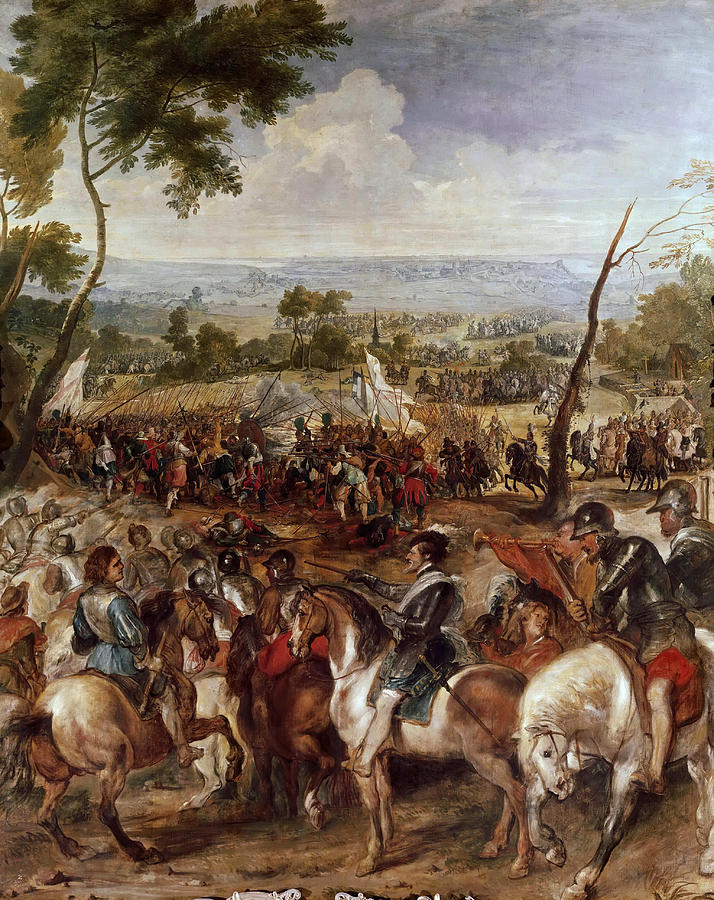
“Henry IV in the Battle of Arques” by Peter Paul Rubens is a sweeping martial panorama that transforms a historical engagement into a grand statement about royal heroism, strategy, and destiny. Across the wide surface, armies clash, cavalry surge across the terrain, and banners flutter in the wind, while King Henry IV himself appears in the foreground on horseback, commanding the scene with calm authority. The painting is as much a celebration of kingship as it is a record of battle: Rubens uses the drama of war to glorify a ruler who leads with both courage and intelligence.
The work exemplifies Rubens’ mastery at fusing narrative detail with Baroque dynamism. The viewer is plunged into a living landscape of smoke, dust, and movement, yet the composition remains coherent, carefully built around the figure of the king. By combining panoramic distance with intimate foreground portraits, Rubens invites us to experience the Battle of Arques not merely as an event in the French Wars of Religion, but as a defining moment in the story of a monarch’s rise.
Historical and Political Context
The Battle of Arques, fought in 1589, was a crucial encounter in which Henry of Navarre, the future Henry IV of France, defended his claim to the throne against the Catholic League. Outnumbered, Henry relied on tactical brilliance and the advantage of terrain to repel attacking forces near the town of Arques, not far from Dieppe. His resilience in these early campaigns paved the way for the eventual consolidation of his rule and the relative peace that followed his reign.
Rubens painted this scene decades later, when the memory of Henry IV had already taken on an almost legendary aura. The painting participates in a broader culture of royal propaganda that sought to portray Henry as a model king: brave in battle, shrewd in strategy, and ultimately a peacemaker. By revisiting the Battle of Arques, Rubens underscores the notion that Henry’s eventual success and the stability of France were forged on the battlefield. The painting becomes a visual monument to a specific historical victory and to the character of the monarch who achieved it.
A Panoramic Composition
The composition stretches horizontally, opening onto a wide battlefield framed by trees on either side. In the far distance, hills and a town recede into a hazy horizon, establishing a vast stage for the conflict. Rubens divides the painting into three main zones: the foreground cavalry group with Henry IV and his officers, the midground melee where infantry clash and artillery emplacements are visible, and the background with marching troops and landscape.
This layered structure allows Rubens to convey both the immediate human drama and the larger scale of war. The foreground riders are almost life-size, close enough for the viewer to sense the muscular power of the horses and the detailed armor of the soldiers. Beyond them, the viewer’s eye is drawn toward the swirling center of the battlefield where pikes, standards, and clustered figures meet. The distant city and rolling countryside remind us that the consequences of this clash extend far beyond the warriors themselves, affecting the fate of the kingdom.
Henry IV as the Focal Point
At the lower center of the painting, astride a spirited horse, sits Henry IV. He is easily identifiable, not only because the composition privileges him, but also through his posture and dress. The king turns slightly in profile, gesturing with his arm as he issues orders or confers with another mounted officer. His armor gleams subtly, and his bearing is relaxed yet alert.
Rubens portrays Henry not in the heat of physical combat but in the crucial role of commander. This choice emphasizes strategic leadership over brute force. The king remains composed, a figure of order amid chaos, suggesting that victory flows from his intelligence and authority. His horse, responsive and energetic, parallels his own controlled vigor. By placing Henry in the foreground, Rubens invites viewers to identify this central figure as the mind behind the battle, the one whose decisions shape the outcome unfolding in the distance.
The Cavalry in the Foreground
Surrounding Henry IV are an array of officers and riders, each carefully individualized. They wear varied costumes: some in shining armor, others in colorful doublets and breeches. Their plumed helmets, sashes, and banners add rich accents of red, white, and blue, enlivening the earthy tones of the battlefield.
These men form a semicircular formation that frames the king, their gesturing arms and turned heads subtly leading the eye toward him. Horses twist and rear, hooves digging into the soil, tails swishing. Rubens delights in depicting the anatomy and movement of the animals: muscles flex beneath glossy coats, and the horses’ heads toss with nervous energy. Through this lively equestrian group, he conveys the tension that precedes a decisive charge, capturing the moment when orders are being discussed and the cavalry awaits the signal to act.
The presence of this refined entourage also underscores the social dimension of war. These are not anonymous soldiers but noble commanders, bound to the king by loyalty and shared honor. Their proximity to Henry suggests a network of alliances and a hierarchy of command that supports the monarch’s authority.
The Clash of Armies in the Midground
Moving beyond the foreground, the viewer encounters the dense center of the battle. Here Rubens compresses a remarkable amount of detail: infantry lines bristling with pikes, clusters of soldiers locked in combat, gun positions, and encampments. Standards ripple above the masses, helping to differentiate factions. Smoke from gunfire curls upward, mingling with the clouds and adding a hazy veil that hints at noise, confusion, and dust.
Despite this complexity, Rubens organizes the midground so that the main opposing lines are legible. Diagonals of troops converge toward a central area, conveying the sense of forces meeting head-on. Fallen soldiers scattered on the ground, discarded shields, and other debris introduce the grim reality of casualties. The viewer perceives both the grandeur and the cost of battle.
This part of the painting functions like a visual fulcrum: it is where the strategy devised in the foreground is executed and where the political consequences represented by the distant town will be decided. Rubens thus knits the entire picture together through this bustling central zone of engagement.
Landscape and Atmospheric Depth
Beyond the clash of arms, the landscape opens up in a broad, luminous vista. The fields, woods, and distant hills are painted in softer tones, fading into bluish grays as they recede. A town or fortified city lies on the horizon, partially obscured by light haze, symbolizing the broader territorial stakes of the conflict.
The expansive sky occupies almost half of the canvas, filled with rolling clouds that capture the shifting light. Patches of blue and soft whites suggest a break in the weather, perhaps metaphorically echoing the clearing of political skies as Henry moves toward triumph. The tall trees at the sides frame the composition and provide a sense of scale, their trunks and branches stretching upward as if tensing in sympathy with the drama below.
Rubens uses atmospheric perspective masterfully: objects further away lose sharpness and saturation, creating a convincing illusion of distance. This depth enhances the sense that the battle is part of a larger environment, not confined to a small patch of ground but spilling across a broad, living landscape.
Color and Light
The color palette of the painting blends earthiness with flashes of brilliance. Warm browns and greens dominate the landscape and the horses, while the sky mixes cool blues and grays with sunlight breaking through the clouds. Against this natural setting, splashes of brighter color appear in the garments, banners, and sashes of the soldiers: crimson, white, and golden yellows.
Light falls unevenly across the scene, helping to structure the composition. The foreground, particularly Henry IV and his immediate attendants, is bathed in a clearer light that models the figures with tangible solidity. The midground is partially veiled in atmospheric haze, where smoke and dust soften contours. The distance glows with a paler, cooler illumination.
This distribution of light reinforces the narrative hierarchy. The king stands in the most visually legible zone, while the chaos of the battle is slightly obscured, and the eventual prize—control of the landscape and town—shimmers on the horizon. Rubens thus uses both color and light to guide the viewer’s gaze and to emphasize the significance of Henry’s presence.
Movement and Baroque Energy
Like much of Rubens’ work, “Henry IV in the Battle of Arques” is infused with movement. Diagonals crisscross the canvas: from the slanting lines of cavalry lances and banners to the sloping contours of the terrain. Horses rear, soldiers rush forward, and clouds billow. Yet the motion never feels chaotic; it is orchestrated to create a sense of energetic order.
The Baroque love of dynamic composition is evident in the way figures twist and interact. Many of the riders in the foreground turn and converse, their bodies angled in varied directions that create visual rhythm. The infantry in the midground form waves and clusters, suggesting the surge of advancing and retreating units. Even the trees bend slightly, their branches curved in response to the unseen wind blowing across the battlefield.
This energy reflects the nature of war itself: unpredictable, forceful, and constantly in flux. At the same time, the calm control exhibited by Henry amid all this motion shows the ideal of a sovereign who harnesses the chaos of conflict to achieve political order.
War, Strategy, and Royal Authority
One of the painting’s most compelling aspects is the way it intertwines the themes of war and rule. Henry IV is not portrayed as a reckless warrior throwing himself blindly into the fray. Instead, he is shown as a strategist who surveys the field, issuing commands and coordinating his forces. His high vantage point, along with those of his officers, allows them to see more than the soldiers engulfed in combat.
The viewer, sharing this vantage, experiences the battle as something legible and almost orchestrated. The tactical advantage Henry holds at Arques—a strong position on elevated ground—is reflected visually in the painting’s composition. The foreground cavalry, symbolizing command, occupies the upper slope, while the enemy forces are arrayed in the lower fields. This spatial arrangement turns geography into metaphor: the king stands literally above the struggle, guiding it with foresight.
In this way, Rubens crafts a powerful visual argument in favor of monarchical authority. War is not glorified for its own sake; it is presented as a tool that, under the guidance of a wise ruler, can secure peace and stability.
Collaboration and Workshop Practice
Many large battle scenes associated with Rubens involve collaboration with specialists in military panoramas and landscapes. The intricate detail of the distant troops and encampments, along with the broad sweep of the terrain, suggests the participation of an artist steeped in battlefield topography. Whether or not another painter contributed, the composition exemplifies the kind of workshop practice where Rubens would design the overall scheme and key figures while allowing assistants to execute some portions under his direction.
This collaborative aspect does not diminish the unity of the painting. Rubens’ guiding vision is evident in the coherent narrative, dynamic structure, and emotional tone. The combination of his figure style with precise depictions of formations and equipment results in an image that is both artistically rich and historically evocative.
Emotional Tone and Human Experience
Although the painting serves political and commemorative purposes, it does not ignore the human cost of battle. In the midground, fallen soldiers are visible on the ground, their bodies scattered among broken spears and debris. Some figures are seen carrying wounded comrades or retreating from the center of conflict. These small vignettes, easily overlooked on first glance, add a layer of poignancy to the grand spectacle.
At the same time, the foreground group of officers, including Henry, are portrayed as fully human rather than distant icons. We see them conversing, pointing, and reacting. Their faces express concentration, concern, and determination. By giving them individual personalities, Rubens reminds us that even the commanding elite experience the strain and uncertainty of war.
The overall emotional tone is one of tense anticipation rather than simple triumph. The battle is underway, not yet conclusively won. This choice engages viewers, drawing them into the unfolding drama and inviting them to imagine the eventual success that history assures us Henry will achieve.
Place within Rubens’ Oeuvre
“Henry IV in the Battle of Arques” fits within Rubens’ broader interest in large-scale historical and allegorical scenes. Throughout his career, he painted cycles celebrating rulers, including the famous series dedicated to the life of Marie de’ Medici. These works frequently blend real events with symbolic imagery to craft narratives of legitimacy and glory.
In this painting, Rubens leans more toward direct historical depiction, yet the underlying aim is similar: to elevate a monarch by capturing decisive moments in his story. The combination of panoramic battle, individual portraiture, and grand landscape reveals Rubens’ ability to synthesize genres. He is not merely recording a military engagement but transforming it into a visual epic where every horse, soldier, and cloud contributes to the legend of Henry IV.
Conclusion
“Henry IV in the Battle of Arques” is a testament to Peter Paul Rubens’ skill at uniting history, politics, and artistry. The painting immerses the viewer in a vast battlefield where cavalry thunder across the foreground, infantry collide in the middle distance, and a sunlit landscape stretches toward the horizon. At the heart of this complexity, Henry IV sits astride his horse, composed and commanding, the embodiment of royal leadership guiding the storm of war.
Through masterful composition, nuanced color, and energetic movement, Rubens turns a specific episode of the French Wars of Religion into a timeless statement about courage, strategy, and the responsibilities of kingship. The painting celebrates Henry’s tactical genius and eventual success while acknowledging the human cost of conflict. It invites viewers to appreciate not only the spectacle of battle but also the vision of a ruler who strives to shape history from the saddle.
In its blend of panoramic breadth and intimate characterization, “Henry IV in the Battle of Arques” stands as one of Rubens’ most compelling explorations of military heroism and political destiny, a work that continues to fascinate anyone drawn to the intersection of art, power, and history.