Image source: wikiart.org
Introduction
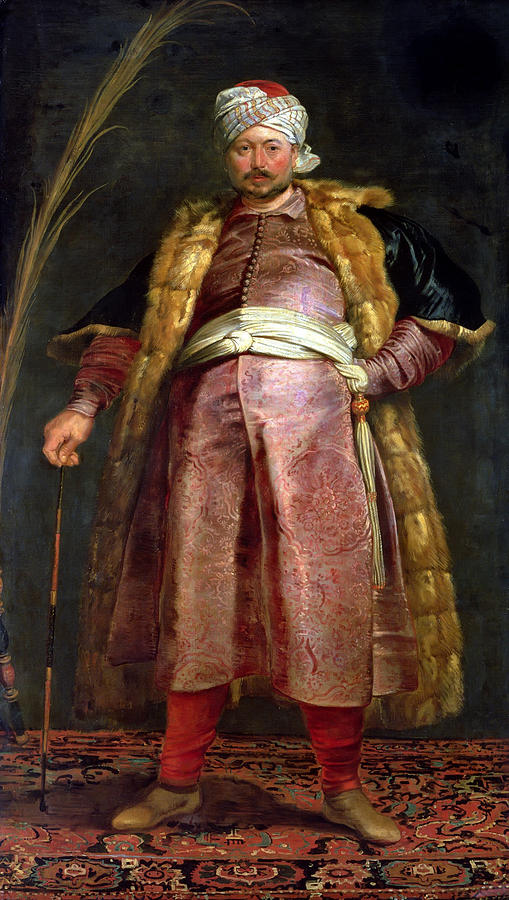
“Portrait of Nicolas De Respaigne” by Peter Paul Rubens is an arresting full-length portrait that commands attention through sheer presence. A richly dressed man stands on an oriental carpet, framed against a dark background, his luxurious fur-lined coat, embroidered robe, and elaborate turban transforming him into a figure of almost theatrical grandeur. Rubens presents Nicolas De Respaigne not only as a wealthy individual, but as someone deeply aware of the power of costume, posture, and spectacle in shaping identity.
The painting belongs to Rubens’s mature period as a portraitist, when he combined Baroque dynamism with a precise observation of character. Although the exact date is unknown, the work clearly reflects an era when European elites were fascinated by Eastern costumes and courtly display. Through this portrait, Rubens explores how clothing and stance can project authority, exoticism, and personal confidence, while still allowing psychological nuances to emerge from the sitter’s face.
Historical and Cultural Context
Rubens lived in a time when Antwerp was a cosmopolitan commercial hub, enriched by trade with Spain, Italy, and the Ottoman Empire. Exotic textiles, carpets, and garments circulated widely among the upper classes, who enjoyed staging themselves in sumptuous foreign dress for portraits, masquerades, and festivities. Such costumes suggested not only wealth but also worldliness, diplomatic connections, and a certain cultivated sophistication.
Nicolas De Respaigne appears to be one of those gentlemen eager to present himself in this fashionable guise. Whether he actually held an official position associated with the East or simply adopted the costume for its prestige, the portrait uses “Oriental” dress to assert status and distinction. Rubens, who spent years working at European courts and embassies, understood how clothing functioned as political language. Here he amplifies that language on canvas, turning Respaigne into a living emblem of power wrapped in fur, silk, and metallic thread.
Baroque portraiture often emphasized dramatic presence and theatrical staging. Rather than depicting sitters as static, Rubens liked to give them the air of entering a room or standing on a stage. The deep, neutral background functions like a curtain, while the richly patterned carpet at the sitter’s feet becomes a kind of platform. This cultural and artistic context helps explain the extraordinary flamboyance of the image: the sitter is both a real person and a carefully constructed persona.
Composition and Stance
The composition is dominated by the vertical figure of Nicolas De Respaigne, placed almost frontally in the center of the canvas. His body fills the height of the painting from head to toe, with very little space above his turban or below his shoes. This close cropping intensifies the sense of physical presence, as though the viewer stands just a step away from him.
Respaigne stands with legs apart, one slightly forward, projecting solidity and confidence. His right arm, bent at the elbow, rests on his hip, creating a strong diagonal line that cuts across the torso. This gesture is assertive, almost imperious, and helps to anchor the swirling folds of fabric that surround him. His left hand grips a slender cane, another vertical that echoes the upright posture of his body.
The figure is subtly asymmetrical: the fur mantle hangs more heavily on one side, the sash wraps diagonally around the waist, and the turban tilts slightly. These variations prevent the composition from becoming rigid and enhance the sense of movement and individuality. Rubens balances these diagonals with the solid horizontal line of the sash and the stable base of the carpet, achieving harmony between dynamism and stability.
The eye is led naturally from the patterned carpet upward along the red stockings, through the shimmering robe, then to the rich textures of fur and silk, and finally to the sitter’s face. Rubens’s control of composition ensures that, despite the abundance of luxurious detail, the viewer’s attention ultimately focuses on the man himself.
Costume and the Language of Power
The most striking aspect of the portrait is undeniably the costume. Nicolas De Respaigne wears a long, rose-colored robe with intricate patterns that suggest woven or embroidered silk. Over this, he dons a lavish fur coat, open at the front to reveal the rich textile beneath. A broad, pale sash wraps several times around his waist, its folds catching the light and emphasizing the roundness of his midsection.
On his head sits a turban, made of striped fabric wound into layers and topped with a small cap of red. The turban’s unusual shape and bright accents mark the sitter as a man tapping into an “Oriental” visual vocabulary associated with exotic courts and powerful rulers. Such headgear was not standard European fashion; it was a deliberate choice to signal prestige, travel, or diplomatic connections.
Every element of the costume speaks to status. The fur speaks of wealth and winter warmth, the silk robe of luxury trade, the sash of ceremonial dress. Even the cane in his hand may function as a symbol of office or authority, not merely a walking aid. The broad, radiant carpet under his feet reinforces the association with Eastern luxury, echoing the textiles found in Ottoman palaces and prized European collections.
Rubens paints these materials with extraordinary attention. The sheen of the silk, the softness of the fur, the crisp edge of the sash, and the fine pattern of the carpet are each rendered with distinctive brushwork. This virtuosity is not mere display of technical skill; it serves to highlight the sitter’s prosperity and the tactile richness of his world. By granting so much visual pleasure to the textures of wealth, Rubens mirrors the sensibilities of his elite patrons, who measured status partly through possession and display of such items.
Color, Light, and Atmosphere
Color plays a crucial role in shaping the mood and impact of the portrait. The dominant hue is a rich, warm red, visible in the robe, stockings, and accents of the turban. This red is sophisticated, layered with subtle patterns and variations rather than a flat tone. It conveys energy, passion, and authority, while also flattering the sitter’s complexion.
The fur coat introduces golden browns and soft yellows, which catch the light and frame the central band of red. The sash provides a counterpoint with its pale, almost creamy color, wrapping the midsection in luminous bands that draw the eye to the center of the figure. Smaller touches—such as the glint of the cane’s handle or the delicate tassel hanging from the sash—add points of light that animate the surface.
Rubens sets all of this against a dark, cool background. The deep charcoal and muted green tones behind the figure push him forward, enhancing his three-dimensional presence. The background is not elaborately detailed; instead, it functions as an atmospheric space that allows the colors of the costume to glow. This contrast between dark surround and luminous figure is a hallmark of Baroque painting, designed to make portraits visually compelling even from a distance.
The lighting appears to come from the left, casting gentle highlights along the robe, fur, and face. Shadows define the folds of fabric and the volume of the body, especially around the waist and legs. Rubens’s nuanced modelling suggests the physical bulk of the sitter, yet he avoids heaviness by allowing light to dance across the surfaces. The result is a portrait that feels both solid and alive, saturated with color yet not garish.
Texture and Painterly Technique
One of the pleasures of studying this painting lies in observing how Rubens differentiates textures with his brush. The fur of the coat is rendered with soft, feathery strokes that suggest fluffiness and warmth. In contrast, the robe’s silk is painted with longer, smoother strokes that catch the light in a convincing way, creating the impression of dense, weighty fabric that falls in heavy folds.
The sash shows another kind of touch: its tightly wrapped folds are highlighted with crisp, bright accents, emphasizing its tautness. The carpet at the bottom of the canvas displays a finer, more intricate handling, with small decorative motifs woven into the surface. By changing the size, direction, and density of his brushstrokes, Rubens conveys the distinct character of each material without needing to over-describe.
The face and hands, by comparison, are handled with particular delicacy. Rubens employs subtle gradations of flesh tones—pinks, ochres, and soft browns—to model the cheeks, nose, and knuckles. The texture of skin is smoother than that of the garments, which helps the viewer intuitively distinguish the living body from its luxurious coverings. This contrast underscores the Baroque fascination with the interplay between the sensual world of objects and the inner world of the human subject.
The Psychology of the Sitter
Although the costume powerfully asserts status, Rubens does not allow it to overshadow Nicolas De Respaigne’s personality. The face is the psychological center of the painting, and Rubens treats it with nuanced attention. The sitter’s eyes meet the viewer’s gaze directly, creating an immediate sense of confrontation. There is composure in his expression, but also a hint of weariness or gravity, as though he is accustomed to responsibility.
His cheeks are slightly flushed, his lips closed but not tightly pressed. The faint shadow of a mustache and beard adds texture and maturity to the features. Rubens balances dignity with humanity: Respaigne is impressive, yet not an idealized hero. Rather, he is a worldly man whose physical presence hints at comfort, indulgence, and perhaps a certain stubborn self-assurance.
The stance reinforces this reading. The hand on the hip suggests self-confidence, even a touch of swagger. Yet the tilt of the head and the direct, slightly narrowed gaze imply that he is evaluating the viewer as much as he is being observed. Instead of a passive subject, Rubens presents Respaigne as an active, conscious participant in the act of self-presentation. The portrait becomes a silent dialogue between sitter and audience, mediated by the painter’s skill.
Identity, Status, and the “Other”
The choice of Eastern costume introduces complex questions about identity. In early modern Europe, dressing in foreign garb could signal many things: diplomatic roles, military service abroad, participation in trade, or simply a taste for fashion and theatrical display. Whatever the precise motive in Respaigne’s case, the painting uses the visual language of the “exotic” to heighten his distinctiveness.
By adopting Turkish or Near Eastern dress, the sitter aligns himself with a world of power and opulence that captured the European imagination. The turban, fur, sash, and carpet all reference cultures that were simultaneously admired and feared. This ambivalence gave such costumes a fascination that went beyond mere luxury. They suggested access to other worlds, other courts, and other spheres of influence.
At the same time, Rubens’s portrayal is clearly anchored in European aristocratic portrait traditions. The pose, the frontal presentation, the emphasis on individual character all belong to Western conventions. The painting thus stages a subtle play between the familiar and the foreign. Respaigne is both himself and an actor in a larger drama of cultural fantasies. Rubens invites the viewer to admire the spectacle while also recognizing the sitter’s underlying, unmistakably European identity.
Rubens as Portraitist
This work offers a vivid example of why Rubens was celebrated as one of the foremost portraitists of his age. He combines accuracy of likeness with a sense of life, drama, and narrative. Instead of a mere record, the portrait becomes a story about how Nicolas De Respaigne wishes to be seen: commanding, prosperous, cosmopolitan, and perhaps a bit flamboyant.
Rubens’s portraits often share certain traits: full-bodied figures, expressive faces, rich color harmonies, and dynamic compositions. Yet he adapts his approach to each sitter. In this case, he emphasizes the sitter’s physical bulk and imposing silhouette, making his body fill the pictorial space like a monument. The careful rendering of costume and the theatrical staging further align the portrait with courtly display, suggesting that the sitter moved in circles where representation was a form of power.
Compared to more intimate half-length portraits by Rubens, the full-length format here signals an elevated social rank. Such large-scale portraits required significant resources and were typically commissioned by nobles or wealthy officials. In painting Respaigne in this grand manner, Rubens grants him a place among the elite figures of his time and underscores his importance within his own social milieu.
Legacy and Visual Impact
“Portrait of Nicolas De Respaigne” continues to captivate viewers because it unites the pleasures of exquisite surface with a complex, layered exploration of identity. On one level, it is a virtuoso display of fabrics, fur, and flesh, a feast of color and texture. On another level, it is a subtle psychological study, revealing a man who uses costume to project authority yet cannot entirely conceal the human vulnerability of his expression.
The painting also speaks to enduring questions about how we present ourselves. Modern audiences can recognize in Respaigne’s carefully chosen outfit the same impulse that drives contemporary fashion, branding, and image management. Clothing becomes a language by which individuals negotiate status, belonging, and difference. Rubens, centuries ago, captured this universal dynamic with astonishing clarity.
Standing before this portrait, viewers are likely to feel both awe and curiosity. Awe at the opulence of the garments and the mastery of the painter’s hand; curiosity about the life, ambitions, and personality of the man beneath the turban and fur. It is this combination of sensory richness and psychological depth that makes the painting a lasting masterpiece.
Conclusion
Peter Paul Rubens’s “Portrait of Nicolas De Respaigne” is much more than a record of an individual in extravagant dress. It is a fully realized Baroque drama, compressed into a single figure. Through commanding posture, luxurious costume, and sensitive facial expression, Rubens transforms the sitter into an emblem of worldly success and cross-cultural fascination, while preserving the nuances of his inner life.
The dark background and glowing colors concentrate attention on the man and his garments, making him seem to step forward from the shadows of history. His steadfast gaze meets ours across the centuries, inviting us to consider not only who he was, but how art constructs and preserves identity. In celebrating material splendor, the painting also meditates on its purpose: to fix in paint a fleeting human presence, wrapped in the symbols of its time yet still instantly recognizable in ours.