Image source: wikiart.org
Introduction to Rubens’s “Anatomical Studies of Three Male Figures”
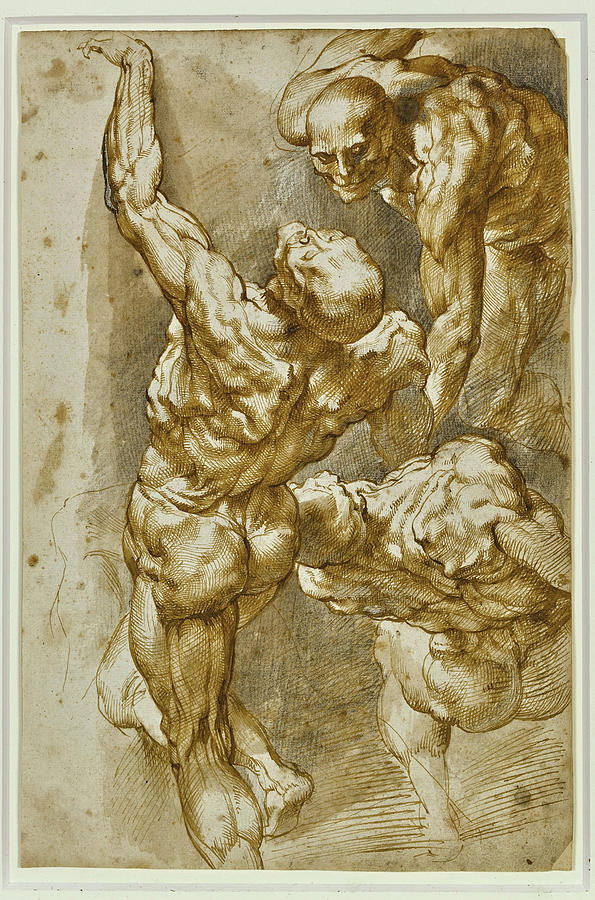
“Anatomical Studies of Three Male Figures” by Peter Paul Rubens is not a finished painting destined for a church or palace, but a working sheet where the artist probes the limits of the human body. Three monumental male nudes twist, strain and arc through the space, their muscles picked out with almost sculptural precision. Although the drawing is monochrome, made with pen, ink and wash, it contains as much drama and tension as many full-scale Baroque canvases.
Rubens used studies like this to prepare for large compositions filled with battling soldiers, writhing martyrs or ascending saints. The sheet reveals his obsession with anatomy, movement and expressive pose. It also shows how deeply he absorbed the lessons of Renaissance masters such as Michelangelo, translating their monumental figures into his own energetic, fluid style. Viewed today, this drawing stands as a complete work in its own right, a concentrated manifesto of Rubens’s understanding of the heroic male body.
Description of the Three Figures and Their Poses
The composition is dominated by a central figure seen from behind and slightly below. He plants his weight on his left leg, while his right leg bends and thrusts backward. His torso twists powerfully as his left arm shoots upward, hand reaching out of the frame. The head is thrown back, neck taut, chin lifted toward an unseen force. This pose stretches and contracts every muscle, from the bulging calf to the exaggerated deltoids and spinal ridges running down his back.
To the right, another male body leans forward, head turned down toward the central figure. Only parts of his legs are visible; Rubens concentrates on shoulders, arms and torso, which are foreshortened and thrust toward the viewer. The muscles of the back bunch and knot, and the slightly skeletal, mask-like face adds a sense of strain or intensity, as if this figure is observing or urging on the one below.
In the lower right corner a third figure bends forward, his head nearly hidden. Rubens focuses on the massive sweep of his shoulders and back, creating a compact, almost block-like form. The legs are sketched more lightly, suggesting that his attention is on the torso’s complex planes. Together the three figures create a swirling cluster of bodies, a study in torsion and counter-torsion, compression and extension.
There is no narrative setting, no landscape or architecture. The background consists of light wash and hatching, just enough to anchor the forms. The entire sheet is a laboratory for the body in motion, free of all distractions.
Rubens’s Obsession with Anatomy and the Heroic Male Nude
Rubens was famous for his voluptuous women, but his drawings reveal an equally intense interest in the male physique. Works like “Anatomical Studies of Three Male Figures” show how he internalized the structure of bones and muscles, using them not simply to achieve naturalism but to heighten expressive power.
The figures are clearly informed by anatomical knowledge, yet they are not strictly realistic. Muscles swell, twist and separate in ways more pronounced than in everyday bodies. The exaggeration is purposeful, meant to convey extreme effort or spiritual exaltation. Rubens wants us to feel the torque of joints, the strain of sinews, the heavy pull of gravity resisted by muscular force.
These heroic nudes owe much to the legacy of Michelangelo, whose Sistine Chapel figures and sculpted slaves Rubens studied closely during his years in Italy. The central figure’s arched back and raised arm recall the ignudi on the Sistine ceiling, while the overall density of musculature echoes the Florentine master’s monumental style. Rubens, however, infuses the bodies with his own Baroque energy. The lines are more fluid and rhythmic, the forms more serpentine and less block-like, giving the figures a sense of organic motion rather than carved permanence.
Composition and the Illusion of Rotating Space
Although this is a study sheet, the arrangement of the three figures reveals a sophisticated understanding of composition. The central figure establishes a strong diagonal that runs from lower left to upper right. His raised arm and lifted head prolong this line, propelling the eye upward through the picture plane.
The two flanking figures create counter-diagonals. The upper right figure leans down and inward, his head bending toward the central nude, while the lower right figure curves in the opposite direction. These opposing movements produce a swirling, almost vortex-like pattern. The viewer senses a rotation of bodies around a central axis, as if caught in a spiraling movement that could belong to a battle scene, a fall from heaven, or a tumultuous resurrection.
Rubens uses overlapping forms to build depth. The central figure stands in front of the others, partially obscuring them, while the foreshortening of limbs suggests that some parts project toward us and others recede. Even without color or atmospheric perspective, the sheet feels spatially rich. It functions as a kind of three-dimensional model on paper, allowing Rubens to test how bodies might interlock within a larger composition.
Use of Line, Hatching and Wash
The technical handling of pen and wash contributes enormously to the sheet’s impact. Rubens outlines major forms with a firm, confident line that varies in thickness. Contours swell and taper to emphasize bulges of muscle and shifts of plane, enlivening the silhouette.
Within the outlines he deploys dense networks of hatching and cross-hatching. Lines follow the anatomical direction of muscles, wrapping around limbs and torsos like topographical contours on a map. Where light strikes directly, the paper is left almost bare; in the shadows, the strokes accumulate into rich, dark passages. This method not only creates volume but also communicates the tactile quality of flesh, with its ridges and depressions.
Over the drawing Rubens adds areas of brown wash, especially on the right and in the background. The wash deepens the shadows and establishes a tonal ground against which the highlighted bodies stand out more vividly. In some places he seems to have lifted or scratched out highlights, letting the lighter paper come forward as flashes of reflected light on shoulders and backs. The combination of precise line and loose wash mirrors the interplay of structure and spontaneity that defines his mature style.
The Drawing as a Working Tool and Artistic Statement
Although today we admire “Anatomical Studies of Three Male Figures” as an autonomous work of art, it originally served as part of Rubens’s working process. Such studies allowed him to explore difficult poses before committing them to oil on canvas. The extreme contortions are easier to test in small, quickly executed drawings than on a large scale.
Rubens would often fill a single sheet with several variants of a pose, rotating the body, altering the angle, or exaggerating certain muscles to achieve maximum expressivity. In this sheet we glimpse that exploratory spirit. The three figures are not simply copies of one another; each represents a different solution to the problem of showing a twisting male nude from a particular viewpoint.
At the same time, Rubens’s draftsmanship is so assured that the sheet transcends mere utility. The intensity of the modeling, the dramatic interplay of light and shadow, and the almost sculptural presence of the bodies turn the study into a quasi-finished composition. It demonstrates to patrons and fellow artists alike that Rubens possesses unrivaled command over the human form.
Possible Connections to Larger Projects
Scholars often connect anatomical studies like this one to Rubens’s larger history paintings and altarpieces. Scenes such as “The Elevation of the Cross,” “The Descent from the Cross,” or violent mythological battles required figures who lifted heavy weights, struggled, fell or clung to precarious perches. The extreme muscular tension in this drawing suggests that Rubens was preparing for such moments of high drama.
The central figure, for example, could easily belong to a man hauling up a cross, hoisting a wounded comrade, or reaching toward a divine apparition. The upper right figure might become an onlooker leaning out from a crowded group, while the compact, crouched body below could serve as a base element in a complex pyramid of figures. Rubens rarely copied studies directly into finished works, but he drew from banks of such sheets to enrich his visual vocabulary.
Even if we cannot pinpoint the exact painting this sheet relates to, we can see it as part of Rubens’s continuous practice of refining his understanding of the body under strain. Every large commission demanded new combinations of poses, and drawings like this one were his rehearsal stage.
Dialogue with Renaissance and Classical Traditions
“Anatomical Studies of Three Male Figures” also reveals Rubens’s deep engagement with the art of the past. His interest in exaggerated musculature and complex twisting poses reflects the influence of Michelangelo, whose frescoes and sculptures he studied in Rome and Florence. The heavy back muscles, blocky forms and dynamic contrapposto echo the Florentine master’s language.
At the same time, Rubens’s bodies are less rigidly carved and more fluid. Their surfaces ripple with motion, and they occupy space in a more relaxed, organic way. This difference points to Rubens’s synthesis of Renaissance ideals with his own Baroque sensibility, which favored movement, emotional intensity and painterly freedom.
Classical sculpture also plays a role. Ancient fragments and Hellenistic works such as the “Laocoön” would have provided models of straining torsos and twisting limbs. Rubens admired these examples for their dramatic expressiveness and used them as starting points, pushing their formal possibilities even further. In this drawing we see how he internalized and reimagined the classical heritage to serve his own creative aims.
Expressive Meaning Beyond Anatomy
While the sheet is ostensibly a technical study, it carries an expressive charge that goes beyond anatomy. The tense, twisted bodies can be read as metaphors for struggle, passion or transformation. The upward-reaching central figure suggests aspiration, reaching toward light or salvation, while the looming figure above might represent an opposing force, an observer or even a guiding spirit.
The absence of clear narrative encourages viewers to project their own interpretations. Some may see the drawing as a symbolic depiction of human striving under pressure; others might sense echoes of biblical or mythological themes, such as Jacob wrestling the angel, souls rising on Judgment Day, or heroes grappling in battle. The ambiguity is part of its power. Rubens offers pure physical energy, leaving open the question of what that energy is for.
Looking at the sheet today, one might also feel a modern resonance. The distorted, almost abstract pattern of muscles and limbs approaches the language of twentieth-century expressionism, where the human body becomes a vehicle for psychological tension. In this sense, Rubens appears surprisingly contemporary, reminding us how enduring the expressive potential of anatomy can be.
Lessons for Artists and Viewers
For artists, “Anatomical Studies of Three Male Figures” provides a masterclass in drawing. It demonstrates how to build forms from inside out, how to use line direction to model volume, and how to balance structural clarity with gestural spontaneity. The sheet shows that understanding anatomy is not about copying diagrams but about feeling how muscles actually move and interact in extreme poses.
For viewers, the drawing offers insight into the labor behind Baroque masterpieces. The grand altarpieces and mythological scenes that hang in museums were not spontaneous bursts of inspiration. They were built on countless hours of study, experimentation and revision. This sheet lets us stand in Rubens’s studio for a moment, watching ideas take shape in raw, muscular lines.
It also invites a more intimate connection with the artist. Here we see his hand at its most direct and unguarded, without the polished finishes of oil paint. The energy of his strokes, the trial and error visible in certain contours, the smudges and tonal adjustments—all these details bring us close to Rubens as a working creator rather than a distant Old Master.
Conclusion
“Anatomical Studies of Three Male Figures” is a remarkable window into Peter Paul Rubens’s artistic mind. On a single sheet of paper he explores the possibilities of the male body in three powerful, twisting poses, using pen, hatching and wash to carve muscular forms out of light and shadow.
The drawing serves multiple functions. It is a working tool for larger compositions, a personal exercise in mastering anatomy, a dialogue with Renaissance and classical predecessors, and a self-sufficient artwork charged with expressive force. The central figure’s upward reach, the flanking bodies’ tense engagement, and the swirling composition together create a visual symphony of strength and movement.
In this study we see the essence of Rubens’s approach to the human figure: robust, dynamic, emotionally charged and deeply rooted in both observation and imagination. The sheet reminds us that behind every great Baroque painting lies a foundation of intense drawing, where the artist wrestles with form and motion until the body on paper feels as alive as any person in the world.