Image source: wikiart.org
Introduction to “Boreas Abducting Oreithyia”
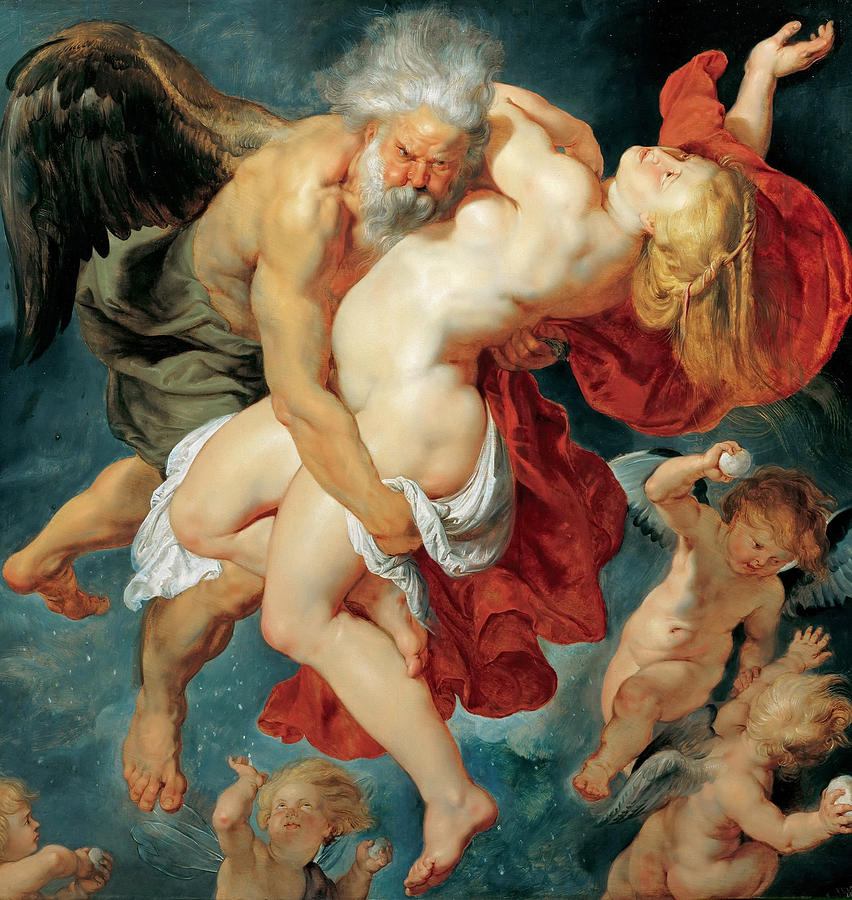
“Boreas Abducting Oreithyia” by Peter Paul Rubens is one of the most intense and turbulent mythological scenes in the artist’s oeuvre. The painting plunges the viewer into midair, where the powerful North Wind god, Boreas, seizes the Athenian princess Oreithyia and carries her away through a stormy sky. Their bodies twist together in a vortex of flesh, scarlet drapery, and beating wings, while small winged putti swirl around them like fragments of wind and cloud. The work encapsulates the Baroque fascination with movement, strong emotion, and the dramatic interplay of human vulnerability and divine force.
Although its precise date is unknown, the painting clearly belongs to Rubens’ mature period, when he was at the height of his powers as a storyteller and master of the human body in motion. It fuses classical mythology with the dynamic expressiveness characteristic of seventeenth-century Flemish art, creating an image that is both visually spectacular and psychologically unsettling.
Mythological Background and Narrative Focus
The subject comes from Greek mythology. Boreas, the personification of the North Wind, fell in love with Oreithyia, daughter of the Athenian king Erechtheus. According to the myth, his attempts to win her heart peacefully were rejected, so he finally resorted to his own violent nature, swooping down in a gust of wind to abduct her. Their union would later produce the winged sons known as the Boreads.
Rubens chooses the climactic instant of the abduction. We do not see the moment of approach or the aftermath; we are thrown into the very heart of the action, as Boreas lifts Oreithyia away from the earth. This focus on the decisive moment underscores the themes of overwhelming force and abrupt change. It is a visual equivalent of a sudden gust of wind tearing a tree from the ground.
The painting does not include a detailed earthly setting. There are no city walls or horrified onlookers. Instead, Rubens sets the drama entirely in the sky, emphasizing the supernatural dimension of the event. Oreithyia is already separated from the world she knows, suspended between her former life and an unknown future with a god who is both captor and husband.
Composition and the Diagonal Vortex
The composition of “Boreas Abducting Oreithyia” is built around an emphatic diagonal that runs from the upper left to the lower right of the canvas. Boreas’ muscular torso and Oreithyia’s arched body form a sweeping curve that propels the viewer’s eye through space. Their intertwined figures create a rotating motion, as if we have caught them mid-spin in a whirlwind.
This diagonal energy is reinforced by the orientation of their limbs. Boreas’ legs trail behind him, echoing the direction of flight, while Oreithyia’s feet and outstretched arm counterbalance the movement, adding tension. The scarlet drapery, caught by the wind, unfurls in arcs that complement and amplify the main motion. Rather than simply wrapping the body, the fabric becomes a visual trace of Boreas’ gusts, a physical manifestation of invisible air currents.
Around this central vortex, Rubens scatters smaller forms: the putti at the lower edge of the painting, each with their own small diagonals and curves that echo the larger movement. Their arrangement keeps the eye circling back to the main figures, preventing it from slipping out of the composition. The overall effect is of a tightly choreographed chaos, where every element contributes to the sense of rapid, spiraling ascent.
Depiction of Boreas: Divine Force and Physical Power
Boreas is depicted as an older, bearded man with powerful wings and a body built like a seasoned athlete. His torso is knotted with muscle, his shoulders and arms tense as he grips Oreithyia. Rubens emphasizes his age through the white hair and beard, yet there is nothing frail about him. Instead, the combination of age and strength suggests an elemental, ancient power.
The expression on Boreas’ face is intense and almost grim. His brows are furrowed, eyes narrowed, and mouth set in a determined line. This is not the face of a tender lover; it is the face of a force of nature acting with irresistible will. Rubens thus remains faithful to the mythological character of the North Wind, who is both passionate and violent.
Boreas’ wings are dark and heavy, unlike the delicate wings of the putti. Their broad, shadowy feathers contrast with the pale skin of Oreithyia, reinforcing the idea that he belongs to a different, more formidable order of being. The wings also serve as a compositional anchor, their mass balancing the bright, twisting forms of the central couple and helping to frame Oreithyia’s body.
Oreithyia: Vulnerability, Beauty, and Suspended Resistance
Oreithyia is presented in the full, luminous flesh typical of Rubens’ ideal of feminine beauty. Her body is almost entirely nude, with only a small white cloth at her hips and a red mantle swirling behind her. Her pale skin shines against the darker tones of Boreas’ body and the deep sky, making her the focal point of the viewer’s gaze.
Her pose is complex and expressive. Her torso arches backward, her head tilted, golden hair streaming, and one arm flung outward in a gesture that could indicate alarm or helpless surrender. The twist of her body reveals both front and back at once, an ingenious solution that heightens the sense of motion. The position of her limbs suggests that she is not entirely passive; there is a trace of resistance in the tension of her muscles and the extension of her arm. Yet the tight grip of Boreas around her waist and thigh makes it clear that she is overpowered.
Rubens walks a delicate line here. He must convey the drama of abduction and the pathos of Oreithyia’s plight without descending into graphic brutality. He does so by focusing on the emotional tension and the physical dynamics rather than explicit violence. The viewer is made aware of her vulnerability through the contrast between her soft, exposed body and the rough strength of the god who seizes her.
Color, Light, and Atmospheric Drama
The color scheme of the painting is dominated by the juxtaposition of cool and warm tones. The background sky is a swirling blue-green, reminiscent of storm clouds and churning air. Against this cool ground, the warm flesh tones of Boreas and Oreithyia stand out, glowing with internal light. The sharp contrast gives the figures a sculptural presence, as if they are carved from marble and illuminated by a hidden source.
One of the most striking chromatic elements is the red cloth that wraps around Oreithyia and billows behind her. Its deep, almost crimson hue carries strong emotional associations: passion, danger, and blood. It also serves as a visual link between the figures, physically connecting Boreas’ grasping hand to the curve of Oreithyia’s body. The color red recurs subtly in Boreas’ flushed face, reinforcing the heat of his desire and effort.
Light in the painting seems to come from multiple directions, as if bouncing off clouds and bodies in the turbulent sky. Highlights on shoulders, thighs, and faces are carefully placed to emphasize three-dimensional form. At the same time, Rubens allows areas of soft shadow—particularly beneath the figures—to suggest depth and recession into space. This interplay of light and dark enhances the dramatic atmosphere, making the scene feel like a revelation caught in a sudden break in the storm.
The Role of the Putti and the Sense of Scale
Scattered across the lower portion of the painting are several small winged putti. They toss snowballs or clouds, ride invisible currents of air, and look up at the central drama with varied expressions. Their presence serves multiple functions.
First, they help establish the scale of the main figures. Because the putti are typically associated with divine or allegorical scenes and often appear at a standard size, their smallness here underscores the monumental proportions of Boreas and Oreithyia. The god’s power is further magnified by the fact that he seems almost too large for the sky he occupies.
Second, the putti contribute to the swirling motion of the composition. Each is oriented in a different direction, their limbs and wings echoing the dynamic curves of the central couple. They are like fragments of wind or cloud broken off from the main gust that carries Boreas and Oreithyia upward.
Third, their playful aspect adds a layer of complexity to the mood. While the abduction is a serious and troubling event, the putti’s childlike activity injects a slightly lighter, mythic tone, reminding us that we are witnessing a story from classical legend rather than a literal real-world scene. This juxtaposition is typical of Baroque mythological painting, where tragedy, passion, and play often coexist in the same image.
Baroque Dynamism and Expressive Anatomy
“Boreas Abducting Oreithyia” is an exemplary Baroque painting in its emphasis on energy, emotion, and complex movement. Rubens deploys every aspect of his technical skill to make the viewer feel the pull and rush of the wind. The figures are not static but caught in a transformational state, their muscles flexing, hair whipping, and garments swirling.
The anatomy is heroic yet flexible. Rubens, who studied classical sculpture and Renaissance masters, uses powerful foreshortening to project the bodies outward from the picture plane. Boreas’ torso twists so that his shoulders turn differently from his hips, while Oreithyia’s spine curves in opposition. These contrapuntal movements create a sense of torque, as if the figures are being twisted by invisible forces.
At the same time, the surfaces of the bodies are handled with Rubens’ characteristic sensuousness. Skin is rendered in smooth transitions from warm highlights to cooler shadows, suggesting both softness and internal strength. This combination of muscular structure and tender flesh gives the painting its distinctive blend of power and vulnerability.
Themes of Power, Consent, and Mythic Violence
The subject of abduction in classical myth raises difficult questions from a modern perspective, particularly regarding consent and violence. Rubens’ painting, like the myth itself, centers on a moment when divine desire overrides human autonomy. Boreas’ grip, Oreithyia’s vulnerable position, and the overall forceful motion all convey the reality of her being taken against her will.
However, within the context of seventeenth-century art, such scenes were often interpreted as allegories of passion’s overwhelming power or as episodes leading to fated unions that produced heroic offspring. Rubens approaches the subject through the lens of drama and emotion rather than explicit cruelty. Oreithyia is not depicted as physically harmed; the focus is on her shock and helpless suspension between earth and sky.
For contemporary viewers, the painting can open up discussions about how myths encode historical attitudes toward gender and power, and how artists of different eras choose to represent or question those attitudes. The image’s undeniable beauty coexists with its troubling implications, making it a complex object of reflection rather than simple admiration.
Relationship to Other Works by Rubens
This painting resonates with several other works in Rubens’ mythological repertoire. It shares with “The Rape of the Daughters of Leucippus” and “The Rape of the Sabine Women” an interest in the dramatic moment of seizure, where bodies are lifted, dragged, or carried in a whirlwind of action. In each case, Rubens uses abduction scenes to explore complex figure groupings and intense emotional interaction.
“Boreas Abducting Oreithyia” is distinctive, however, in its airborne setting and its focus on a single pair of protagonists rather than a crowd. The sky becomes a stage where the interplay of two bodies takes on monumental importance. The putti echo this focus while maintaining the sense of mythic context.
Comparisons can also be drawn to Rubens’ depictions of other powerful male deities, such as Neptune or Jupiter, who are similarly portrayed as muscular, bearded figures embodying elemental forces. Boreas stands out as particularly wild and wind-like, his hair and beard blown back, his features hardened by the strain of flight.
Emotional Impact and Viewer Experience
For the viewer, the immediate impact of “Boreas Abducting Oreithyia” is one of astonishment at the sheer physicality of the figures and the sense of motion. The painting seems to erupt out of the frame, as if the swirling bodies might burst into the viewer’s space at any moment. This immersive quality is a hallmark of Baroque art, which seeks to break down the barrier between image and spectator.
At the same time, the work produces a complex emotional response. There is admiration for the technical brilliance and the heroic nude forms, but also unease at the imbalance of power between Boreas and Oreithyia. The swirling putti and dynamic sky amplify both sensations, creating a mixture of wonder and tension.
The painting’s ability to hold these reactions in balance is part of its lasting fascination. It does not resolve the conflict between beauty and violence; instead, it presents them intertwined, challenging viewers to confront how art can simultaneously captivate and disturb.
Conclusion
“Boreas Abducting Oreithyia” showcases Peter Paul Rubens at his most dramatic and technically accomplished. Through a masterful composition built on diagonals and vortex-like curves, a bold contrast of color and light, and a keen understanding of anatomy in motion, he transforms a classical myth into an electrifying visual experience. The painting captures the essence of Baroque art: emotional intensity, dynamic movement, and the interplay of human vulnerability and cosmic power.
At the heart of the image lies a complex story about desire, force, and the limits of human control in the face of divine or natural forces. Oreithyia’s luminous, twisting body and Boreas’ dark, muscular form embody opposing poles of fragility and strength, yet they are bound together in a single, spiraling flight. The surrounding putti, the turbulent sky, and the crimson drapery all contribute to a sense that we are witnessing not only a mythic abduction but also the very nature of the wind captured in paint.
For modern viewers, the painting invites both admiration for Rubens’ artistic mastery and reflection on the themes of power and consent embedded in mythological narratives. It remains a compelling example of how art can render physical motion and emotional conflict in a single, unforgettable image.