Image source: wikiart.org
Introduction to “Portrait of Nicolas Trigault in Chinese Costume”
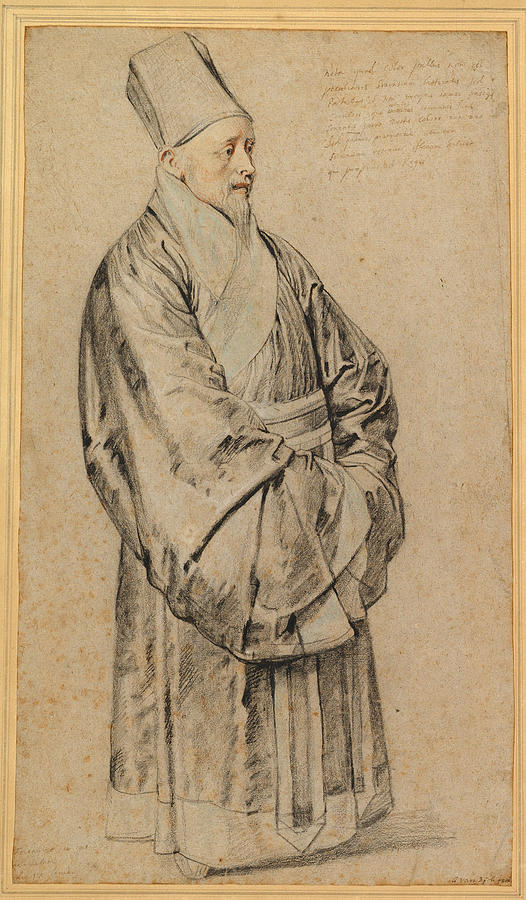
“Portrait of Nicolas Trigault in Chinese Costume” is one of the most fascinating images in Peter Paul Rubens’s oeuvre because it brings together two worlds that rarely met in European art of the early seventeenth century. The drawing shows the Jesuit missionary Nicolas Trigault dressed in elaborate Chinese robes and high hat, standing in profile with his hands folded inside his voluminous sleeves. Rendered with black, red, and subtle blue chalks on paper, this portrait is at once a sensitive likeness, an ethnographic document, and a visual statement about global encounter, religion, and cultural translation.
Rubens captures Trigault not in the usual black cassock of a European Jesuit, but as he appeared after his return from China, when he traveled through Europe dressed as a Confucian scholar to raise support for the mission. The portrait thus records a moment in which identity is layered and complex: the sitter is a European priest inhabiting a Chinese scholar’s persona for strategic and spiritual purposes. Rubens’s drawing reveals both the foreignness and the dignity of this role.
Nicolas Trigault And The Jesuit Missionary Context
Understanding the sitter’s biography illuminates the portrait’s meaning. Nicolas Trigault was a Flemish Jesuit who joined the Catholic mission in China. The Jesuits, led initially by Matteo Ricci, adopted an accommodationist strategy, learning Chinese language and customs, wearing local dress, and presenting Christianity in ways that harmonized with Confucian philosophy. Trigault played a key role as a mediator between Europe and China, translating texts, writing accounts of the mission, and raising funds and personnel for further work.
When Trigault returned to Europe, he deliberately wore Chinese scholar’s robes to attract attention and embody the cultural bridge the mission represented. Rubens likely encountered him during this period and was deeply impressed. The drawing becomes more than a simple portrait: it is evidence of early modern globalization, of the curiosity and admiration that Chinese civilization inspired, and of the Jesuits’ sophisticated understanding of image and costume as tools of persuasion.
The Unusual Chinese Costume
The most striking aspect of the portrait is the voluminous Chinese robe and high hat. Rubens renders the garment with meticulous attention, using strong lines and subtle modeling to convey the weight and structure of the cloth. The robe wraps around Trigault’s body in broad, flowing folds, cinched at the waist by a wide sash. Long sleeves hang down and envelop his hands, creating large, soft masses that contrast with the vertical fall of the hem.
The high hat, tall and slightly tapering, immediately identifies the costume as non-European. It resembles the headgear of Chinese scholars or officials, reinforcing Trigault’s deliberate identification with the Confucian elite. Rubens’s careful depiction of the hat, with its subtle angles and the way it sits securely on the head, suggests that he studied the object closely from life rather than inventing an exotic fantasy.
The costume’s texture is also important. The robe appears to be made of heavy silk or another rich fabric, with a smooth surface that catches the light in broad, gentle highlights. Rubens uses the medium of chalk to trace these luminous areas, especially along the sleeves and front panels, giving a sense of sheen without color. The suggestion of pale blue in the inner collar and sash introduces a cool note that distinguishes these elements from the rest of the garment and adds subtle richness to the overall effect.
Composition And Profile View
Rubens chooses a full-length, standing profile for this portrait, a relatively rare format in his drawn likenesses. The profile emphasizes the sitter’s role rather than his individual psychology; it is a pose associated with medals, official portraits, and classical cameos. By placing Trigault in profile, Rubens invites viewers to contemplate him as a representative figure: the European missionary who has, quite literally, donned Chinese scholarly identity.
The composition is vertical and frontal, with Trigault occupying most of the sheet. He stands firmly, feet slightly apart, body turned to the right. The profile of his face is sharply defined against the blank background, allowing the viewer to study his features in detail. The long line of his beard, the slope of his nose, and the attentive gaze of his eye all emerge clearly from the careful chalk work.
Though he stands still, the portrait is not rigid. The sweeping arcs of the sleeves and hem, the slight forward tilt of the head, and the soft shift of weight suggested at the feet lend a quiet rhythm to the figure. The way the robe’s folds converge around the belt gives structural coherence, anchoring the flowing forms to a stable central point.
The Face Of The Missionary
Within this sea of fabric, Trigault’s face is relatively small, but Rubens ensures that it holds attention. The artist uses touches of red and darker chalk to model the nose, lips, and eyelids, giving the face a warm, lifelike presence. The profile view highlights the strong bone structure and the neat beard, which descends in a narrow wedge from cheek to chest.
Trigault’s expression is attentive and composed. He looks slightly downward and forward, as if listening carefully or awaiting conversation. This quiet concentration suits his role as scholar and mediator. There is no theatrical emotion; instead, the portrait conveys intellectual seriousness and spiritual discipline.
The contrast between European features and Chinese clothing heightens the sense of cross-cultural encounter. Rubens does not try to exoticize Trigault’s face; he presents him as recognizably Flemish, with fair skin and a reddish beard, suggesting the dual identity he inhabits. The sitter remains himself, even while fully embraced by foreign costume.
Rendering Of Fabric And Volume
One of Rubens’s great strengths as a draftsman is his ability to capture the weight and fall of fabric. In this portrait, the Chinese robe becomes a playground for his virtuoso handling of line and tone. He renders the sleeve folds with broad, sweeping strokes, suggesting the thick, slightly stiff nature of the textile. In the areas where the cloth bunches at the elbows and waist, he introduces deeper shadows and overlapping lines to create a sense of layered volume.
The interplay of light and dark across the garment gives it a sculptural quality. Highlights along the upper arms, chest, and lower hem suggest light falling from the left, while the right side of the figure sinks into shadow. Yet Rubens never overworks the drawing; many folds are indicated with just a few confident lines, leaving the viewer’s eye to complete the forms. This combination of precision and economy is characteristic of his best draftsmanship.
The belt and collar provide structural accents within the expansive field of cloth. Their straighter edges and horizontal orientation counterbalance the swirling curves of the sleeves and hem, keeping the composition visually stable. The carefully indicated seams and borders on the robe further ground the costume in reality, showing that Rubens was attentive to its actual construction rather than treating it as an amorphous mass.
Inscription And Documentary Character
In the upper right corner of the sheet, there is an inscription in Rubens’s hand that identifies Trigault and notes details of his mission. Although the text may be difficult to read in reproduction, its presence transforms the drawing into a historical document as well as an artwork. It records not only the likeness but the context: this is Nicolas Trigault, Jesuit, returning from China and wearing Chinese dress.
Such annotations were typical of Rubens when he recognized the documentary value of a subject. The inscription indicates his awareness that this image captured something rare and significant: the physical embodiment of Europe’s encounter with a great Asian culture. For modern viewers, the writing underscores the hybrid nature of the portrait, straddling the boundaries between portraiture, travel record, and missionary propaganda.
Cultural Translation And Jesuit Strategy
The portrait can also be read as a visual statement about intercultural strategy. By adopting Chinese scholar’s dress, Trigault was signaling respect for Chinese traditions and seeking a place within existing elites. The Jesuits believed that by presenting themselves as learned men conversant with Confucian ethics, they could win influence at court and among intellectual circles, thereby spreading Christianity more effectively.
Rubens’s image reflects this careful positioning. Trigault appears dignified, learned, and serene, much like a Confucian scholar as imagined by European observers. The long robe and high cap indicate status and refinement, while his composed posture suggests moral self-control. At the same time, his face and inscription anchor him firmly in the Catholic world. The drawing thus becomes a visual embodiment of the Jesuit ideal: fully engaged with Chinese culture yet still a servant of the Church.
For audiences in Antwerp and beyond, such an image would have been both exotic and reassuring. It promised that Christianity could travel to the ends of the earth without losing its core identity, adapting outward forms while preserving inner truths.
Style, Medium, And Rubens’s Draftsmanship
“Portrait of Nicolas Trigault in Chinese Costume” is executed in black chalk with touches of red and blue on laid paper. This combination was favored by Rubens for its versatility. Black chalk allows for strong contours and shading; red adds warmth to flesh; blue gives subtle distinction to garments and shadows. The medium allows Rubens to move easily between precise line drawing and soft tonal modeling.
The drawing reveals his typical energy and confidence. Lines describing the robe’s folds are swift and fluid, yet controlled. In the face and hands, he slows down, layering delicate strokes to capture nuance. Occasionally the chalk seems to skip or break, leaving the paper’s texture visible; rather than correcting these, Rubens incorporates them into the overall liveliness of the surface.
Unlike highly finished presentation drawings meant for collectors, this portrait retains a sense of immediacy. It feels as though it was done from life in a relatively short sitting, capturing the essentials of pose and expression while the sitter stood patiently in his remarkable attire. That spontaneity is part of its charm.
Comparison With Other Rubens Portraits
Compared to Rubens’s oil portraits of nobles, merchants, or family members, this chalk portrait is more restrained and linear, yet it shares key qualities. Rubens consistently sought to convey character through posture and gesture as much as through facial expression. In this drawing, Trigault’s folded hands, modest downward gaze, and enveloping robe all contribute to an impression of reflective calm and inward focus, much as the hands and stance of a noble sitter might signal authority or charisma in paint.
The drawing also aligns with Rubens’s interest in diverse costumes and types. In other works he portrayed people in exotic dress, soldiers in elaborate armor, and figures in theatrical costumes. The Trigault portrait fits into this pattern, yet stands out because the costume is not fantasy but an actual cross-cultural garment worn for real purposes. It shows Rubens not merely inventing exoticism, but responding to a genuine global encounter in his own milieu.
Emotional Tone And Viewer Response
The emotional tone of the portrait is quiet, contemplative, and slightly austere. There is none of the exuberant movement or sensuous color associated with Rubens’s mythological scenes; instead, the drawing invites a slower, more meditative engagement. The viewer’s eye moves over the broad planes of the robe, up to the calm profile of the face, and back again, tracing the interplay between foreign costume and familiar human presence.
This calmness is fitting for a portrait of a missionary and scholar. It conveys spiritual focus and intellectual seriousness rather than worldly power or erotic allure. Yet there is still warmth in the subtle color and the gentle modeling of features. Rubens approaches his sitter with respect and curiosity rather than cold detachment. The combination of objectivity and empathy is what makes the portrait persuasive and enduring.
Conclusion
“Portrait of Nicolas Trigault in Chinese Costume” is far more than a curiosity of dress. It is a profound record of early modern cultural exchange, a window onto the Jesuit strategy of adaptation in China, and a testament to Rubens’s sensitivity as a portraitist and draftsman. Through the carefully observed Chinese robe and hat, the composed stance, and the thoughtful profile, Rubens presents Trigault as a bridge between civilizations.
The drawing captures the tension and harmony of layered identities: European priest, Chinese-style scholar, emissary between East and West. At the same time, it showcases Rubens’s mastery of chalk, his ability to render fabric and volume with a few expressive strokes, and his talent for distilling character into pose and line.
For modern viewers, the portrait continues to fascinate because it speaks to enduring questions about how cultures meet, how individuals inhabit multiple roles, and how clothing and image can express complex histories and aspirations. In the quiet figure of Nicolas Trigault, Rubens gives us a deeply human embodiment of a global story.