Image source: wikiart.org
Introduction to “Saint Bega and Her Husband Ansegius”
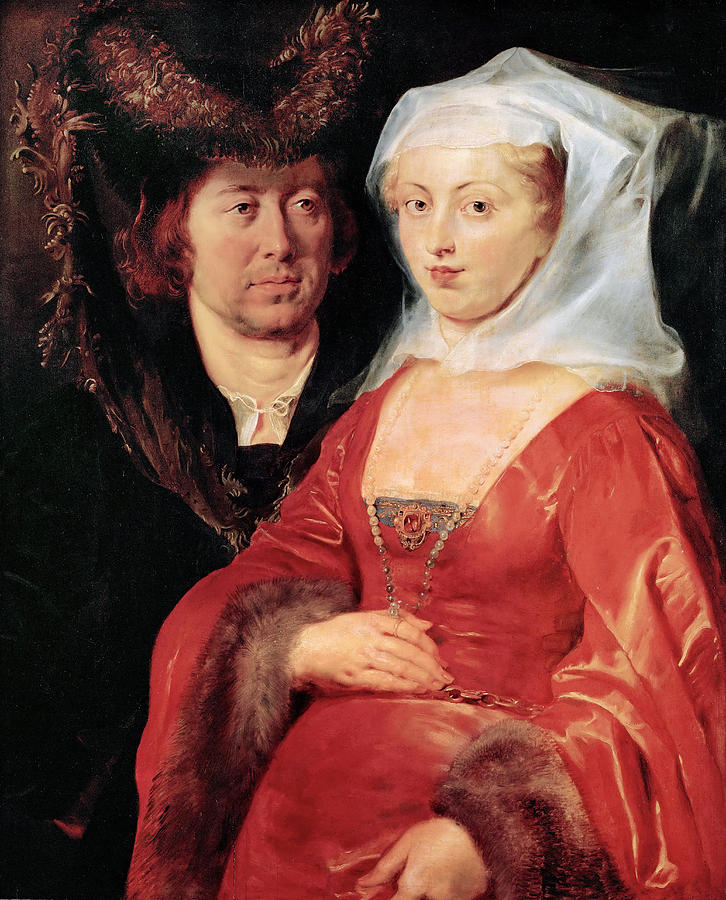
“Saint Bega and Her Husband Ansegius” by Peter Paul Rubens is a richly colored double portrait that fuses devotional overtones with the intimacy of a marital likeness. Two figures occupy the dark, shallow space: a woman in a vivid red dress trimmed with fur, and a man positioned slightly behind her left shoulder, dressed in sober black and crowned with an elaborate feathered hat. The woman looks directly toward the viewer with an alert, luminous gaze, while the man’s eyes turn subtly toward her, creating a psychological triangle between husband, wife and spectator.
The painting stands at the crossroads of several genres Rubens mastered so well: portraiture, religious imagery and allegorical representation. Whether the sitters are meant as literal saints or as noble patrons adopting saintly identities, Rubens crafts an image that speaks of status, piety, affection and social harmony. The work offers a window into early modern conceptions of marriage and virtue, wrapped in the visual splendor typical of the Baroque age.
Composition and Spatial Relationships
Rubens organizes the composition around a simple but powerful contrast between foreground and background. Saint Bega occupies the frontal plane, her body angled slightly to the right but her head turned toward the viewer. Her husband Ansegius stands behind and to her left, emerging from the shadowy backdrop. This staggered positioning emphasizes Bega’s prominence while signaling the supportive presence of her spouse.
The couple is tightly framed, filling almost the entire canvas. There is little sense of deep space; instead, the dark background functions like a velvety backdrop, pushing the figures forward. This compositional choice heightens the feeling of intimacy, as if the viewer were seated directly in front of the couple. It also directs attention away from any external setting and toward the interplay of expressions, gestures and clothing.
Bega’s seated pose is carefully constructed. Her torso is upright, but her hands rest loosely on her lap, suggesting composure rather than rigidity. The gentle diagonal of her arm and the curve of her body counterbalance the vertical axis of her husband’s figure. Ansegius leans slightly inward, his face placed just above Bega’s shoulder so that their heads form a subtle diagonal line. This closeness conveys marital unity without overt displays of physical affection, appropriate to the period’s portrait conventions.
Light, Color and the Power of Red
Color is one of the painting’s most striking features, dominated by the intense red of Bega’s gown. Rubens uses a warm, saturated red that varies from deep crimson in the shadows to fiery vermilion where light strikes the fabric. The fur trimming the sleeves introduces a soft brownish-grey tone, emphasizing the garment’s luxury and weight. This sweeping field of red immediately identifies Bega as the visual and symbolic focus of the work.
Light falls primarily from the left, illuminating Bega’s face and upper body while leaving parts of Ansegius’s figure in more subdued shadow. Her pale skin glows against the red dress and the dark backdrop, giving her an almost halo-like luminosity. The translucent white veil draped over her head catches the light in delicate folds, framing her face like a soft, earthly crown.
Ansegius, by contrast, wears black, with hints of dark brown and muted red. His feathered hat introduces subtle variations of warm dark tones, but his costume remains understated beside his wife’s resplendence. The contrast between her vivid clothing and his sober attire reinforces the visual hierarchy: Bega is the saintly focus, Ansegius the dignified companion. At the same time, his black costume draws the eye back to her, working as a visual foil that deepens the effect of her colors.
Rubens subtly echoes the red of Bega’s dress in her jewelry. A pendant at her chest glows with red stones set in gold, and the chain that descends from it adds a rhythmic vertical element. These small but intense accents unite her costume and highlight the center of her body, suggesting both material wealth and spiritual significance.
Portrait Likeness and Psychological Characterization
As in many of his portraits, Rubens achieves a remarkable sense of individuality in both faces. Bega’s features are delicate but firm: a broad, smooth forehead, arched brows, clear eyes, straight nose and small, slightly pursed mouth. Her expression is poised, perhaps a touch reserved, yet not cold. She appears aware of being observed, maintaining a dignified calm that suits both a noblewoman and a saintly figure.
Ansegius’s face is more weathered, with a stronger jawline, fuller cheeks and subtle signs of age around the eyes. His mouth is relaxed, and his gaze, though directed outwards, seems less confrontational than his wife’s. There is a hint of introspection in his eyes, suggesting a thoughtful temperament. By turning his head gently toward Bega, Rubens communicates a sense of attention and support: Ansegius is present, but his focus rests on his companion rather than on self-display.
The psychological dynamic between the two is carefully calibrated. Bega’s frontal engagement with the viewer asserts her spiritual and social authority. Ansegius, slightly behind and turned toward her, acknowledges that authority while remaining a strong, protective presence. The result is an image of marital harmony where roles are complementary rather than competitive.
Costume, Status and Cultural Context
The couple’s clothing communicates their high status and their alignment with contemporary ideals of respectability. Bega’s dress, with its rich fabric, fur trim and elaborate jewelry, clearly denotes wealth. The bodice is carefully fitted, with a square neckline that reveals the upper chest but remains modest. The long sleeves trimmed with fur suggest winter or ceremonial wear, while the chain and pendant emphasize refined taste.
Her headwear is especially significant. The translucent, white veil gently covers her hair, softening her features and lending a modest, almost nun-like quality. Veiled women were often associated with chastity and piety, associations that align well with the notion of Bega as a saintly figure. At the same time, the veil’s fine fabric indicates that her virtue coexists with aristocratic privilege.
Ansegius’s costume, though not as flamboyant, is equally telling. He wears a dark garment that may be a robe or doublet, with a modest white collar at the neck. His tall hat with feathered ornamentation marks him as a person of rank or office, perhaps a magistrate or nobleman. Yet there are no ostentatious medals or chains of office; his dignity is understated. The combination of austerity and subtle luxury conveys moral seriousness and social responsibility.
Together, the costumes position the couple within the world of Flemish elite culture, where wealth, piety and propriety formed an ideal triangle. By presenting Bega and Ansegius as both materially prosperous and spiritually oriented, Rubens reflects the aspirations of patrons who valued both earthly success and heavenly favor.
Religious Meaning and the Idea of the Holy Couple
Although the painting functions on one level as a double portrait, its title invokes the names of Saint Bega and her husband Ansegius, inviting a religious interpretation. Whether or not Rubens intended specific historical saints, he clearly constructs the couple as an ideal of holy matrimony.
Bega’s direct gaze and luminous veil recall images of female saints and the Virgin Mary. The red of her dress can be read symbolically as both love and sacrifice, echoing the color often associated with martyrdom and divine charity. Her calm demeanor suggests inner spiritual strength.
Ansegius’s proximity to his wife and his turning gaze evoke the supportive role of a Christian husband. He does not overshadow Bega but stands with her, acknowledging her sanctity while contributing his own stability. His dark clothing can be read as a sign of humility and temperance.
In the context of Counter-Reformation spirituality, which was active in Rubens’s Catholic Flanders, marriage was increasingly promoted as a holy vocation. Images that showed married couples in dignified, harmonious poses reinforced the idea that conjugal life could be a path to sanctity. Rubens’s painting participates in this discourse, offering Bega and Ansegius as exemplars of a union where love, respect and faith coexist.
Baroque Sensuality and Restraint
Like many of Rubens’s works, this painting balances sensual richness with moral restraint. Bega’s red dress, smooth skin and softly modeled hands undeniably carry a sensuous appeal. The lush textures of fur, fabric and feather add a tactile dimension that invites visual caress. Rubens’s brushwork around the sleeves and hat brim is loose and vibrant, emphasizing the physicality of the materials.
Yet the overall tone remains controlled and decorous. Bega’s neckline is modest by Rubens’s standards; there is no excessive exposure of flesh. Her posture is dignified, and her gaze is steady rather than flirtatious. Ansegius’s dark garments and serious expression counterbalance any sensual excess, framing the couple within a moral and social order.
This mixture of visual luxuriance and ethical discipline is a hallmark of Baroque portraiture for the Catholic elite. It allowed patrons to enjoy the pleasures of art—color, texture, lifelike presence—while still proclaiming their virtue. In “Saint Bega and Her Husband Ansegius,” Rubens successfully harmonizes these elements, creating an image that is both visually seductive and spiritually respectable.
Painterly Technique and Use of Detail
Rubens’s technical mastery is evident throughout the painting. The faces are rendered with carefully blended brushstrokes that model the forms smoothly, capturing the soft transitions of light across cheeks, noses and foreheads. Small highlights in the eyes and on the lips give the figures a vivid immediacy.
In contrast, the clothing and accessories reveal a more vigorous handling. The fur trim on Bega’s sleeves is suggested through rapid, feathery strokes that mimic the texture of hair. The red fabric is built up with layered glazes and opaque accents, producing a sense of depth and sheen. Ansegius’s hat, adorned with feathers, is painted with a combination of thick and thin touches that convey both the structure and the airy lightness of plumage.
Rubens also pays close attention to jewelry and minor details without allowing them to dominate. The chain and pendant at Bega’s chest are precisely delineated, yet they remain integrated into the larger color field of the dress. The subtle lace at Ansegius’s collar softens the transition between his face and his dark garment. These details reward close inspection while serving the overall unity of the image.
Emotional Tone and Viewer Engagement
Perhaps the most compelling aspect of “Saint Bega and Her Husband Ansegius” is its emotional tone. The painting exudes a quiet, steady warmth rather than overt passion. The intimacy between the couple is suggested rather than displayed: in their closeness of positioning, in the direction of Ansegius’s gaze, and in the calm security of Bega’s pose.
For the viewer, the direct eye contact with Bega creates an immediate connection. She seems to acknowledge the spectator with poised self-awareness, inviting a respectful encounter rather than casual scrutiny. Ansegius’s sideways glance introduces a second line of attention, as if he too is aware of being seen but remains primarily concerned with his wife.
This interplay of gazes draws the viewer into a triangular relationship with the couple. The painting becomes not just a record of their appearance but an active social exchange across time. Viewers are positioned as guests, perhaps invited into the domestic or devotional space where the couple sits, asked to recognize their virtue and status.
Place within Rubens’s Oeuvre and Lasting Significance
Within Rubens’s vast body of work, “Saint Bega and Her Husband Ansegius” stands as a fine example of his approach to double portraiture and to the representation of women. Like his more famous portraits of his own wives, Isabella Brant and Helena Fourment, this painting emphasizes both the individuality and the idealized qualities of the female sitter. At the same time, it explores the dynamic between husband and wife, showing them as partners in social and spiritual identity.
The painting also illustrates Rubens’s ability to merge portraiture with allegory. By presenting the couple under saintly names, he elevates their likeness beyond mere social record. They become models of a holy union, a theme that would have resonated strongly with contemporary audiences and continues to speak to modern viewers interested in historical constructions of marriage and gender roles.
Today, the work remains captivating for its combination of psychological insight, coloristic brilliance and narrative suggestion. It invites viewers to imagine the lives of the sitters, the circumstances of the commission and the devotional or social functions the painting once fulfilled. At the same time, the immediacy of the faces and the tactile richness of the surfaces ensure that the painting continues to feel alive, bridging centuries through the enduring human themes of partnership, dignity and aspiration.
Conclusion
“Saint Bega and Her Husband Ansegius” is more than a double portrait; it is a nuanced meditation on marital identity, virtue and status in the Baroque age. Through complex interplay of composition, color, costume and expression, Peter Paul Rubens presents a couple who are simultaneously individuals, partners and potential saints.
Bega’s radiant red gown, luminous veil and steady gaze make her the spiritual and visual center, while Ansegius’s darker presence affirms support and shared dignity. The painting balances sensual richness with moral restraint, intimate immediacy with timeless allegory.
In bringing together these layers, Rubens demonstrates why he remains one of the great masters of European painting. “Saint Bega and Her Husband Ansegius” continues to engage viewers not only as an exquisite work of art but as a thoughtful image of what a holy, harmonious marriage might look like, rendered in glowing color and living flesh.