Image source: wikiart.org
Introduction to “Head of a Bearded Man”
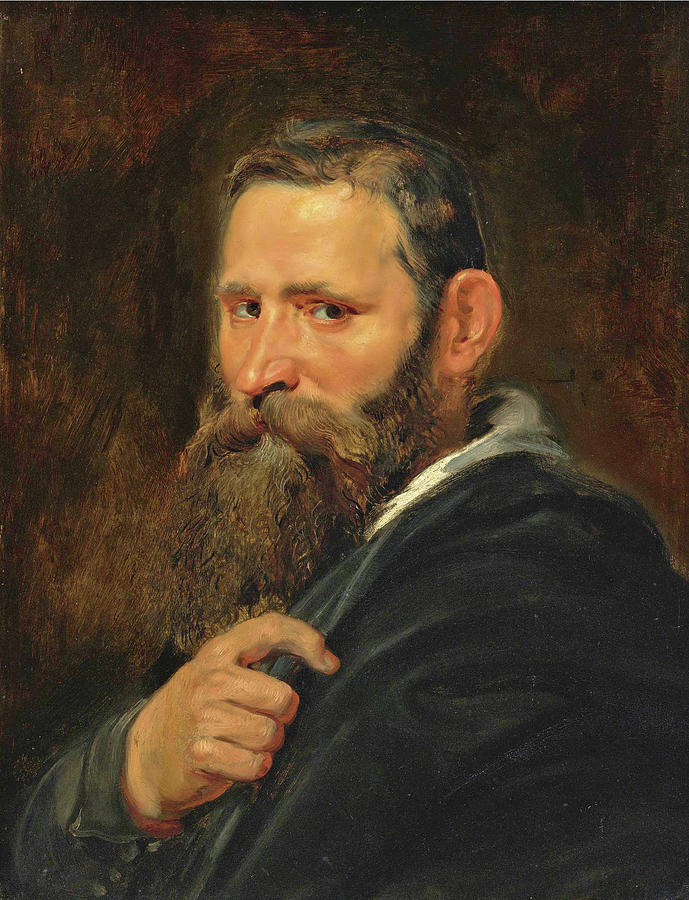
“Head of a Bearded Man” is an arresting portrait by Peter Paul Rubens that showcases the artist’s extraordinary ability to fuse physical presence with psychological depth. The painting presents a mature man with a full, flowing beard, turning slightly in three-quarter view and looking toward the viewer with an intense, almost wary gaze. His hand rises to his chest and beard, as if caught in a moment of thought or self-presentation.
Rubens frames this figure against a dark, warm background, allowing the face and hand to emerge with striking clarity. There is no elaborate setting, no symbolic objects, just the man and his penetrating expression. The result is a powerful study of character and an excellent example of how Rubens could make a single head feel as monumental and alive as a full-scale history painting.
First Impression And Emotional Impact
At first glance, the viewer is struck by the directness of the man’s gaze. His eyes are sharp, slightly reddened at the rims, giving an impression of vigilance, fatigue, or deep experience. The tilt of his head and the firmness of his mouth suggest a strong personality, perhaps someone accustomed to scrutiny and responsibility.
Yet there is also vulnerability. The closeness of the viewpoint and the rise of his hand, touching his beard near the collar, create a sense of intimacy. It feels as though the sitter has turned toward us unexpectedly, interrupted mid-gesture. This mix of dignity and unguarded immediacy gives the portrait a compelling emotional tension.
Composition And Point Of View
Rubens chooses a three-quarter view, one of the most effective angles for conveying depth and character in portraiture. The man’s head turns toward the left side of the canvas while his torso angles slightly in the opposite direction. This counter-twist creates a subtle dynamic movement, preventing the figure from appearing rigid.
The composition is closely cropped. The top of the head approaches the upper edge, and the shoulders almost touch the sides. This tight framing enhances the sense of proximity, drawing us into the sitter’s personal space. The lower portion of the canvas is dominated by the hand and wrist, which nestle into the foreground and anchor the figure in a believable three-dimensional space.
Rubens balances the diagonal line of the arm with the vertical axis of the head. The beard, flowing downward in thick waves, reinforces this verticality, guiding the viewer’s eye from the intense gaze down through the intricate tangle of hair and back to the hand. The surrounding darkness offers no distractions, concentrating attention on the interplay of face, beard, and gesture.
Light, Color, And Atmosphere
Light in “Head of a Bearded Man” seems to fall from the upper left, striking the sitter’s forehead, nose, cheekbones, and hand, then fading into shadow along the far side of the face and the folds of his cloak. This controlled illumination sculpts the features, emphasizing the structure of the skull and the planes of the face.
Rubens relies on a warm palette: rich browns, reddish flesh tones, and deep, earthy shadows. The background is a soft, variegated brown that subtly modulates from darker edges to a slightly lighter area behind the head, creating a halo-like glow without resorting to overt symbolism. The warmth of the flesh contrasts gently with the cooler, dark tones of the garment, ensuring that the viewer’s eye always returns to the illuminated skin.
The slight redness around the eyes and on the nose adds to the realism, suggesting a living body with blood circulation and perhaps a certain weathering from age or outdoor exposure. These touches of color prevent the portrait from slipping into idealization and keep it grounded in physical truth.
The Expressive Power Of The Gaze
The eyes are the focal point of the painting. Rubens positions them along a strong horizontal axis slightly above the center, ensuring they capture immediate attention. The pupils are small, the whites subtly tinted with pink and grey, giving them a moist, lifelike quality.
The direction of the gaze is ambiguous enough to be intriguing. The sitter appears to look slightly past the viewer rather than straight into the eyes, which can create a sense of introspection or guardedness. It feels as if he is aware of being observed yet remains absorbed in his own thoughts.
The eyebrows, slightly raised toward the center, introduce a hint of concern or skepticism. Combined with the firm line of the mouth and the taut muscles around the eyes, they suggest a man who evaluates the world carefully, perhaps with a touch of suspicion.
Gesture, Hands, And The Body In Space
The hand is almost as expressive as the face. It rises from the lower left, fingers curled gently as they grasp the edge of the beard or the lapel of the cloak. Rubens paints the knuckles, fingernails, and veins with remarkable sensitivity, showing both the strength and subtlety of the sitter’s touch.
This gesture can be read in multiple ways. It might be a habitual movement, a sign of contemplation, or a nervous adjustment of clothing. In Baroque portraiture, such hand positions are rarely accidental: they help define the sitter’s character. Here, the hand suggests self-awareness, as if the man is consciously presenting himself, steadying his beard and cloak for the viewer’s inspection.
The slight bend of the wrist and the soft modeling of the fingers also serve a compositional function, creating a curved echo of the jawline and beard. Together, these curves and diagonals lead the viewer’s eye in a continuous loop around the canvas, from hand to beard to eyes and back again.
Treatment Of Hair, Beard, And Texture
Rubens revels in the textures of the man’s hair and beard. The scalp hair is shorter, thinning slightly at the crown, and painted with brisk strokes that follow the natural direction of growth. The beard is a masterpiece of painterly description: thick, layered, and full of tonal variation.
Using a combination of darker underpainting and lighter, semi-transparent strokes, Rubens creates the illusion of dense hair catching the light at different depths. Golden-brown highlights trace the outer curls, while deeper, cooler browns recede into shadow near the neck. This complexity gives the beard a tactile presence; you can almost feel its coarse softness.
The contrast between the crisp details of hair and the smoother treatment of skin enhances the realism. The ears, slightly reddened at the tips, and the wrinkles around the eyes and mouth are rendered with subtlety, indicating both age and vitality without exaggeration.
Brushwork And Painterly Technique
Close inspection of the painting reveals Rubens’s flexible brushwork. In areas of high focus, such as the eyes and the tip of the nose, the paint is applied with small, precise strokes to define edges and highlights. In the beard and garment, brushstrokes become broader and more fluid, allowing the textures to emerge from the layered pigments rather than from fine line drawing.
The cloak, likely a dark, heavy fabric, is suggested with sweeping strokes of deep greenish-brown and black, with just a few lighter accents indicating folds. Rubens is not interested in cataloging every seam or stitch; instead, he conveys the overall weight and drape of the cloth, leaving the painting free from unnecessary detail that might compete with the face.
The background exhibits even looser handling. Swirls and blends of warm brown create a soft, atmospheric field. Slight variations in tone keep it from feeling flat, while its relative simplicity ensures that the head and hand appear to emerge from darkness, a hallmark of Baroque chiaroscuro.
Psychological Depth And Possible Identity
The sitter’s identity is unknown, but his strong features and commanding presence have led some viewers to speculate that he might be an artist, scholar, or notable citizen. The ordinary clothing and lack of overt symbols argue against royal or aristocratic rank, yet there is clear intelligence and self-possession in his expression.
Whether or not he was a prominent figure, Rubens treats him with great seriousness. This is not a decorative likeness; it is an exploration of personality. The furrowed forehead, the careful gaze, the protective gesture of the hand all point toward an introspective, perhaps slightly melancholic temperament.
Rubens was deeply interested in capturing the inner life of his sitters. In this portrait, he avoids flattery and theatrical poses. Instead, he presents a man absorbed in thought, aware of being watched but not performing. That honesty is part of what makes the image feel timeless and relatable.
Context Within Rubens’s Portrait Practice
Although Rubens is best known for his grand mythological and religious scenes, he was also an accomplished portraitist. He painted rulers, diplomats, family members, and anonymous models with equal skill. “Head of a Bearded Man” sits at the intersection of formal portraiture and studio study.
The directness of the pose and the focus on head and hand recall Rubens’s preparatory studies from live models, which he often used as references for figures in larger compositions. At the same time, the carefully resolved features and the balanced composition suggest that this painting was intended to stand on its own as a finished work.
It may have served as a character study, capturing a particular type of face that could later inspire apostles, philosophers, or patriarchs in history paintings. Rubens frequently re-used physiognomies across different works, drawing on his mental library of faces to populate complex scenes. If this bearded man later appears as a saint or prophet, his portrait here gives us a rare, unmasked glimpse of the real individual behind the role.
Human Presence And Timeless Appeal
One of the most remarkable aspects of “Head of a Bearded Man” is how contemporary the sitter feels. Despite the historical clothing and Baroque style, his alert eyes and guarded expression are instantly recognizable human traits. The painting transcends its era by focusing on universal qualities: aging, self-consciousness, dignity, and introspection.
The lack of symbolic props or elaborate setting contributes to this timelessness. We are left alone with the man’s face and gesture, free to imagine his story. He might be a scholar returning from work, a craftsman pausing to think, or a friend caught in a moment of private reflection. Rubens gives us enough information to sense depth of character but not so much that the mystery is resolved.
This open-ended quality invites repeated viewing. Each time, different nuances emerge: a hint of humor in the eyes, a trace of tension in the jaw, a warmth in the hand poised near the beard. The portrait rewards close attention, just as the sitter seems to scrutinize us in return.
Conclusion
“Head of a Bearded Man” is a concise yet deeply expressive example of Peter Paul Rubens’s talent for portraiture. Through a tightly framed composition, masterful use of light and color, and richly varied brushwork, he transforms a simple bust-length likeness into a psychological study of great resonance.
The sitter’s penetrating gaze, thoughtful gesture, and carefully rendered features convey a sense of lived experience and complex inner life. Rubens honors his subject not by idealizing him but by observing him with empathy and painterly brilliance. In doing so, he creates a portrait that feels as immediate and compelling today as it must have in the seventeenth century—a vivid encounter with another human being across time.