Image source: wikiart.org
Introduction to “Abundance”
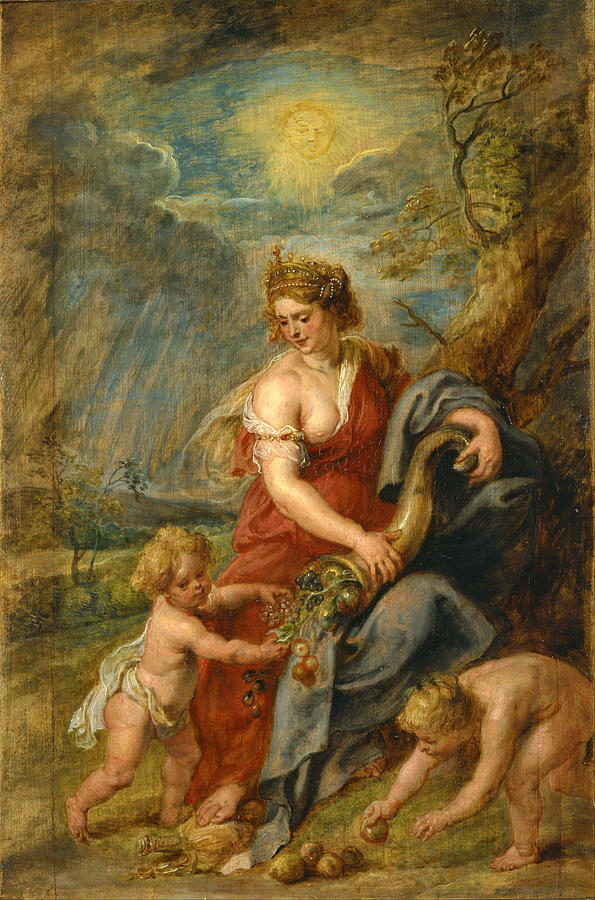
“Abundance” by Peter Paul Rubens is a radiant allegorical painting that celebrates prosperity, fertility, and the generous bounty of nature. At the center sits a crowned female figure, an embodiment of Abundance or plenty, with a cornucopia overflowing in her lap. Around her, chubby putti scramble eagerly to gather the fruits, vegetables, and golden gifts pouring from the horn of plenty. Above, the glowing sun breaks through swirling clouds, illuminating the scene with warm light and suggesting a divine source for this overflowing richness.
This work distills many of Rubens’s favorite themes: voluptuous, life-filled figures, dynamic compositions set in vibrant landscapes, and classical personifications reimagined with warm humanity. More intimate and sketch-like than some of his large court commissions, “Abundance” still carries the full force of his Baroque energy, color, and symbolism.
Allegorical Meaning And Classical Roots
The painting draws on the long classical tradition of personifying abstract ideas as female figures. Abundance, also known as Plenty or Copia, appears frequently in Roman art as a matron holding a cornucopia. Rubens, steeped in humanist learning and familiar with antique sculpture, reinterprets this motif in a distinctly Baroque way.
The crowned woman is no distant statue: she is warm, fleshy, and caught in a moment of gentle motion. Her exposed breast, while typical of Rubens’s sensual style, also carries symbolic meaning. In Renaissance and Baroque imagery, a bared breast can signify nurturing, maternal generosity, and the life-giving power of nature. Here, it reinforces the idea that Abundance feeds the world, much like a mother nourishing her children.
The cornucopia itself, curving across her lap, is the central symbol. From its wide mouth spill fruits and vegetables: grapes, apples, pomegranates, perhaps gourds and other harvest goods. These objects stand for agricultural fertility and material prosperity, but they also hint at spiritual and cultural richness—the many “fruits” of peace and good governance that Rubens’s princely patrons valued.
Composition And The Flow Of Movement
Rubens organizes the composition around a sweeping diagonal that runs from the glowing sun in the upper left, down through Abundance’s bowed head and arms, and into the pouring cornucopia and scurrying children below. This diagonal energy gives the painting a sense of natural flow, as if the bounty is cascading from heaven through the personification into the world.
Abundance’s body forms a stable triangle at the center, anchoring the composition. Her red dress and blue-grey mantle create broad color masses that contrast with the more delicate tones of the children’s flesh and the sunlit sky. Her seated pose curves gently, with one leg extended forward and the other bent, while her torso twists slightly as she guides the cornucopia’s contents toward the children. This twist adds liveliness and prevents the figure from appearing static.
The putti create a counter-rhythm at the bottom of the canvas. One reaches up eagerly toward the stream of fruit, another crouches to gather what has already fallen, and a third, partly hidden, bends down in concentrated attention. Their varying postures and directions of movement animate the lower half of the painting, balancing the more monumental calm of Abundance herself.
The Putti As Symbols Of Joy And Gratitude
Rubens often uses putti not only as decorative motifs but as emotional barometers of a scene. Here, they embody the delight and wonder of receiving plenty. Their plump bodies echo the fullness of the cornucopia; they themselves are little embodiments of prosperity and healthy growth.
The child on the left, with golden curls and a white cloth tied loosely around his waist, stands firmly on the ground and stretches his small hands toward the fruits. His expression suggests eager curiosity rather than greed, conveying a natural, innocent desire for the gifts offered.
The putto on the right bends almost to the ground, intent on picking up an apple or similar fruit. His focus suggests gratitude and industriousness: abundance is not simply admired, it is gathered, used, and enjoyed.
Together, the children create a scene of playful activity that tempers the solemnity of the allegory. Abundance is not an abstract principle; it is something that spills into the everyday lives of people, especially the most vulnerable and dependent.
Light, Sky, And The Radiant Sun
The sky plays an important symbolic role. Above the scene, Rubens paints swirling clouds parted by a bright golden sun, whose rays spread across the upper half of the canvas. The sun’s face is faintly suggested, giving it a quasi-personal presence.
This celestial light signifies the ultimate source of abundance. In a mythological sense, it might evoke the favor of the gods; in a Christianized reading, it can stand for divine providence that blesses the earth with warmth and growth. The path of light moving from the sun down to Abundance visually supports the idea that she mediates heavenly gifts to the world.
Rubens’s handling of the sky is painterly and expressive. Loose, energetic strokes create the sense of shifting clouds and atmospheric effects. Blues and greys mingle with golden highlights, suggesting both the aftermath of rain and the clearing promise of sunshine. The dramatic sky underscores the Baroque love of dynamic, emotionally charged nature.
Color Harmony And Symbolic Hues
Color is central to the painting’s impact. Abundance’s dress is a deep, warm red, while her mantle is a cool blue-grey. This classic complementary pairing creates a vibrant contrast that immediately draws the eye to her figure. Red here connotes vitality, passion, and the ripeness of harvest, while the blue mantle adds a note of dignity and calm.
The golden crown on her head and the warm highlights on her skin echo the tones of the sun above, further linking her to celestial radiance. The fruits and vegetables spilling from the cornucopia introduce a range of rich greens, yellows, and reds, echoing the colors of the earth’s bounty.
The putti’s flesh tones are soft and peachy, harmonizing with the warm earth beneath them. Their white draperies, though small, provide bright accents that punctuate the composition. Overall, Rubens’s palette blends earthiness with luminosity, reinforcing the theme of nature suffused with grace.
Texture, Brushwork, And Material Sensation
Although the painting is modest in size, Rubens’s brushwork remains rich and varied. The folds of Abundance’s dress are described with broad, fluid strokes that suggest heavy, flowing fabric. Highlights glide across the ridges of the drapery, while deeper tones sink into the shadowed creases, giving a sense of weight and volume.
In the cornucopia’s contents, his strokes become smaller and more broken, capturing the dimpled surfaces of fruit, the translucence of grapes, and the irregular shapes of vegetables. We sense the difference between the smooth curve of an apple and the more textured skin of other produce, even though the details remain painterly rather than meticulously precise.
The tree trunk to the right and the grass beneath the figures are rendered with rougher, more energetic strokes, suggesting bark and foliage without over-defining them. This balance between resolved figures and more loosely suggested background is typical of Rubens’s oil sketches and smaller works; it gives the painting vitality and keeps attention on the central symbols.
Abundance As Feminine Power And Earth Mother
Abundance in this painting is both queen and earth mother. Her crown and regal posture signal sovereignty—she is a ruler over the domain of plenty. Yet her bare shoulder and breast, her flowing hair, and the grounded simplicity of her surroundings anchor her in the natural world.
She looks downward rather than outward, her expression focused and gentle. This introspective gaze suggests that her power is not one of conquest but of nurturing. She is not displaying riches for ostentation; she is guiding them toward the children.
In this way, the painting offers a vision of feminine power rooted in generosity and care. The fecund earth, symbolized by her body and the overflowing horn, is personified as a woman who gives without exhaustion. This theme would have resonated in courtly environments where rulers wished to be seen as providers of prosperity for their subjects.
Landscape Setting And The Idea Of Pastoral Plenty
The landscape around Abundance subtly reinforces the theme. In the distance to the left, we glimpse open fields and perhaps a river or path winding through the countryside. The ground beneath the figures is green and fertile, dotted with grasses and small plants. The sturdy tree to the right, its trunk twisting upward, hints at deep roots and long growth, a natural counterpart to the theme of enduring richness.
Rubens’s landscape here is not meticulously topographical; it is an idealized pastoral setting. Such environments were associated with peace, good governance, and the flourishing of agriculture. By placing Abundance in this kind of countryside, Rubens links her virtues to a stable, harmonious world where war and scarcity are absent.
Possible Political And Courtly Resonances
Although the painting is primarily allegorical, it likely held political overtones for Rubens’s contemporaries. In early modern Europe, rulers often commissioned personifications of Abundance, Peace, and similar virtues to advertise the benefits of their reign. A monarch associated with Abundance promised fertile fields, economic growth, and social stability.
Rubens, who worked as a diplomat and court artist for powerful patrons such as the Archdukes of the Southern Netherlands and the kings of Spain and England, was well versed in this visual language of propaganda. Even if “Abundance” was not part of a specific commission, it participates in that broader discourse, suggesting the ideal conditions that enlightened rule can bring.
The crowned figure can thus be read as a generalized emblem of good government, while the children receiving fruit stand for the grateful populace. The sun breaking through clouds may symbolize the end of conflict or misfortune and the dawn of a prosperous era.
Emotional Tone And Viewer Experience
The emotional tone of “Abundance” is warm, serene, and quietly joyful. Unlike some of Rubens’s more tumultuous mythological scenes, there is no violence or dramatic gesture here. Movement exists in the flowing drapery, the tumble of fruit, and the children’s activity, but everything remains harmonious.
For viewers, the painting offers a sense of reassurance. Abundance appears seated, stable, and focused on her task. The putti’s playful actions invite empathy and perhaps a smile, while the glow of the sun and the rich colors surround the scene with a soft radiance. The viewer is encouraged to contemplate the comforts of plenty, the beauty of a well-ordered natural world, and the satisfaction of seeing needs generously met.
Rubens’s Baroque Style In A Modest Format
Despite its comparatively small scale, “Abundance” encapsulates key elements of Rubens’s Baroque style: dynamic diagonals, robust figures, saturated color, and the integration of human bodies with a living landscape. The painting’s intimate format might suggest a study or cabinet picture intended for a private collector, yet its allegorical clarity and polished execution give it the authority of a finished work.
Rubens’s ability to convey grand themes in a compact space is evident here. With a handful of figures, a horn of plenty, and a luminous sun, he constructs a complex visual statement about prosperity, nature, and divine favor. The viewer does not need extensive narrative explanation; the symbols are familiar and immediately legible, yet enriched by his painterly sensitivity.
Conclusion
“Abundance” by Peter Paul Rubens is a richly layered celebration of prosperity and generosity. Through the crowned personification, the overflowing cornucopia, the eager putti, and the radiant sun, Rubens crafts an image in which heavenly favor flows into the natural world and then into human hands.
The painting’s warm colors, energetic brushwork, and harmonious composition embody the very qualities it depicts: fullness, vitality, and joy. Abundance is not cold excess; it is life-sustaining bounty shared with the vulnerable and young. In presenting this vision, Rubens offers both an ideal of nature’s generosity and a subtle reminder of the responsibilities of those who govern and provide.
Even centuries later, the painting invites viewers to pause and imagine a world where resources overflow, where care is given freely, and where the light of the sun touches every corner of the earth’s fruitful fields.