Image source: wikiart.org
Introduction to “Vulcan Forges Jupiter’s Thunder”
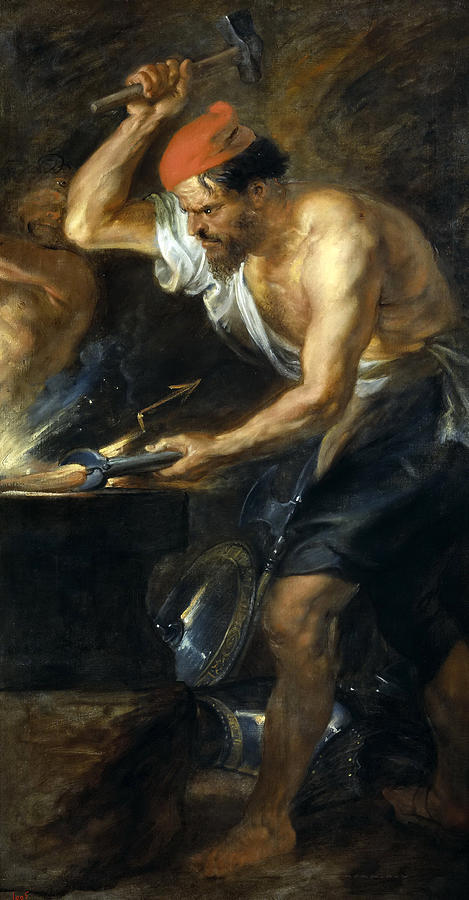
“Vulcan Forges Jupiter’s Thunder” shows Peter Paul Rubens at his most muscular and dramatic. The painting captures the mythological god of fire and metalwork in the heat of his forge, shaping the thunderbolts that will arm the king of the gods. Instead of a distant Olympian scene, Rubens brings us right into the workshop. The composition is tall and narrow, dominated by the sweaty, straining body of Vulcan as he raises his hammer for another blow.
This is not a polite mythological vignette; it is a celebration of physical labor, glowing metal, and divine power being born out of brute force. The painting belongs to Rubens’s broader fascination with classical mythology, but it also reflects his admiration for craftsmen, soldiers, and the energy of the Baroque age itself.
Mythological Background And Narrative Focus
In Roman mythology, Vulcan (Hephaestus in Greek) is the god of fire, smithing, and metalwork. Lame and often ridiculed by other gods, he nevertheless creates their weapons and armor. For Jupiter (Zeus), he forges the thunderbolts that express the god’s authority over sky and storm.
Rubens chooses a precise moment in this mythic process: Vulcan is in mid-strike, thunderbolt in the making on the anvil. We see only a fragment of the workshop and a hint of another assistant’s arm at the left edge, but that is enough to signal a team effort. The focus remains on Vulcan himself and the divine weapon he is shaping.
By concentrating on a single action rather than a complex narrative, Rubens turns the scene into a timeless image of creation through fire and effort. The thunderbolt stands for Jupiter’s justice, but in the painting it is metal still in process, sparks flying under the hammer. Power, in other words, is being forged, not yet fully formed.
Composition And The Dominance Of The Body
The vertical format heightens the sense of effort. Vulcan’s body fills almost the entire height of the canvas, from bare feet planted on the ground to muscular arm lifted high with hammer in hand. The diagonal line of that raised arm, combined with the bend of his torso and the thrust of his other arm toward the anvil, generates a powerful zigzag rhythm that guides the viewer’s eye through the image.
Rubens crops the figure tightly. There is very little empty space; background details sink into shadow. This closeness places us almost shoulder to shoulder with the god. We feel the swing of the hammer, the heat from the forge, the strain in the shoulders and back.
The anvil sits at the lower left, partly cut off by the frame, which enhances the impression that the action continues beyond what we see. On the ground near Vulcan’s feet lie polished pieces of armor and shields. They form a cluster of reflective curves and edges that echo the rounded muscles of the smith, linking his body to the objects he creates.
Light, Fire, And Baroque Drama
Light in this painting seems to emanate both from the forge and from an unseen source in front of the figure. Vulcan’s torso glows with warm highlights, as if firelight is licking across his skin. The brightest areas are the raised hammer arm, the shoulder, and the upper torso, emphasizing the physical effort at the center of the scene.
Rubens uses deep, smoky shadows around and behind the figure, allowing the background to recede into darkness. This stark contrast between brightness and obscurity, a strong form of chiaroscuro, is typical of Baroque painting and adds theatrical intensity. The viewer’s attention is forced onto the illuminated body and the tools of labor.
The thunderbolt on the anvil catches flashes of light, suggesting both its metallic nature and its future identity as lightning. While we do not see flames directly, the warm golden tones on Vulcan’s skin and the subtle glow on the armor pieces evoke the constant presence of fire. The entire scene feels suffused with heat and energy.
Vulcan As Worker And God
Rubens presents Vulcan first as a blacksmith, second as a god. There are no obvious halos or divine auras; instead, divinity is expressed through the sheer power and concentration of his labor. The red cap and rolled-up white sleeve are more reminiscent of an ordinary artisan than an Olympian deity. His bare chest and legs, rough beard, and intense gaze make him feel like a man we might encounter in a real workshop—except magnified in strength and presence.
This humanization is characteristic of Rubens’s approach to myth. He grounds legendary figures in physical reality so that viewers feel their emotions and exertion. At the same time, Vulcan’s exaggerated musculature and scale lift him beyond the merely human, hinting at supernatural strength. The tension between everyday worker and divine smith gives the painting its particular charge.
Anatomy, Movement, And The Rubensian Male Nude
Rubens is often remembered for his voluptuous female nudes, but works like “Vulcan Forges Jupiter’s Thunder” show his equal mastery of the male body. Vulcan’s torso twists in a complex contrapposto: chest turned slightly downward and inward, hips angled in the opposite direction, one leg bearing more weight. This twist allows Rubens to display back, shoulders, chest, and arm in a single flowing form.
Muscles bulge with strain, but they are rendered with soft transitions rather than hard outlines. The skin looks pliant and alive, not marble-hard. Rubens’s brushwork follows the contours of the muscles, creating a sense of flesh in motion rather than static anatomy.
The raised hammer arm is particularly striking. By pushing it almost to the top edge, Rubens conveys the full arc of the swing. The viewer can imagine the hammer descending in the next instant, striking the metal with a resounding clang. The painting thus contains not just a frozen pose but the suggestion of time and movement.
Symbolism Of The Thunderbolt And Armor
The thunderbolt that Vulcan is forging is more than a weapon; it symbolizes Jupiter’s authority, justice, and capacity to punish. In ancient and early modern imagery, the thunderbolt represents decisive power from above. Rubens visualizes it here in its embryonic state: a glowing, angular form being shaped on the anvil.
The armor scattered at Vulcan’s feet adds another layer of meaning. These gleaming pieces, perhaps recently finished, suggest that Vulcan has already equipped other gods or heroes. Their polished surfaces reflect light, echoing the glint that the thunderbolt will eventually unleash across the sky. Armor also hints at warfare and the consequences of divine weaponry in the human world.
By juxtaposing the raw effort of forging with the finished elegance of the armor, Rubens shows the full cycle of creation: from brute pounding at the anvil to refined objects destined for battle and glory.
The Forge As Metaphor For Artistic Creation
It is difficult not to see in this scene a metaphor for Rubens’s own work as a painter. Just as Vulcan hammers glowing metal into precise form, Rubens shapes raw pigment into images of gods and heroes. The artist may have identified with the divine smith: both work in hot, demanding conditions; both transform inert materials into instruments of power—Vulcan through weapons, Rubens through visual persuasion.
The red cap and bared arms, typical of working men, could be read as symbols of the artist’s own laborious craft. Baroque painters were increasingly claiming higher status as intellectual creators rather than mere artisans, yet they still spent long hours physically engaged with canvas and pigment. Vulcan functions here as an emblem of the dignity and force of skilled manual work, something Rubens undoubtedly valued in himself and others.
Atmosphere, Setting, And Suggested Space
Rubens gives only minimal information about the forge itself. We see the anvil, a hint of another worker’s arm, and a vague dark background that could be rock or smoke-blackened walls. This economy of setting is deliberate. Instead of distracting us with detailed machinery, he concentrates on the combination of man, metal, and fire.
The confined, shadowy space heightens the feeling of heat and exertion. There is no cool breeze, no open window; everything presses close. The vertical format can even suggest the narrow interior of a cave-like smithy. Vulcan’s hunched posture and close approach to the anvil reinforce this impression of intense, enclosed focus.
Emotional Tone: Concentration, Effort, And Resolve
Emotion in this painting resides less in facial expression and more in posture and gesture. Vulcan’s brow is furrowed, his eyes narrowed, his mouth set in determination. He is not chatting or glancing around; his entire being is directed toward the task at hand.
The raised hammer is not just a physical action but an emotional statement of resolve. We sense determination to get the form exactly right: each blow must land precisely to shape the thunderbolt. There is also a hint of controlled aggression in the way his muscles tense and his body leans into the strike. As god of fire and forge, Vulcan channels destructive heat into constructive power, and that transformation is palpable in the painting.
Place Within Rubens’s Mythological Works
Rubens returned repeatedly to mythological subjects, painting scenes from Ovid, Virgil, and other classical sources for both courtly patrons and private collectors. Many of these works feature gods in dramatic, emotionally charged situations: love affairs, battles, divine miracles. “Vulcan Forges Jupiter’s Thunder” stands out for its focus on work rather than spectacle.
Instead of Jupiter hurling thunderbolts from the sky, we see the preparation that makes such displays possible. The painting belongs with other Rubens works that delve into behind-the-scenes aspects of myth, such as the labors of Hercules or the forging of armor for Aeneas. It reflects a Baroque fascination with process—how things come into being—rather than only their final, glorious appearance.
Technique, Brushwork, And Material Presence
The surface of the painting is alive with varied brushstrokes. In the flesh, Rubens uses broad, blended strokes to suggest the smooth transitions of skin over muscle. In the drapery, strokes become more angular and broken, capturing the crumpled texture of cloth. The metal of the armor and thunderbolt features small, sharp touches of light against darker tones, giving the impression of shine and reflection.
The background is handled with loose, almost abstract swirls of dark paint, which create a smoky, turbulent atmosphere. This looseness contrasts with the more carefully modelled body and tools, reinforcing the sense that the figure emerges out of a cloud of heat and shadow.
Through these technical choices, Rubens makes viewers aware of the materiality of the painting itself. We can almost feel the thickness of the pigment in heavily worked areas, another parallel to the forging of hard metal.
Interpretation For Modern Viewers
For contemporary audiences, “Vulcan Forges Jupiter’s Thunder” can be read on several levels. It is a vivid illustration of a classical myth, a celebration of physical labor, a study of male anatomy in motion, and an allegory of creative power.
The painting also resonates with modern ideas about technology and energy. Vulcan’s forge is an early-industrial space where raw natural forces—fire, metal, and human strength—are harnessed to produce tools and weapons. In an age when questions about technology’s impact on humanity and environment are pressing, Rubens’s image of a god sweating over dangerous instruments feels surprisingly current. It asks us to reflect on who controls such power and how it is created.
At the same time, the painting retains the immediacy of a human story: one figure absorbed in difficult, necessary work. Viewers can empathize with Vulcan’s concentration and physical strain, regardless of their familiarity with myths or art history.
Conclusion
“Vulcan Forges Jupiter’s Thunder” is a compact powerhouse of a painting. Peter Paul Rubens condenses myth, anatomy, drama, and metaphor into the single figure of a laboring god at his forge. The raised hammer, glowing metal, and scattered armor create a visual symphony of effort and emerging power.
By emphasizing Vulcan’s humanity as much as his divinity, Rubens honors the dignity of skilled work and implicitly aligns it with his own vocation as an artist. The painting invites us to feel the heat of the forge, to anticipate the ringing blow of the hammer, and to consider the moment when raw material becomes an instrument of overwhelming force. In doing so, it remains one of the most compelling visualizations of creative energy in Baroque art.