Image source: wikiart.org
Introduction to “Head of One of the Three Kings Melchior the Assyrian King”
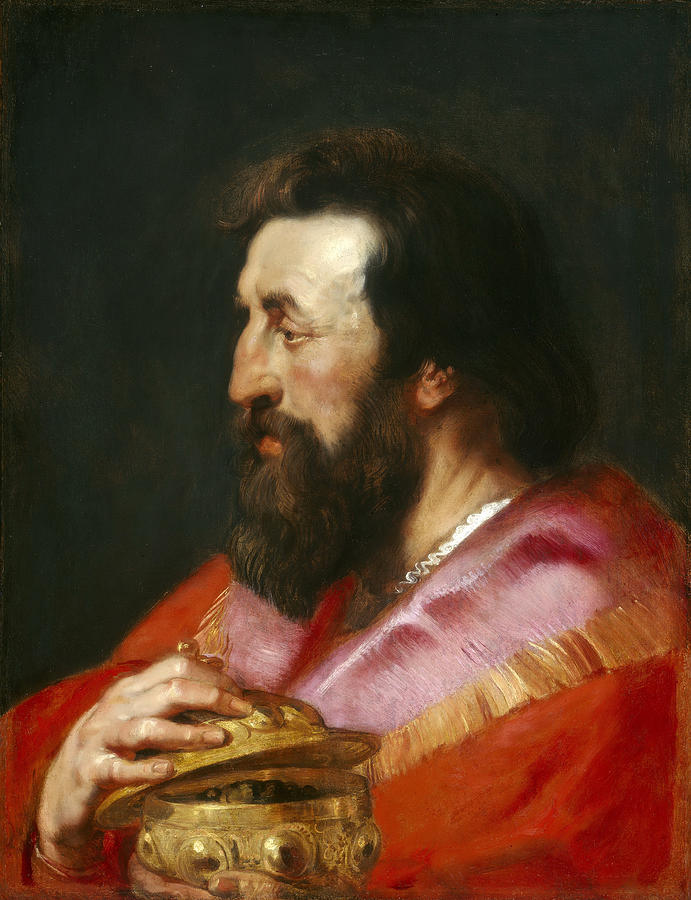
“Head of One of the Three Kings Melchior the Assyrian King” by Peter Paul Rubens is an intimate, powerfully focused study of one of the Magi from the Nativity story. Unlike large, bustling Adoration scenes, this painting isolates the king in profile, allowing viewers to contemplate his character, age, and spiritual intensity. Clad in rich red and violet garments and holding a golden vessel of incense, Melchior appears deep in thought, caught at the moment when worldly power bows before the infant Christ.
Although the exact date is unknown, the painting bears all the hallmarks of Rubens’ mature style: a warm, glowing palette, supple brushwork, and a masterful ability to reveal inner life through subtle facial modeling. Likely created as a study or independent devotional picture linked to a larger Adoration of the Magi project, it stands today as a compelling example of Baroque portraiture infused with biblical meaning.
Melchior and the Meaning of the Magi
In Christian tradition, the three Magi or Wise Men—often named Melchior, Caspar, and Balthazar—are noble visitors from the East who follow the star to Bethlehem and present gifts of gold, frankincense, and myrrh to the Christ Child. Over centuries, they came to symbolize the homage of the Gentile world to Christ and the three ages of man: youth, maturity, and old age.
Melchior is commonly portrayed as the eldest of the three, bearer of gold or, in some traditions, of frankincense. Rubens’ figure aligns with this tradition: we see an older man with a full beard, noble profile, and a vessel of precious metal cradled in his hands. Calling him “the Assyrian King” underscores his exotic, Eastern origin, reinforcing the idea that Christ’s kingship extends beyond Judaea to the far reaches of the known world.
By isolating Melchior in a concentrated bust-length image, Rubens invites viewers to reflect on the Magi not as distant symbolic figures but as individual souls confronted with the mystery of the Incarnation.
Composition and Profile View
The composition is simple yet extremely effective. Melchior is shown in strict profile, facing left, set against a deep, dark background that eliminates any distractions. His head and upper torso fill the majority of the canvas, creating an almost sculptural presence. Rubens positions the king slightly off center, allowing space for the golden vessel in the lower right and giving a sense of forward motion in the direction he looks.
The profile view has classical overtones. Renaissance and Baroque artists frequently used it for depictions of rulers, coins, and medals. Here, it emphasizes Melchior’s royal dignity and strong character. The nose, brow, and beard form a clear silhouette, immediately legible even from a distance. At the same time, the profile carry a sense of introspection: we observe him, but he does not meet our gaze, suggesting interior contemplation.
The king’s hands, clasping the ornate container, are turned toward us, introducing a second focal point that balances the head. This placement hints at the dual identity of Melchior as both sovereign and supplicant—he holds a regal gift, yet his posture suggests offering and humility.
Color, Light, and Rich Textures
Color plays a crucial role in communicating Melchior’s status. Rubens dresses him in a luminous red mantle lined with a lavender-violet fabric whose sheen catches the light. The red evokes warmth, power, and passion; the violet hints at spiritual dignity and royal associations. Golden trim along the garment echoes the golden gift he holds, visually tying his identity to the act of offering.
Light enters from the left, bathing his forehead, nose, and cheekbone, while the rest of the face recedes into warm shadow. This chiaroscuro modeling brings the head to life, emphasizing its three-dimensional form and giving the impression of living flesh. The dark background enhances this effect, making Melchior appear almost to emerge from the depths.
Rubens’ handling of texture is especially striking. The rough softness of the beard, the shiny folds of the satin-like cloak, and the hard, gleaming surface of the metal vessel are all differentiated through varied brushwork. On the golden container, small highlights and subtle reflections suggest intricate embossing and the cool weight of precious metal. On the garment, broader strokes indicate folds and sheen, while the skin tones are blended more delicately, achieving a sense of warmth and pulsing life beneath the surface.
Facial Expression and Psychological Insight
Although we see Melchior only in profile, Rubens manages to convey a subtle, complex emotional state. The king’s brow is slightly furrowed, and the corners of his mouth turn down in what could be read as concentration or gentle melancholy. His gaze, directed downward and slightly ahead, seems fixed on something unseen—perhaps the Christ Child in the larger narrative, or the star that led him.
This introspective expression transforms the painting from mere costume portrait to psychological study. Melchior appears as a man who has traveled far, both physically and spiritually. The lines around his eyes and the fullness of his beard signal age and experience, while the softness of his gaze suggests humility and wonder before the divine mystery he is approaching.
Rubens avoids exaggeration; there is no theatrical gesture or overt emotion. Instead, he captures a quiet, dignified intensity, as if we are witnessing a private moment of realization. This restraint makes the painting all the more moving, inviting viewers to project their own sense of reverence onto the king’s contemplative profile.
The Hands and the Gift
The hands, prominently placed near the bottom center, are painted with the same careful attention as the face. They are strong yet slightly worn, with visible knuckles and veins, suggesting a life of action and responsibility. Their positioning—one supporting the vessel from below, the other lifting the lid—implies both possession and offering. It is as if Melchior is in the act of revealing the treasure within.
The golden container itself is richly decorated, studded with rounded ornaments and encircled by bands of relief. Rubens uses the vessel not only as a symbol of royal wealth but also as a compositional anchor. Its circular form and metallic sheen contrast with the organic curves of the beard and the soft folds of the mantle, adding visual interest and symbolic weight.
In Christian iconography, the Magi’s gifts often carry deeper meanings. Gold can symbolize kingship, frankincense divine worship, and myrrh prefiguration of Christ’s death. Rubens leaves the exact content of Melchior’s vessel ambiguous, but the act of holding and opening it is clearly central. It represents the moment when earthly riches are willingly surrendered in recognition of a higher king.
Spiritual and Symbolic Dimensions
Although the painting contains no explicit background narrative, its spiritual implications are clear. Melchior stands as an emblem of the wise ruler who recognizes his own limitations and submits to divine authority. His rich clothing and costly gift speak of earthly power, but his bowed head and thoughtful expression convey reverence rather than pride.
The darkness that surrounds him can be read symbolically as the night of pagan ignorance or pre-Christian searching, from which he emerges partially illuminated by the light of faith. The glow on his face and garment suggests the star’s guiding radiance or the spiritual enlightenment he has received.
For viewers, the image serves as a model of how worldly success and sincere humility can coexist. Melchior does not renounce his kingship; instead, he redeems it by placing it in service to Christ. This message would have resonated in Rubens’ time with princes, nobles, and civic leaders who were expected to be both powerful and pious.
Rubens’ Portraiture and Italian Influences
“Head of One of the Three Kings Melchior the Assyrian King” also illustrates Rubens’ exceptional skill as a portraitist. Even when working within a religious context, he brings to his figures the immediacy and individuality of real people. The strong profile, subtle modeling, and vivid sense of presence suggest that the painting may have been based on a live model, perhaps one of Rubens’ assistants or acquaintances, transformed into the biblical king through costume and attributes.
Rubens’ years in Italy influenced his approach profoundly. The warm color harmonies, expressive brushwork, and attention to sculptural form recall the work of Titian and the Venetian school. The profile view echoes classical busts and cameos, which Rubens studied in antiquities collections. Yet he infuses these influences with his own energy, creating a figure that feels both timeless and intensely human.
This painting also shows how Rubens often prepared for large multi-figure compositions by creating head studies. These oil sketches allowed him to experiment with character, lighting, and color before integrating the figure into a broader narrative. Whether or not this particular work was a preparatory study, it possesses the directness and vitality typical of his oil sketches, while being polished enough to stand as an independent artwork.
Dialogues of Color and Form
The interaction of color and form in the painting deserves special attention. The red cloak, violet lining, and golden vessel form a triad of saturated hues that immediately capture the eye. Rubens balances these with the neutral tones of skin and beard and the deep, almost black background. This contrast heightens the sense of depth and ensures that the viewer’s focus remains on the king’s head and hands.
The shapes within the composition reinforce its calm strength. The contour of the head creates a dominant arc, echoed by the curved lid of the vessel and the rounded knuckles of the hands. These curves are countered by the diagonal line of the shoulder and the vertical of the neck, giving the picture stability. The result is a harmonious arrangement in which no element feels extraneous.
Such careful orchestration of color and form reflects Rubens’ belief that painting should appeal to the senses as well as the mind. He offers viewers a feast for the eyes that simultaneously supports the spiritual narrative.
Emotional Impact and Devotional Use
Even apart from its biblical context, the painting has strong emotional impact. Viewers often respond to Melchior’s mixture of dignity and vulnerability—the proud profile of a king softened by the reflective gaze of a believer. The work invites not just admiration but empathy. We sense the weight of the journey he has made, the significance of the gift he offers, and the interior movement of his heart.
In a devotional setting, such an image would serve as a focal point for meditation during the Christmas season or throughout the year. Contemplating Melchior’s humility and generosity, believers could examine their own willingness to offer what they treasure most. The painting thus functions as visual theology, teaching by example rather than by text.
Conclusion
“Head of One of the Three Kings Melchior the Assyrian King” is a superb demonstration of Peter Paul Rubens’ ability to combine portrait realism, narrative suggestion, and rich symbolism in a single, concentrated image. Through a powerful profile, glowing colors, and exquisitely rendered textures, Rubens transforms one of the Magi into a vivid individual whose inner life is almost palpable.
Melchior appears as an aging ruler on the threshold of spiritual revelation, his worldly splendor subordinated to the act of offering a precious gift to a greater king. The painting captures the essence of the Epiphany story: the meeting of human seeking and divine self-disclosure, played out in the quiet drama of a single face and a pair of hands holding a golden vessel.
As viewers today stand before this work, they encounter not only a masterpiece of Baroque painting but also an enduring reflection on generosity, humility, and the transformation of power into worship.
