Image source: wikiart.org
Introduction to Peter Paul Rubens’s “Minerva Slaying Discord”
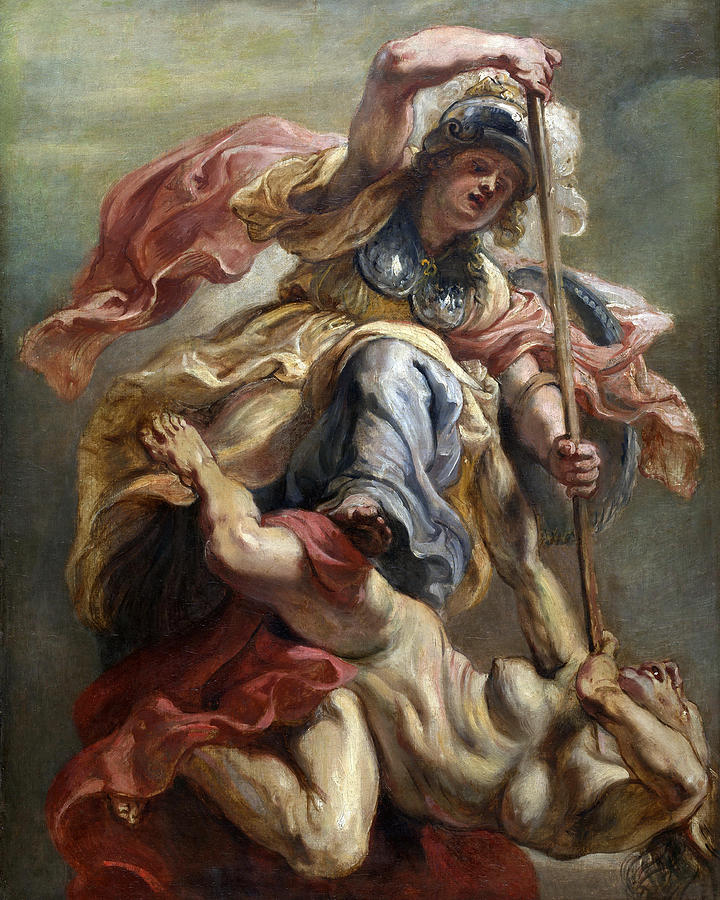
“Minerva Slaying Discord” by Peter Paul Rubens is a fiercely energetic allegorical painting that showcases the Baroque artist at his most dramatic. The goddess Minerva, known in Roman mythology as the deity of wisdom, just warfare, and civic order, dominates the scene. Clad in armor and swirling draperies, she pins a writhing male figure beneath her and drives a spear toward him. This defeated opponent is Discord, the embodiment of chaos, violence, and civil strife.
The painting compresses into a single, explosive moment the triumph of reason over rage and of lawful authority over anarchy. Rubens uses swirling motion, muscular bodies, luminous color, and tense diagonals to transform a moral allegory into a visceral experience. Although the exact date of the work is unknown, it clearly belongs to Rubens’s mature period, when he frequently employed mythological figures to comment on political realities and ethical themes.
Mythological Background and Allegorical Meaning
To understand the painting’s full resonance, it is helpful to recall the roles of Minerva and Discord in classical tradition. Minerva, equivalent to the Greek Athena, is the goddess of wisdom, strategic warfare, and the arts. She represents intelligence, justice, and protective strength rather than brute aggression. Discord, often associated with Eris or with destructive warlike forces, personifies quarrel, faction, and the breakdown of social harmony.
By picturing Minerva physically overpowering Discord, Rubens visualizes the victory of enlightened governance over civil conflict. This allegory would have been especially meaningful in seventeenth-century Europe, where religious wars and political unrest threatened fragile peace settlements. The painting may well have been conceived as a visual compliment to a ruler or statesman committed to restoring order. For contemporaries, the message would have been unmistakable: wise authority must actively suppress the forces that tear societies apart.
Composition and Dynamic Movement
The composition of “Minerva Slaying Discord” is a dazzling example of Baroque dynamism. Rubens constructs the scene around a sweeping diagonal that runs from the upper left, where Minerva’s flowing mantle billows in the wind, down to the lower right, where Discord’s body stretches in a desperate arc. This diagonal is reinforced by the vertical thrust of the spear and the crossing lines of the figures’ limbs, creating a sense of swirling combat frozen at its climax.
Minerva is positioned above, dominating the pictorial space. Her body twists as she leans forward, left leg planted firmly on Discord’s chest and right arm raised high to drive the weapon downward. Discord lies on his back, shoulders arched, head thrown back, legs flailing. The contrast between her upright, controlled posture and his contorted, almost serpentine pose underscores the outcome of the struggle.
The entire composition is set against a relatively open background. Soft, cloudy sky fills the upper portion, while a reddish base anchors the figures below. By avoiding complex architectural or landscape elements, Rubens ensures that nothing distracts from the collision of these two personifications. The viewer’s eye is drawn instantly to the center where Minerva’s helmeted head, the gleaming spear, and Discord’s torqued torso converge.
Minerva’s Armor, Drapery, and Divine Authority
Rubens’s portrayal of Minerva combines martial power with feminine grace. She wears a helmet adorned with plume and crest, signaling her identity as a warrior goddess. A breastplate covers her torso, painted with metallic highlights that catch the light and curve convincingly over her body. Beneath the armor, pale blue garments and a swirling pink cloak cascade in voluminous folds, their fluid movement contrasting with the hard surfaces of bronze and steel.
The goddess’s clothing is not merely decorative; it participates in the visual drama. The cloak, caught by an unseen wind, arcs upward behind her like a billowing banner, amplifying her motion and presence. Its rosy hue injects warmth and vitality into the scene, while the gold and blue tones of her armor connect her to celestial light and divine authority.
Minerva’s expression is intense and focused. Her mouth is slightly open, as if crying out or exerting herself; her gaze is directed downward toward her enemy. This is not a detached, abstract allegory but a goddess fully engaged in physical combat. Yet despite the effort, there is no sense of chaos in her movement. Every gesture is purposeful, guided by reason and justice rather than blind fury.
Her spear, gripped firmly with both hands, serves as both weapon and symbolic axis. It marks the line along which order is imposed upon disorder. The straightness of the shaft contrasts with the writhing forms of Discord’s limbs, visually reinforcing the notion that principle and law straighten what is twisted by conflict.
The Figure of Discord and the Drama of Defeat
Discord, by contrast, embodies raw, undisciplined energy. Rubens paints him as a powerful, nearly nude male figure, muscles taut and veins visible, yet completely overpowered. His body twists in a complex contrapposto: pelvis turned one way, chest another, head thrown back in a cry of anguish. The red drapery that clings to parts of his form echoes the color of Minerva’s cloak but appears tangled and unstable, suggesting bloodshed and turmoil.
His face is contorted with rage and pain. The mouth opens wide, teeth bared; the brow furrows in a mixture of defiance and terror. One arm reaches upward as if to ward off the impending blow, while the other is pinned, emphasizing his helplessness. Rubens’s study of anatomy allows him to convey precisely the strain in each muscle, making Discord’s defeat not just symbolic but physically convincing.
The choice to depict Discord as a strong, youthful male rather than as a grotesque monster heightens the drama. He is clearly a formidable force, not a weak opponent. Minerva’s victory, therefore, is not easy or trivial; it requires active, determined intervention. This implies that the suppression of discord in human affairs likewise demands courage and effort from wise leaders.
Color, Light, and Baroque Atmosphere
The emotional intensity of “Minerva Slaying Discord” is amplified by Rubens’s handling of color and light. The palette is dominated by warm reds, pinks, and golds, offset by cooler blues and greys in the garments and sky. These hues are laid down in thick, juicy brushstrokes that give the surface a palpable energy.
Light comes from above and slightly to the left, illuminating Minerva’s face, arm, and armor while casting more dramatic shadows across Discord’s body. This lighting scheme reinforces the moral hierarchy of the scene. The goddess, agent of wisdom and justice, occupies the brighter zone, while Discord lies partially in shadow, his form half-swallowed by gloom.
The way Rubens modulates light across the figures also enhances their three-dimensionality. Highlights on Minerva’s armor and on the curves of Discord’s torso make them appear almost sculptural. The background remains more subdued, with soft clouds and diffused light that support the action without competing for attention.
Color serves symbolic functions as well. The pink and red draperies suggest passion, conflict, and sacrifice. The golden tones in Minerva’s armor evoke nobility and divine favor. The earthy flesh tones of Discord emphasize his mortal, fallible nature. Together, these colors create a visual symphony of struggle and resolution.
Rubens’s Allegorical Language and Political Resonances
Rubens frequently used mythological allegory to comment on contemporary politics and to flatter patrons who saw themselves as defenders of peace and stability. In “Minerva Slaying Discord,” the goddess can be read as a personification not only of abstract wisdom but of a specific state or ruler. She may stand for a Christian monarchy that protects its people from civil war, or for a wise statesman who quells factionalism through prudent governance.
The image of Discord being physically crushed would have resonated strongly in regions that had suffered from religious or dynastic conflicts. In the context of the Spanish Netherlands, for example, such allegories were often used to praise authorities who pursued reconciliation after years of strife. Rubens, who served as a diplomat as well as a painter, knew how powerful such visual metaphors could be in shaping political narratives.
At the same time, the painting also carries a more universal message. It suggests that reason and order must constantly struggle against the irrational forces that threaten to disintegrate communities and individuals alike. The fact that Minerva is actively striking, not merely standing with symbolic attributes, emphasizes that maintaining harmony requires ongoing action rather than passive hope.
Painterly Technique and the Character of an Oil Sketch
“Minerva Slaying Discord” has the lively, spontaneous quality often associated with Rubens’s oil sketches. The brushwork is vigorous and visible; contours are suggested rather than meticulously drawn. Certain areas, particularly the background and the swirling draperies, display a looseness that indicates Rubens was more interested in capturing dynamic movement and light than in polished finish.
These characteristics suggest that the painting may have functioned as a modello or preparatory study for a larger, more finished work. Rubens frequently produced such sketches to present his ideas to patrons or to guide assistants in his workshop. Yet even if this is an oil sketch, it possesses a completeness and vitality that make it fully convincing as an independent artwork.
The painterly approach contributes to the effect of immediacy. Brushstrokes follow the direction of muscles and folds, effectively “drawing” with paint. The viewer can sense the speed and confidence with which Rubens worked, as if he were racing to match the intensity of the battle he depicts. This energetic application of paint mirrors the struggle between Minerva and Discord, turning the act of painting into a parallel form of controlled force.
Emotional and Moral Impact on the Viewer
Encountering “Minerva Slaying Discord,” the viewer is drawn into the tumultuous action almost physically. The foreshortening of Discord’s body, thrust toward the foreground, makes his defeat feel close and immediate. Minerva’s raised arm and spear form a powerful visual arc that seems to break out of the frame.
Emotionally, the painting evokes a mixture of awe and relief. The brutality of the scene—the imminent strike, the contorted victim—confronts the viewer with the reality of violence. Yet the knowledge that the figure being subdued is Discord, not an innocent person, transforms the violence into a necessary act of justice. Rubens thereby navigates the tension between admiration for martial strength and horror at its consequences, a tension that was central to Baroque religious and political thought.
The moral message reinforces this emotional response. Viewers are encouraged to see Minerva’s action as exemplary: wisdom must not remain merely contemplative but must actively resist the forces that destroy concord. In personal terms, the painting can be read as a call for individuals to master their own inner discord—anger, envy, and irrational impulses—through reason and virtue.
Conclusion
“Minerva Slaying Discord” is a compact yet monumental work that captures the essence of Rubens’s Baroque genius. Through a dramatic confrontation between a powerful goddess and a defeated embodiment of chaos, the artist gives visual form to the victory of wisdom, order, and just authority over conflict and disorder.
The swirling composition, muscular anatomy, luminous color, and vigorous brushwork combine to create an image that feels both intensely physical and richly symbolic. Whether interpreted in relation to seventeenth-century politics or as a timeless moral allegory, the painting speaks to enduring human concerns about the fragility of peace and the necessity of active virtue.
Rubens does not present harmony as a gentle, effortless state; he shows it as the hard-won result of struggle. Minerva’s poised yet forceful act is a reminder that to preserve justice and concord—within societies or within the self—requires courage, intelligence, and decisive action. The painting thus remains as relevant to modern viewers as it was to those of Rubens’s own time, a powerful testament to art’s ability to dramatize the conflicts at the heart of human experience.