Image source: wikiart.org
Introduction to Peter Paul Rubens’ “Christ and the Adulteress”
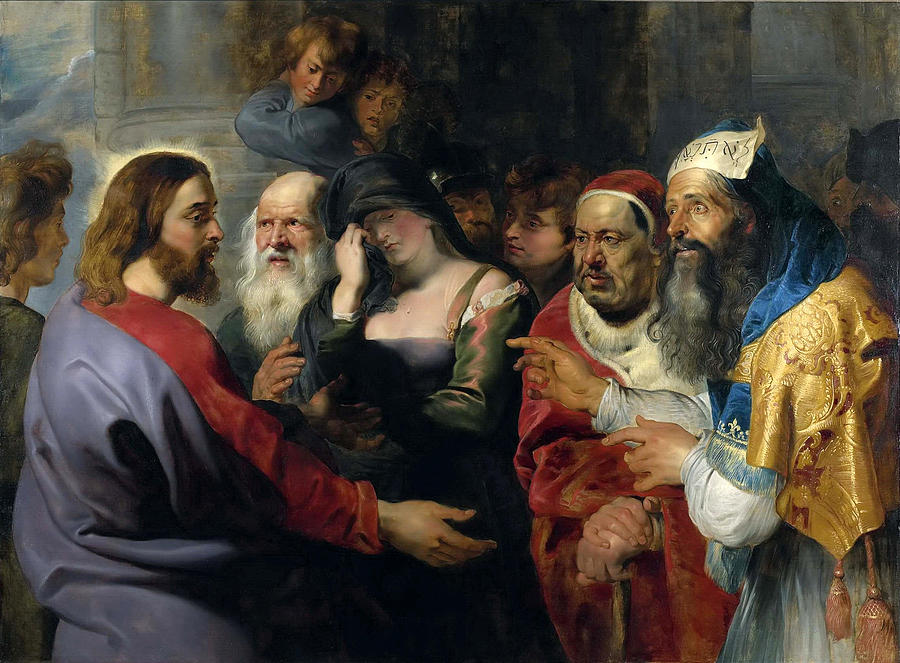
“Christ and the Adulteress” by Peter Paul Rubens is a gripping Baroque interpretation of one of the New Testament’s most poignant episodes. The painting captures the moment when Christ confronts the scribes and Pharisees who have dragged before him a woman accused of adultery. Instead of joining their condemnation, Jesus utters the famous challenge, “He that is without sin among you, let him first cast a stone at her.” Rubens translates this moral drama into a crowded, emotionally charged scene where every gesture, glance, and fold of fabric contributes to the tension between judgment and mercy.
The date of the work is unknown, but its mature handling of color, light, and complex group composition places it firmly in Rubens’ Antwerp period, when he was at the height of his powers as a religious painter. The painting embodies Counter-Reformation ideals, inviting viewers not just to watch an event from Scripture, but to feel implicated in it.
Biblical Story and Theological Focus
The subject comes from the Gospel of John, chapter 8. Religious leaders bring an adulterous woman to Jesus, hoping to trap him between Mosaic Law, which demands stoning, and Roman authority, which restricts capital punishment. Christ’s unexpected response exposes their hypocrisy and transforms a public trial into a lesson on humility and forgiveness.
Rubens focuses on the climactic instant when the accusers confront Jesus and the woman stands, crushed by shame, between them. Rather than depicting stones, violence, or the eventual dispersal of the crowd, he concentrates on the psychological standoff. Jesus’ calm yet authoritative presence contrasts with the agitated faces and pointing fingers of the legal experts. The painting thus becomes a meditation on the clash between rigid legalism and compassionate justice.
Composition and Spatial Structure
The composition is tight and horizontal, packed with half-length figures pressed close to the picture plane. There is no deep landscape or architectural vista; the space behind the central characters quickly dissolves into shadow and indistinct faces. This compression pulls the viewer into the heated encounter, making it feel almost uncomfortably intimate.
Christ stands on the far left, turned toward the group. Opposite him, on the right, stand the leading accusers—scribes and priests in ornate garments—leaning forward, gesturing, and speaking with insistent energy. Between them, slightly set back, appear the woman and an elderly bearded man, often read as one of the onlookers or perhaps a more moderate authority figure. Behind this central cluster, a dense throng of observers fills the background, their heads overlapping in a rhythm that evokes murmuring, speculation, and tension.
Rubens uses diagonal lines of sight and gesture to keep the viewer’s eye moving. Christ’s extended arm leads toward the woman; the pointing fingers of the priests lead back toward Christ; the bowed head of the woman creates a downward diagonal that conveys shame and vulnerability. These intersecting diagonals form a visual web binding the figures together in moral confrontation.
The Figure of Christ: Calm Authority and Compassion
Rubens presents Christ as a youthful, bearded man with long hair and a gentle yet resolute expression. He wears a red tunic with a violet cloak, colors traditionally associated with sacrifice and royalty. The garments fall in broad, simple folds, their relative restraint distinguishing him from the richly brocaded robes of the priests. This simplicity underscores his inner authority and spiritual transparency.
Christ’s posture is crucial. He leans slightly forward, left arm open in a broad, welcoming gesture while his right hand, closer to the viewer, is angled downward as if to restrain aggression. His body forms a stable vertical and diagonal axis that anchors the entire composition. The calm set of his features contrasts strongly with the furrowed brows and animated mouths of his opponents. Rubens thus conveys the sense that Christ, though outnumbered, is in complete command of the situation.
The light falls gently on Christ’s face and shoulders, giving him a quiet halo of illumination without resorting to overt symbolic rays. This subtle emphasis ensures that even in the visual chaos of the crowd, the viewer immediately recognizes him as the focal point and moral center.
The Adulteress: Shame, Fear, and Hope
At the center of the painting stands the accused woman, dressed in a dark, slightly disordered gown. Her head is bowed, eyes closed or downcast, and one hand wipes tears from her face. The other hand clutches her clothing near the chest, a gesture that both protects her modesty and signals inner turmoil. Rubens portrays her as young and attractive but not idealized; her distress and exhaustion are palpable.
The woman’s placement between Christ and the accusers is telling. She literally occupies the space of conflict, object of their judgment yet potential recipient of Christ’s mercy. The light falls on her face and upper body, emphasizing her as a key figure. However, unlike the calm radiance around Christ, the illumination here accentuates her emotional fragility: wet eyes, flushed cheeks, a tremor in the mouth.
Her dark clothing sets her apart chromatically from the bright robes of the priests and the colored garments of the crowd. This sober palette underscores her isolation. At the same time, her proximity to Christ—his open hand close to her, his gaze directed toward her situation—suggests that she is already being drawn into the sphere of forgiveness.
The Accusers: Legalism, Status, and Inner Conflict
On the right side of the canvas Rubens gathers the scribes and priests who have brought the woman. Their varied expressions and lavish costumes provide a vivid study of human motives. The frontmost figure, wearing an ornate blue and gold robe and a headpiece with Hebrew script, may represent the high priest. His gray beard and direct profile give him gravitas. Yet his hand is raised in an accusatory gesture, index finger pointing emphatically toward Christ and, by extension, toward the law he believes is being violated.
Beside him stands another official in red and white, lips pursed, eyebrows knotted. His slightly hunched posture and folded hands suggest unease, as if he senses the moral trap into which they have fallen. A bit behind, other men lean forward, their faces eager, skeptical, or simply curious. Rubens avoids caricature; even as he shows their hardness, he allows hints of doubt and complexity.
The priests’ garments dazzle the eye: gold embroidery, patterned fabrics, rich blues and crimsons. These visual riches highlight their institutional power and social status. Yet the contrast with Christ’s simpler attire implies that true authority does not lie in outward splendor. Their fingers, hands, and mouths are very active—pointing, explaining, arguing—while Christ’s gestures remain broad and open, signaling a different kind of discourse.
The Crowd and the Sense of Public Judgment
Behind the principal characters, Rubens paints a throng of onlookers, their heads stacked in overlapping tiers. Some crane their necks to see, others lean over shoulders, one young boy at the top rests his chin on his hand, following the exchange with wide eyes. This background crowd creates a sense of public spectacle: the woman’s shame is not hidden but exposed before many.
The faces in the crowd offer a range of reactions—curiosity, concern, skepticism, and even empathy. One figure near the center behind the woman peers intently at Christ, perhaps already moved by his words. Another seems to whisper to a neighbor. Through these details Rubens shows that the drama is not confined to a few legal experts and one woman; it reverberates through the entire community, just as the Gospel message addresses all humanity.
The crowd also deepens the spatial illusion, preventing the painting from feeling like a flat frieze. Their darker, more loosely painted forms recede into the shadows, making the foreground figures stand out more vividly.
Gesture, Hands, and the Language of the Body
One of Rubens’ great strengths lies in his ability to tell stories through gesture. In “Christ and the Adulteress,” hands are everywhere, each with its own expressive role. Christ’s open palms invite, reassure, and challenge without aggression. The high priest’s pointed finger accuses and asserts authority. Another priest grips his own hands tightly, a sign of inner anxiety. The elderly man beside the woman extends his hand as if arguing a point or pleading for restraint.
Even the woman’s hands speak volumes: one hides her tears, the other clutches her dress, revealing both shame and self-defense. The layering of these hand gestures creates a complex choreography, almost like a silent conversation in multiple voices. Viewers are invited to “read” these signals and discern the moral alignments of each character.
By emphasizing hands and arms, Rubens makes the painting almost audible: one can imagine the arguments, protests, and murmured reactions circulating through the group. This aligns with Baroque art’s aim to engage the viewer emotionally and imaginatively, not just visually.
Light, Color, and Emotional Atmosphere
Rubens uses light strategically to guide the viewer’s attention and create emotional atmosphere. A warm, golden light falls primarily on Christ, the woman, and the central elders, leaving the distant crowd in cooler, dimmer tones. This concentration of light on the main protagonists heightens the sense of dramatic focus, as if a spotlight from heaven were illuminating the moral crux.
Color contributes as well. Christ’s garments in red and violet are both intense and harmonious, conveying dignity and sacrificial love. The woman’s dark dress and veil communicate her status as sinner and outcast, yet the light on her skin hints at the possibility of transformation. The priests’ robes shimmer with luxurious blues and golds that catch the light, symbolizing worldly power and religious authority.
Rubens tempers the richness of color with areas of subdued brown and gray, especially in the background. This balance prevents the painting from becoming overly decorative and keeps the emotional tone sober. The overall effect is one of warm, human drama rather than cold, distant allegory.
Counter-Reformation Message and Spiritual Implications
As a leading Catholic artist of the Baroque period, Rubens worked within a context shaped by the Counter-Reformation, which emphasized clarity of narrative, emotional engagement, and doctrinal orthodoxy. “Christ and the Adulteress” fits these aims beautifully. It conveys in a single glance the central message of the Gospel story: all are sinners; only Christ has the right to judge; true justice is inseparable from mercy.
The painting also speaks to contemporary debates about law, conscience, and institutional authority. By showing religious leaders caught in their own trap of self-righteousness, Rubens warns viewers against using religion as a tool of condemnation. Yet he does not vilify the priests; instead, he paints some of them as visibly troubled, suggesting that they too might be converted by Christ’s words.
For devout viewers, the adulteress becomes a mirror of their own need for forgiveness. Her bowed head and tears invite identification, while Christ’s gentle but firm presence offers hope. The work thus functions as a visual homily, encouraging humility and trust in divine mercy.
Relationship to Rubens’ Other Religious Works
Rubens painted numerous scenes from the life of Christ, often focusing on moments of intense emotion: the Raising of the Cross, the Descent from the Cross, the Supper at Emmaus. “Christ and the Adulteress” shares with these works a concern for expressive faces, dynamic composition, and the interplay of light and shadow. Yet it is distinctive in its relative absence of overt physical violence. The drama here is psychological and moral, not bodily.
The painting also demonstrates Rubens’ fascination with group scenes where multiple characters interact within a tight space. Similar crowd compositions appear in his “Miracle of St. Ignatius” and “Conversion of St. Paul.” In each case, he uses swirling gestures and intersecting diagonals to create a sense of momentary chaos resolved by a central divine figure.
Viewed within his broader oeuvre, “Christ and the Adulteress” highlights Rubens’ ability to handle quiet ethical conflict as effectively as grand heroic action. The painting reveals his skill in portraying not just suffering bodies, but conflicted consciences.
Conclusion
“Christ and the Adulteress” by Peter Paul Rubens is a masterful Baroque exploration of mercy, judgment, and human frailty. Through a densely packed composition, nuanced light, and extraordinarily expressive gestures, Rubens invites viewers into the heart of a Gospel drama that remains timelessly relevant. Christ stands calm amid agitation, the adulteress embodies both guilt and hope, and the accusers reveal the dangers of self-righteousness even as they show glimmers of doubt.
The painting exemplifies Rubens’ power to blend narrative clarity with psychological depth and painterly richness. It asks each viewer implicitly: with whom do you stand in this scene—the accusers, the crowd, the trembling woman, or the Christ who calls everyone to acknowledge their own sins and choose compassion over condemnation? In posing that question so vividly, “Christ and the Adulteress” continues to speak across centuries as both an artistic triumph and a profound spiritual reflection.
