Image source: wikiart.org
Introduction to “The Education of the Virgin”
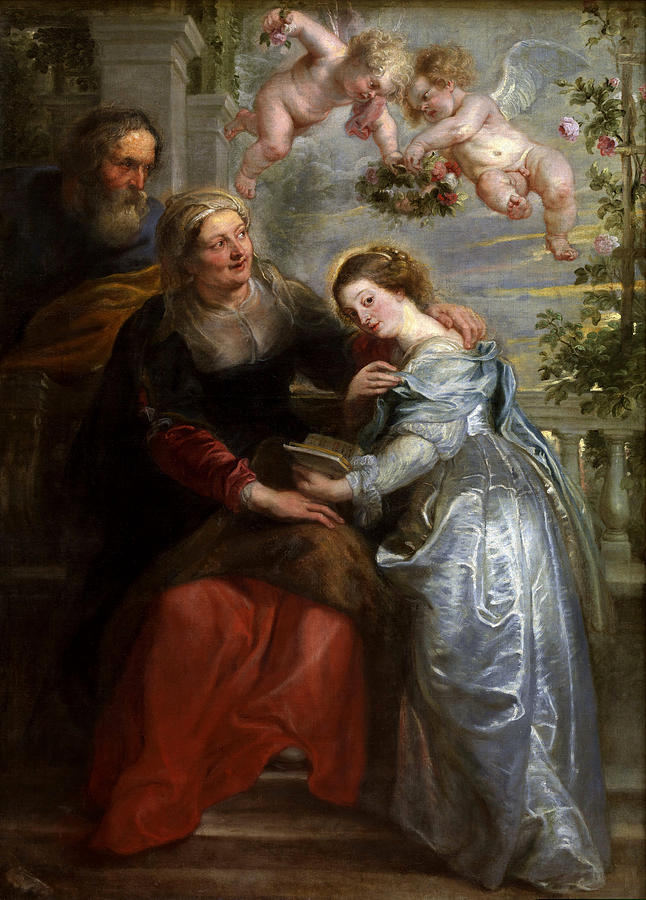
“The Education of the Virgin” by Peter Paul Rubens is a tender and luminous exploration of childhood, family, and divine destiny. The painting shows the young Virgin Mary in an intimate domestic setting, learning to read under the gentle guidance of her mother, Saint Anne, while Saint Joachim watches from the shadows. Above them, playful putti hover in a soft sky, crowning the scene with garlands of flowers as if heaven itself blesses the lesson.
Rubens transforms a quiet moment of instruction into a richly symbolic vision of grace and vocation. The child Mary is not simply a little girl with a book; she is the future Mother of God, and her early education foreshadows her role as a thoughtful, receptive servant of the divine word.
Iconography and Theological Meaning
The subject of the Virgin’s education is not found directly in the Gospels but arises from later Christian tradition, which imagined Mary as a pious, studious child prepared from an early age for her unique calling. The book she holds symbolizes Scripture and divine wisdom. By emphasizing her literacy and contemplation, the image presents Mary as a model of prayerful engagement with God’s word rather than passive obedience.
Saint Anne, seated and embracing her daughter, represents both maternal affection and the transmission of faith from one generation to the next. Joachim, standing behind them, completes the holy family and anchors the scene in a recognizably human household. The putti above, carrying flowers and a garland, introduce a celestial dimension, suggesting that the learning taking place is not merely academic but graced and approved by heaven.
Composition and Spatial Structure
Rubens composes the scene in a compact yet layered space. The principal triangle of figures is formed by Anne, Mary, and Joachim. Anne sits at the center, broad and stable, her lap supporting Mary’s small body. Mary leans against her, twisting in a graceful S-curve that leads the eye from the book in her hands up to her delicate face turned partly toward the viewer. Joachim stands behind to the left, his dark form emerging from the shadowed column, watching quietly.
The architectural background—a stone column, balustrade, and distant sky—creates a sense of depth and stability, as though this tender episode unfolds within a solid, enduring world. The balustrade marks the boundary between the earthly terrace where the family sits and the open heavens above, where the putti float among clouds and foliage.
Everything in the composition moves gently toward the child at its heart. Anne’s arm curves protectively around Mary’s shoulders. Joachim’s gaze and slightly forward-leaning posture converge on her. The putti overhead angle their bodies and garland downward. Even the folds of Mary’s shimmering dress follow lines that draw the viewer’s attention back to her face and the book.
The Figures of Anne, Joachim, and Mary
Saint Anne’s presence is warm and robust. Rubens gives her a broad, maternal face animated by a tender smile as she looks at Mary. Her clothing is composed of dark, earthy tones, with a red skirt and dark bodice softened by a pale headscarf and collar. This palette signals stability, experience, and grounded affection. Her hands are large, capable, and gentle, one resting on the book, the other encircling her daughter, guiding both mind and heart.
Joachim, partly in shadow, appears older and more contemplative. His beard and furrowed brow speak of age and reflection. Draped in deeper colors, he recedes into the background, his role quieter but essential. His watchful stance conveys paternal concern and pride, as though he witnesses the unfolding of a destiny he only partly understands.
Mary, by contrast, is all light and delicacy. Her dress is a luminous blue satin, with silver highlights that catch the light and ripple across the fabric. The color recalls her traditional Marian blue but rendered here with youthful freshness. Her fair hair is softly gathered, and her face is round and innocent yet already thoughtful. She leans into Anne’s embrace while simultaneously twisting toward the book and the viewer, suggesting both dependence and emerging individuality.
The Role of the Book and the Gesture of Learning
At the center of the interaction is the small book held between Anne and Mary. Mary’s right hand cradles it, while Anne’s hand rests gently on its pages, perhaps pointing out words or lines. This shared grasp embodies the process of teaching and learning: knowledge passes not in isolation but through relationship, touch, and conversation.
The book itself is more than an object of literacy; it symbolizes the Scriptures and the wisdom of God. In Christian tradition, Mary is often portrayed as the one who listens deeply to God’s word and “ponders these things in her heart.” By showing her already engaged with a sacred text as a child, Rubens suggests that her later acceptance of the angel’s message (“Be it done unto me according to thy word”) is rooted in a lifetime of contemplation.
Mary’s slightly tilted head and soft, inward gaze express concentration and receptivity. She is being formed intellectually and spiritually in the quiet school of the home, with Anne as her first teacher of faith.
Heavenly Putti and the Atmosphere of Grace
Above the family group, three chubby putti animate the upper part of the canvas. Two fly forward bearing a floral garland, while another reaches out playfully. Their bodies twist in lively poses, creating a swirling movement that contrasts with the calm solidity below. Yet their gestures and garland are directed toward the figures beneath, visually linking heaven and earth.
The flowers they carry evoke purity, joy, and the blossoming of virtues. The garland can be read as a hint of the future Marian titles and honors—Queen of Heaven, Seat of Wisdom—that will “crown” the girl now learning her letters. The putti’s presence assures viewers that this ordinary domestic scene is suffused with divine favor.
Rubens paints the sky in soft blues and pale golds, with flecks of cloud and greenery, creating a light, airy backdrop. This heavenly zone balances the denser architecture and dark interior shadows on the left, making the composition both grounded and radiant.
Light, Color, and Textural Richness
Light plays a crucial role in shaping the emotional and symbolic tone of the painting. A warm, diffuse light falls from the right, illuminating Mary’s face and dress most strongly. Her blue satin gown gleams with pearly highlights, emphasizing her role as the focal point. The light also touches Anne’s face, hands, and red skirt, and glances off Joachim’s beard and clothing, while leaving other areas in softer shadow.
Rubens’s palette is rich but harmonious. The deep reds and browns of Anne’s garments anchor the lower half of the painting, while Mary’s cool blue adds vibrancy and youthful freshness. Joachim’s darker tones blend into the architecture, ensuring that he does not compete with the central pair for attention. Above, the pinkish flesh of the putti, the fresh greens of foliage, and the delicate colors of flowers create a festive, gentle canopy.
Textural contrasts also enrich the scene. The coarse fur on Anne’s lap, the soft linen of headscarves, the smooth stone of columns, and the glossy sheen of Mary’s satin all demonstrate Rubens’s pleasure in materiality. These details make the sacred story tangible and sensuous, inviting viewers to imagine not only what the scene looks like but how it would feel to touch.
Intimacy, Tenderness, and Domestic Sanctity
One of the most striking features of “The Education of the Virgin” is its emphasis on tenderness. Anne’s arm wrapped around Mary, the gentle tilt of Mary’s head resting against her mother, Joachim’s quiet presence, and the playful, affectionate putti together create an atmosphere of safety and affection.
This domestic warmth is more than sentiment; it conveys a theological message about the sanctity of family life. Rubens presents the holy family of Mary’s parents not as distant, austere figures but as loving people whose everyday interactions are suffused with grace. In doing so, he suggests that holiness grows within ordinary routines—lessons, conversations, shared reading—rather than only in dramatic visions or miracles.
The painting would have resonated strongly with seventeenth-century viewers for whom religious instruction of children, especially girls, was increasingly emphasized. It provides a model in which women, represented by Anne, play a central role in nurturing faith and knowledge within the home.
Rubens’s Baroque Style and Italian Influences
Stylistically, the painting demonstrates Rubens’s mature Baroque language: dynamic composition, rich color, and an interplay of movement and stillness. The swirling putti and flowing drapery introduce motion and exuberance, while the seated figures and architectural framework provide stability.
Italian influences are evident, particularly from artists such as Titian and Veronese. The luminous color and sumptuous fabrics recall Venetian painting, while the integration of everyday domesticity with elevated religious themes owes something to Northern traditions as well. Rubens unites these currents into a distinctive style that is both opulent and emotionally immediate.
The figures’ robust forms, modeled with soft, rounded anatomy, are typical of Rubens. Faces are expressive but never caricatured; they seem caught mid-conversation, mid-smile, conveying life rather than frozen idealization. Brushwork is confident and varied: smoother in faces and key details, broader and more energetic in fabrics and background foliage.
Emotional and Spiritual Resonance for Viewers
For viewers then and now, “The Education of the Virgin” speaks on multiple levels. Parents might see in it a reflection of their own responsibility to teach and care for their children. Those devoted to Mary would find a new way to contemplate her life, imagining her not only as distant queen and intercessor but as a child once taught to read and pray by her mother.
The painting invites contemplation of the hidden years that prepare a person for future mission. Mary’s later assent to the angel, her steadfastness at the cross, and her role in the early Church are rooted in this quiet apprenticeship in faith. Rubens captures that idea visually: the child’s small hands hold a book today; tomorrow, those same hands will cradle the Christ-child.
Emotionally, the scene conveys joy more than solemnity. There is laughter lurking in Anne’s smile, curiosity in Mary’s tilted head, contentment in Joachim’s gaze, and playful delight in the airborne putti. The overall effect is one of hopeful serenity, suggesting that true education—spiritual and intellectual—should be suffused with love, beauty, and grace.
Conclusion
“The Education of the Virgin” is a beautifully balanced work in which Rubens combines domestic intimacy with theological depth. Through exquisite handling of light, color, and composition, he transforms a simple reading lesson into a meditation on family, faith, and vocation. The painting honors the role of parents and teachers, celebrates the dignity of the child Mary, and hints at the glorious future contained within this quiet moment.
By drawing heaven and earth together—putti above, family below—Rubens reminds viewers that the everyday acts of teaching, listening, and learning can themselves become sacred when oriented toward the divine. The result is a painting that remains moving and relevant, whether approached as a devotional image, a masterpiece of Baroque art, or a timeless tribute to the transformative power of education and love.
