Image source: wikiart.org
Introduction to “Crowning of Saint Catherine”
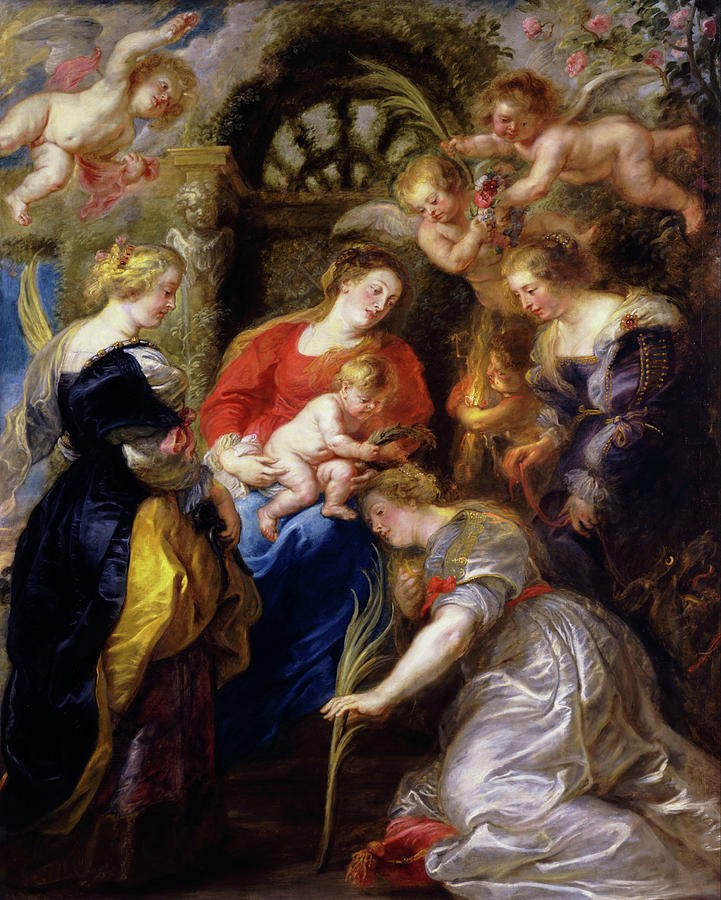
Peter Paul Rubens’ “Crowning of Saint Catherine” is a radiant celebration of mystic love, feminine sanctity, and Baroque opulence. The painting shows the Virgin Mary seated at the center, holding the Christ Child, while Saint Catherine of Alexandria kneels in adoration before them. Around this sacred encounter, richly dressed women, winged cherubs, and glowing symbols of martyrdom create a dynamic, almost theatrical vision. Set in a lush garden space, the scene fuses heavenly glory with courtly elegance, embodying Rubens’ ability to make spiritual mysteries feel immediate and sensuous.
Although the exact date of the work is unknown, its refined handling of color, light, and composition places it among Rubens’ mature religious paintings. It was likely intended for private devotion or for a chapel setting, where viewers could meditate on Saint Catherine’s mystical union with Christ and draw inspiration from her courage and learning. The painting offers a window into Counter-Reformation spirituality, which encouraged vivid, affective images capable of stirring the heart as well as instructing the mind.
The Legend of Saint Catherine and Its Meaning
Saint Catherine of Alexandria was a favorite subject in early modern Europe. According to tradition, she was a highly educated princess who converted to Christianity and openly challenged the pagan philosophers of the Roman emperor Maxentius. When arguments failed to dissuade her, the emperor ordered her tortured on a spiked wheel; when the wheel miraculously broke, he had her beheaded. Because of her learning and eloquence, Catherine became patron saint of philosophers, scholars, and young women seeking discernment in their vocation.
Another part of Catherine’s legend, central to Rubens’ painting, is the story of her mystical marriage to Christ. In a visionary experience, the Virgin Mary presented Catherine to the Infant Jesus, who placed a ring upon her finger as a sign of spiritual betrothal. This union represented total dedication of her life to Christ and a rejection of earthly suitors. Artists in the late Middle Ages and Baroque period frequently depicted this scene to illustrate the intimacy possible between the soul and the divine.
Rubens chooses to focus on the crowning or wedding moment, when Catherine bends before the Christ Child to receive a sign of his love. Rather than emphasizing the brutality of her martyrdom, he presents her as a beloved bride surrounded by beauty and light. The result is a tender yet triumphant image of sanctity that would have appealed strongly to devout viewers.
Central Figures: The Virgin Mary and the Christ Child
At the compositional and spiritual center sits the Virgin Mary. Clad in a deep red dress with a blue mantle wrapped around her lap, she embodies both earthly motherhood and heavenly majesty. Red in Marian iconography often symbolizes love and sacrifice; blue evokes the sky and the spiritual realm. Together these colors present Mary as the bridge between human and divine.
Mary’s pose is gentle and slightly leaning. She looks down at the kneeling Catherine with a soft, contemplative expression, as though acknowledging the saint’s total self-offering. Her left arm supports the Christ Child, while her right hand lightly steadies him as he reaches toward Catherine. Unlike rigid enthroned Madonnas of earlier periods, Rubens’ Mary is physically relaxed and emotionally engaged, a mother participating with warmth in the ceremony taking place.
The Christ Child is depicted in Rubens’ characteristic style: robust, lively, and very human. He balances on Mary’s lap, his little body twisting forward. One hand reaches toward Catherine, perhaps to offer a ring or a sprig of flowers; the other rests on Mary for support. His direct, almost curious gaze contrasts with Catherine’s downward look, underlining his role as the active giver of grace. The Child’s nudity emphasizes innocence and vulnerability, while his gesture conveys authority. Even as an infant, he is the Bridegroom of souls, conferring a spiritual crown on the saint.
Saint Catherine’s Gesture of Humility and Devotion
Kneeling in the lower right foreground, Saint Catherine forms a diagonally oriented figure that draws the viewer’s eye directly to the central exchange. She bows deeply from the waist, her head inclined toward the Christ Child, one hand pressed against her chest in a gesture of heartfelt devotion. Her other hand holds a long palm branch, the traditional emblem of martyrdom. The palm also visually connects her to the angels above who carry similar fronds, creating a vertical axis of meaning: from her earthly fidelity to her heavenly reward.
Catherine’s clothing reflects both her royal birth and her spiritual dignity. She wears a luminous silver-white gown with gold embroidery and a red sash. The fabric gathers in rich folds around her knees and flows across the foreground, catching the warm light and displaying Rubens’ mastery of drapery. Pearls and gold decorations adorn her bodice and sleeves, yet the overall impression is not one of vanity but of a bride adorned for a holy wedding.
Rubens gives Catherine a youthful, serene face framed by soft blond hair. Strands of hair escape from her hairstyle, suggesting natural vitality beneath the ceremonial setting. Her expression is one of intense yet peaceful concentration. Rather than ecstasy or overwrought emotion, we see reverent absorption, as if she is quietly interiorizing the significance of what is happening: she is binding herself irrevocably to Christ, even at the cost of suffering.
Companions and Courtly Atmosphere
Flanking the central group are two elegantly dressed women who contribute to the painting’s sense of a sacred court. On the left stands a woman in a dark blue gown with yellow under-skirt. She faces Mary and Catherine, watching the event with calm attention. Her slightly profile view and elaborate hairstyle make her look almost like a portrait of a contemporary noblewoman. She may represent a patron, a saintly companion such as Saint Barbara or Saint Agnes, or an allegory of a virtue like Faith.
On the right another woman in a purple gown leans forward, holding a small flaming lamp or candle. The lamp casts a warm golden glow on her face and hands, symbolizing enlightened faith, wisdom, or the presence of the Holy Spirit. This figure echoes Catherine’s role as a learned woman: her lamp can be read as the light of understanding, kept burning through study and prayer. Her posture—bent slightly toward the kneeling saint—suggests empathy and solidarity, as if she recognizes in Catherine a model for her own spiritual journey.
Together these attendants infuse the scene with the elegance of a courtly gathering. Their luxurious clothing, pearls, and carefully styled hair link the heavenly event to the refined world of Rubens’ patrons. Viewers in seventeenth-century Flanders could easily imagine themselves or their peers among such women, thereby drawing closer emotionally to the religious narrative.
Angels, Cherubs, and the Garden Setting
Above the main figures, the sky opens to admit a flurry of cherubs. In the upper left, a plump putto bursts forth from the clouds, arm raised in a rejoicing gesture. At the top center two winged children hover with a floral crown and palm branches, descending to participate in Catherine’s coronation. On the upper right another cherub leans forward with a bouquet of roses, assisted by a companion behind him. Their rosy flesh and fluttering draperies are painted with Rubens’ typical spontaneity and sensuality, adding delightful movement to the composition.
These cherubs are more than decorative. Their garlands and palms echo the symbols below, reinforcing the idea that heaven actively celebrates Catherine’s union with Christ. Their presence also signals that the event is visionary rather than historical: we are witnessing a spiritual reality made visible in symbolic form.
The earthly setting is no less meaningful. Behind Mary rises an arched trellis covered with foliage, evoking the “hortus conclusus” or enclosed garden, a long-standing symbol of Mary’s purity and of paradise. Climbing roses and dense greenery surround the figures, creating an intimate, fragrant space. This walled garden suggests that the event takes place in a spiritual sanctuary, sheltered from the world’s corruption. It also conjures the imagery of the Song of Songs, a biblical text often interpreted as describing the love between Christ and the soul. Rubens thus situates Catherine’s mystical marriage within a broader tradition of divine love described in lush, garden imagery.
Light, Color, and Painterly Technique
Light in “Crowning of Saint Catherine” is warm and enveloping rather than focused from a single direction. A golden radiance seems to emanate from within the scene—especially from the central figures and the lamp held by the attendant on the right—bathing the characters in a soft glow. This creates an atmosphere of gentle illumination appropriate to a spiritual epiphany. Shadows are deep but translucent, allowing underlayers of color to vibrate.
Rubens’ color palette is sumptuous and carefully coordinated. The blue of Mary’s mantle resonates with the dark blue gown of the woman on the left; the rich reds of Mary’s dress and Catherine’s sash provide warm focal points; the gold and yellow fabrics echo the halos of light around the cherubs. Silver-white highlights on Catherine’s gown, the cherubs’ wings, and scattered flowers help unify the composition and guide the eye. The result is a harmonious orchestration of complementary colors that enhances the sense of festivity.
In terms of technique, Rubens employs energetic, fluid brushwork. Fabrics are rendered with sweeping strokes that capture sheen and texture without over-defining every fold. The cherubs’ bodies are painted with rapidly blended tones that suggest softness and liveliness. Faces, by contrast, receive finer modeling with delicate touches around the eyes and mouths, conveying subtle emotion. This combination of broad handling and careful detail is typical of Rubens’ mature style, in which painterly vitality coexists with narrative clarity.
Theological and Symbolic Layers
“Crowning of Saint Catherine” invites multiple levels of interpretation. At the most immediate level, it commemorates a particular saint’s mystical experience and encourages viewers to admire her courage and purity. Catherine’s palm, the lamp of wisdom, the floral crown, and the enclosed garden all point to her virtues and her participation in Christ’s victory over death.
At a deeper level, the painting functions as an allegory of the soul’s union with God. In Catholic spirituality, every believer is called to a kind of spiritual marriage with Christ, expressed through faith, love, and fidelity under trial. Catherine becomes a model for this vocation. Her humility, intellectual rigor, and acceptance of suffering exemplify how the soul should respond to divine invitation. The tender gestures of the Christ Child and the Virgin embody God’s initiative in this relationship: it is Christ who reaches out, Christ who crowns, Christ who grants the palm of victory.
The presence of richly dressed female attendants and joyful cherubs suggests that holiness is not a grim renunciation of beauty but its fulfillment. Earthly splendor—fine fabrics, flowers, music implied by the angels—is elevated and transformed, not rejected. This message resonated strongly in the Baroque era, when the Catholic Church emphasized that art, ritual, and sensory experience could lead people toward God.
Relationship to Rubens’ Broader Work
Rubens painted numerous images of saints in ecstatic or visionary states, including Saint Teresa, Saint Francis, and various martyrs. In many of these works he explores the interplay between physical expressiveness and spiritual intensity. “Crowning of Saint Catherine” fits squarely in this tradition but distinguishes itself by the prominence of female figures and the gentle, bridal atmosphere.
The work also reflects Rubens’ engagement with Italian art. Venetian painters like Titian and Veronese influenced his devotion to rich color and his tendency to stage sacred events as grand yet intimate pageants. At the same time, his Northern roots show in the detailed rendering of fabrics and flowers and in the psychological individuality of the faces.
Within his oeuvre, this painting can be seen as a companion to other Marian compositions in which the Virgin serves as mediator between Christ and a saint or donor. The soft tilt of Mary’s head, the placement of the Child on her lap, and the encircling cherubs recall altarpieces such as the “Triptych of Saint Ildefonso.” Together these works reveal Rubens’ continuing fascination with Mary as mother, queen, and spiritual matchmaker.
Emotional Impact and Continuing Appeal
For contemporary viewers, “Crowning of Saint Catherine” remains compelling because it combines narrative clarity, rich symbolism, and emotional warmth. The painting does not merely present a doctrinal lesson; it invites empathy. We can feel the weight of Catherine’s decision, the tenderness of Mary’s support, the playful delight of the cherubs celebrating above. The lush garden and sumptuous gowns appeal to the senses, while the humble posture of the kneeling saint speaks directly to the heart.
The work also touches on enduring questions: How does one dedicate one’s life to a higher calling? What does it mean to remain faithful amid pressure and potential suffering? How can wisdom and love coexist? By depicting a young woman who unites intellectual brilliance with deep piety, Rubens offers a powerful, attractive model of integrated holiness.
In museums or reproductions today, the painting continues to draw viewers into its golden atmosphere. Its blend of beauty and devotion illustrates why Rubens is regarded as one of the great visual theologians of the Baroque age—a painter who could translate complex religious ideas into scenes of palpable human encounter.
Conclusion
“Crowning of Saint Catherine” showcases Peter Paul Rubens at the height of his powers as storyteller, colorist, and interpreter of spiritual experience. In a lush, enclosed garden, the Virgin Mary presents the Christ Child to the kneeling Saint Catherine, while angels, attendants, and symbols of martyrdom surround them in a radiant choreography of forms and colors. The painting celebrates Catherine’s mystical marriage to Christ and uses her example to invite all viewers into a deeper relationship with the divine.
Through dynamic composition, luminous color, and expressive gestures, Rubens turns an episode from hagiography into a living drama of love, wisdom, and sacrifice. The work stands as a testament to the Baroque conviction that art can lead the soul toward God by captivating the eyes and stirring the emotions. In this glowing vision of heavenly coronation, holiness appears not as bleak renunciation but as a joyful, richly adorned crowning of the human person in the presence of divine love.
