Image source: wikiart.org
Introduction to “The Lamentation”
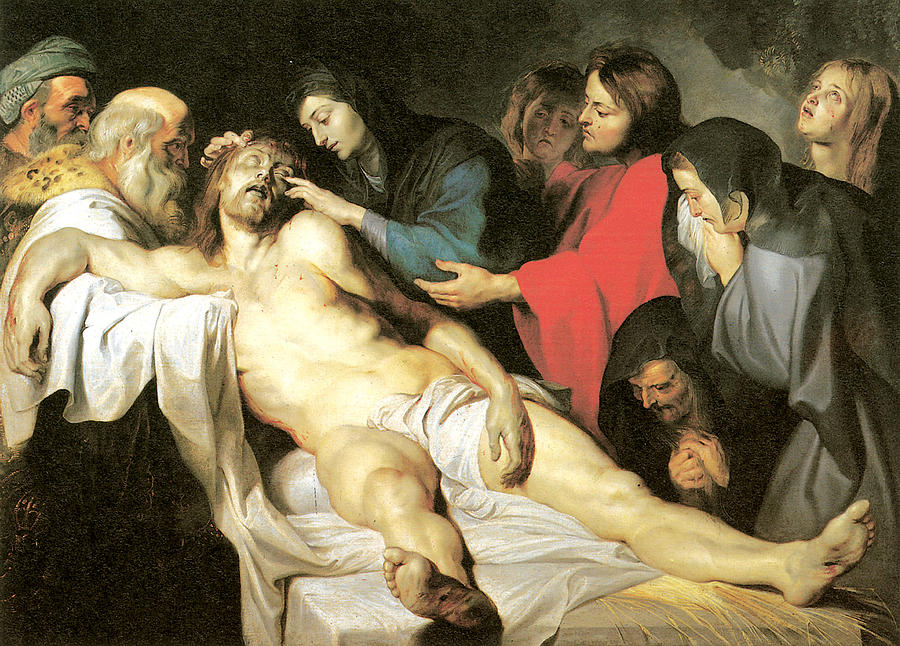
Peter Paul Rubens’s “The Lamentation” presents one of the most poignant moments in Christian narrative: the body of Christ taken down from the cross and mourned by those who loved him most. Christ lies diagonally across the foreground, his lifeless body surrounded by the Virgin Mary, St. John, Mary Magdalene, and other grieving figures who lean in, touching, supporting, and contemplating his wounds.
Rather than focusing on the drama of the Crucifixion itself, Rubens chooses the stillness that follows, when shock gives way to sorrow and intimacy. The painting draws the viewer into a tight circle of mourners, almost as if we too bend over the body, invited to share in the grief and meditation on sacrifice.
Composition and the Dramatic Diagonal
The composition is organized around a powerful diagonal that runs from Christ’s extended feet in the lower right up to his head resting on a white shroud at the left. This diagonal line of the body acts like a visual bridge across the painting, connecting the groups of mourners. The figures cluster closely around Christ, forming an almost semicircular wall of faces and hands that protect and frame him.
Rubens situates Christ’s torso at the center of the canvas, but he tilts the body forward into the viewer’s space. The foreshortened legs and relaxed arm hanging over the edge of the slab give the sense that we are only a step away. This device collapses the distance between the sacred event and the beholder, a typical Baroque strategy intended to engage the viewer emotionally and spiritually.
The white drapery beneath Christ forms a luminous mass that both supports his body and reflects light upward onto the surrounding figures. It serves as a visual anchor amid rich, dark tones of clothing and background, ensuring that the eye always returns to the suffering yet peaceful form of Christ.
The Body of Christ: Vulnerability and Heroism
Rubens’s depiction of Christ’s body balances vulnerability with monumental dignity. The skin is pale, almost marble-like, with subtle bluish shadows that suggest lifelessness. Muscles and bones are modeled with careful attention, recalling classical sculpture, yet the limpness of the limbs and the open mouth underscore the reality of death.
The wounds of the Crucifixion are present but not exaggerated: the pierced hands and feet, the mark on the side, and the traces of blood around the brow where the crown of thorns once sat. The head tilts slightly backward, hair falling away, neck exposed. This openness conveys both helplessness and offering, as if the body is laid out for contemplation and veneration.
Christ’s position recalls altarpiece imagery of the Pietà and Deposition, but Rubens makes the figure more accessible by bringing him so close to the foreground. The strength of the torso and limbs hints at the heroism of the sacrifice, even as the slack posture reminds us of his humanity.
The Virgin Mary and the Heart of Grief
At the center of the group, slightly above Christ’s head, stands the Virgin Mary, dressed in dark blue. She bends forward, her right hand gently touching her son’s face, as if to close his eyelids or wipe away lingering blood. Her expression is one of deep, controlled sorrow rather than theatrical lamentation. The lines around her eyes and mouth suggest age and suffering; this is a mother who has endured much.
Mary’s dark clothing sets her apart from the others, marking her as the principal mourner and spiritual center. Her posture is composed yet inwardly broken, capturing the paradox of the Madonna: grief-stricken yet steadfast, heart pierced yet still a figure of faith.
Rubens thus places the viewer in an intimate proximity to a mother’s loss. Her gesture of touching Christ’s face is among the tenderest in religious art, emphasizing the real, physical relationship between mother and son even within a cosmic drama of redemption.
Supporting Figures and the Spectrum of Emotion
Around Mary and Christ unfolds a rich spectrum of human responses to tragedy. To the left, two older men—often identified as Joseph of Arimathea and Nicodemus—assist in supporting the body. Joseph, in a fur-trimmed garment, looks down with a grave, contemplative expression, his hands still engaged in the work of burial. Nicodemus, bald and bearded, seems absorbed in sorrow, his gaze directed toward Christ’s lifeless form.
To the right of Mary, a young man in red, likely St. John the Evangelist, leans forward with gentle urgency, hands extended as if ready to help or comfort Mary. His bright red cloak introduces a vivid color accent, symbolically linked to love and sacrifice. Behind him, another figure peers over with a troubled look, sharing in the collective grief.
Further right, women traditionally identified as Mary Magdalene and other holy women react with different intensities. One presses a cloth to her face, eyes red from weeping; another lifts her gaze upward, mouth parted, as if questioning heaven. A figure near the bottom right folds her hands tightly, the posture of desperate prayer.
By varying the expressions and gestures, Rubens allows viewers to find their own emotional entry into the scene—quiet contemplation, anguished questioning, tearful mourning, or prayerful acceptance.
Light, Color, and Chiaroscuro
Light in “The Lamentation” is carefully controlled to heighten the spiritual and emotional drama. A strong, warm light source falls from the left, illuminating Christ’s body and the faces closest to him while leaving the background in deep shadow. This chiaroscuro effect creates a dramatic contrast between light and dark, emphasizing the central figures and suggesting that a divine light still surrounds Christ even in death.
The white of the shroud is the brightest passage in the painting, catching and reflecting light onto Christ’s torso and face. This brilliance contrasts with the deep blues, blacks, and reds of the surrounding garments, which absorb more light and recede slightly into the darkness.
Rubens’s color choices are rich but harmonious. The blue of Mary’s cloak, the red of John’s garment, the muted browns and greens of the older men, and the darker veils of the mourning women create a somber palette that nevertheless avoids dullness. Flesh tones are warm and lifelike, with subtle variations that distinguish youth from age, male from female, living from dead.
The interplay of light and color not only models forms but also conveys theological meaning. The illuminated body of Christ becomes the visual and symbolic source of light, around which the entire composition revolves.
Space, Depth, and Intimate Closeness
Rubens compresses the space tightly around Christ and the mourners, eliminating any expansive landscape or architectural setting. The background is mostly darkness, with only hints of shadowy forms. This focus intensifies the sense of closeness, as if the viewer is standing in a small chamber or at the foot of an altar where the body has just been laid out.
Despite this compression, Rubens still achieves a sense of depth through overlapping figures, foreshortening, and carefully graded tones. The heads form a gentle arc from left to right, receding slightly into space. The diagonal of Christ’s body leads the eye backward toward Mary and then forward again to the outstretched hands of John and the women.
This spatial construction creates a circular movement of attention, keeping the viewer’s gaze engaged within the group and preventing it from drifting outward. The result is an intimate devotional space rather than a distant narrative tableau.
Iconography and Theological Meaning
“The Lamentation” belongs to a long tradition of Christian imagery depicting the moments between Christ’s death and burial. In addition to its narrative content, the painting is rich with symbolic and theological resonances.
The white shroud prefigures both burial and resurrection: it is the cloth that will wrap Christ in the tomb but also recalls Eucharistic linens and the garments of the transfigured, risen body. The exposed wounds invite meditation on the price of redemption and the physical reality of the Passion.
The presence of Mary, John, and Mary Magdalene links the painting to Gospel passages where these figures remain faithful at the foot of the cross. Their fidelity contrasts with the disciples who fled, offering models of devotion and courage for believers.
The cluster of mourners can also be read as an image of the Church gathered around the sacrificed Christ, drawing consolation and identity from his suffering. In this sense, the painting becomes not only a record of past grief but a living, ongoing scene in which each viewer may find a place.
Rubens and the Baroque Lamentation Tradition
Rubens painted several versions of the Lamentation and related themes throughout his career, often inspired by Italian masters such as Titian, Correggio, and Caravaggio. What distinguishes this work is its synthesis of emotional immediacy with grand compositional design.
Compared with earlier, more restrained depictions, Rubens’s version is intensely tactile and physical. The weight of Christ’s body is palpable; the hands and faces of the mourners are rendered with sculptural solidity. Yet the painting is not merely about physicality. The dynamic arrangement of figures, the dramatic lighting, and the focus on the precise moment of intimate contact reflect the Baroque aim to move the viewer’s heart.
Unlike Caravaggio’s stark realism, Rubens maintains a certain idealization—forms are robust, gestures graceful even in grief. This balance between realism and ideal beauty allows the painting to function both as a human tragedy and as a noble, elevated vision of redemptive suffering.
Devotional Function and Viewer Experience
For its original audience, “The Lamentation” would have served a devotional purpose, encouraging meditation on Christ’s Passion and the sorrow of his followers. The painting invites viewers to imagine themselves among the mourners, touching the wounds, sharing the grief, and contemplating the mystery of salvation.
The proximity of Christ’s body and the straightforward depiction of pain speak to the senses and emotions. At the same time, the compositional order and serene dignity of key figures, especially Mary, guide that emotion toward reflection rather than mere sentimentality.
In a church setting, the painting might have been placed near an altar or side chapel, perhaps associated with a confraternity devoted to the Passion. During Holy Week or funerary rites, it would have resonated deeply, connecting the community’s own experiences of loss with the central Christian narrative.
Even for contemporary viewers outside a strictly religious context, the work retains its power. The universality of grief, the tenderness of touch, and the confrontation with mortality transcend specific belief systems. Rubens’s mastery ensures that the painting communicates across centuries and cultures.
Conclusion: Humanity and Divinity Intertwined
“The Lamentation” by Peter Paul Rubens stands as a compelling example of how Baroque art unites human emotion with theological reflection. Through careful composition, luminous color, and expressive figures, Rubens transforms a biblical event into an intimate encounter with suffering, love, and hope.
The painting’s strength lies in its dual focus: the vulnerable human body of Christ and the surrounding circle of mourners whose reactions mirror our own potential responses to loss. At the same time, the radiant light and dignified poses hint at a reality beyond death, suggesting that this grief is not the final word.
In contemplating this work, we are drawn into a space where art becomes a form of prayer and reflection, where the viewer is invited not merely to look but to participate—to share the sorrow, to touch the wounds in imagination, and to ponder the mystery of compassion that lies at the heart of the scene.