Image source: wikiart.org
Introduction to Peter Paul Rubens’s “Woman with a Mirror”
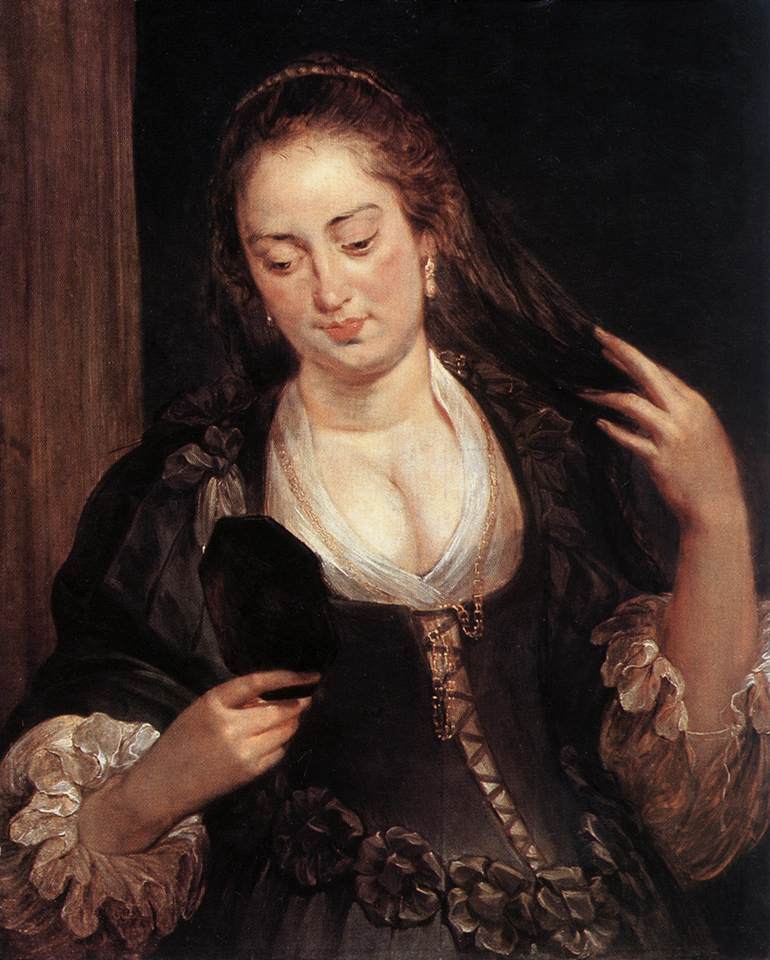
“Woman with a Mirror,” painted by Peter Paul Rubens around 1640, is an intimate and psychologically rich portrait that captures a young woman in a private moment of self-contemplation. She turns slightly toward the viewer but looks downward, her gaze seemingly absorbed by thoughts rather than by her own reflection. In one hand she holds a small, dark mirror, while her other hand lifts her hair in a gesture that is half adornment, half distraction.
The painting belongs to Rubens’s late period, when his brushwork became broader and more atmospheric, and when he increasingly explored personal, inward scenes instead of large-scale public commissions. Unlike his grand mythologies or religious altarpieces, “Woman with a Mirror” draws us into a quiet, domestic space. It invites us to observe a single woman as she negotiates the relationship between how she appears and how she feels inside.
The canvas functions on several levels at once: as a portrait, as a study of feminine beauty, and as a subtle reflection on vanity, time, and self-awareness. Rubens uses light, color, and pose to balance sensual allure with emotional depth, transforming a simple act of grooming into a moment of human truth.
Composition and the Framing of Intimacy
The woman occupies most of the vertical canvas, shown from the waist up. Rubens places her slightly off center, with a dark background that pushes her figure forward into the viewer’s space. To the left is a narrow strip of warm-toned architectural element—perhaps a wooden doorframe or panel—that stabilizes the composition and provides contrast to the velvety darkness behind her.
Her head tilts gently toward her left shoulder. The line of her gaze falls downward, not toward the mirror but somewhere just beyond it, suggesting introspection rather than simple self-admiration. The mirror itself, a small faceted object, catches almost no light; instead of gleaming and drawing attention to itself, it appears almost like a dark jewel.
Rubens composes the figure in a series of soft diagonals. The line of the woman’s right arm, holding the mirror, slopes upward from the lower left toward the center of the painting. Her left hand, raised to her hair, creates a counter-diagonal that leads the eye back toward her face. The shallow “V” of her open bodice and the triangular pattern of her lacing reinforce these directional forces. All of these lines converge near her face and chest, making them the visual and emotional focus of the work.
The framing is tight, with very little space above her head or below her waist. This closeness enhances the sense of intimacy, as if we are standing just a step away from her. It also isolates her from any specific setting; there is no detailed interior, no landscape, only a neutral backdrop that allows her expression and gesture to carry the narrative.
The Woman’s Face: Between Vanity and Melancholy
The most striking feature of the painting is the woman’s expression. Her eyebrows are slightly drawn, her eyelids heavy, and her lips gently pursed. She does not smile, nor does she appear overtly sad; instead, she seems lost in thought, almost as if she is using the mirror as a pretext for internal reflection.
Rubens paints her skin with delicate transitions of color: warm pinks at the cheeks and lips, cooler tones around the eyes and jaw line. There is a faint shadow under her chin that hints at the natural aging of the skin, suggesting that she is not a perfect, idealized beauty but a real person marked by time and emotion. The play of light across her face emphasizes the roundness of her cheeks and the subtle swell of her lower lip, giving her features a soft, living presence.
Her downcast look creates an ambiguous psychological effect. On one hand, the lowered gaze and lack of direct eye contact fit traditional imagery of modesty; she appears shy, even demure, as though aware of being observed. On the other hand, this detachment from the viewer gives her an interior life that we cannot fully access. She is not performing for us; she is caught in a private moment, perhaps judging herself, perhaps thinking of something far removed from physical appearance.
In this way Rubens avoids reducing her to a symbol of vanity. Instead he presents a complex, introspective woman who happens to be holding a mirror. The painting thus becomes as much about self-knowledge as about self-display.
Costume, Jewelry, and Social Identity
The subject’s clothing is rich but not ostentatious. She wears a dark dress—likely black or deep brown—adorned with rose-like decorations at the waist and with voluminous sleeves that end in lavish white ruffles. The contrast between the dark fabric and the light ruffles is a hallmark of seventeenth-century fashion and allows Rubens to display his skill in painting different textures: the soft transparency of lace, the sheen of silk, the weight of velvet.
Over her shoulders and chest lies a fine white scarf that crosses under the open neckline, revealing a full décolletage. This slight exposure contributes to the sensual allure of the portrait, yet the overall effect is one of elegance rather than indecency. She wears a simple chain or string of pearls around her neck and small earrings that catch highlights of light. A delicate gold chain hangs down the front of her bodice, further emphasizing the vertical center of the composition.
Her clothing and jewelry indicate a woman of comfortable social status, likely from the urban middle or upper class. She is neither extravagantly adorned nor plainly dressed; her appearance suggests refinement, taste, and some wealth. This social framing is important, because it places her within the world Rubens himself inhabited in Antwerp—a world of merchants, professionals, and cultured households that commissioned portraits to mark their status and preserve their likenesses.
The Mirror as Symbol
Mirrors in seventeenth-century art carry a rich range of meanings. They can symbolize vanity and self-absorption, but also truth, self-knowledge, and the fleeting nature of beauty. In “Woman with a Mirror,” Rubens chooses to depict not a large, reflective surface but a small, dark hand-mirror. It reflects almost nothing back to the viewer; we cannot see the woman’s face inside it, nor any illuminated details of the room.
This darkness is significant. Rather than showing a sparkling object that glorifies her appearance, the mirror seems to absorb light, becoming a mysterious compact of shadow. It is as if the woman’s thoughts are turned inward, into a space we cannot see. The mirror becomes a metaphor for introspection and the unknown aspects of the self.
At the same time, the very act of holding a mirror suggests awareness of appearance and the passing of time. Portraits of women with mirrors often carry a gentle vanitas message: beauty fades, life is short, and what we see on the surface is fragile. Rubens, however, tempers this moralizing with empathy. The woman does not appear shallow or frivolous. Her meditative look implies that she may be confronting precisely this awareness of transience, feeling both the attraction and the insufficiency of physical beauty.
Thus the mirror holds together two contrasting meanings: the lure of vanity and the possibility of honest self-evaluation. The painting remains open to interpretation, allowing each viewer to decide which aspect predominates.
Light, Color, and Painterly Technique
Rubens’s use of light in “Woman with a Mirror” is subtle yet extraordinarily effective. A soft, warm light falls from the left, illuminating the woman’s forehead, nose, cheeks, and chest. This light also touches the ruffles of her sleeves and the edge of the mirror, while leaving much of the background and parts of her clothing in shadow.
The contrast between the luminous skin and the dark surroundings creates a strong focal point. The spectator’s eye cannot help but move toward her face and exposed décolletage, then down to the mirror and back up along her raised arm and hair. This concentrated lighting enhances the sense of intimacy, as though we are witnessing a candlelit or window-lit moment in a private room.
Rubens’s color palette is relatively restrained compared to some of his mythological works. The dominant tones are earthy browns, greys, and blacks, punctuated by the warm pinks of the flesh and the creamy whites of the scarf and ruffles. This limited palette gives the painting a unified, almost monochrome harmony, while the flesh tones stand out as islands of vitality.
The brushwork, especially in the hair and clothing, is loose and energetic. In the darker areas, strokes blend into a soft haze, whereas in the highlighted areas they become more defined and textured. This variation reflects Rubens’s late style, where he allowed the paint surface to remain visible and active, conveying a sense of spontaneity and immediacy. The result is a portrait that feels alive, not mechanically polished.
Psychological Depth and the Late Rubens
By 1640 Rubens was in his early sixties and had lived through an extraordinarily full life as painter, diplomat, and landowner. His late works often reveal a mellowed, reflective sensibility. “Woman with a Mirror” fits within this phase, where emphasis shifts from spectacular narratives to quieter, more introspective subjects.
The psychological richness of this painting suggests that Rubens was less interested in producing a flattering likeness than in capturing an interior mood. Whether the woman is a specific sitter, a family acquaintance, or a model remains debated; in any case, Rubens uses her features as a vehicle for exploring broader human feelings: self-consciousness, contemplation, perhaps a touch of melancholy.
Her averted eyes and thoughtful expression refuse the type of direct, confrontational gaze seen in many Baroque portraits. Instead, she draws the viewer into a more empathetic relationship. We are not simply looking at her; we are invited to wonder what she is thinking, to project our own experiences of self-doubt, vanity, or quiet reverie onto her.
This psychological complexity is one of the hallmarks of Rubens’s late work and contributes significantly to the painting’s enduring appeal. It feels modern in its refusal to offer a simple reading and in its respect for the subject’s interior life.
Feminine Beauty, Modesty, and Self-Awareness
“Woman with a Mirror” occupies an interesting position in the history of representations of women. Whereas many earlier images either idealized women as unattainable beauties or used them as moral warnings against vanity, Rubens offers a more nuanced and sympathetic vision.
The subject is undeniably attractive: her full lips, smooth skin, and softly rounded figure align with Rubens’s well-known preference for robust, “Rubenesque” beauty. Her dress emphasizes her femininity, and the open neckline exposes part of the chest, a common element in Baroque portraiture symbolizing vitality and fertility.
Yet her body language tempers any outright seductiveness. She leans slightly inward rather than outward; her head bows rather than lifts; her hands move with quiet, almost distracted motions. She seems absorbed in herself, but not in a self-displaying way. The mirror she holds is turned at a slight angle, so that even within the picture she may not be seeing her face clearly.
This combination of physical allure and emotional reserve suggests a complex understanding of feminine identity. The woman is aware of being looked at—by herself and by others—but she is not defined solely by that gaze. Rubens allows her a private zone of thought, an inner world that remains partly unknown.
Symbolic Resonances: Time, Identity, and the Gaze
Beyond its immediate subject, “Woman with a Mirror” resonates with broader themes of time and identity. The act of looking into a mirror is inherently temporal: one sees oneself as one is now, while silently comparing it to memories of how one looked before and imaginings of how one might look in the future. This temporal tension is often associated with vanitas imagery, reminding viewers that youth and beauty are fleeting.
Rubens does not include explicit vanitas symbols such as skulls, wilting flowers, or extinguished candles. Instead, he suggests the passing of time through more subtle means: the shadowed background, the gentle signs of maturity in the woman’s face, and the introspective mood. The painting becomes a quiet reflection on how we confront our own changing appearance and how the gaze—both our own and that of others—shapes our sense of self.
The viewer, too, becomes part of this network of gazes. We watch a woman looking at herself; she, however, does not return our gaze. This asymmetry can prompt self-consciousness in the viewer. We may feel that we are intruding on a private moment, which heightens the painting’s emotional power. Rubens thus plays with the act of looking, making us aware of our own role as observers and, implicitly, as people who also judge ourselves in the mirror of others’ eyes.
Legacy and Contemporary Appreciation
Today, “Woman with a Mirror” continues to speak to audiences because of its combination of sensual beauty and psychological realism. In an era saturated with images of self-presentation—from mirrors to smartphone cameras—the painting feels remarkably current. It captures a timeless experience: the quiet moment when one confronts one’s own reflection and all the questions that come with it.
Rubens’s mastery lies in his ability to make this moment both specific and universal. The woman’s features and costume anchor her in seventeenth-century Flanders, yet her expression, posture, and gesture transcend historical boundaries. Viewers from different cultures and eras can recognize themselves in her hesitation, her self-awareness, and perhaps her mixed feelings about what she sees.
The painting also serves as a reminder of Rubens’s versatility. While known chiefly for dynamic mythological and religious scenes, he was equally capable of subtle, introspective portraiture. “Woman with a Mirror” showcases the sensitivity and empathy he brought to individual sitters, as well as his unwavering technical brilliance in handling light, color, and texture.
Conclusion
“Woman with a Mirror” by Peter Paul Rubens is far more than a simple depiction of a woman grooming herself. Painted around 1640, it weaves together portraiture, symbolism, and psychological insight to explore the complex relationship between appearance and self-knowledge. The woman’s downcast eyes, delicate hands, and dark mirror invite us to consider how we see ourselves and how the passage of time shapes that vision.
Through a restrained yet rich palette, skillful use of light, and nuanced characterization, Rubens transforms a private domestic moment into a timeless image of introspection. The painting celebrates feminine beauty while acknowledging its fragility and the inner life that lies behind it. In doing so, it reveals the artist’s own mature understanding of human nature and secures the work’s place as one of the most compelling portraits of his late career.
