Image source: wikiart.org
Introduction to “Truce between Romans and Sabines”
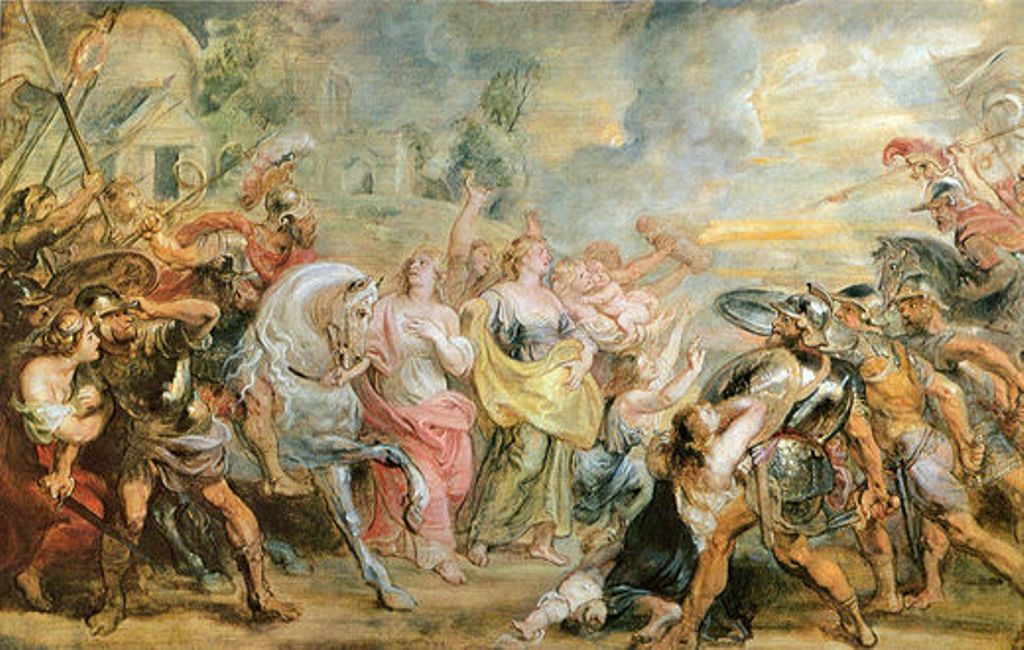
“Truce between Romans and Sabines,” painted by Peter Paul Rubens around 1640, captures the climactic moment in the legendary conflict between early Rome and the neighboring Sabine people. The long, horizontal canvas bursts with movement: armored soldiers on both sides rush toward the center, weapons raised, while a group of women and children stand between them with outstretched arms, imploring peace.
Rubens transforms this ancient story into an intensely human drama. Rather than glorifying battle, he focuses on the emotional power of reconciliation. The painting presents war at the very instant it is halted, showing how maternal courage, vulnerability, and love can intervene between two enraged armies. It is a late work, painted when Rubens was at the height of his powers, and it combines his virtuoso handling of the human figure with a profound reflection on conflict and mercy.
Mythological and Historical Context
The subject comes from Roman legendary history, particularly from stories told by Livy and Plutarch. In the early days of Rome, the city lacked women, so Romulus and his men abducted young women from the neighboring Sabines at a festival—an episode often called the “rape” or “abduction” of the Sabine women. Outraged, the Sabines prepared for war to reclaim their daughters and wives.
The story reaches its turning point when battle finally erupts between Romans and Sabines. The women, now bound to Roman husbands and mothers of Roman children, intervene. They rush between the two armies, pleading with fathers and brothers on one side and husbands on the other to stop fighting. Their appeal leads to a truce and eventual union: Romans and Sabines agree to live as one people.
Rubens chooses this decisive moment of intervention and reconciliation. By focusing on the women rather than the initial abduction or the military clash alone, he emphasizes the agency of those who suffer most from war. The painting therefore offers a classical lesson in the power of compassion and compromise, ideas that would have resonated strongly in seventeenth-century Europe, still riven by religious and political conflicts.
Composition and Narrative Focus
The composition stretches across the canvas like a grand battle frieze, yet everything converges on the cluster of women at the center. On the left and right edges, armed soldiers surge forward, their lances, spears, and standards creating spiky diagonals that push toward the middle. Horses rear, shields flash, and muscular bodies twist in readiness for combat.
Between these two advancing masses stands a wedge of women, many carrying infants or holding the hands of small children. They are bathed in a brighter light and wear softer, more luminous garments in pinks, yellows, and pale blues. Their upward-reaching arms create a vertical counterpoint to the horizontal sweep of the armies, visually blocking the forward motion of the soldiers.
Rubens uses overlapping figures and dynamic diagonals to keep the eye moving. Yet every path of movement leads back to the central figures: the tall woman in yellow and pink, another holding out a child as if offering him to both sides, and others whose hands gesture toward the heavens. The entire narrative hinges on this group. We sense that the clash of steel and armor is only moments away, but the women’s presence has already begun to alter the course of events.
The Sabine Women as Agents of Peace
The women at the center are not passive victims; they are active agents who bring about the truce. Rubens represents them with a combination of vulnerability and determination. Their garments are loose and flowing, revealing the fullness of their bodies in typical Rubensian fashion, but their gestures and expressions convey moral strength.
The central woman in yellow, often interpreted as Hersilia (Romulus’s Sabine wife), is particularly striking. She stands with her chest lifted, eyes turned upward, arms spread as if appealing both to the gods and to the warriors around her. Her pose evokes both prayer and command, signaling that she speaks with the authority of love and motherhood.
Another woman cradles a child while extending him toward the soldiers. The infant is both symbol and reality: he embodies the new generation born from the union of Romans and Sabines, and his vulnerability shames the warriors’ aggression. Other women clutch children to their breasts or cling to their garments, reinforcing the idea that it is family ties which render continued violence unbearable.
Rubens thus presents the Sabine women as the moral center of the painting. Their bodies form a bridge between the two hostile groups, demonstrating that reconciliation comes not from power or strategy but from empathy and shared human bonds.
The Roman and Sabine Armies
On both sides of the canvas, Rubens fills the scene with powerful soldiers in gleaming armor. The distinction between Roman and Sabine is intentionally blurred: their helmets, shields, and muscular physiques are similar, emphasizing that they are brothers in culture and strength even if currently enemies.
On the left, a cluster of warriors presses forward, one of them turning his head as if listening to the women’s cries. A white horse rears up, hooves pawing the air, its rider caught in mid-motion. The animal’s agitation mirrors the soldiers’ excitement and the chaos of impending battle.
On the right, a group of soldiers, some mounted, respond to the central drama. One leans back, shield raised, while another appears to halt his advance. The variety of expressions—anger, confusion, resolve—suggests that the women’s intervention has thrown the warriors into moral conflict. Their bodies are poised for movement yet held back, visually representing the struggle between ingrained martial instincts and dawning recognition of a higher claim.
By portraying both armies with equal vigor and nobility, Rubens underscores that there are no simple heroes or villains here. The real contrast is not between Romans and Sabines but between warlike fury and the plea for peace.
Light, Color, and Atmosphere
Rubens uses light to highlight the spiritual and emotional core of the scene. The sky in the upper center glows with a mixture of gold and gray, suggesting both the smoke of battle and a break in the clouds. A subtle beam of light seems to fall upon the women, especially the central figures, bathing them in a soft radiance. This heavenly illumination reinforces their role as instruments of reconciliation.
The color palette is warm and energetic. Flesh tones range from rosy pinks to golden hues, bringing vitality to the figures. The warriors’ armor reflects blue-gray tones of the sky, shot through with touches of red and gold. The women’s clothes are painted in brighter, lighter colors—soft yellows, pale pinks, and creamy whites—that stand out against the darker metals and leather of the soldiers.
This contrast of color not only separates the central group from the armies but also conveys symbolic meaning. The women’s lighter colors evoke innocence, compassion, and hope, while the darker tones of armor and weaponry suggest aggression and danger. Yet the entire scene is unified by Rubens’s fluid brushwork and harmonious blending of tones, preventing the painting from fragmenting into separate zones.
Emotion, Gesture, and Baroque Energy
“Truce between Romans and Sabines” is saturated with emotion, communicated primarily through gesture and facial expression. Nearly every figure is caught in a moment of intense feeling. Soldiers shout or strain forward, their mouths open and brows furrowed. Women cry out, clutch their children, or lift their hands in pleading or protest. Even the animals participate: the horses rear, eyes wide, nostrils flaring.
Baroque art thrives on such movement and expressive exaggeration, and Rubens is a master of the style. He arranges bodies in spirals, diagonals, and curves that suggest continuous motion. The viewer senses the momentum of the armies, the swift rush of the women as they step between them, and the sudden spiritual shift as the prospect of peace emerges.
Yet within this turbulence there is also a rhythmic order. Groupings of three or four figures form visual units that guide the eye across the painting. Rubens balances areas of dense activity with small passages of relative calm—a kneeling figure here, a soldier pausing there—so that the overall effect is dynamic but not chaotic.
Themes of Reconciliation and Contemporary Resonance
At its heart, the painting is an allegory of reconciliation. The legendary truce between Romans and Sabines becomes a model for resolving conflict through empathy and compromise rather than total victory. In Rubens’s Europe, beset by religious wars and political rivalries, such themes were especially relevant.
Rubens himself had served as a diplomat, traveling between courts in an effort to negotiate peace during the early phases of the Thirty Years’ War. His experience in diplomacy likely deepened his interest in images that extolled peacemaking. In several works he depicts allegorical scenes of peace overcoming war; “Truce between Romans and Sabines” fits within this larger body of work as a narrative counterpart grounded in classical history.
The painting also explores the role of women in peace processes. By giving the Sabine women the decisive role, Rubens highlights how those who endure the consequences of war—especially mothers and children—may also be best positioned to call for its end. Their emotional appeal transcends politics and appeals directly to shared humanity.
Rubens’s Late Style and Artistic Maturity
Painted around 1640, shortly before Rubens’s death, this work exemplifies his late style. The brushwork is freer and more atmospheric than in his earlier, more tightly controlled compositions. Forms are defined with broad, confident strokes that blend colors on the canvas, creating a shimmering, almost impressionistic surface when viewed up close.
Figures remain muscular and robust, but their outlines often soften into one another, contributing to a sense of continuous movement. The landscape and architecture in the background are barely sketched, serving more as tonal backdrops than as detailed settings. This looseness allows the viewer to focus on the expressive gestures and the overall emotional impact rather than on small descriptive details.
Rubens’s long experience is evident in the ease with which he manages the large number of figures without losing clarity. The painting feels spontaneous and urgent, yet every element contributes to the central theme. It is the work of an artist who has mastered his craft and can now use it to tackle profound ethical and emotional questions.
Visual Symbolism and Subtle Details
A closer look reveals symbolic details that enrich the narrative. The abandoned weapons and fallen figures near the center hint at the cost of conflict already incurred. Some soldiers appear wounded or collapsed, reminders that the truce comes only after blood has been spilled.
The upward gestures of the women toward the heavens suggest an appeal not only to human conscience but also to divine witness. The glowing cloud in the sky might be read as a sign of the gods’ presence or approval, aligning celestial order with the act of reconciliation.
Even the position of the horses carries meaning. One white horse in the foreground, originally charging forward, now rears as its rider checks it. The animal’s sudden halt dramatizes the suspension of violence, as if nature itself responds to the women’s plea.
Legacy and Modern Interpretation
“Truce between Romans and Sabines” remains a powerful image for modern audiences. Its message—that lasting peace often requires acts of courage from those willing to stand between opposing forces—feels timeless. In contemporary discussions about war, diplomacy, and gender, the painting offers a historical exemplar of women asserting their agency to influence political outcomes.
Art historians admire the work for its complex composition and for the way it encapsulates Rubens’s mature Baroque style. Students of painting can learn from its handling of large multi-figure scenes, its integration of narrative and emotion, and its sophisticated use of light and color to guide meaning.
For general viewers, the painting is compelling because it tells a story visually, without needing text. One can sense the urgency, fear, hope, and relief embodied in the figures, even without knowing the classical legend. Rubens taps into universal feelings associated with conflict and reconciliation, allowing the work to transcend its historical origin.
Conclusion
“Truce between Romans and Sabines” is one of Peter Paul Rubens’s most powerful late works. It transforms a legendary moment from early Roman history into a vivid, emotionally charged meditation on war and peace. Through dynamic composition, expressive figures, and luminous color, Rubens shows how mothers, wives, and children can become the catalysts for ending conflict.
The painting stands as a testament to his skill not only as a painter of bodies and movement but also as a visual thinker concerned with ethics and politics. In a single frozen instant—the moment when weapons are raised but not yet struck—Rubens captures the fragile possibility of peace, reminding viewers across centuries that even in the midst of violence, reconciliation is possible when humanity prevails over hatred.