Image source: wikiart.org
Introduction to Peter Paul Rubens’s “Nymphs and Satyrs”
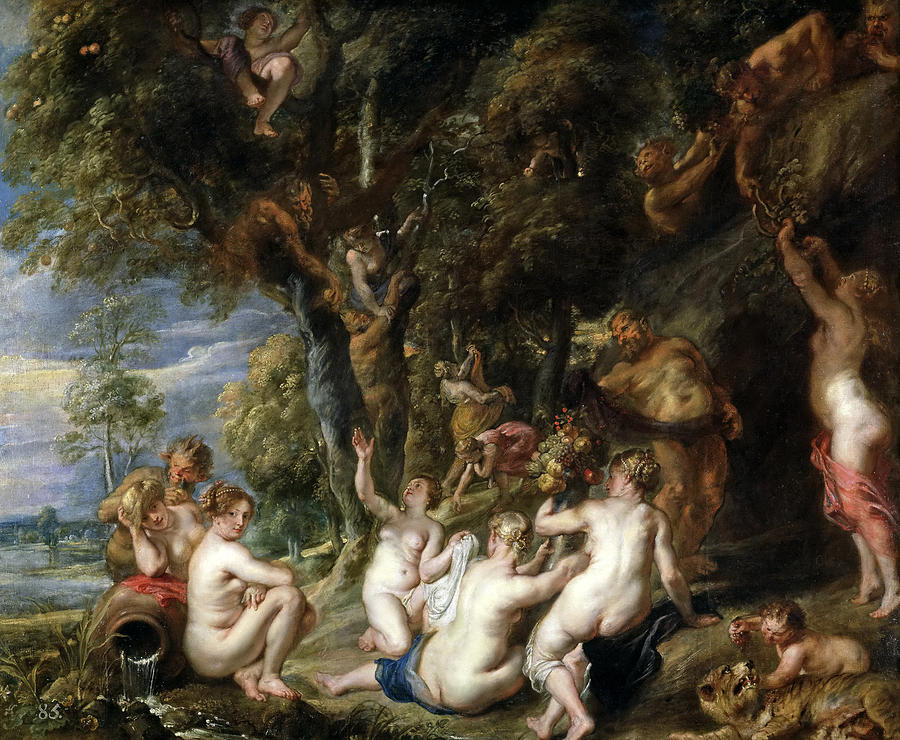
“Nymphs and Satyrs,” painted by Peter Paul Rubens around 1640, is a luxuriant celebration of mythological pleasure, nature, and abundance. The painting stages a lively encounter between nude nymphs, mischievous satyrs, and playful putti in a wooded glade, near a stream that winds through a sunlit landscape. Everywhere the viewer looks, bodies are in motion: women bathe, dance, and chat; satyrs gather fruit or watch with lustful amusement; cherubs clamber through the trees and wrestle with a lion’s skin at the lower right.
This rich, crowded composition exemplifies Rubens’s mature Baroque style. The figures are robust and sensuous, their flesh glowing in warm light. Trees and rocks frame the scene, creating a natural amphitheater for the festivities. The whole canvas exudes movement, sound, and joy, as if the earth itself were joining the revelry.
Mythological Context: Nymphs, Satyrs, and Bacchic Revels
In Greco-Roman mythology, nymphs are minor female divinities associated with woods, rivers, and mountains. They symbolize the life-giving forces of nature, often depicted as eternally youthful and irresistibly beautiful. Satyrs, by contrast, are male woodland spirits, half human and half beast, famous for their lustful pursuit of nymphs and their association with Dionysus, god of wine and ecstasy.
Rubens loved such Bacchic themes, which allowed him to combine classical learning with exuberant depictions of the human body. In “Nymphs and Satyrs,” he does not illustrate a specific mythic episode but rather creates a generalized scene of rustic revelry. It is a timeless moment of carefree sensuality, where divine beings embody the pleasures of nature: water, fruit, music, and erotic desire.
While the Christian moral world of seventeenth-century Flanders frowned on excess, these mythological subjects gave Rubens freedom to explore physicality and joy without direct moral condemnation. The painting thus operates in a playful, liminal space between sacred and profane, allowing viewers to indulge in the fantasy of a golden age where humans and nature live in harmonious celebration.
Composition and Spatial Design
The composition of “Nymphs and Satyrs” is dense yet masterfully organized. Rubens arranges the figures in a sweeping curve from lower left to upper right, leading the viewer’s eye through multiple clusters of interaction. The foreground is dominated by a ring of nymphs near a stream. Behind them, satyrs and additional nymphs gather beneath massive trees and rocky outcrops. Putti populate the branches above and the ground below, stitching together the different registers of the scene.
On the left, the landscape opens out toward a distant river and sky, providing a sense of space and air. This open vista balances the darker, more enclosed right side, where rock and foliage form a grotto-like enclosure around the revelers. The diagonal emphasis from bright left to shadowed right adds both depth and dynamism.
The curves of tree trunks, raised arms, and twisting bodies echo one another, creating a rhythm of circular motion. The viewer’s gaze continually moves around the composition, from the nymphs at the water’s edge to the fruit-bearing satyr on the right, up into the trees where putti climb and peek through leaves, and back down again. The scene feels like a single continuous surge of life.
The Nymphs: Embodied Grace and Sensuality
At the center and lower part of the painting, Rubens places several nymphs whose luminous bodies form the focal point. Their pale flesh stands out against darker greens and browns, making them visual manifestations of nature’s vitality. Each nymph strikes a different pose, giving Rubens an opportunity to explore a variety of bodily attitudes.
One nymph sits at the far left near a pouring urn, turning slightly toward the viewer with a relaxed yet alert expression. Her pose is introspective, her body elegantly curved. Nearby, another nymph leans forward, arms wrapped partly around herself, half shy and half inviting. At the center, a nymph raises her arms to the sky in a gesture of exultation, while those around her crouch, twist, or reach out to one another.
Rubens’s ideal of beauty is unmistakable: full hips, rounded stomachs, soft thighs, and gently sloping shoulders. These are not ethereal, weightless beings but solid, sensuous women whose bodies assert presence and power. Their skin is modeled with warm tones and smooth transitions of light and shadow, making them appear almost touchable.
Yet the nymphs are not mere objects. Their gestures and glances suggest conversation, shared jokes, and emotional reactions to the surrounding satyrs and putti. Some seem amused, others wary, a few fully absorbed in play. Rubens grants them agency within the scene, portraying them as active participants in the festival of nature rather than passive ornaments.
Satyrs and Bacchic Energy
Around and above the nymphs swarm the satyrs, embodiments of earthy, male energy. On the right side, a plump bearded satyr stands near a rock face, a cloth wrapped around his waist and a garland of fruit and flowers cradled in his arm. His broad grin and relaxed posture convey indulgent pleasure. Nearby, another satyr leans out from the rock, perhaps offering grapes or peering at the women below.
In the trees, more satyrs climb among the branches, reaching for fruit or watching the nymphs with lively interest. Their darker, more rugged bodies contrast with the smooth whiteness of the nymphs, emphasizing the duality of masculine wildness and feminine grace. Horns, shaggy hair, and goat-like features mark them as hybrids of man and beast, closely tied to the untamed forces of the forest.
Despite their notorious reputation in myth as relentless pursuers of nymphs, Rubens portrays them here as more playful than predatory. The mood is festive rather than threatening. Their presence adds a note of bawdy humor and rustic exuberance, contributing to the overall sense of abundance and unchecked vitality.
Putti and Playful Intermediaries
Scattered throughout the painting are small wingless putti—chubby children whose frolics echo and soften the adult interactions. One clambers in the tree at the upper left, another dangles from a branch in the middle distance, and a pair at the bottom right wrestle with a lion’s skin or perhaps tease a small animal.
These childlike figures serve several functions. Visually, they help connect foreground and background, earth and canopy. Symbolically, they embody innocent joy and the continuity of life. Their presence suggests that the pleasures of nature belong to all ages and that erotic energy is intertwined with generative, life-affirming forces.
The putti’s playful antics mirror the carefree atmosphere and also lighten the erotic charge. Where the satyrs’ gaze might otherwise seem threatening, the presence of children reminds us that this is a world governed more by frolic than by violence.
Landscape and Atmosphere
While the figures dominate the scene, Rubens’s landscape is essential to its impact. To the left, a river glints under a soft sky streaked with clouds. Trees of varied shapes and sizes recede into the distance, their bluish tones creating depth through atmospheric perspective. The open view suggests an endless, fertile countryside beyond the immediate glade.
The central and right portions of the painting, by contrast, are filled with dense foliage and rock formations. A towering tree trunk rises near the center, splitting the composition into zones of light and shadow. The rock face on the right, with its moss and creeping vegetation, gives the impression of an ancient, sacred grotto where such mythic gatherings might occur.
The landscape is not merely background; it seems to participate actively in the revelry. Fruit-laden branches arch over the figures, water pours tirelessly from urns into the stream, and dappled sunlight filters through leaves to caress skin and stone. Nature appears both nurturing and exuberant, echoing the vitality of its divine inhabitants.
Light, Color, and Painterly Technique
The painting’s mood of sensual abundance owes much to Rubens’s treatment of light and color. Warm, golden light bathes the nymphs’ bodies and picks out highlights on the satyrs’ skin and the surfaces of fruit and flowers. Cooler blues and greens recede into the background, allowing the warmer foreground tones to advance toward the viewer.
Rubens uses a rich, varied palette: creamy flesh tones, deep ochres and browns in the earth and tree trunks, vibrant greens in the foliage, and touches of red, pink, and yellow in draperies and floral garlands. These colors are blended with loose, confident brushstrokes that maintain clarity at a distance while dissolving into energetic paintwork up close.
The interplay of light and shadow creates a unified atmosphere. The left side is brighter, catching the open sky; the right side is more shaded, but flashes of light on fruit, hair, and skin maintain visual interest. This dynamic lighting enhances the sense of spontaneity, as if the viewer has stumbled upon the revelers at a particular, fleeting moment of late afternoon or early evening.
Rubens’s technique is especially evident in the rendering of flesh. Subtle variations of hue suggest underlying blood and muscle, giving bodies a sense of inner life. The paint seems to breathe, capturing not only the appearance but the warmth and movement of living forms.
Themes of Nature, Desire, and Abundance
At its core, “Nymphs and Satyrs” is a celebration of nature as a realm of perpetual abundance and desire. The overflowing urn, the profusion of fruit, the lush trees, and the robust bodies all convey a world where scarcity and restraint have no place. Life overflows in every direction: water, wine, laughter, and physical pleasure.
This vision can be read as a classical Golden Age, an idealized time before rigid moral codes and social hierarchies. The nymphs and satyrs exist in a state beyond conventional shame; their nudity is natural, their interactions governed by instinct rather than law. Rubens invites viewers to imagine a harmony between human sensuality and the rhythms of the natural world.
At the same time, the painting reflects Baroque fascination with the senses. It appeals powerfully to sight, but one can almost imagine the sounds of water and music, the smell of leaves and fruit, the tactile softness of flesh and fur. The work thus becomes a visual hymn to the body and its pleasures, filtered through the lens of myth to make such indulgence acceptable and even ennobling.
Rubens’s Late Style and Artistic Legacy
Created near the end of Rubens’s life, “Nymphs and Satyrs” showcases the culmination of his experience with large mythological compositions. The crowded yet readable arrangement, the confident handling of multiple figures in complex poses, and the harmonious blending of landscape and human form testify to his artistic maturity.
Compared to his earlier mythological works, the brushwork here is freer, the contours softer, and the mood more relaxed. Rather than focusing on a single dramatic event—an abduction, a judgment, a divine punishment—Rubens offers a continuous flow of small, interrelated actions. The painting reflects a late-life serenity, an enjoyment of the world’s richness without the need for overt heroics or moralizing.
Rubens’s treatment of nymphs and satyrs influenced countless later artists, from Rococo painters who embraced playful mythological scenes to nineteenth-century artists attracted to classical sensuality. His robust, “Rubenesque” female figures became a lasting archetype of voluptuous beauty in Western art.
“Nymphs and Satyrs” stands as a testament to his ability to translate ancient myth into an emotionally immediate, visually sumptuous experience. It invites repeated viewing, each look revealing new details: a satyr’s mischievous grin, a child’s gesture, a glint on the water, a fruit about to drop from a branch.
Conclusion
“Nymphs and Satyrs” by Peter Paul Rubens is a dazzling orchestration of myth, nature, and human sensuality. Painted around 1640, it brings together nymphs, satyrs, and putti in a wooded glade that vibrates with light, color, and movement. The painting celebrates the body, the fertility of the earth, and the joy of communal revelry, using classical imagery to explore timeless themes of desire and abundance.
Through its masterful composition, warm palette, and energetic brushwork, the work exemplifies Rubens’s late Baroque style at its most confident and expansive. It offers viewers not a moral lesson but an experience: the sense of stepping into an enchanted grove where gods and spirits of nature still dance, bathe, and feast under a generous sky.
