Image source: wikiart.org
Introduction to “Landscape with a Trees”
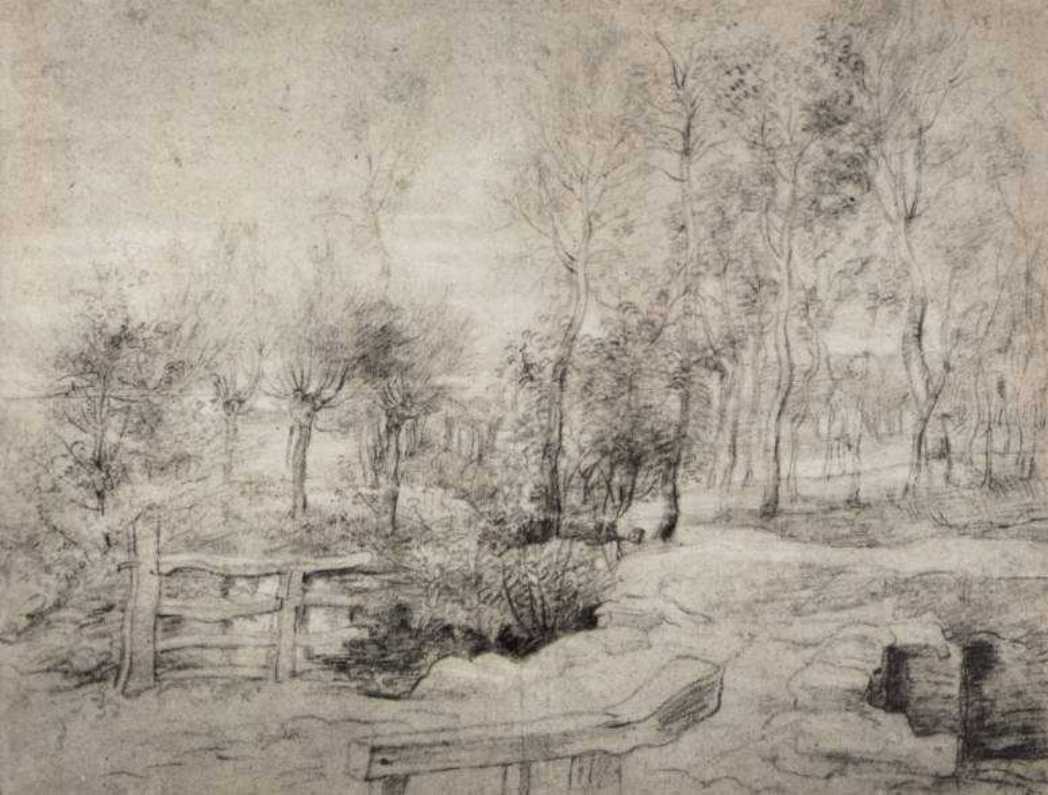
“Landscape with a Trees,” created around 1640, belongs to the very last phase of Peter Paul Rubens’ career. Unlike the grand altarpieces and mythological canvases for which he is most famous, this work is a quiet, intimate drawing. Executed in delicate black lines on a light ground, the composition shows a rustic scene with a rough wooden fence, a worn path, clusters of low trees, and a stand of taller trunks receding into the distance. Everything is rendered with a loose, searching touch that feels more like an artist thinking on paper than staging a theatrical drama.
This landscape is especially valuable because it reveals Rubens as a draftsman and a lover of the countryside. In his final years, ill with gout and semi-retired from court life, he spent long periods at his country estate of Het Steen outside Antwerp. There he turned his attention to fields, woods, and farm tracks, observing the changing seasons and weather. “Landscape with a Trees” condenses these experiences into a modest yet profoundly thoughtful study of nature.
Subject and Setting
At first glance, the subject seems almost deliberately ordinary. There is no grand vista or picturesque ruin, no biblical event or mythological figure. The eye moves from a simple wooden gate or fence in the left foreground across a patch of uneven ground toward a line of pollarded trees. On the right, the path curves into a denser stand of slender trunks, their crowns dissolving into the sky. In the bottom right corner, a rectangular depression or trough suggests a water hole, drainage ditch, or small stone structure.
This humble setting corresponds closely to the Flemish countryside around Rubens’ estate. Pollarded willows, modest fences, and sandy paths were common features of agricultural land along the Scheldt. By choosing such a scene, Rubens distances himself from the idealized Italianate landscapes popular among many of his contemporaries. Instead of imaginary ruins and classical shepherds, he draws the real woods and fields he walked through every day.
The very title, “Landscape with a Trees,” underscores this ordinariness. It does not identify a specific place or event; it simply points to the presence of trees, the most basic building blocks of a landscape. In this sense the drawing becomes a meditation on nature in its unadorned state, an exploration of structure, rhythm, and atmosphere rather than narrative.
Composition and Spatial Organization
Despite the modest subject, the composition is carefully organized. The drawing is horizontally oriented, and Rubens uses the width of the sheet to lead the eye into depth. In the foreground, the rough fence slants diagonally from lower left toward the middle of the picture, acting as a visual threshold between the viewer and the space beyond. The path or open ground flows around this barrier and curves toward the right, guiding the gaze into the wooded area.
The trees themselves are arranged in two main clusters. On the left, a row of short, pollarded trunks creates a low, rhythmic boundary. Their tops are cropped, and their branches form a horizontal band that echoes the line of the horizon. On the right, by contrast, taller, more slender trees rise vertically, their trunks bending slightly as they reach upward. This interplay of horizontal and vertical elements gives the composition a subtle tension, as if the landscape were stretching both across and up.
Rubens also uses overlapping and shifts in scale to suggest depth. Trees and bushes in the foreground are drawn with stronger, darker lines; those in the middle distance are lighter and less defined; and the far distance dissolves into a faint haze. The sky occupies a large, nearly empty area at the top of the drawing, increasing the sense of open air and giving the eye a place to rest after wandering through the thicket of branches.
Line, Texture, and Drawing Technique
“Landscape with a Trees” demonstrates Rubens’ mastery of line as a flexible, expressive tool. He uses a variety of strokes to convey different textures and depths: quick, scribbled marks for foliage; gentle, wavering lines for tree trunks; and firmer, more deliberate contours for the fence and path.
The fence is rendered with slightly heavier lines and a touch of shading, making the rough planks almost tactile. The ground is suggested with irregular horizontal strokes and patches of crosshatching that indicate bumps, depressions, and perhaps muddy areas. In contrast, the foliage of the trees is evoked with clusters of short, flickering marks that imply leaves without enumerating them.
Rubens’ technique here is spontaneous, almost sketch-like, yet never careless. The drawing feels as though it was done directly from nature, perhaps outdoors or immediately afterward, while impressions were still fresh. Rather than constructing the scene with rigid perspective grids, he lets the landscape emerge from the accumulation of observed details. This gives the image an organic, living quality.
The lightness of the medium—likely chalk or graphite—also contributes to the drawing’s mood. Because the marks are not heavily saturated, the paper’s tone plays a major role in defining space and atmosphere. The result is a soft, silvery image that seems to vibrate gently rather than shout.
Light, Atmosphere, and Seasonal Mood
Even though the drawing is monochrome, Rubens achieves a strong sense of light and atmosphere. There are no dramatic shadows cast by bright sunlight. Instead, the illumination appears diffused, as on an overcast day or in early morning. The sky is left largely untouched, allowing the pale paper to suggest a luminous, cloudy expanse. The trees and ground are darker by comparison, but there is no abrupt contrast; values shift gradually, creating a calm, enveloping light.
This atmospheric subtlety invites speculation about the season. The trees have foliage but not in heavy masses; many branches remain visible, and the crowns are airy rather than dense. This might suggest early spring, when leaves have returned but not yet fully thickened, or late autumn when foliage is thinning. The slightly bare quality of the trees, combined with the subtly worn path and the hints of water or damp soil, give the scene a cool, transitional feeling.
Rubens was keenly sensitive to such seasonal nuances. In his larger landscape paintings, he often depicted specific times of day and year, using color and light to evoke morning haze, autumn twilight, or stormy afternoons. “Landscape with a Trees” conveys a similar awareness in a more restrained register. The drawing captures not just the forms of trees and fences but the moisture in the air and the quiet mood of a countryside between seasons.
The Human Presence, Seen and Unseen
No figure appears prominently in the drawing, yet the landscape is not devoid of human traces. The fence in the foreground is a clear sign of cultivation and boundary-making. Its rough construction—irregularly spaced planks secured to simple posts—suggests a working farm rather than an ornamental garden. The path that curves toward the right also implies regular passage, perhaps by farmers, shepherds, or villagers.
If one looks closely, there may even be tiny indications of distant figures among the trees, though they are so faint that they remain ambiguous. Whether or not actual people are present, the landscape bears the imprint of human activity. It is neither untouched wilderness nor carefully manicured parkland, but a semi-wild area shaped by work and routine.
This subtle human presence resonates with Rubens’ own life. In his later years at Het Steen he was both observer of nature and gentleman farmer, involved in the management of fields, woods, and livestock. “Landscape with a Trees” implicitly reflects this dual role. The drawing records the land as both aesthetic object and lived environment, a place walked through daily and shaped by labor.
Comparison with Rubens’ Painted Landscapes
Contrasting this drawing with Rubens’ large oil landscapes reveals how he used different media for different purposes. In paintings like “Landscape with a Rainbow” or “The Chateau de Steen,” he deploys vibrant color, dramatic skies, and bustling figures to create expansive, celebratory views of the countryside. Those works are carefully orchestrated compositions intended for courtly patrons and major collections.
“Landscape with a Trees,” by contrast, feels private and exploratory. It lacks the narrative episodes and theatrical lighting of the oils; instead, it focuses on structure, rhythm, and immediacy. Whereas the painted landscapes often include mythological or peasant scenes to entertain the viewer, this drawing offers nothing but trees, fence, and path. Its value lies not in spectacle but in intimacy, inviting the viewer to share the artist’s reflective gaze.
At the same time, the drawing may have served as a preparatory study or a resource for larger projects. Its careful observation of tree shapes, branch patterns, and spatial layering would have informed Rubens’ later compositions, helping him maintain natural plausibility even when he embellished scenes for dramatic effect. In this sense, “Landscape with a Trees” is both independent artwork and workshop tool.
A Late Meditation on Nature
The date of the drawing—around 1640, the year of Rubens’ death—adds poignancy to its quiet mood. In his final years, physically weakened and increasingly detached from court politics, Rubens turned inward toward his estate and the natural world around it. Landscapes became not just commissions but personal refuges.
“Landscape with a Trees” embodies this late meditation. There is no striving for glory here, no monumental architecture or grand allegory. Instead, Rubens records the modest beauty of a stand of trees, a sagging fence, a patch of uneven ground. The drawing’s openness and lack of ornament suggest a kind of acceptance—a recognition that the ordinary countryside, viewed with attentive eyes, holds its own profound dignity.
The trees themselves, with their slender trunks and delicate crowns, may even carry symbolic overtones. Trees have long been associated with growth, endurance, and the passage of time. In this drawing they stand quietly, shaped by wind and pruning, bearing the marks of years. For an aging artist, they could serve as silent analogues for human life: rooted yet flexible, scarred yet continuing to grow.
Rubens and the Evolution of Landscape Art
While Rubens is not primarily known as a landscape artist, his contributions to the genre were important for the development of later Northern painting. He helped elevate landscape from background scenery to a subject worthy of serious consideration, blending Flemish traditions of detailed natural observation with broader, more dynamic compositions influenced by Italian art.
Drawings like “Landscape with a Trees” show the observational foundation of that achievement. By spending time sketching actual fields and woods, Rubens built a mental library of forms and atmospheres that gave his painted landscapes their convincing vitality. His approach would influence artists such as Jacob Jordaens, Jan Brueghel the Younger, and, indirectly, eighteenth-century landscape painters who sought both truth and poetry in nature.
Moreover, the drawing anticipates modern attitudes toward landscape as a subject of quiet contemplation rather than grand narrative. In its modesty and honesty, it foreshadows the sketches of later artists like Constable and Corot, who likewise valued the direct study of humble rural scenes.
Viewing “Landscape with a Trees” Today
For contemporary viewers, “Landscape with a Trees” offers a different kind of encounter with Rubens than his more famous works. There are no heroic bodies or swirling draperies, no spectacular altarpiece drama. Instead, the drawing invites a slow, patient gaze. One notices the slight wobble in a tree trunk, the way a cluster of branches thickens, the soft fade of forms into the distance.
Because the medium is simple and the scale relatively small, viewers can imagine the artist’s hand moving across the paper, pausing, returning, adjusting. The drawing becomes almost a record of looking—a visual diary entry from a walk in the woods. In a world saturated with color and spectacle, its gray, subdued tones and unassuming subject can feel surprisingly refreshing.
“Landscape with a Trees” also encourages us to pay closer attention to everyday environments. It suggests that beauty and complexity are present in neglected corners: by a fence, along a path, at the edge of a sparse wood. Rubens’ careful observation transforms a simple clump of trees into an intricate web of lines and spaces, reminding us that ordinary nature holds inexhaustible visual interest for those willing to look.
Conclusion
“Landscape with a Trees” stands as a quiet yet powerful testament to Peter Paul Rubens’ love of the natural world and his mastery as a draftsman. Created at the end of his life, this modest drawing abandons grand historical narratives in favor of a simple rural scene: a wooden fence, a winding path, and a stand of trees rendered in delicate, searching lines. Through sensitive composition, atmospheric light, and subtle variations of texture, Rubens transforms this humble subject into a meditative exploration of space, season, and the traces of human presence in the land.
More than a preparatory sketch, the work captures an artist at peace with his surroundings, observing the countryside that had become his refuge. It reveals another side of Rubens—less the flamboyant court painter, more the reflective country gentleman who found meaning in the quiet rhythms of fields and woods. For modern viewers, “Landscape with a Trees” offers not only insight into Rubens’ late style but also an invitation to rediscover the poetic richness of everyday landscapes.