Image source: wikiart.org
Introduction to “Portrait of Helene Fourment with a Coach”
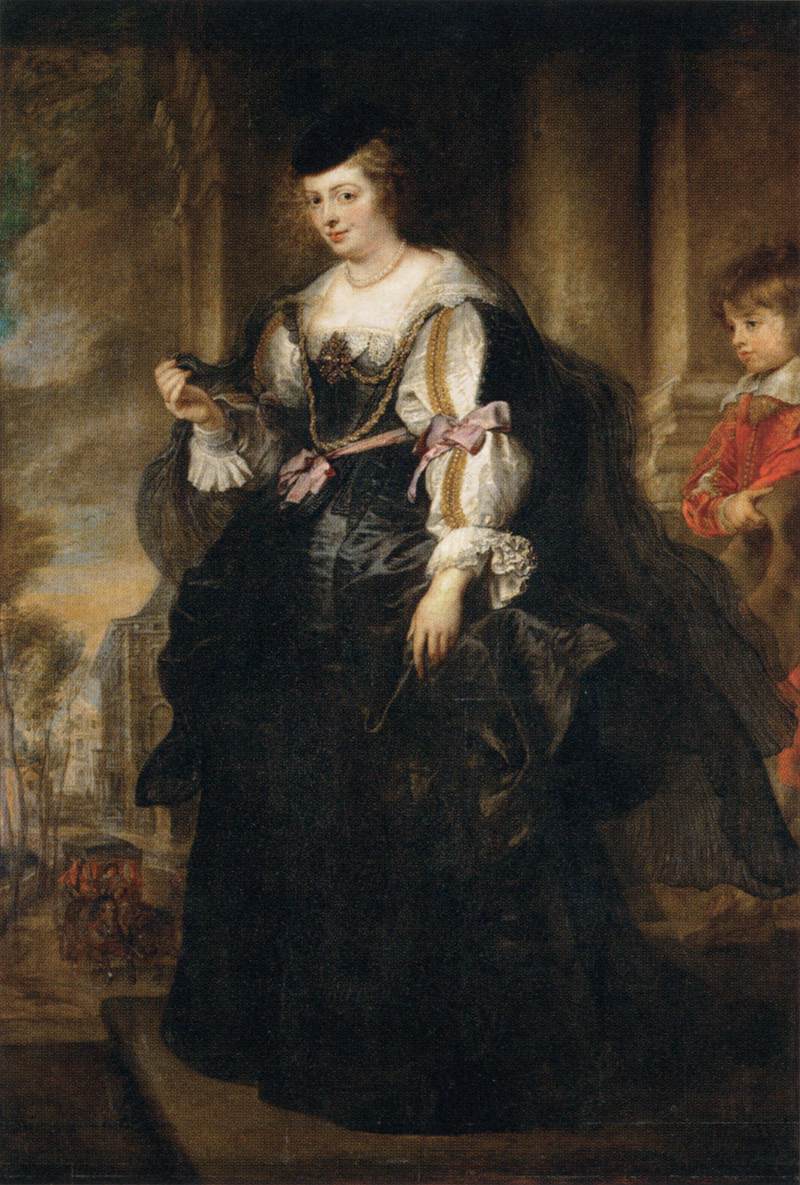
“Portrait of Helene Fourment with a Coach,” painted by Peter Paul Rubens in 1639, presents the artist’s young wife as an elegant lady of Antwerp society. Helene stands on a stone step framed by heavy architecture, dressed in a sumptuous black gown that glows with subtle highlights. Behind her, a child in red, often identified as one of their sons, watches attentively. In the left background, a distant street opens toward a city gate where a horse-drawn coach approaches, anchoring the portrait in the bustle of urban life.
This painting is much more than a simple likeness. It is a carefully staged vision of status, domestic pride, and the world Rubens inhabited at the end of his life. Helene appears both approachable and dignified, poised yet slightly informal, as if caught mid-step between the privacy of her home and the social realm suggested by the coach.
Historical Context and Helene’s Role in Rubens’s Late Career
By 1639 Rubens was in his early sixties and nearing the end of a remarkably productive career. After the death of his first wife, Isabella Brant, he married the much younger Helene Fourment in 1630. She brought renewed happiness and energy into his life and became a frequent model in his paintings, appearing as herself, as mythological goddesses, and in allegorical scenes celebrating love and fertility.
These years were also marked by Rubens’s withdrawal from diplomatic commissions and his increasing attachment to his estates and family. “Portrait of Helene Fourment with a Coach” belongs to this domestic phase. Unlike official portraits of monarchs or ambassadors, it focuses on the artist’s immediate circle, yet it retains the grandeur and richness expected of a Baroque masterpiece. The coach in the background hints at the social world the couple moved in, while the architecture and costume proclaim Helene’s status as the wife of a wealthy, internationally respected painter.
Composition and Spatial Structure
Rubens constructs the composition vertically, emphasizing Helene’s standing figure as the central axis. She is placed slightly off-center, leaning toward the viewer, while the child stands behind her to the right, creating a gentle diagonal line that connects their faces. The steps beneath her feet and the columns rising behind establish a stable architectural framework.
To the left, the space opens outward. Through an arch-like gap we glimpse a city street receding into the distance, lined with buildings and trees. A coach drawn by horses moves along this road, its small scale emphasizing the depth of the scene. This contrast between the monumental foreground figure and the receding cityscape enriches the painting’s sense of space, drawing the viewer from intimate portrait to broader environment.
Helene’s body acts as a hinge between the domestic interior suggested by the columns and the public world of the street. The subtle forward movement of her left foot and the slight turn of her torso hint that she may be either arriving or preparing to depart. This ambiguity gives the portrait narrative tension and makes the viewer wonder about the moment captured.
Helene’s Presence and Characterization
Helene’s expression is gentle yet assured. Her face, softly lit, shows a calm gaze directed toward the viewer, with a faint, knowing smile. Rubens avoids idealizing her features; instead he conveys an individual presence with rounded cheeks, clear eyes, and slightly parted lips. There is a sense of warmth and intelligence that suggests familiarity rather than distant formality.
Her posture contributes to this characterization. She stands poised, holding a fold of her cloak in one hand while the other hangs relaxed, fingers slightly curved. This gesture, half practical and half decorative, demonstrates both self-awareness and ease. The slight inclination of her head and shoulders toward us conveys openness, as if she is acknowledging the viewer’s presence.
Rubens thus navigates between intimacy and public image. Helene is clearly a real woman with a distinct personality, yet she is also presented as an exemplar of genteel femininity, capable of representing not only herself but the honor of her household.
Costume, Fashion, and Social Status
Helene’s dress is one of the painting’s most striking features. She wears a dark, probably black gown with a full skirt that spreads around her feet, contrasted by a white chemise and sleeves puffed and gathered above the wrists. Elaborate lace cuffs, pink ribbons at the elbows, and a decorative bodice with gold trim and jewelry add layers of luxury. A delicate pearl necklace encircles her neck, and she wears a small black hat perched on her head, enhancing the vertical silhouette.
In seventeenth-century Flanders, black was often associated with high-quality, expensive fabrics and sober elegance. The sheen of Helene’s gown suggests costly silk or satin, whose complex folds Rubens renders with deep shadows and soft highlights. The pale sleeves and lace details create bright accents that break up the dark mass of the cloak and gown, guiding the viewer’s eye upward toward her face.
These sartorial choices communicate more than fashion. They announce Helene as a woman of means and refinement, aligned with the aristocratic tastes of the time. The pink ribbons and soft pearls, however, inject a note of youthful charm and tenderness. The costume thus balances dignity with feminine grace, presenting Helene as both respectable matron and still-youthful beauty.
The Child and the Theme of Motherhood
Behind Helene, slightly to the right, stands a child dressed in a reddish outfit with white collar and cuffs. His presence introduces an important dimension: the portrait is not only of a woman but of a mother. The child’s gaze is directed toward his mother, and his body is turned slightly inward, as if seeking protection or closeness.
Rubens often celebrated family life in his late works, depicting Helene with their children in tender domestic scenes. Here, the child’s partial inclusion—he is not fully in the foreground—suggests that Helene remains the central figure, but her identity is inseparable from her role within the family. The child’s vivid red garment provides a chromatic counterpoint to Helene’s dark dress, reinforcing their connection and liveliness amid the more neutral architectural tones.
The child’s presence also subtly humanizes the grand setting. Instead of a purely formal, isolated image, we encounter a living relationship. This reinforces the sense that Rubens is portraying not merely social rank but the intimate reality of his own household.
The Coach and the World Beyond
In the distance, near the lower left, we see a small coach moving along a street, pulled by horses and accompanied by figures. This detail is crucial to the painting’s meaning. The coach functions as a symbol of social mobility, public life, and the worldly engagements that fill the lives of prosperous families. It hints at travel to and from the city, visits, ceremonies, and the circulation of people and goods.
By including the coach, Rubens places Helene in a dynamic social context. She is not confined to a private interior; she stands at the threshold between home and city, fully prepared to step into the world. The viewer may imagine that the coach has either brought her home or waits to carry her away. In either case, it marks her as an active participant in the social scene, not a secluded figure.
Visually, the coach also contributes to the painting’s depth and narrative richness. Its warm tones and the movement of the horses animate the distant background, forming a miniature drama within the larger portrait. This Baroque layering of scenes keeps the viewer’s eye engaged and underscores the interconnectedness of personal and public realms.
Light, Color, and Atmosphere
Rubens uses light selectively to emphasize Helene’s face and costume while maintaining a moody, atmospheric background. A soft, warm light falls from the left, illuminating her upper body, the white of her chemise, and the pearls around her neck. This light creates gentle highlights on the folds of her gown and cloak, giving them volume and texture.
The background is more subdued, composed of muted browns, grays, and greens. The architecture recedes into shadow, while glimpses of sky and trees appear in the distance beyond the columns. The coach and street are bathed in a slightly hazy glow, suggesting depth and the presence of air between foreground and background.
Color contrasts play a significant role. The deep blacks and dark blues of Helene’s gown anchor the composition, while the bright whites of lace and chemise act as focal points. The pink ribbons and warm skin tones introduce subtle color variation. The child’s red garment adds a vivid accent that draws the eye to the right and balances the composition.
Overall, the lighting and color create a sense of late afternoon or early evening, a time associated with both activity and the winding down of the day. This temporal suggestion aligns with the painting’s theme of transition between interior and exterior, rest and movement.
Architecture, Space, and Baroque Grandeur
The architectural setting in “Portrait of Helene Fourment with a Coach” is typical of Rubens’s ability to merge portraiture with grand surroundings. Massive columns frame the scene, rising beyond the top edge of the canvas. Their fluted shafts and ornate capitals evoke classical architecture, linking the sitter to a heritage of antiquity and noble design.
These structures serve both practical and symbolic purposes. Practically, they provide a vertical counterweight to Helene’s figure, strengthening the overall composition. Symbolically, they lend solidity and permanence to the image, suggesting that Helene’s status and the Rubens household are firmly established. The columns also create a threshold space—a kind of portico or entrance hall—that connects the domestic interior behind Helene with the street outside.
The use of perspective in the architecture and street scene reinforces the painting’s depth. Lines converge toward a vanishing point in the distant city, giving the viewer the sense of looking down a real street from a high vantage point. This sophisticated spatial construction reflects Rubens’s interest in stage-like settings and his familiarity with Italian Renaissance architectural painting.
Emotional Tone and Narrative Suggestions
Despite the formal setting and luxurious costume, the emotional tone of the painting is surprisingly gentle. Helene’s expression is calm and almost conversational; she appears less like a distant aristocrat and more like someone pausing to greet a friend. The slight movement in her gown and cloak, and the presence of the child and coach, hint at an unfolding story rather than a static moment.
One can imagine multiple narratives. Helene may be stepping out to enter the coach for a visit, momentarily delaying to acknowledge the viewer. Alternatively, she may have just returned and pauses on the steps while her child hovers nearby. This ambiguity allows viewers to project their own interpretations, enhancing the painting’s engagement.
The overall mood is one of contentment and confidence. There is no sense of anxiety or tension. Instead, Rubens presents a picture of harmonious domestic and social life, a reflection of the stability he had achieved after years of travel and negotiation.
Comparison with Other Portraits of Helene Fourment
Rubens painted Helene numerous times, each portrait revealing a different facet of her personality and role. In more intimate works, such as “Helene Fourment with her Children,” she appears as a nurturing mother in light garments, seated and surrounded by little ones. In “The Three Graces” or other mythological scenes, she is transformed into an idealized goddess figure.
In “Portrait of Helene Fourment with a Coach,” the emphasis is on Helene as a lady of rank moving within urban society. Unlike the relaxed domestic portraits, here she is upright, formally dressed, and situated within a grand architectural frame. Yet Rubens retains a touch of intimacy through her open expression and the presence of the child.
Comparing this portrait to earlier images of his first wife, Isabella Brant, we see continuity in Rubens’s appreciation for strong, dignified women. At the same time, Helene’s more elaborate Baroque costume and the dynamic background reflect the evolution of fashion and of Rubens’s own late style.
Significance within Rubens’s Oeuvre
“Portrait of Helene Fourment with a Coach” holds a special place among Rubens’s late works. It unites several themes that preoccupied him in his final years: family, social standing, urban and rural life, and the interplay between private affection and public display. The painting serves as a visual testament to the world he had built—a world of prosperity, domestic happiness, and artistic achievement.
As a portrait, it demonstrates Rubens’s ability to capture likeness and character while integrating complex spatial and narrative elements. As a historical document, it offers insight into seventeenth-century fashion, architecture, and urban culture in the Southern Netherlands.
Above all, the painting is a tribute to Helene herself, acknowledging her importance in his life. She is portrayed not as a remote ideal but as a living, breathing presence at the threshold of home and society, embodying both personal affection and the dignity of her station.
