Image source: wikiart.org
Introduction to Peter Paul Rubens’s “Diana and Callisto”
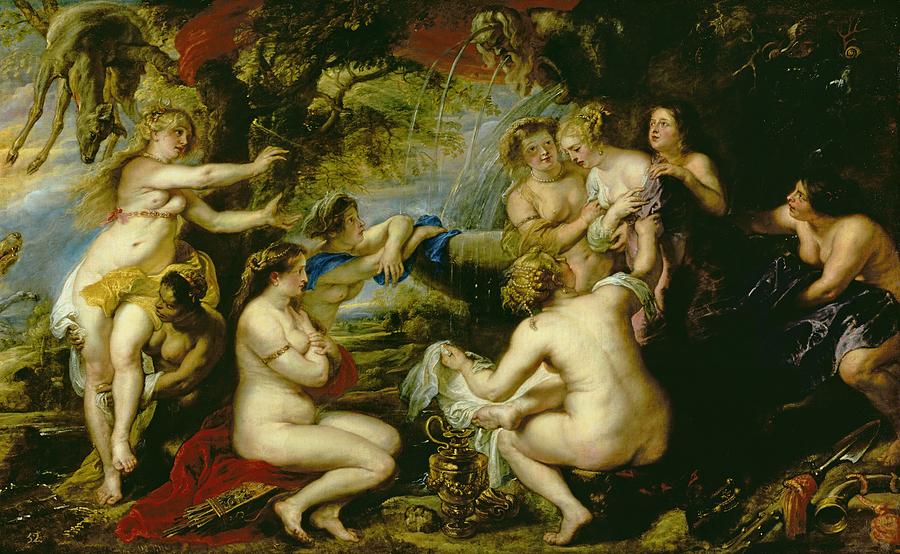
“Diana and Callisto,” painted by Peter Paul Rubens around 1639, is a sensuous and emotionally charged interpretation of one of the most dramatic myths from Ovid’s “Metamorphoses.” The painting shows the moment when the chaste goddess Diana discovers that her favorite nymph Callisto is pregnant, having been seduced by Jupiter. In a single crowded scene Rubens combines mythological narrative, opulent female nudes, sparkling water, and lush landscape to create a quintessential Baroque vision of beauty and betrayal.
Across the canvas a ring of nymphs surrounds Callisto, who twists in shame while her companions pull away her clothing. Diana stands to the left, arm outstretched in accusation. Small putti and attendants assist with the bathing ritual beside an ornate fountain. The setting is a secluded woodland pool, yet the emotional temperature is high: gestures are amplified, bodies are in motion, and every face responds differently to the unfolding scandal.
Mythological Background: The Fate of Callisto
In classical mythology Callisto is a follower of Diana (Artemis), the virgin goddess of the hunt. Bound by a vow of chastity, Callisto lives among Diana’s retinue of nymphs. Jupiter (Zeus), struck by her beauty, disguises himself as Diana to approach Callisto and then forces himself upon her. Months later, while the nymphs are bathing, Callisto’s pregnancy is discovered. Furious at the violation of her rule, Diana expels Callisto from the group.
The story continues with further tragedy: Juno, jealous wife of Jupiter, transforms Callisto into a bear, and eventually she is placed in the sky as the constellation Ursa Major. Rubens focuses on the pivotal moment of discovery, when innocence is publicly shattered and female solidarity turns into condemnation. This episode allows him to explore themes of chastity, violation, shame, and the fragile position of women in mythic narrative.
Overall Composition and Spatial Drama
Rubens organizes the composition as a sweeping arc of figures that curves from left to right around the central fountain. Diana stands on the far left, slightly elevated and framed by a tree, creating a visual anchor. Her left arm extends toward Callisto, linking the two women across the scene. Around Callisto a cluster of nymphs kneel, bend, and twist, their bodies forming a whirlpool of movement that contrasts with Diana’s more upright stance.
The fountain, decorated with sculpted lion heads spouting streams of water, sits just off center. These arcs of water mirror the arcs of limbs and drapery and serve as a visual metaphor for the ritual of bathing that has turned into an interrogation. Behind the figures the landscape recedes into soft green foliage and a distant sky. The top left shows a hunting trophy or animal carcass hanging from a tree, reminding us that this is Diana’s hunting domain.
The crowding of bodies in the foreground, combined with the relative emptiness of the background, pushes the drama toward the viewer. We feel almost part of the circle, uncomfortably close to Callisto’s humiliation. Rubens uses diagonal lines—Diana’s pointing arm, the leaning nymphs, the flow of water—to drive the eye repeatedly back to the central revelation of the pregnant body.
The Figure of Diana: Authority and Anger
Diana is instantly recognizable by her crescent moon diadem and the presence of hunting imagery. She stands mostly nude, with golden drapery gathered at her hips, accompanied by a dark-skinned attendant who helps hold her quiver or garment. Her body is powerful and athletic, yet her expression blends outrage with disappointment.
Her outstretched arm, palm facing Callisto, is a classic gesture of accusation and rejection. At the same time, her torso twists slightly away, suggesting a recoil from contamination. Rubens captures the goddess at the moment when her ideal of virgin community has been shattered, and her reaction is swift, almost judicial.
The presence of the attendant beside Diana intensifies the sense of hierarchy. She emphasizes that Diana is both goddess and leader, separate from the other nymphs. While many figures in the painting are caught in chaotic motion, Diana remains the focal point of order, even if that order takes the form of merciless judgment.
Callisto: Shame, Vulnerability, and the Revealed Body
Callisto occupies the emotional center of the painting, slightly to the right of the fountain. She is half-raised from her seated position by the nymphs who are pulling away her drapery. Her body twists in a complex contrapposto, one arm crossing over her breast in a futile attempt at modesty while the other is pulled aside. Her head turns away, eyes cast downward in shame, lips parted in a silent protest or sob.
Rubens renders her flesh with his characteristic warmth and softness, emphasizing roundness and fullness, particularly in her slightly swollen abdomen. Unlike the confident, open poses of many Rubensian nudes, Callisto’s posture is defensive and constricted. She is on display against her will, her body becoming evidence in a moral trial.
The psychological tension arises from the contrast between the sensual beauty of her form and the emotional agony she experiences. Rubens invites the viewer to sympathize with Callisto rather than with the unforgiving goddess. Even as our eye is drawn to the curves of her body, we are reminded that this gaze participates in her exposure and humiliation.
The Nymphs: A Chorus of Reactions
Surrounding Callisto, the nymphs function like a chorus in a drama, each expressing a different reaction to the revelation. One kneels behind Callisto, clutching the loosened garment and glancing toward Diana as if awaiting instruction. Another, closer to the viewer, leans in with an expression of curiosity mixed with alarm. A more compassionate attendant at the far right appears hesitant, her face troubled rather than accusatory.
Several of the nymphs in the left foreground are at various stages of undress, adjusting their own garments or preparing to enter the water. Their casual nudity contrasts with Callisto’s enforced exposure. For them, the bath is a ritual of camaraderie and cleansing; for Callisto, it becomes a moment of condemnation.
By giving each figure a distinct attitude, Rubens transforms the group into a study of social dynamics. Some delight in gossip, some enforce the rules, and some quietly empathize with the outcast. This complexity prevents the painting from becoming a simple moral allegory; it feels instead like a realistic portrayal of how communities often respond to scandal.
Putti, Water, and the Fountain of Revelation
At the center near the fountain a cluster of cherubic children play a supporting role. One putto holds a gleaming brass vessel, another dangles cloth in the water, and a third looks up with wide-eyed interest. These figures, with their round bodies and innocent expressions, echo Callisto’s own lost innocence. They also bridge the gap between the divine world of myth and the earthly world of everyday bathing rituals.
The fountain itself is a key symbolic element. Water in classical art often stands for purification, renewal, or truth. Here, instead of cleansing Callisto, the waters reveal her secret. The jets bursting from the lion mouths emphasize sudden disclosure and uncontrollable force. The reflective surface of the pool beneath hints at another layer of visibility: whatever is hidden eventually surfaces, just as Callisto’s pregnancy can no longer be concealed.
Moreover, the association of Diana with moonlight and pure springs makes this defilement particularly poignant. The very element that defines the goddess—her sacred water—becomes the instrument that exposes the violation of her law.
Light, Color, and Sensual Atmosphere
Rubens bathes the scene in a warm, golden light that caresses the flesh of the nymphs and sparkles on the water. Flesh tones range from creamy ivory to rosy pinks, enriched by subtle shadows that model the roundness of limbs and torsos. Against these soft hues, bright accents of drapery—scarlet, blue, and gold—provide visual rhythm and emphasize key figures.
The left side of the painting, where Diana stands, is somewhat brighter, with sunlight filtering through foliage. The right side, where the darker rock and foliage frame the pool, is more shadowed and intimate. This gradation of light leads the eye from the public authority of the goddess toward the more vulnerable, enclosed space where Callisto is exposed.
Rubens’s brushwork is fluent and energetic. Draperies are painted with sweeping strokes that convey their weight and movement. The textures of skin, hair, metal, and stone are differentiated yet harmonized by the unifying glow of the overall color scheme. The result is an atmosphere thick with sensuality and moisture, appropriate to a woodland grotto but also evocative of emotional intensity.
The Baroque Female Nude and Rubens’s Ideal
“Diana and Callisto” showcases Rubens’s distinctive conception of the female body. His nymphs are robust, full-figured, and palpably physical, with rounded thighs, soft stomachs, and dimpled knees. This ideal, often called “Rubenesque,” celebrates abundance rather than thinness.
In this painting, the proliferation of nudes creates a kind of visual chorus of femininity. Yet the bodies are not interchangeable; each has unique posture, expression, and energy. Some nymphs are seated, others standing or leaning, creating a complex choreography of curves. The viewer’s eye follows the sequence of bodies like a musical melody, from Diana’s commanding presence through the tense knot around Callisto to the more relaxed figures on the right.
At the same time, Rubens uses this display of flesh to highlight the central drama. Because the viewer is surrounded by nudity, Callisto’s pregnancy—rather than her simple nakedness—becomes the difference that matters. The painting thus meditates on the line between natural sensuality and socially policed morality.
Moral and Emotional Interpretation
Although based on pagan mythology, the story of Diana and Callisto resonated with moral concerns in Rubens’s Christian context. The painting can be read as a reflection on chastity, temptation, and the harshness of judgment. Callisto is both victim and accused; she has broken the vow, yet she did so under divine deception and force. Diana’s implacable reaction demonstrates how rigid ideals can produce cruelty even among women themselves.
Rubens does not clearly take sides, but his sympathetic rendering of Callisto’s expression and posture invites compassion. The painting encourages viewers to question the fairness of collective condemnation and the tendency to blame the vulnerable rather than the powerful perpetrator, who is absent from the scene. Jupiter’s unseen presence hangs over the painting like a silent indictment of patriarchal authority.
At the same time, the sumptuous beauty of the composition suggests that sexuality and fertility are not purely negative forces. The lush landscape, flowing water, and cluster of children all point toward life and abundance. The tragedy arises not from nature itself but from the clash between natural desire and inflexible codes of purity.
Relationship to Other Versions and Artistic Tradition
The story of Diana and Callisto has attracted many artists, including Titian, whose celebrated version Rubens knew well. Titian’s painting emphasizes the dramatic moment of disrobing, with Diana clearly seen dismissing Callisto while the landscape opens behind. Rubens adapts and expands this model, intensifying the level of physicality and crowding the scene with additional figures and putti.
Compared with Titian, Rubens’s composition is more exuberant and baroque. Where Titian uses a relatively stable arrangement of forms, Rubens multiplies diagonals and swirling gestures. The emotional tone is correspondingly heightened. Instead of a quiet revelation, we see a noisy, almost theatrical confrontation.
Rubens also painted other mythological scenes featuring Diana and her nymphs at the bath, but “Diana and Callisto” stands out for its mixture of sensuality and cruelty. It demonstrates how the same setting of female camaraderie and water can shift from harmony to conflict when social rules are breached.
Viewing Experience and Lasting Impact
Encountering “Diana and Callisto” today, viewers are struck by its visual richness and psychological complexity. The sheer number of figures invites prolonged looking, as the eye moves from one vignette to another, decoding gestures and expressions. Yet the central narrative remains clear: an outcast in the midst of her former companions, subjected to their scrutiny and to the goddess’s condemnation.
The painting raises questions that still resonate. How does a community respond when one of its own breaks a rule, especially in matters of sexuality? Who bears the blame when power and desire collide? How do ideals of purity and honor shape women’s relationships with one another? Rubens’s mythological scene becomes a mirror for social dynamics that extend far beyond ancient legend.
At the same time, the painting continues to be admired for its mastery of color, anatomy, and composition. It encapsulates Rubens at the height of his powers, weaving storytelling, sensual beauty, and moral ambiguity into a single, compelling work.
