Image source: wikiart.org
Introduction to Peter Paul Rubens’ “Andromeda”
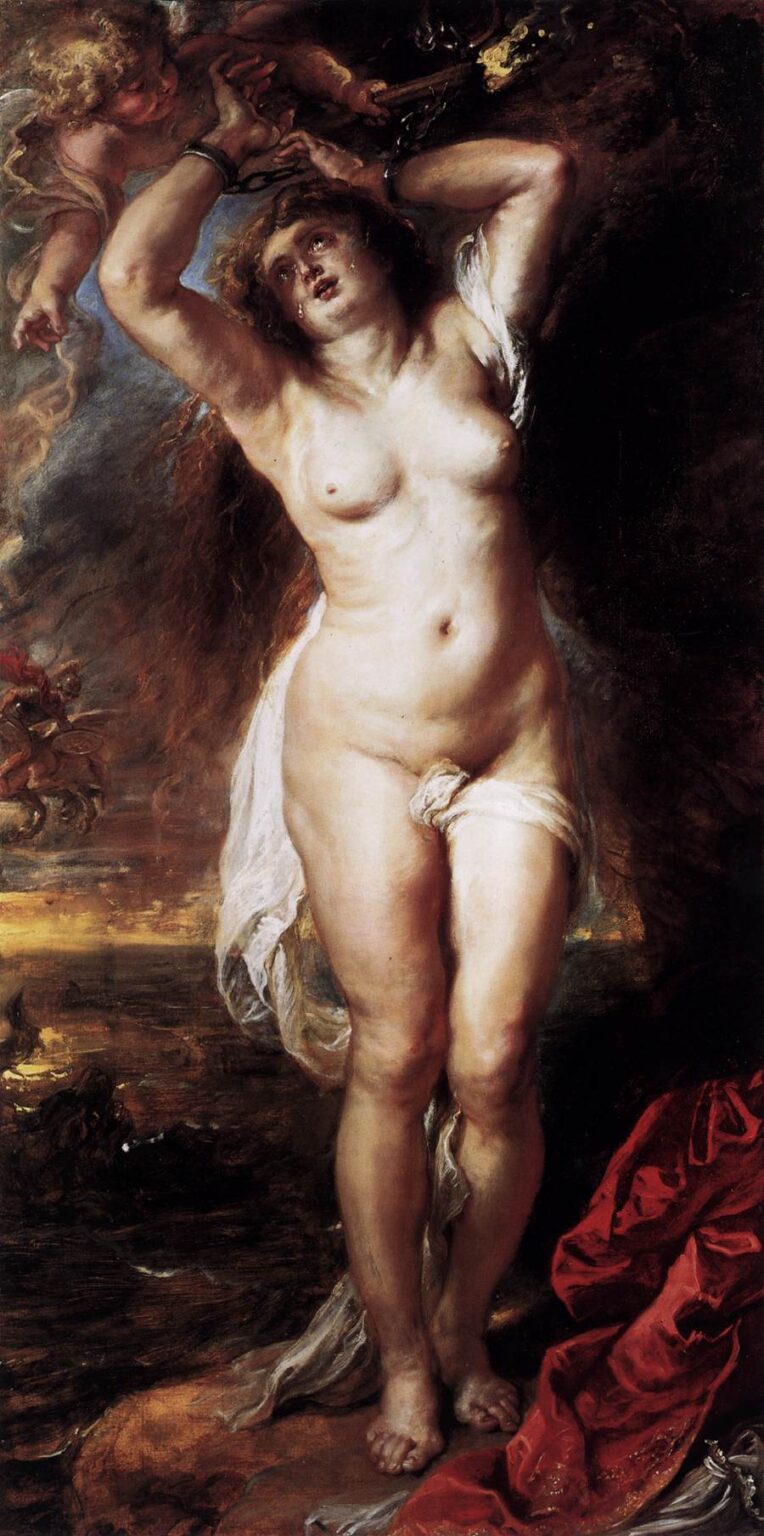
Peter Paul Rubens’ “Andromeda,” painted around 1638, is one of the most intense mythological nudes of his late career. The tall, narrow canvas presents the princess of Ethiopia standing against a rocky shore, chained high above her head as she awaits the sea monster sent to devour her. Her body is almost completely nude, a thin strip of cloth slipping around her hips and a wisp of drapery trailing behind her. Tears glisten on her cheeks as she lifts her face upward in a mixture of terror and supplication.
Around this central figure, Rubens weaves hints of the larger story. In the distant left, Perseus battles the monster; above Andromeda’s raised arms, a winged putto reaches toward the chains, suggesting imminent rescue. The stormy sea, dark rocks, and swirling sky frame the heroine with elemental drama. The painting fuses physical vulnerability, emotional extremity, and heroic myth in a way that is unmistakably Baroque and unmistakably Rubens.
The Myth of Andromeda and Its Dramatic Potential
The story of Andromeda comes from Greek mythology and was popularized in Ovid’s Metamorphoses. Andromeda’s mother Cassiopeia boasted that her beauty surpassed that of the Nereids, provoking the wrath of Poseidon. To punish this arrogance, the sea god sent a devastating monster to ravage the coast. An oracle declared that the only way to appease the gods was to sacrifice Andromeda, so she was chained to a rock by the sea as an offering.
Perseus, returning from slaying Medusa, saw Andromeda and fell in love. He negotiated with her parents: if he killed the monster and saved their daughter, he would marry her. Perseus then descended to the shore, fought the beast, and rescued Andromeda, freeing her from the chains and from a fate she had not chosen.
Artists across centuries recognized the dramatic possibilities of this story: a young woman in peril, a terrifying monster, and a heroic savior. Rubens chooses not to emphasize the monster itself, nor even the climactic battle, but the moment of maximum psychological intensity—Andromeda alone on the rock, poised between despair and hope as her rescuer approaches.
Composition: A Vertical Column of Vulnerability
One of the most striking aspects of Rubens’ “Andromeda” is its extreme vertical format. The canvas rises like a column, echoing the upright stance of the heroine. Her body occupies almost the full height of the painting, from bare feet near the bottom edge to the uplifted arms at the top. This format emphasizes both her isolation and her helpless suspension between earth and sky.
Andromeda’s pose is profoundly expressive. Her wrists are fastened in iron manacles, joined by a chain that attaches to the unseen rock above. This forced upward pull stretches her torso and elongates her figure. She twists slightly, weight resting on one leg while the other bends forward, toes touching the uneven ground. The slight shift in her hips creates an elegant S-curve typical of Rubens’ nudes, but here it also communicates strain and instability.
Her head tilts backward, eyes raised toward the heavens. Tears slide down her cheeks, rendered as bright drops catching the light. The upward gaze, combined with the extended arms, forms a strong vertical line that conveys appeal—to the gods, to Perseus, to anyone who might save her. At the same time, the diagonal of her body, leaning just off-center, suggests vulnerability and the possibility of collapse.
To the lower right, a vivid red drapery lies bunched on the rock, its folds swirling like a frozen wave. This splash of color balances the pale flesh tones of Andromeda and grounds the composition. On the left, the background opens to a restless seascape and distant forms of Perseus and the monster, rendered small but legible. The overall arrangement keeps Andromeda at the center of attention while hinting at the heroic action taking place beyond her immediate awareness.
Andromeda’s Expression and Emotional Charge
Rubens’ portrayal of Andromeda’s face is essential to the painting’s emotional impact. Unlike earlier, more serene classical depictions of bound nymphs, Rubens shows a woman in the grip of genuine terror and anguish. Her mouth is slightly open, as if mid-prayer or stifled cry. Her brows knit together, and her eyes glisten with tears that stream downward in visible trails.
This overt display of emotion aligns with Baroque aesthetics, which favored expressive faces and dramatic pathos. Andromeda is not a passive ideal; she feels the weight of impending death. However, there is also a note of hope in her upturned gaze. She is not looking at the monster or at the viewer but toward something beyond the frame—perhaps the approaching Perseus, perhaps the gods, perhaps both. The viewer, knowing the mythic outcome, can read this as the moment when despair begins to give way to salvation.
Her long hair tumbles freely around her shoulders and down her back, animated by wind and tension. In classical symbolism, unbound hair often connotes both erotic allure and distress. Here it reinforces her status as a victim of forces larger than herself, stripped of social protection and literally exposed to the elements.
The Nude Body: Vulnerability, Beauty, and Baroque Ideal
Rubens is famous for his robust, full-bodied nudes, and Andromeda fits this ideal while also being shaped by the needs of the narrative. Her body is soft and substantial, with rounded abdomen, strong thighs, and natural proportions. Rather than the slender, hard-edged figures of later classicism, Rubens celebrates flesh as alive, warm, and vulnerable.
The nudity in “Andromeda” is not merely ornamental. Within the story, she has been stripped for sacrifice, and her lack of clothing emphasizes her extreme exposure. The thin white cloth tied at one hip and trailing behind offers minimal physical cover; it functions more as a compositional accent than as real protection. The drapery underscores the fact that her body, like her life, has been placed at the mercy of external forces.
At the same time, Rubens’ treatment avoids gratuitous explicitness. He positions Andromeda in a frontal, upright stance that, while revealing, conveys dignity. The modeling of the flesh emphasizes form and light rather than erotic display. The viewer is invited to respond with empathy as much as admiration. Beauty and vulnerability are intertwined: her physical attractiveness is precisely what makes her sacrifice both horrifying and poignant.
The Putto and the Chains: Signs of Rescue
At the top left of the composition, a small winged putto enters the scene, reaching toward Andromeda’s chains. The child-like figure holds a key or tool and grasps the iron links, suggesting that the process of liberation is underway. The putto’s presence introduces a divine or allegorical element: he can be read as an agent of love, of the gods, or of fate itself.
This subtle detail transforms the painting from a pure scene of victimization into one of impending salvation. The chains that bind Andromeda are no longer only instruments of oppression; they are also the focus of divine intervention. The putto leans downward with urgency, echoing Andromeda’s upward reach and creating a visual bridge between heaven and earth.
Technically, the putto helps balance the composition. His pale body and fluttering drapery echo Andromeda’s tones, while his small scale and diagonal posture keep the focus on the heroine. The blackness of the chains contrasts sharply with the surrounding flesh and fabric, making them stark symbols of captivity.
Perseus and the Monster in the Distance
To the lower left, partially obscured by atmosphere and swirling paint, Rubens includes a miniature scene of Perseus battling the sea monster. On close inspection, one can see the hero on a winged horse or in active combat, weapon raised against the beast arising from the water. The forms are sketchy but energetic, rendered in reds, browns, and flashes of light.
By relocating the battle to the background, Rubens shifts emphasis away from heroic action toward the psychological experience of the victim. Andromeda does not watch the fight; she stands turned slightly away, eyes fixed upward. This creates a poignant dramatic irony: we see the rescue unfolding, but she does not. Her continued expression of fear and grief reminds us that even when salvation is near, suffering remains intensely real for those undergoing it.
The distant combat also situates the scene within a broader mythic world. We are reminded that this is not an isolated act of cruelty but part of a heroic saga involving gods, monsters, and legendary deeds. Still, Rubens allows Andromeda’s personal ordeal to dominate, giving the myth emotional immediacy.
Light, Color, and Atmosphere
The lighting in “Andromeda” is complex and theatrical. A warm, golden illumination seems to strike the figure from the left, highlighting her torso, face, and legs while casting subtle shadows along the right side of her body. This light picks out the texture of her skin and the sheen of the white drapery. The red cloth at her feet glows richly, echoing the warm tones in the distant sea and sky.
The background is a turbulent mix of browns, dark greens, and smoky blues. Rubens uses vigorous brushwork to suggest heaving water, rocky cliffs, and swirling clouds. The contrast between the luminous flesh and the darker surroundings isolates Andromeda visually, almost as if she stands in a spotlight amid encroaching darkness.
Color also carries symbolic weight. The red drapery may suggest both royal status and danger; it can evoke blood, passion, or sacrificial rites. The white remnants of cloth around her hips and behind her hint at lost purity and innocence. The deep, earthy tones of the rocks and sea reinforce the sense of natural, elemental forces—tides, storms, geological solidity—against which the fragile human body appears small.
Baroque Drama and the Single Figure
Unlike many of Rubens’ large canvases bustling with multiple figures, “Andromeda” is essentially a single-figure composition. This makes it a particularly powerful example of Baroque drama distilled into one human body. The emotional narrative—terror, appeal, hope—is carried almost entirely by her pose and expression.
The vertical format and minimal setting recall certain religious images of saints in ecstasy or martyrdom. Indeed, there is a subtle parallel between Andromeda’s upward gaze, bound hands, and naked vulnerability and the iconography of Christian martyr-saints tied to stakes or trees. Rubens, steeped in Counter-Reformation art, may well have drawn on this visual language to elevate the pagan story into a more universal meditation on innocent suffering and divine deliverance.
At the same time, the painting retains the sensual richness associated with mythological subjects. The Baroque aesthetic often linked sacred and profane themes, recognizing that human responses to beauty, fear, and hope cut across religious boundaries. “Andromeda” sits at this intersection, inviting both contemplation and emotional engagement.
Rubens’ Late Style and Personal Context
By 1638, Rubens was in his sixties, suffering from gout yet still extraordinarily productive. Many of his late works display freer brushwork, warmer palettes, and an intensified interest in atmospheric effects and human emotion. “Andromeda” reflects this mature style. Surfaces are handled with fluid, confident strokes; details in the background dissolve into expressive suggestions rather than precise descriptions.
The painting also resonates with Rubens’ affection for the female form and his admiration for his second wife, Helene Fourment, whose features and physique influenced many of his later nudes. While we cannot say definitively that Helene served as the model here, the soft, rounded contours and fair complexion of Andromeda echo her image in other works.
Rubens’ engagement with classical literature and Italian art also shapes the painting. He would have known earlier depictions of Andromeda by artists like Titian, as well as antique sculptures of bound figures. Rather than imitating them directly, he translates the theme into his own dynamic vocabulary, giving the figure a powerful physical presence that reflects both scholarly knowledge and personal sensibility.
Themes of Vulnerability, Fate, and Transformation
At its core, Rubens’ “Andromeda” explores themes that go beyond mythic narrative. The painting confronts viewers with the spectacle of extreme vulnerability: a young woman exposed to destruction because of others’ actions. Her nudity, chains, and tears symbolize the ways in which individuals can be bound by forces—family, gods, politics—that they did not choose.
Yet the painting also gestures toward transformation. The presence of the putto at the chains and the distant Perseus suggest that Andromeda’s fate is about to change dramatically. She will move from sacrificial victim to rescued bride, from isolation on the rock to union with a hero and eventual placement among the stars as a constellation. Rubens captures the transitional moment when all possibilities hang in the balance.
For modern viewers, this mixture of vulnerability and hope remains compelling. The painting can be read as a reflection on resilience in the face of overwhelming danger and on the possibility that help may arrive from unexpected quarters. It also raises questions about spectatorship: as we look at Andromeda, are we complicit in a voyeuristic gaze, or do we stand with Perseus and the putto as agents of rescue?
Conclusion
“Andromeda” by Peter Paul Rubens is a masterful synthesis of mythological narrative, emotional intensity, and Baroque aesthetics. Through a towering single figure, Rubens expresses terror, supplication, beauty, and imminent deliverance. The painting’s vertical composition, evocative lighting, and vigorous brushwork draw viewers into the heroine’s plight, while subtle details—the putto at the chains, the distant battle of Perseus and the monster—remind us that this moment is part of a larger story of heroism and transformation.
The work stands as a testament to Rubens’ late artistic power, his ability to infuse ancient tales with psychological depth, and his enduring fascination with the expressive possibilities of the human body. Even centuries later, “Andromeda” continues to move viewers, inviting us to contemplate vulnerability, courage, and the fragile line between despair and salvation.