Image source: wikiart.org
Introduction to Rubens’ “Tereus Confronted with the Head of His Son Itylus”
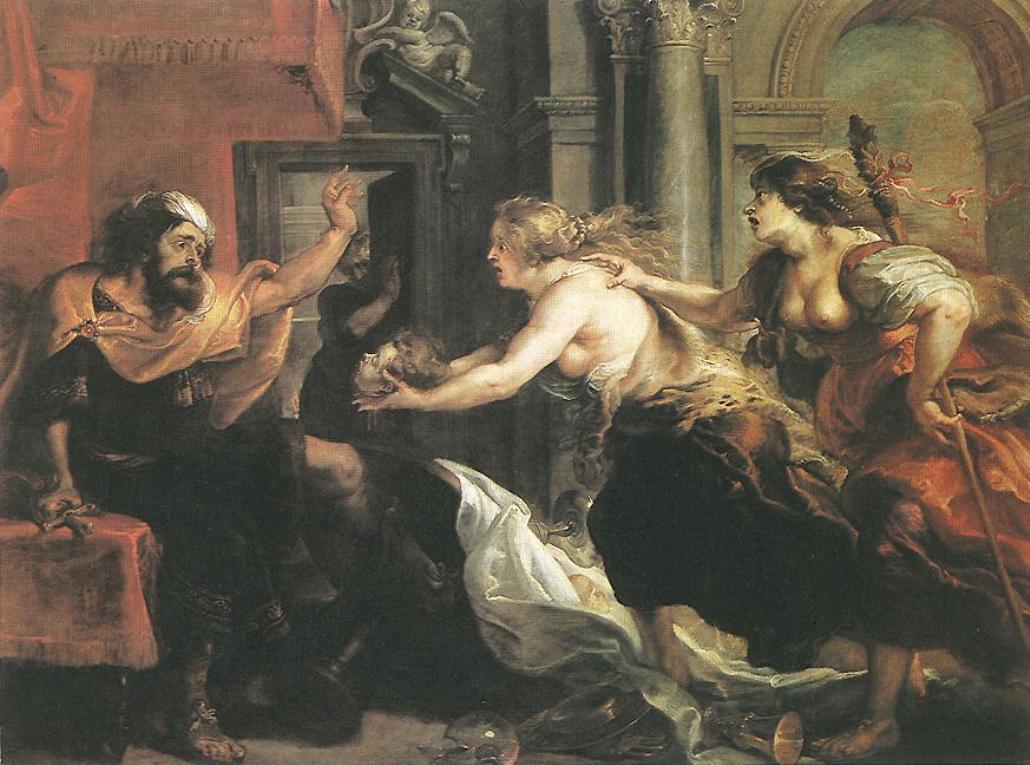
Peter Paul Rubens’ “Tereus Confronted with the Head of His Son Itylus,” painted around 1638, is one of the darkest and most emotionally charged works of his late career. The painting captures the climax of a shocking myth from Ovid’s Metamorphoses: the moment when the Thracian king Tereus discovers that his wife Procne and her sister Philomela have killed his son Itylus and served him to his father as revenge for Tereus’ earlier crimes.
Rubens focuses not on the gruesome act itself, but on the instant of revelation. Procne lunges forward, thrusting the child’s head toward Tereus as proof of what she has done. Philomela restrains her sister and cries out behind her. Tereus recoils in horror, one arm flung up in a futile attempt to ward off what his eyes cannot deny. The entire scene is a storm of motion, cloth, and raw emotion—anger, guilt, terror, and triumph colliding in a single explosive moment.
The Mythological Story Behind the Painting
To fully appreciate Rubens’ interpretation, it helps to recall the disturbing narrative that lies behind it.
Tereus, king of Thrace, married Procne, daughter of the Athenian king Pandion. After several years of marriage, Tereus traveled to Athens and persuaded Pandion to let Procne’s sister Philomela visit Thrace. Once away from her family’s protection, Tereus assaulted Philomela and, to keep her from revealing his crime, cut out her tongue. He then imprisoned her in a remote place and told Procne that her sister had died.
Philomela, unable to speak, wove the story of her suffering into a tapestry and sent it secretly to Procne. Horrified, Procne freed her sister and plotted revenge. During the festival of Bacchus, while the city was distracted, Procne killed her young son Itylus. She and Philomela prepared his flesh as a meal for Tereus. After he had eaten, they revealed the truth, showing him the child’s head. In a rage, Tereus pursued the women with a sword, but the gods intervened, transforming all three into birds.
Rubens chooses the split second when Procne reveals Itylus’ head and Tereus realizes what he has unwittingly consumed. It is the moment when private atrocity erupts into public knowledge, when power reverses and the perpetrator becomes the victim of an equally terrible retaliation.
Composition: A Violent Diagonal of Revelation
Rubens organizes the painting around a dramatic diagonal that runs from the lower right to the upper left. At the right, Philomela and Procne rush forward. Their bodies lean toward Tereus in a powerful surge, arms and garments flying. The diagonal continues through the outstretched arm of Procne as she presents the head, and culminates in Tereus’ recoiling hand and startled face on the far left.
This diagonal of revelation is counterbalanced by a second, subtler diagonal that runs in the opposite direction: from Tereus’ left arm down across his body to the table he grasps for support, then through the twisting white drapery that spills onto the floor beneath the women. The intersection of these lines at the center—where the head is held out—marks the emotional and narrative focus of the scene.
Rubens places the action in a richly articulated architectural interior: marble columns, an arched opening to the sky, carved ornament with small figures above the doorway. These classical elements frame the human drama without distracting from it. The architecture’s stable verticals and arches heighten the sense of chaos in the figures; solid stone contrasts with the swirling movement of people and cloth.
Tereus: Horror, Guilt, and Power Undone
On the left side, Tereus sits or half-rises from a throne-like chair. His body is massive and energetic, but at this moment he is overwhelmed. His left arm throws up a defensive gesture, hand open as if to push away the sight before him. His right hand clutches the edge of the table for support. His face, framed by a dark beard and a turban-like headdress, is twisted with horror and disbelief.
Rubens captures multiple emotions simultaneously: shock at the revelation, revulsion at what he has done unwittingly, and rage at the women who have turned his own child into an instrument of revenge. The king’s mouth is slightly open, suggesting either a shout or a gasp. Shadows deepen around his eyes, giving them a haunted, almost hollow appearance.
Tereus’ richly patterned garment and the luxurious drapery behind him emphasize his royal status. Yet his posture, leaning back and off balance, shows his power slipping away. The arm raised in supposed authority becomes a purely defensive gesture. Rubens thus visualizes the moment when patriarchal control is shattered by female agency and previously hidden truths.
Procne and Philomela: Agents of Terrible Justice
At the heart of the composition stand the two sisters. Procne, closest to Tereus, is nearly nude; her dress has fallen from her shoulders, exposing her torso. She lunges forward on one knee, thrusting the small head toward Tereus with both hands. Her face shows fierce resolve mixed with anguish. This is not a triumphant heroine gloating over vengeance; it is a mother who has sacrificed her own child for the sake of justice and rage.
Her bareness has multiple meanings. It echoes Bacchic frenzy—the story’s revenge takes place during a festival of Dionysus, god of wine and ecstatic excess. It also exposes her vulnerability: in striking back at Tereus, she has stripped herself of maternal identity in the most literal way. Rubens uses the exposed flesh not simply for sensual effect but to heighten the sense of emotional nakedness.
Behind Procne, Philomela grasps her sister’s shoulder, pulling her forward but also seeming to restrain her. Her mouth is open in a cry, her hair flying, her garments swirling in red and gold. Having suffered Tereus’ violence and mutilation, she has become the intellectual architect of this revenge. Yet her expression suggests horror at the extremity of their act, even as she supports it. Rubens captures a complex mix of solidarity, fury, and grief between the two women.
The small head of Itylus, held at the center, is painted with remarkable restraint. Rubens avoids graphic detail. The child’s features are recognizable, but the emphasis lies on his innocence rather than on gore. The horror comes less from what is shown than from the viewer’s knowledge of what has occurred.
Color, Light, and the Emotional Temperature
Rubens uses color and light to intensify the emotional temperature of the scene. Warm reds, oranges, and golds dominate the right side, clustering around the avenging sisters. Procne’s skirt, Philomela’s dress, and the drapery in the background glow with fiery tones, evoking both the Bacchic festival and the burning rage driving their revenge.
On the left, where Tereus sits, the palette shifts toward darker, earthier hues: deep browns, muted reds, and dark fabrics. The bright white of Procne’s fallen garment forms a sharp contrast, slicing across the lower center like a lightning bolt. This white cloth not only leads the eye toward the central action but also suggests purity corrupted or innocence destroyed.
Light falls most strongly on the women’s flesh, illuminating their bodies against the darker setting. Their skin takes on a luminous quality, while Tereus’ face and garments are partially shadowed. This lighting scheme subtly conveys moral emphasis: the women, though guilty of terrible deeds, are also bearers of truth and victims of prior injustice; Tereus, though king, is morally darkened.
In the background, a patch of sky glimpsed through the arch is tinged with soft blues and pinks, almost serene—a distant reminder of another world beyond the palace, indifferent to the private catastrophe unfolding inside.
Baroque Movement and Theatricality
As in many of his works, Rubens infuses this painting with the full theatrical energy of the Baroque. Figures twist and strain; draperies billow; gestures are large and expressive. Yet the movements are not random. All the energy converges toward the central revelation.
The women’s forward rush contrasts with Tereus’ backward flinch, creating opposing forces that heighten tension. The diagonal slant of the head they present adds to the sense of thrust and recoil. Even secondary figures participate in this choreography. A shadowy servant stands in the doorway behind, raising a hand or recoiling, echoing Tereus’ horror. Above, carved stone figures in the architectural decoration seem to lean and writhe, as if the very building reacts to the scene.
This theatricality would have resonated with seventeenth-century audiences accustomed to dramatic stage productions and court masques. Rubens essentially turns Ovid’s story into a frozen theater scene, choosing the most intense emotional moment and rendering it with maximum expressive force.
Psychological Depth and Moral Ambiguity
One of the painting’s most striking qualities is its psychological complexity. No figure is simply heroic or villainous. Tereus is undoubtedly the instigator of the cycle of violence, yet at this moment he is also a father confronting the loss of his child. Procne and Philomela have good reason for their hatred, but the means they choose are horrifying. Rubens lets the viewer feel both sympathy and repulsion for each character in turn.
Procne’s posture in particular communicates moral ambiguity. Her face is taut with determination; she clearly wants Tereus to recognize what he has eaten. But her body, tumbling forward, half-kneeling, seems on the verge of collapse. The viewer senses that once this moment of confrontation passes, she will be left with unbearable grief. Philomela’s cry and restraining grasp reinforce this sense that revenge cannot undo trauma; it can only transform it into another form of pain.
Rubens thus presents the myth not merely as a sensational story but as a meditation on the destructive cycle of violence. Violence begets violence; violation answered with extremity leads only to further fragmentation of families and communities. The gods’ later transformation of the characters into birds can be interpreted as an acknowledgment that such crimes defy continued human existence.
Classical Learning and Artistic Tradition
Rubens was deeply learned in classical literature, and his treatment of this Ovidian theme reflects both scholarly knowledge and engagement with earlier art. Renaissance and Baroque artists had long drawn on the Metamorphoses for dramatic subjects, but the Tereus story was less commonly depicted than other myths like Apollo and Daphne or Perseus and Andromeda, perhaps because of its disturbing content.
By choosing this subject, Rubens demonstrates both erudition and boldness. He also draws on compositional strategies developed in earlier depictions of biblical scenes of confrontation, such as Judith displaying the head of Holofernes or Salome with the head of John the Baptist. The central device of a female figure presenting a severed head to a male authority figure has deep visual roots; Rubens adapts it to a pagan context with his own Baroque dynamism.
The classical architectural background situates the action in an imagined ancient palace. Columns, arches, and carved reliefs anchor the myth in a world of monumental, timeless structures. Yet the drama itself feels contemporary to Rubens’ viewers; the costumes blend antique and early modern elements, making the moral message feel relevant rather than remote.
Rubens’ Late Career and Emotional Intensity
Painted just a couple of years before Rubens’ death, “Tereus Confronted with the Head of His Son Itylus” belongs to the artist’s late period, marked by increasingly free brushwork and heightened emotional expression. Having retired to his estate and suffering from illness, Rubens nonetheless continued to tackle ambitious subjects.
The looseness of the paint handling, especially in draperies and background, contributes to the painting’s sense of immediacy. Colors swirl and merge; edges are softened; the viewer feels the artist’s hand moving rapidly across the canvas. This painterly freedom parallels the uncontrolled emotional outburst depicted in the narrative.
At the same time, Rubens’ long experience allows him to orchestrate complex groups of figures with effortless clarity. The viewer never loses track of who is doing what, despite the tumult. The balance between controlled composition and free brushwork reflects the tension between fate and chaos in the story itself.
Viewing the Painting Today
For contemporary viewers, Rubens’ painting can be challenging because of its disturbing subject. Yet it offers rich opportunities for reflection. The work prompts questions about justice and revenge, the impact of gendered violence, and the ethical limits of retaliation. It also invites comparison with modern stories—literary, cinematic, and real-life—where trauma leads to cycles of destructive reprisal.
At the same time, the painting showcases Rubens’ extraordinary ability to convey emotion through gesture, color, and composition. Even if viewers are unfamiliar with the myth, they can immediately sense the terror, anger, and despair at play. The work functions as both a narrative illustration and a broader exploration of human extremes.
As a piece of Baroque art, it demonstrates how seventeenth-century painters could integrate classical learning, religious sensitivity, and psychological insight into a single dramatic image. It stands alongside Rubens’ more famous altarpieces and mythological scenes as evidence of his range and depth.