Image source: wikiart.org
Introduction to “Portrait of Helena Fourment”
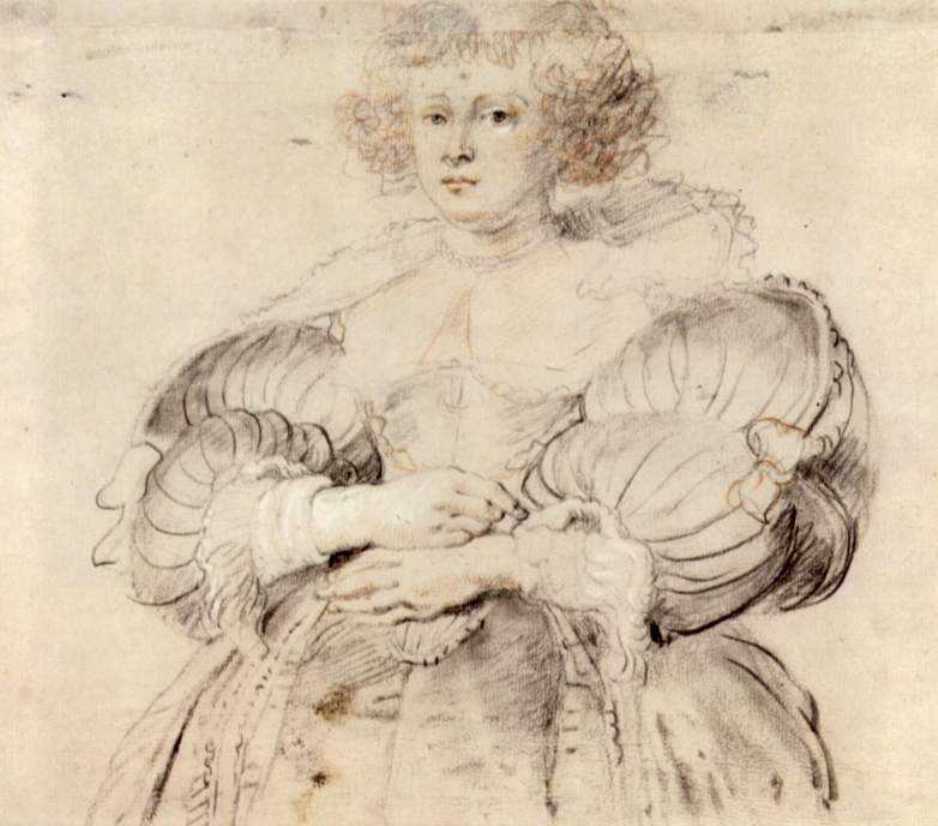
“Portrait of Helena Fourment,” drawn by Peter Paul Rubens in 1638, is an intimate and revealing study of the artist’s young wife. Rather than a fully painted, resplendent portrait meant for public display, this work is a drawing in which Rubens explores pose, expression, and costume with a mixture of precision and spontaneity. The sheet captures Helena in a three-quarter view, hands folded gently at her waist, encased in voluminous, fashionable sleeves that seem almost as important as her face.
What makes this portrait remarkable is its unfinished quality. Parts of the dress are carefully modeled, while other areas remain mere outlines or hints of volume. The result is that we see Rubens thinking on paper, building up his wife’s presence through successive layers of line and shading. The drawing is both a likeness of Helena Fourment and a window into the creative process of one of the greatest Baroque masters.
Historical Context and Helena’s Place in Rubens’s Life
Helena Fourment entered Rubens’s life in 1630 when he married her after the death of his first wife, Isabella Brant. She was significantly younger than the painter and quickly became a central figure in his domestic and artistic world. Helena appears in many of Rubens’s late works, sometimes as herself in portraiture, sometimes disguised as Venus, a shepherdess, or an allegorical embodiment of love and abundance.
By 1638, when this drawing was made, Rubens was an established, wealthy artist with a large household and several children by Helena. He had withdrawn somewhat from diplomatic duties and focused increasingly on his family and his estates. This portrait belongs to that late phase in which his art, though still grand when required, acquired a greater sense of intimacy and personal affection.
Unlike the state portraits or mythological canvases intended for royal patrons, this drawing likely served a more private purpose: a preparatory study for a painted portrait, a record of Helena’s appearance in a particular costume, or simply an exercise in capturing her presence. It reveals a domestic, contemplative side of Rubens that balances his better-known public persona.
Composition and Pose
Rubens positions Helena in a modest yet dignified pose. She stands facing slightly to her right, her head turned toward the viewer. Her hands are gently clasped at her midsection, fingers loosely intertwined. This pose creates a quiet triangle that stabilizes the figure and conveys composure.
The composition fills the sheet without feeling cramped. Rubens crops the figure just below the hips, allowing the viewer to focus on the upper body, elaborate sleeves, and hands. The shoulders are slightly rounded, suggesting relaxed posture rather than stiff formality. Helena’s head is relatively small in relation to the breadth of her sleeves and bodice, an effect that emphasizes the fashion of the time as much as the individual.
There is no detailed background. The empty space surrounding the figure keeps the attention on Helena herself and heightens the sense that this is a working study, not a finished court portrait. A faint horizon of graphite marks hints at a suggestion of space, but Rubens resists the temptation to elaborate. The simplicity of the setting allows the viewer to encounter Helena almost as if she were emerging from the blank page.
Expression and Character
Helena’s expression is gentle, reserved, and slightly introspective. Her lips are closed, and her gaze meets the viewer without overt flirtation or theatricality. Rubens renders her eyes with small, precise strokes that capture both the reflective light on the pupils and the softness of the surrounding lids. There is a hint of curiosity in her gaze, as though she is aware of being studied by someone she trusts.
Her face is rounded, with softly modeled cheeks and a delicate chin. Rubens suggests the texture of her skin through subtle shading, avoiding harsh contours. This softness reinforces the impression of youth and vitality. The faint blush suggested around the cheeks and nose further humanizes the portrait; Helena is not an idealized statue but a living, breathing woman, caught in a quiet moment.
The modesty of her expression contrasts with the extravagance of her dress. While the costume proclaims wealth and status, the face remains simple and sincere. Rubens thereby balances the social role of Helena—as the wife of a famous and prosperous artist—with an intimate, personal vision of her inner calm.
Costume and the Drama of the Sleeves
One of the most striking features of the drawing is Helena’s dress, particularly the enormous, puffed sleeves. Rubens lavishes attention on these forms, building them up with curved lines, layered shading, and delicate accents that suggest their structure. The sleeves are arranged in segmented bands, each swelling outward before tucking back into the seams. Their volume emphasizes Helena’s slight waist and makes her hands appear smaller and more delicate.
The central bodice is only lightly indicated but clearly structured. There is a sense of boning or stiffening beneath the fabric, as was typical of seventeenth-century fashion. Rubens sketches the vertical seams and the suggestion of lacing, offering just enough detail to anchor the figure’s torso. The neckline is high, likely framed with lace or a ruff that Rubens barely hints at with light strokes. This choice of costume underscores Helena’s respectability and modesty, even as her social standing is advertised through sumptuous tailoring.
Around the waist, Rubens begins to explore the folds and fall of the skirt, though he does so more suggestively than in the sleeves. The lower part of the dress descends toward the bottom of the sheet in a series of broad, sweeping lines. They provide a sense of movement and weight but stop short of full elaboration, reinforcing the idea that this is a preparatory study rather than a finished showcase.
Line, Medium, and the Unfinished Surface
The drawing appears to be executed primarily in black chalk with touches of red or brown chalk and possibly some light wash. Rubens uses the black chalk to define contours, build up shadow, and articulate the intricate forms of the sleeves. Redder tones may be used sparingly in the face and hands to suggest warmth and blood under the skin.
One of the most fascinating aspects of the work is the visible evolution of the drawing. Certain lines are firm and decisive, while others are tentative, overlapping, or abandoned. For example, the outlines of the sleeves show areas where Rubens adjusted their curve or size, leaving ghost lines that reveal his experimentation. The hands are built up with multiple strokes, some slightly misaligned, indicating that he was searching for the exact placement and gesture.
The upper part of Helena’s hair and parts of her dress remain sketchy. Her curls are suggested through looping, airy lines rather than fully modeled volume. The absence of heavy shading in the hair allows the viewer to feel the lightness and fluffiness of her hairstyle. At the same time, the contrast between the detailed sleeves and less finished head creates a sense of hierarchy: the artist seems first concerned with the overall pose and costume silhouette, leaving finer facial detailing for last or for transfer into an oil painting.
The unfinished areas contribute to the drawing’s charm. We witness Rubens’s working method, the oscillation between observation and invention, between looking at Helena and building a conceptual image of her on the page.
The Hands and the Language of Gesture
Though lightly drawn, Helena’s hands play a crucial role in the portrait’s mood. They are folded one over the other at her midsection, fingers gently curved, thumbs touching. There is no tension in the fingers; they rest naturally, suggesting poise and self-containment.
Rubens pays particular attention to the articulation of knuckles and the subtle planes of the fingers. Even in their partial state, the hands feel three-dimensional and expressive. They convey not only modesty but also a sense of inwardness, as if Helena is quietly keeping her thoughts to herself.
The placement of the hands also reinforces the triangular compositional structure and draws the viewer’s eye to the center of the figure. They act as a visual hinge between the massive sleeves, the bodice, and the descending skirt. In many of Rubens’s portraits, hands are key indicators of character; here, their modest containment echoes the quiet dignity of Helena’s facial expression.
Comparison with Painted Portraits of Helena
Rubens painted Helena numerous times in oil, often in sumptuous color with flowing fabrics and luminous flesh. Compared with those painted portraits, this drawing feels more introspective and less theatrical. The lack of color removes the dazzling distraction of rich satins and jewels, allowing us to focus on structure, line, and personality.
In some painted portrayals, Helena appears as an ideal of beauty, with radiant skin, elaborate hairstyles, and a hint of flirtatious charm. In the 1638 drawing, she is more restrained. The high neckline and enclosed sleeves present her in a more formal, almost demure mode. This suggests that Rubens was exploring different aspects of her persona: the glamorous muse suited for allegorical roles and the dignified matron appropriate for a more conventional portrait.
The drawing may have served as a preparatory step toward such a painted portrait. Rubens could work out the arrangement of sleeves, bodice, and gesture before committing the composition to canvas. Even if no direct painted counterpart survives, the drawing remains a crucial link in understanding how Rubens approached likeness and costume design for his wife.
Intimacy, Status, and the Role of the Artist
“Portrait of Helena Fourment” sits at the intersection of personal affection and social representation. On one hand, it is a portrait of a beloved wife, drawn with a familiarity that could only come from close daily observation. On the other, it reflects the expectations of portraiture in Rubens’s time, where clothing, pose, and demeanor conveyed rank and respectability.
Helena’s elaborate sleeves, expensive fabrics, and composed stance speak of a woman of considerable status—the spouse of a wealthy, celebrated artist and property owner. Rubens’s decision to dedicate so much effort to the costume underscores his pride in the position he and his wife occupied in Antwerp society. Yet the softness of her expression and the intimate scale of the drawing counterbalance any sense of cold formality.
The work also reminds us of Rubens’s role as both husband and interpreter. Through his hand, Helena’s presence is translated into a language of line and shadow. The drawing not only records her appearance but also reveals how he saw her—calm, dignified, and enveloped in the fashions of her day yet marked by an inner stillness.
The Drawing as a Record of Time
By 1638, several years into his marriage with Helena, Rubens was living a life divided between urban studio and countryside retreat. This drawing captures a moment in that period—a snapshot of Helena perhaps in preparation for a social event or simply wearing one of her finer gowns. Because of its unfinished state, the portrait feels fleeting, like a paused moment rather than a polished, timeless icon.
For modern viewers, this lends the work a sense of immediacy. We can imagine Helena standing in the studio, perhaps only briefly, while Rubens rapidly blocked in the structure of her dress and features. The sheet then becomes not just a representation of a person but evidence of an encounter between artist and sitter, husband and wife, in a specific time and place.
As a record, the drawing has historical value. It reveals details of dress construction, hairstyle, and the bodily ideals of seventeenth-century Flanders. It also complements painted images of Helena, providing a more candid, less glossed-over view of her appearance. In this sense, the drawing bridges the gap between private life and public art.
Legacy and Contemporary Appreciation
Today, “Portrait of Helena Fourment” is appreciated not only as a portrait of an individual but also as an exemplary Baroque drawing. It shows how great painters used drawing as a thinking tool—testing ideas, adjusting proportions, and exploring personality before embarking on more elaborate projects.
For viewers, the work offers a quieter counterpoint to Rubens’s large, colorful canvases filled with mythological action. Here, the drama is internal and subtle, residing in the play of line around a sleeve, the soft shading of a cheek, or the gentle fold of two hands. The drawing invites slow looking, encouraging us to follow each stroke and to imagine the decisions behind it.
In a broader sense, the portrait speaks to enduring themes: partnership, domestic pride, and the desire to preserve a loved one’s image on paper. It reminds us that behind Rubens’s grand public achievements lay a world of small, intimate studies that sustained his vision and gave depth to his representations of humanity.
