Image source: wikiart.org
Introduction to Peter Paul Rubens’s “Saturn”
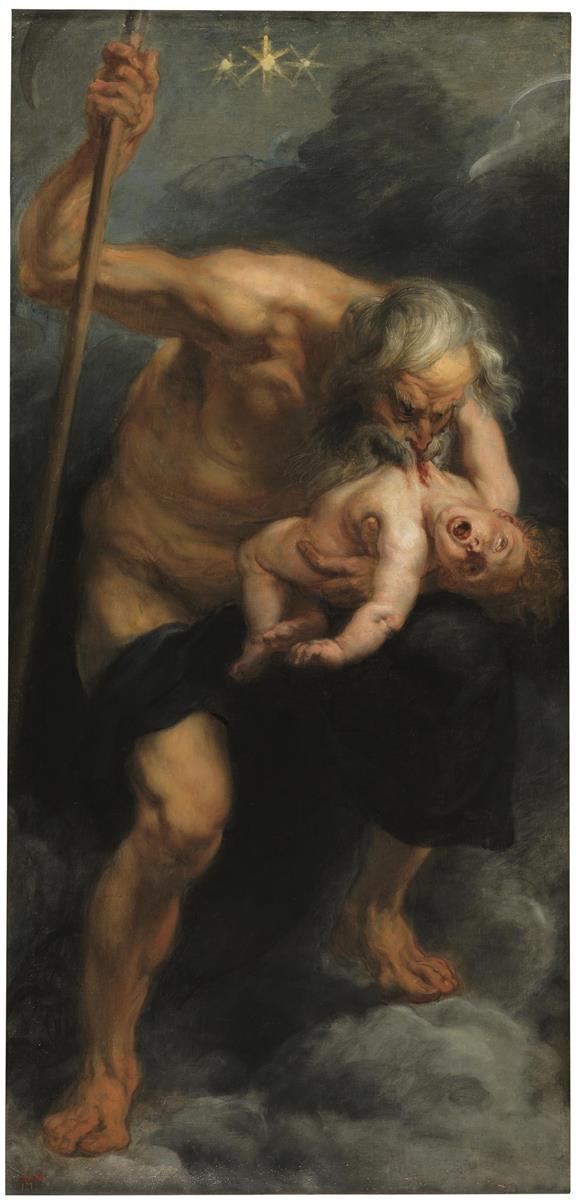
Peter Paul Rubens’s “Saturn,” painted in 1638, is one of the most disturbing and psychologically intense works of the Baroque era. The tall, narrow canvas shows the bearded titan Saturn (the Roman equivalent of the Greek Cronus) in the act of devouring one of his children. Naked except for a dark cloth around his waist, he clutches the writhing child against his chest and sinks his teeth into the small body. In his other hand he raises a scythe, while an hourglass hovers in the clouds above.
This terrifying image fuses mythological narrative with allegory. In classical tradition Saturn is both the father of the gods and a personification of Time, who ultimately destroys everything it creates. Rubens’s painting thus works simultaneously as a literal story of infanticide and a symbolic statement about mortality, power, and the passage of time.
Mythological Background: Saturn, Cronus, and the Devouring Father
The subject of Saturn devouring his child comes from Greco-Roman mythology. Cronus (Saturn) overthrew his own father Uranus and became ruler of the universe. A prophecy warned him that he would, in turn, be overthrown by one of his children. To prevent this, he swallowed each child at birth. His wife Rhea, desperate to save at least one offspring, tricked him by substituting a stone for the infant Zeus (Jupiter), who eventually defeated his father and released his siblings from the titan’s belly.
By Rubens’s time, this myth had become a popular allegory for Time, which consumes all created things, and for tyrannical power willing to destroy its own heirs to maintain control. Humanist writers and artists treated Saturn as a melancholic, destructive force, the dark counterpart to beneficent gods like Apollo. Rubens, steeped in classical literature, translates this complex figure into raw, physical immediacy.
Composition and Vertical Drama
The painting’s tall, narrow format intensifies its sense of looming menace. Saturn fills nearly the whole height of the canvas, his muscular body charged with tense energy. He stands on swirling gray clouds, suggesting a mythic, celestial setting rather than a specific earthly place. The vertical thrust of his figure, from bare feet through straining torso up to the raised scythe, gives the impression that he towers over the viewer, making the scene inescapably confronting.
The child’s small body is positioned diagonally across Saturn’s chest, head tilted backward, arms flailing. This diagonal line cuts sharply across Saturn’s vertical mass, creating a visual clash that echoes the violent action. The child’s pale flesh stands out against the darker tones of Saturn’s torso and the surrounding clouds, directing the eye immediately to the center of the horror.
Rubens keeps the background relatively bare, with only shadowy clouds and the symbolic hourglass and star-like device above. This emptiness heightens the focus on the interaction between father and child; there is no distraction, no relief, only the stark confrontation between devourer and victim.
Saturn’s Body: Muscular Power and Decaying Age
Rubens’s Saturn is both powerful and old. His body is massive, with bulging shoulders, thick thighs, and strong forearms. The artist’s expertise in anatomy is evident in the way muscles flex as Saturn grips the child and leans forward. At the same time, his skin and features show the signs of age: sagging flesh, veined hands, a long gray beard flowing across his chest.
This combination of strength and age is crucial to the painting’s meaning. Saturn is not a young warrior but an aging tyrant desperately clinging to power. His muscularity demonstrates that he is still dangerous, yet the gray hair and deeply furrowed brow suggest fear and paranoia. He knows time is against him, and in his anxiety he becomes time itself, consuming the future embodied in his children.
His posture is hunched and tense, almost animalistic. He bends over the child as if shielding the act from view, yet the angle of the scene exposes it to us. His entire body seems coiled around the violent impulse, creating a visual metaphor for obsession: Saturn is trapped in his own dreadful necessity.
The Child: Vulnerability and Terror
The infant in Saturn’s arms is painted with wrenching realism. The body is chubby, soft, and completely powerless against the old titan’s grip. One tiny hand presses feebly against Saturn’s chest; the legs kick outward. The head is thrown back, mouth open in a scream, eyes wide with terror.
Rubens’s rendering of the child intensifies the viewer’s emotional response. Unlike more stylized mythological figures, this baby looks like a real, living child, the kind Rubens often painted in tender family scenes and religious depictions of the Christ Child. That familiarity makes the violence all the more shocking.
The blood at the child’s chest, where Saturn’s teeth bite into flesh, is suggested with restrained but unmistakable touches of red. Rubens does not revel in gore; he shows just enough to make the act undeniable. The horror lies less in explicit detail than in the psychological impact of seeing innocence attacked by overwhelming force.
Light, Color, and Atmosphere
The overall color scheme is subdued, dominated by grays, browns, and muted flesh tones. The background clouds swirl in dark, smoky hues, giving the impression of a stormy sky or a cosmic void. Against this somber environment, the skin of both Saturn and the child glows with a sickly, golden light, as if illuminated by a distant, dying sun.
Light comes from above and slightly to the left, casting shadows across Saturn’s body and emphasizing the sculptural modeling of his muscles. Highlights on the child’s limbs draw attention to the tiny form caught in the giant’s grasp. The subtle sheen on Saturn’s scythe and the faint glimmer of the hourglass catch the eye, reinforcing their symbolic importance.
The restricted palette and moody lighting create an oppressive atmosphere. There is no bright escape, no comforting color. Everything contributes to a sense of inevitability, as if we are witnessing a dark cosmic law enacted before our eyes.
Iconography: Time, Devouring, and Cosmic Order
Rubens adds clear allegorical symbols to the mythological scene. The scythe in Saturn’s left hand is a traditional attribute of both the god Saturn and the figure of Time. It is the tool of harvest, cutting down grain at the moment of ripeness. Here it signifies the cutting down of life itself, regardless of age or innocence.
Above Saturn’s head floats an hourglass suspended in the clouds. The hourglass is one of the most common emblems of time’s passage and the brevity of human life. Its placement above the titan reinforces his identification with Time itself: he is not merely a father acting out of jealousy; he is the force that ensures everything eventually perishes.
Taken together, these symbols transform the act of cannibalism into an allegory of universal mortality. The child stands for all living beings, perpetually threatened by the relentless advance of time. Saturn devours his offspring because time inevitably consumes the future. Rubens thus invites viewers to contemplate not only the myth but their own vulnerability to aging and death.
Psychological and Moral Dimensions
Beyond allegory, “Saturn” operates on a psychological level. The painting confronts viewers with an extreme version of parental fear, dominance, and destruction. The father, instead of protecting his child, becomes its executioner. This inversion of the natural order is what makes the scene so deeply unsettling.
At the same time, Saturn’s expression can be read as tormented, not triumphant. His brow is furrowed, his eyes narrowed, his mouth locked in a grim line as he bites. He appears driven by compulsion rather than pleasure. Rubens suggests that Saturn is a prisoner of his own fear of being overthrown. In trying to control the future, he destroys it and condemns himself to eternal guilt.
This portrayal may reflect broader anxieties about political and religious authority in Rubens’s time. Rulers who cling to power by violence, eliminating rivals and heirs, can be seen as modern Saturns. The painting thus doubles as a cautionary image of tyranny: a regime that devours its own children ultimately undermines the very legacy it seeks to preserve.
Comparison with Other Depictions of Saturn
Perhaps the most famous later depiction of this subject is Francisco Goya’s “Saturn Devouring His Son,” painted in the early nineteenth century. Goya’s version is even more nightmarish, with wild eyes and mutilated body parts, but Rubens’s earlier painting laid important groundwork.
Rubens’s Saturn is more classically proportioned and his violence more controlled, yet the psychological horror is comparable. Where Goya plunges fully into insanity, Rubens balances terror with allegorical clarity. His Saturn is a rational, if desperate, figure, still recognizable as a god and personification of time.
Compared to earlier Renaissance depictions, which often show Saturn swallowing a child more symbolically or in a crowded mythological scene, Rubens’s painting is strikingly focused. He eliminates distractions and places the viewer alone with the titan, emphasizing intimate confrontation rather than distant contemplation.
Rubens’s Late Career and Patronage Context
Painted in 1638, “Saturn” belongs to Rubens’s final years, when he was working largely from his country estate near Antwerp. By this time he was an internationally celebrated artist and had already completed grand cycles for royal patrons such as Marie de’ Medici and the Spanish Habsburgs.
This painting is thought to have been part of a series of mythological works commissioned for a princely collection, possibly intended to hang alongside personifications of the planets or allegories of the senses. Within such a cycle, Saturn would represent both the planet associated with melancholy and the destructive aspect of time.
Rubens’s late style combines the energetic brushwork of his earlier years with a looser, more atmospheric handling of paint. In “Saturn,” this results in a surface that feels almost smoky, with edges dissolving into the surrounding clouds. The blending of forms enhances the sense of motion and instability, as if the scene might dissolve at any moment into mist—another reminder of transience.
Viewing Experience and Emotional Response
Encountering “Saturn” in person, viewers are struck first by the painting’s scale and verticality. The life-size titan looms over them, creating a physical sensation of being dwarfed and threatened. The close-up framing, with no safe distance or barrier, intensifies the impact.
Emotionally, the painting generates a complex mixture of horror, fascination, and reflection. The initial response may be revulsion at the sight of a child in peril. Yet as the eye lingers, other feelings emerge: pity for the terrified child, unease at the father’s compulsion, and an awareness of the allegorical message about time and mortality.
Rubens does not provide moral reassurance within the scene itself. There is no Zeus arriving to save the child, no hint of eventual justice. Instead, he leaves viewers to grapple with the image and draw their own conclusions. The painting thus functions as a kind of visual memento mori, a reminder of death and the fragility of life that is impossible to ignore.
Legacy and Contemporary Relevance
“Saturn” continues to be one of Rubens’s most discussed works because it addresses themes that remain painfully current: the abuse of power, the sacrifice of the young to the ambitions of the old, and the inexorable passage of time. In modern discussions, the image can resonate with debates about war, environmental degradation, or any situation in which future generations pay the price for present fears and desires.
Artistically, the painting demonstrates Rubens’s range. Known for lush altarpieces, sensual nudes, and vibrant landscapes, he could also delve into the darkest corners of myth and human psychology. “Saturn” stands as a precursor to later explorations of horror and the grotesque in art, showing how Baroque painting could confront viewers with uncomfortable truths rather than only offering beauty or pious comfort.
By blending myth, allegory, anatomy, and emotion, Rubens created in “Saturn” a work that is as intellectually rich as it is viscerally shocking. It invites repeated viewing and interpretation, challenging each generation to reconsider what it means for time—and those who wield power—to devour their own offspring.