Image source: wikiart.org
Introduction to “Helene Fourment with her Children”
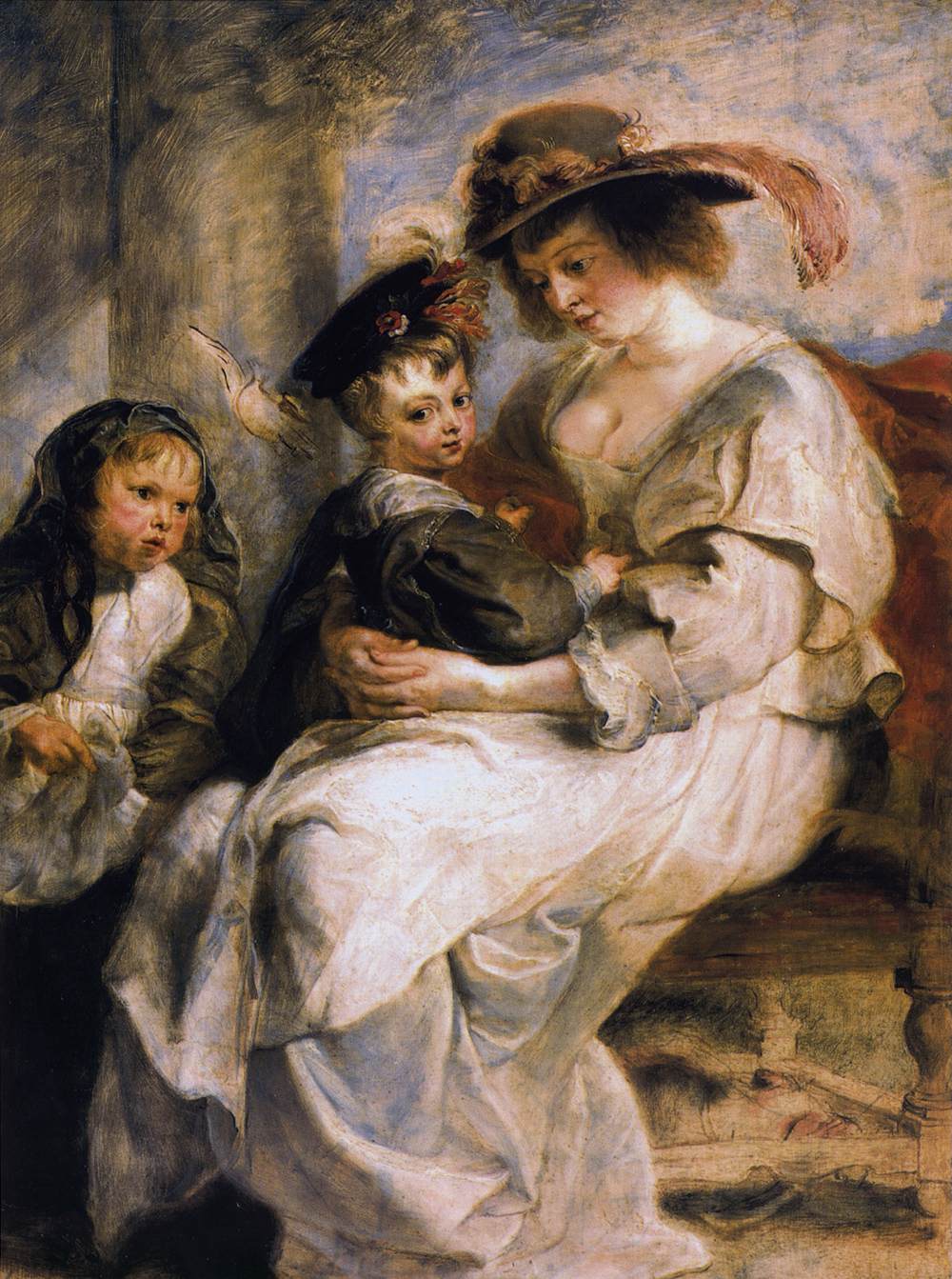
“Helene Fourment with her Children,” painted by Peter Paul Rubens in 1637, is one of the most tender and intimate works of his late career. Instead of mythological gods or heroic warriors, the central figure is Rubens’s young second wife, Helene, seated with two of their children gathered close around her. The painting is a celebration of domestic affection and maternal warmth, rendered with the same opulent color and fluid brushwork that characterize his grand Baroque masterpieces.
The picture offers more than a family snapshot, however. It is a carefully composed image of motherhood, social status, and marital happiness. In the gentle tilt of Helene’s head, the protective circle of her arms, and the curious gazes of the children, Rubens crystallizes an ideal of family life that is rooted in his own experience yet speaks to universal emotions.
Historical Context and the Role of Helene Fourment
By the mid-1630s Rubens was entering the final decade of his life. Widowed from his first wife, Isabella Brant, he had married the much younger Helene Fourment in 1630. She became his companion, muse, and the mother of several children. Many of his late works reflect his happiness in this new marriage and his delight in country life at his estate of Het Steen.
Helene appears repeatedly in Rubens’s paintings, both in formal portraits and as the model for goddesses and allegorical figures. In this work, however, she is not disguised as Venus or a personification of abundance; she is shown simply as herself, a young mother with her children around her. The painting is therefore a rare and valuable insight into the private world of a famous Baroque artist.
At the same time, Rubens is conscious of Helene’s role as the mistress of a prosperous household. Her elegant dress, feathered hat, and composed demeanor signal her status. The children’s fine clothing and expressive individuality convey the pride of a father who has achieved both professional renown and domestic fulfillment.
Composition and Grouping of Figures
Rubens structures the composition around a triangular arrangement with Helene at the apex. Seated in three-quarter view, she occupies the right half of the canvas, her body turned toward the two children at her side. One child sits on her lap, leaning back against her chest; the other stands to the left, closer to the viewer, slightly separated but still pulled into the intimate circle.
The triangular configuration creates stability and unity. Helene’s white dress, with its broad skirt spreading over her knees, forms the base of the triangle, while her head and feathered hat rise to its peak. The children’s smaller forms nestle within this structure, suggesting that they are physically and emotionally anchored by their mother. The gentle curve of Helene’s arms around the child on her lap reinforces this sense of protection and enclosure.
The background is kept relatively simple: a neutral wall, a hint of architectural form, and a warmly colored seat. This restraint ensures that the viewer’s attention remains on the human relationships rather than on setting. Yet Rubens subtly uses the background to enhance spatial depth, with diagonal lines and tonal shifts that suggest a real, inhabitable space.
Helene’s Presence: Mother, Woman, and Muse
Helene dominates the painting through both scale and presence. Her dress is rendered in flowing whites and creams, catching light in soft highlights along the folds and edges. The neckline is low, revealing a modest but unmistakable décolletage, which emphasizes her femininity and sensual appeal even in the context of motherhood. Rubens does not separate maternal tenderness from conjugal attraction; for him, they coexist as aspects of the same beloved woman.
Her hat, adorned with a plume and possibly flowers, adds a note of elegance and playfulness. It frames her face and draws attention to her soft features: the slightly rounded cheeks, the small mouth, and the gaze directed downward toward the child in her lap. Her expression is gentle, absorbed, and quietly attentive. She is neither posing stiffly nor distracted; she is fully engaged with her children.
The way Helene’s hands hold the child is crucial. One hand supports the child’s back while the other rests lightly on his arm. The touch is firm enough to signal security yet relaxed enough to convey trust and ease. This physical contact is the core of the painting’s emotional message: the mother as a source of comfort and stability.
The Children and Their Individual Characters
Rubens gives each child a distinct personality. The child on Helene’s lap, often identified as the couple’s young son, looks outward toward the viewer with a blend of curiosity and self-possession. He wears a dark outfit with a white collar and a small feathered cap echoing his mother’s hat. The parallels in clothing and pose underline the bond between them and hint at the boy’s future role as heir to the family’s social standing.
His gaze is one of the focal points of the composition. It establishes a link between the intimate world inside the painting and the outside viewer. Through that gaze, the viewer becomes a participant in the family scene, acknowledged by the child and, by extension, by Rubens himself.
The child standing at the left is slightly more withdrawn. Dressed in lighter tones with a dark hood or veil framing the face, this child looks sideways toward Helene and the sibling on her lap. The expression is thoughtful and perhaps a little shy, as if observing rather than actively joining the central interaction. The position near the edge of the canvas and the slight bend in the posture suggest that this child is on the threshold between being an observer and joining the embrace.
By differentiating the children in this way, Rubens captures the variety that exists within a family: one child outgoing and connected to the viewer, the other more introspective and attuned to the internal dynamics between mother and sibling.
Light, Color, and Painterly Surface
The painting is suffused with warm, diffused light. It seems to enter from the left, bathing Helene’s face and upper body in a gentle glow and creating subtle shadows on her dress. The children’s faces are similarly illuminated, giving their skin a soft, rosy hue. This lighting reinforces the painting’s mood of calm intimacy, as if the family were seated near a window in a quiet room.
Rubens’s color palette is dominated by creamy whites, warm browns, and soft reds. The largest area of color is Helene’s white dress, which serves as a luminous backdrop for the more saturated tones of the children’s clothing and her hat. The red lining of the seat and the touches of red feathers provide accents that enliven the composition without overwhelming it.
The brushwork is characteristically loose and energetic, especially in the fabrics and background. Rubens allows strokes to remain visible, giving the surfaces a sense of movement and vitality. In contrast, he devotes more careful blending and detail to the faces and hands, where emotional nuance resides. This contrast between painterly exuberance and controlled precision is one of the hallmarks of his mature style.
Intimacy and Social Status
“Helene Fourment with her Children” presents a private moment, but it also functions as a statement of social identity. Helene’s clothing and hat, the refined yet comfortable setting, and the children’s fine attire all signal a prosperous household. Rubens was not only a famous artist but also a respected citizen and landowner; this painting quietly affirms that status.
At the same time, the emphasis on intimacy counters any impression of cold formality. The viewer sees not a stiff dynastic portrait but a living family interaction. The social message is thus a nuanced one: wealth and status are acknowledged but presented as the context for genuine affection and domestic happiness.
This dual character reflects Rubens’s own position. He moved in aristocratic and royal circles, yet he also cherished his role as husband and father. In portraying Helene with their children, he aligns himself with an ideal of noble domesticity that would have appealed to his contemporaries and continues to resonate today.
Comparison with Rubens’s Other Family Portraits
This painting forms part of a broader group of works in which Rubens portrays himself and his family. Earlier, he had painted intimate images of his first wife, Isabella Brant, and later he created scenes such as “The Garden of Love,” where Helene appears among other fashionable figures in an idyllic garden. In those works she participates in a larger social spectacle; here she is the central focus.
Compared to more formal portraits, “Helene Fourment with her Children” is relaxed and spontaneous. The pose is less rigid, the setting more casual, and the emotional tone more personal. The children’s unposed expressions and slight gestures—one tugging at a garment, the other leaning against the mother—convey a sense of reality that suggests Rubens worked from close, affectionate observation.
The painting also echoes his religious images of the Virgin and Child. Helene holding her child on her lap, with another child standing nearby, recalls countless Madonna compositions. Without overt religious symbols, the painting nonetheless infuses maternal love with a sense of dignity and grace associated with sacred imagery, subtly elevating the everyday to something almost devotional.
Emotional Resonance and the Theme of Motherhood
At its core, “Helene Fourment with her Children” is a meditation on motherhood. Helene’s body creates a protective enclave; her lap becomes a secure space where the child rests. The composition, lighting, and gestures all converge to reinforce the idea of the mother as a source of comfort, security, and nurturing.
Yet Rubens does not idealize motherhood in a distant or abstract way. The children’s slight restlessness, the crumpled fabric, and the casual tilt of Helene’s hat all suggest the reality of daily life with young children. It is precisely this combination of ideal and real that makes the painting emotionally convincing. Viewers can sense both the tenderness of the scene and the lived experience behind it.
The painting may also reflect Rubens’s contemplation of legacy and continuity. By 1637 he was aware that he was in the later stage of his life, and these children represented the future of his family line. The affection with which he paints them can be read as an expression of hope and pride, as well as an acknowledgment of time passing.
Painterly Intimacy and the Viewer’s Role
Rubens invites the viewer into this family circle through compositional choices. The closeness of the figures to the picture plane, the direct gaze of the child on Helene’s lap, and the open body language make the space feel accessible. We are not kept at a respectful distance as in some formal portraits; instead, we appear to stand just a step away, as though we had entered the room and caught them in a natural pose.
This proximity enhances the painting’s intimacy. The viewer almost feels the texture of the fabrics, the warmth of the skin, and the softness of the children’s hair. The visible brushstrokes contribute to this tactile impression, as if the act of painting were itself an affectionate caress.
At the same time, the painting maintains a degree of modest reserve. Helene’s gaze is downward; she does not confront the viewer directly. This keeps the focus on her relationship with the children and reminds us that we are respectful observers of a private moment rather than active participants.
Lasting Significance and Contemporary Appeal
“Helene Fourment with her Children” continues to captivate modern audiences because it speaks so directly to enduring human experiences: family love, parental care, and the small, quiet moments that define domestic life. Even viewers unfamiliar with Rubens’s wider oeuvre can respond to the tenderness of Helene’s embrace and the individuality of the children.
For those interested in art history, the painting demonstrates how a Baroque master who often dealt with grand historical and mythological narratives could turn his skills to intimate subjects without losing intensity. The same qualities that animate his large altarpieces—dynamic composition, rich color, and expressive gesture—are present here, but they are harnessed to a different emotional register: not awe and drama, but affection and warmth.
The work also enriches our understanding of Rubens as a person. It reveals that behind the public figure of the celebrated painter stood a man deeply attached to his family, attentive to the nuances of his wife’s character and the personalities of his children. In this sense, the painting functions as both a masterpiece of portraiture and a visual document of a loving household in seventeenth-century Flanders.
