Image source: wikiart.org
Introduction to Rubens’s “Massacre of the Innocents”
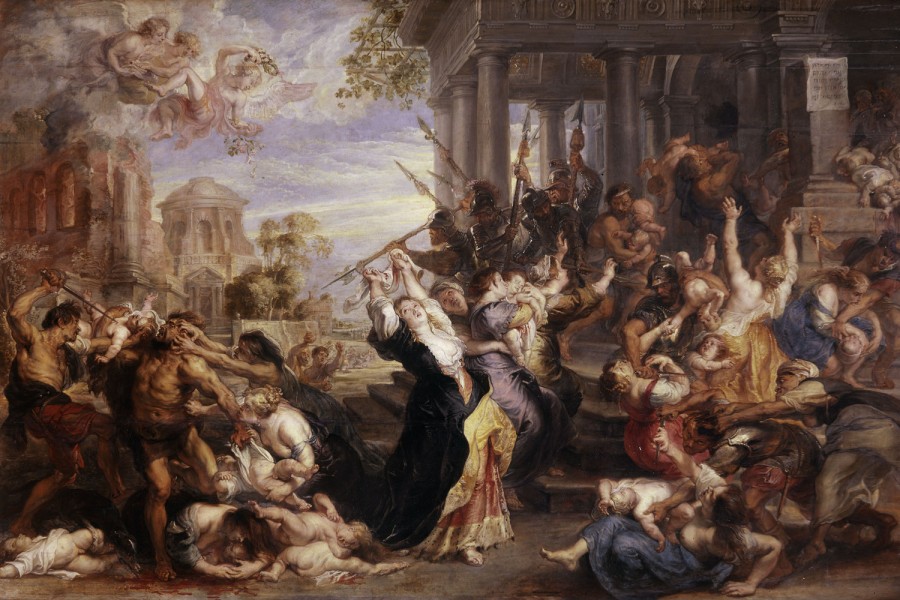
Peter Paul Rubens’s “Massacre of the Innocents,” painted around 1637, is one of the most powerful and harrowing images of the Baroque period. The canvas depicts the biblical episode from the Gospel of Matthew in which King Herod orders the slaughter of all male infants in Bethlehem, hoping to eliminate the newborn Christ. Rubens transforms this story into a swirling cataclysm of bodies, screams, and flashing steel.
Across the surface of the painting mothers fight desperately to save their children, soldiers strain and stab, and infants lie lifeless on the ground. At the same time, monumental architecture and a luminous sky remind us that this horror unfolds within a broader historical and spiritual framework. The painting fuses religious drama with contemporary reflections on war and cruelty, mirroring the violence that ravaged Europe in Rubens’s own lifetime.
Biblical and Historical Context
The subject originates in Matthew 2:16–18, where Herod, alarmed by the prophecy of a new “king of the Jews,” orders the killing of all male children two years old and under. In Christian tradition this massacre becomes the first martyrdom associated with Christ, and the murdered children are venerated as the “Holy Innocents.”
By the seventeenth century the story was frequently used in Catholic art to condemn tyranny, emphasize the fragility of human life, and provoke empathetic sorrow that could lead to spiritual reflection. Rubens, working in the wake of the Counter-Reformation, understood the power of such themes to stir viewers’ emotions and draw them into contemplation of divine justice and mercy.
At the same time, Rubens lived through the brutal conflicts of the Eighty Years’ War and the Thirty Years’ War. News of sieges, massacres, and civilian suffering was widespread. “Massacre of the Innocents” can thus be seen not only as a biblical narrative but also as a meditation on the horrors of war and state violence in his own era.
Overall Composition and Visual Chaos
The painting is built on a complex network of diagonals that create a sense of chaotic motion. There is no empty space: every inch of the canvas is filled with figures, architecture, or sky. The central axis is formed by a woman in black and gold, arms flung upward as she tries to wrench her child away from a soldier. Around her, other mothers and soldiers interlock in a tumultuous knot of bodies.
Rubens organizes the scene in three broad zones. In the foreground, close to the viewer, the most brutal actions occur: children are torn from their mothers, bodies lie sprawled, and muscular executioners swing swords high. The middle ground, dominated by a staircase and colonnade, shows more soldiers and women engaged in struggle. In the background, classical ruins and distant buildings situate the event within an urban landscape that suggests both antiquity and Rubens’s contemporary world.
Despite the pandemonium, the composition is carefully controlled. Triangular groupings of figures repeat across the canvas, stabilizing the mass of movement. The strong verticals of columns and architecture counter the diagonals of limbs and weapons. The result is a scene that feels overwhelming but never visually incoherent.
Central Group: The Heart of the Tragedy
At the emotional core of the painting is the woman in the black dress with a golden underskirt, positioned near the center. Her body twists backward, arms raised in desperation as she clings to her child, whom a soldier is trying to tear away. Her open mouth and upturned face communicate a cry that we can almost hear.
This central figure serves several functions. She acts as an anchor for the viewer’s eye, a focal point amid the crowd. She also epitomizes the maternal anguish that defines the subject: through her we feel the pain of all the mothers in the scene. Her rich clothing and dignified bearing give her a certain nobility, suggesting that suffering spares no social class.
Around her, other women mirror and echo her gestures. One kneels on the right, arms extended as she pleads for mercy. Another crouches low, trying to shield her child with her body. Together they form a chorus of grief, each posture and expression contributing a different shade of emotion—terror, despair, defiance, resignation.
Soldiers and Executioners: Instruments of Herod’s Will
Against the mothers stand the soldiers and executioners, their bodies hard and angular. Many are shown with backs turned to us, emphasizing action over individuality. Their armor gleams, and their helmets cast shadows over their faces, depersonalizing them and turning them into almost mechanical instruments of violence.
Rubens gives particular prominence to the figures on the left foreground: muscular men whose bodies recall classical sculptures but whose actions are brutally contemporary. One grapples with a woman as he pries her baby from her arms; another raises a dagger above an infant held upside down. Their exaggerated musculature underscores the imbalance of power between armed men and defenseless women and children.
In the middle ground, above the central group, soldiers with spears stand on the steps leading into a monumental building. They form a dark barrier, preventing escape and representing Herod’s authority. Their rigid, upright forms contrast with the twisting, contorted bodies of the victims below, reinforcing the sense that brutal power crushes human vulnerability.
The Role of Architecture and Setting
The architectural backdrop is not merely decorative. To the right, a grand colonnade with steps and arches conveys the idea of official power—perhaps Herod’s palace or a civic building. The massacre unfolds literally at the foot of authority, implicating the ruling structures in the violence. The high columns also serve to frame the action and provide a sense of scale, making the human figures seem small yet intensely present.
On the left, ruins and classical structures appear: broken walls, a circular temple-like building, and distant towers. These elements add to the sense of historical depth, reminding viewers that empires rise and fall, but human suffering recurs. The ruined architecture also hints at moral decay: the city that allows such atrocities is spiritually in ruins, no matter how impressive its buildings.
The open sky that extends across the top of the painting introduces a counterpoint to the earthly turmoil. Light breaks through clouds in the distance, suggesting the possibility of divine oversight and eventual justice. Yet this sky remains largely indifferent in the moment, underscoring the isolation of the victims.
Color, Light, and Emotional Atmosphere
Rubens uses a rich, warm palette dominated by reds, golds, and earth tones, punctuated by areas of cooler blue and gray. The violence of the scene is intensified by the saturation of color in the foreground: the scarlet of garments, the warm flesh tones, and the dark browns of shadows all heighten the visceral impact.
Light plays a crucial role. Strong illumination falls on key figures—the central woman in black and gold, several infants, and the nearest executioners—while other areas recede into shadow. This selective lighting guides the viewer’s gaze through the composition, emphasizing the most emotionally charged encounters.
The contrast between illuminated flesh and deep shadow also dramatizes the struggle between life and death. The babies’ pale bodies, picked out by light, stand out starkly against the darker surroundings, making their vulnerability painfully clear. The glints on swords and armor further connect light with lethal power.
Movement, Gesture, and Baroque Dynamism
“Massacre of the Innocents” epitomizes the Baroque fascination with movement and expressive gesture. No figure is static. Limbs reach, twist, and flail; drapery whips through the air; infants are swung, lifted, or dropped. Rubens creates a visual rhythm of arcs and diagonals that move the eye rapidly across the canvas, mimicking the frantic activity of the scene.
Gestures convey specific emotional states. Mothers raise their hands heavenward in appeal, claw at soldiers’ faces, or envelop their children protectively. Soldiers lean forward aggressively, legs braced, arms extended in attack. Even the dead and dying bodies on the ground contribute to the movement, their limp limbs arranged in sweeping curves that lead the eye from one group to another.
This dynamism is not merely decorative; it immerses the viewer in the chaos. We feel as though we are standing within the crowd, buffeted by bodies and unable to find a calm vantage point. The painting’s energy is overwhelming, mirroring the psychological trauma it represents.
Infants and Innocence
The infants themselves, though small, are crucial to the painting’s impact. Rubens paints them with tender realism: soft limbs, round bellies, and delicate faces. Some cry and struggle, others cling to their mothers, and still others lie motionless, their bodies lifeless and limp.
By juxtaposing these fragile forms with the muscular executioners, Rubens heightens the sense of outrage. The disproportionate use of force is visually obvious. The babies act as symbols of innocence destroyed by worldly power and fear, echoing the theological interpretation of the Holy Innocents as early martyrs.
Their presence also humanizes the biblical story, making it impossible for viewers to remain detached. Regardless of religious belief, the sight of infants in peril elicits instinctive empathy, which Rubens amplifies through his composition and color.
Angels and Divine Perspective
In the upper left corner of the painting, Rubens introduces a small group of angels or putti. They look down upon the scene from the clouds, their faces filled with sorrow. One appears to carry a palm branch, a traditional symbol of martyrdom and victory over death.
These celestial figures provide a crucial theological frame. They signal that, despite the apparent triumph of violence, the deaths of the children are not meaningless. In Christian thought, the Holy Innocents are welcomed into heaven and share in the glory of Christ. The angels thus represent divine compassion and the promise of justice beyond earthly history.
Their small scale, however, emphasizes how distant this perspective feels in the moment of disaster. For the mothers on the ground, heavenly consolation may seem remote. Rubens leaves the tension unresolved, allowing viewers to feel both the depth of earthly suffering and the possibility of transcendent meaning.
Contemporary Resonances and Political Subtext
While rooted in a biblical narrative, Rubens’s painting likely resonated with contemporary audiences as a commentary on the violence of their own times. The seventeenth century saw repeated massacres of civilians, religious persecutions, and tyrannical acts by rulers. “Massacre of the Innocents” would have reminded viewers that the powerful often cloak their brutality in politics or religion, just as Herod used the pretext of national security to justify infanticide.
Some scholars have suggested that the painting can be read as a veiled critique of political leaders who sacrifice ordinary people to maintain power. Rubens, himself a diplomat as well as an artist, understood the cost of war and the fragile nature of peace. The extreme emotional charge of the painting may reflect his frustration with human cruelty and the failure of diplomacy to prevent suffering.
Emotional and Spiritual Impact on the Viewer
Baroque religious art aimed not only to inform but to move the viewer to deeper faith and moral reflection. “Massacre of the Innocents” achieves this through its intense emotional realism. Confronted with the mothers’ anguish and the children’s vulnerability, viewers are compelled to ask difficult questions about evil, justice, and the presence of God amid suffering.
The painting also invites personal identification. Viewers may imagine themselves as one of the mothers, as a bystander in the crowd, or even as a soldier following orders. This identification can lead to self-examination: What would I do in such a situation? How do I respond to violence and injustice in my own world?
For believers, the work points toward Christ, whose own future passion is foreshadowed by this earlier shedding of innocent blood. For non-believers, it remains a searing depiction of human cruelty and the costs of power. In either case, the painting refuses indifference.
Rubens’s Artistic Legacy in “Massacre of the Innocents”
“Massacre of the Innocents” stands among Rubens’s most ambitious and emotionally charged works. It showcases his mastery of large-scale composition, his ability to orchestrate dozens of figures without losing cohesion, and his virtuosity in rendering flesh, drapery, and architecture.
The painting also exemplifies his deep engagement with both classical art and contemporary reality. The muscular bodies echo ancient sculpture, while the psychological intensity and crowded violence speak directly to seventeenth-century experience. Later artists—from Delacroix and Goya to modern painters confronting war—would look to works like this as precedents for depicting mass suffering and moral outrage.
Even today, the painting retains its power to shock and move. Its blend of beauty and horror captures a truth about human history: that acts of appalling violence often unfold amidst splendor and ritual, leaving lasting scars on victims and on collective memory.
Conclusion
Peter Paul Rubens’s “Massacre of the Innocents” is more than a vivid retelling of a biblical story; it is a profound meditation on human cruelty, maternal love, and divine justice. Painted around 1637, it transforms a scriptural episode into a universal image of civilian suffering under tyrannical power.
Through dynamic composition, intense color, expressive gesture, and carefully orchestrated light, Rubens immerses viewers in the chaos and grief of the scene. Mothers fight, soldiers strike, infants die, angels mourn, and towering architecture looms above it all. The painting forces us to confront the darkest capacities of human beings while also hinting at the possibility of redemption.
As a masterpiece of Baroque art, “Massacre of the Innocents” continues to challenge and move viewers, reminding us that great painting can be both aesthetically magnificent and ethically unsettling. It stands as a testament to Rubens’s genius and to the enduring relevance of images that confront violence and call us to compassion.
