Image source: wikiart.org
Introduction to “Tournament in front of Castle Steen”
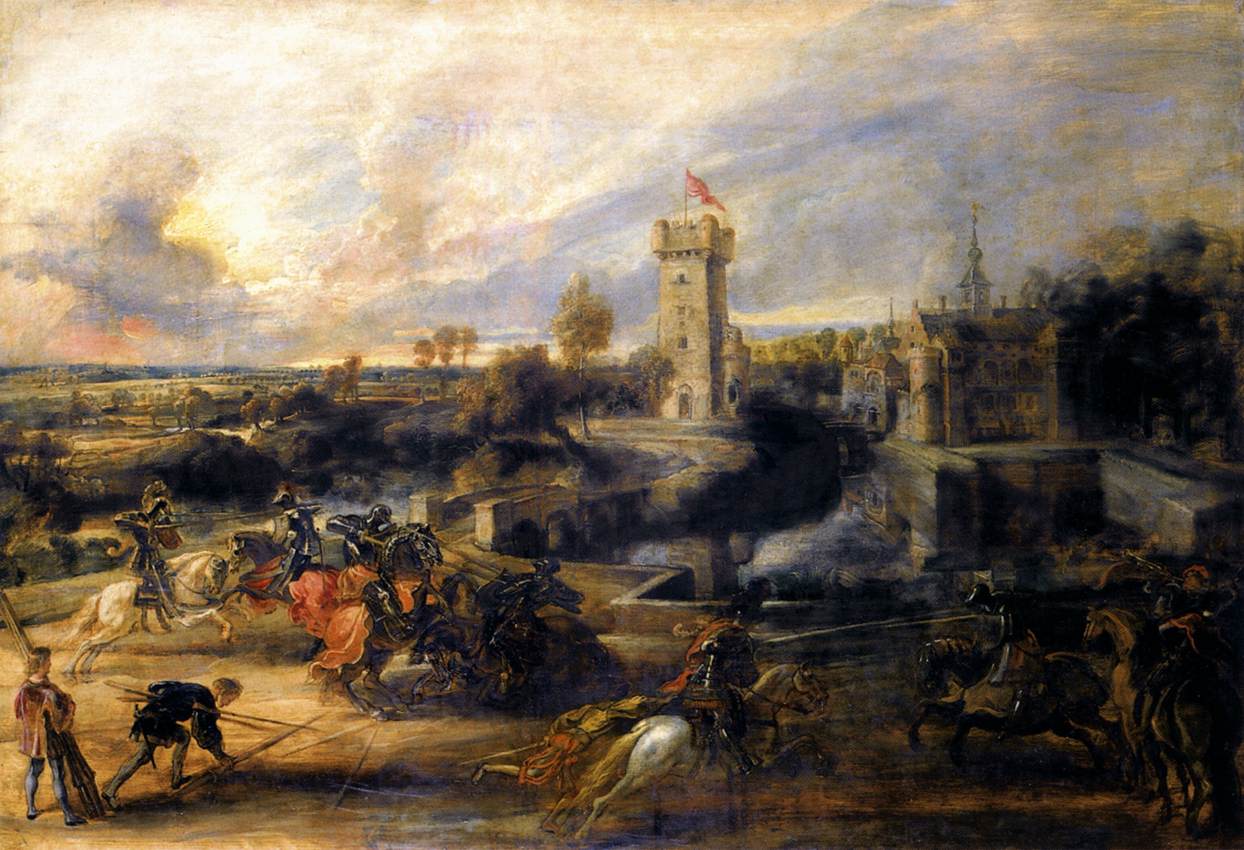
“Tournament in front of Castle Steen,” painted by Peter Paul Rubens in 1637, is a sweeping vision of aristocratic spectacle set against the broad, luminous landscape surrounding the artist’s own country estate. Rather than a quiet, contemplative view of nature, Rubens turns the fields and fortifications of Steen into a stage for chivalric games: armored horsemen charge with leveled lances, pages gather broken spears, and spectators gaze from the castle ramparts while an enormous sky glows above.
The painting combines three subjects that obsessed Rubens in his later years—landscape, horses, and his beloved home—into a single, exuberant composition. It is both an evocation of medieval-style tournaments and a proud celebration of landed status, offering a romanticized glimpse of noble life in the Flemish countryside.
The Setting: Castle Steen as Personal and Symbolic Landmark
At the right of the painting, dominating the middle ground, stands Castle Steen with its tall tower crowned by a red flag. Rubens purchased this estate in the 1630s, and it appears in several of his late landscapes. For the artist it was not only a residence but a symbol of stability, prosperity, and a retreat from the pressures of court and diplomacy.
In “Tournament in front of Castle Steen,” the castle is viewed from a distance, surrounded by ramparts and waterways. Trees cluster around the buildings, softening their outlines and integrating them into the surrounding countryside. The tower rises vertically, acting as a visual anchor amid the swirling action of the tournament. Its red flag introduces a bright color accent that draws the eye and signals the festive nature of the event below.
The estate is not rendered as a cold fortress but as a living, functioning domain. Smaller buildings, bridges, walls, and paths suggest economic activity and daily life. Yet the focus remains on its grandeur and dominance within the landscape, underscoring Rubens’s pride in his property and his identification with the gentleman-farmer ideal.
Panoramic Landscape and Baroque Sky
Beyond Castle Steen stretches an expansive landscape that unfurls across the width of the painting. Fields, hedgerows, and distant trees fade into a bluish horizon, conveying a sense of endless rural space. Rubens’s handling of atmospheric perspective—warmer, darker tones in the foreground gradually shifting to cooler, paler hues in the distance—gives the scene tremendous depth.
Above, an immense sky occupies more than half the painting. Clouds pile up in thick masses, alternately dark and illuminated. Light pours through breaks in the clouds, casting a gentle glow over the fields and the stonework of the castle. The sky is not merely a backdrop but a dynamic presence, suggesting shifting weather and time of day, perhaps late afternoon with the sun sinking toward the horizon.
This vast sky plays a crucial compositional role. It counterbalances the density of action in the lower third of the painting and contributes to the sense that the tournament, for all its clamor, is just one episode within a larger, enduring natural world. The contrast between the transience of human spectacle and the permanence of land and sky is one of the painting’s underlying themes.
The Tournament Arena in the Foreground
In the foreground, closest to the viewer, unfolds the bustling scene of the tournament itself. The ground is a broad, dusty space, defined by low barriers and a slight incline. Here Rubens brings us into intimate contact with the excitement of the joust.
On the left, two attendants bend over broken lances, gathering the splintered wood that litters the ground. Their bent postures and simple clothing contrast with the upright, richly armored riders nearby, emphasizing the hierarchy of labor and rank. The figures are small compared to the overall canvas, yet each is carefully placed to contribute to the rhythm of movement.
The middle zone of the foreground is dominated by charging horsemen. Their armor gleams, their plumes stream backward, and their horses rear or gallop in response to the impact of the lances. Rubens arranges them in a sweeping arc that drives from left to right, echoing the curves of the landscape and guiding the viewer’s eye toward the castle.
On the right, more riders enter or wheel about, turning the tournament arena into a swirling vortex of motion. Some horses are caught mid-stride, others stumble, and one rider appears to be dismounted or in danger of falling. This variety of poses and actions creates a sense of narrative: the viewer can imagine successive rounds of the joust, victories and defeats, all compressed into a single moment.
Horses and Riders: Energy and Elegance
Rubens was one of the great painters of horses, and “Tournament in front of Castle Steen” showcases his mastery. The animals are not generic; each has its own gait, posture, and expression. A white horse on the left rears backward, hooves pawing the air, while another gallops forward with neck extended. Darker horses surge from the right, their bodies twisting as they respond to the pull of reins and the clash of lances.
The riders, clad in shining armor and colorful sashes, are equally dynamic. Their torsos lean forward or twist sideways, following the momentum of their mounts. Some lances are raised, others shattered, and the lines of these long weapons create additional diagonals that slash across the picture plane. Cloaks and pennants catch the wind, adding fluttering accents of red and gold.
The interplay between horse and rider exemplifies Rubens’s fascination with the unity of man and animal in motion. The riders appear almost fused with their mounts, forming composite beings of power and grace. This fusion reinforces the chivalric ideal: the nobleman is defined by his mastery of the horse and by his prowess in mounted combat.
Light, Color, and Atmosphere in the Arena
The tournament arena itself is bathed in a warm, golden light. The earth tones of the ground blend with the ochres and browns of horseflesh and armor, while flashes of bright color—scarlet cloaks, blue sashes, and the red flag on the tower—energize the scene.
Rubens uses light selectively to highlight key moments of action. A particularly vivid glow falls on the central group of riders, picking out their armor and horses against the darker middle ground. This spotlight effect draws attention to the heart of the tournament, even as the eye continues to wander across the rest of the canvas.
Shadows cast by the horses and figures emphasize the late-afternoon angle of the sun, reinforcing the sense of time passing. Dust kicked up by hooves seems to mingle with the atmosphere, softening edges and lending a hazy realism to the scene. The overall effect is one of lively immediacy: we almost feel the heat of the sun, hear the clatter of hooves and the clash of metal, and taste dust in the air.
Narrative and Chivalric Nostalgia
“Tournament in front of Castle Steen” is not a depiction of a specific historical event so much as an imaginative re-creation of medieval-style chivalric games. By the seventeenth century, tournaments had largely lost their military function and persisted mainly as courtly spectacles or nostalgic evocations of a heroic past.
Rubens taps into this nostalgia. The armored riders evoke an earlier age of knightly valor, even as the landscape and architecture belong to his own time. The painting can thus be read as a celebration of the noble virtues associated with chivalry—courage, honor, and the thrill of controlled combat—recast as a leisure pursuit of the landed elite.
At the same time, Rubens’s treatment of the scene includes subtle hints of humor and humanity. Not every rider is triumphant; some have clearly lost their lances, and one appears to be in difficulty. The attendants gathering splintered spears and the casual figures at the margins remind us that even grand spectacles involve mundane tasks and occasional mishaps. This prevents the scene from becoming purely idealized; it remains grounded in the reality of physical exertion and risk.
Integration of Personal Identity and Artistic Vision
Because Castle Steen was Rubens’s own estate, the painting inevitably carries a personal dimension. By placing a tournament in front of his castle, the artist imagines himself at the center of a world of aristocratic leisure and martial display. Even if he is not pictorially present among the riders, his identity is woven into the fabric of the scene.
This assertion of status is subtle but unmistakable. The castle stands proud and secure, the surrounding lands fertile and expansive, and the tournament lively and well attended. The message is that Steen is not just a residence but a hub of cultured activity, where noble traditions are upheld and celebrated.
At the same time, the painting reflects Rubens’s artistic curiosity about how to combine landscape, architecture, and action in a coherent whole. It is not merely a portrait of property but an exploration of how human events unfold within a specific environment. The tournament and the castle are mutually defining: the building provides a dignified backdrop for the riders, while their motion animates the otherwise static architecture.
Landscape, Warfare, and Peaceful Transformation
In many of Rubens’s earlier works, horses and armor appear in the context of real battles and political allegories. Here, however, the violence is ritualized and contained within the rules of the tournament. The lances are blunted, the stakes are honor rather than survival, and the surrounding countryside remains untouched by destruction.
This shift from war to sport may reflect a broader longing for peace after decades of conflict in the Low Countries. The same artist who painted diplomatic allegories for European courts now portrays martial energy channelled into harmless competition. The fertile fields and quiet streams in the background reinforce the sense that this is a world where conflict has been domesticated and turned into entertainment.
In this light, “Tournament in front of Castle Steen” can be read as a vision of postwar stability: the land is secure, the castle stands unthreatened, and the only battles are playful ones staged for enjoyment. The painting celebrates not just chivalry but the possibility of living at ease amid the remnants of a once-violent tradition.
Painterly Technique and the Sketch-like Quality
Although rich in detail, the painting retains something of the freshness and spontaneity of an oil sketch. Brushstrokes remain visible, especially in the sky and landscape, where Rubens uses broad, sweeping motions to suggest cloud formations and distant fields. Edges are softened rather than sharply defined, contributing to the sense of atmosphere and depth.
In the figures and horses, the handling is somewhat more precise but still fluid. Rubens indicates armor, harness, and muscle with economical strokes, trusting the viewer’s eye to complete the forms. This loose technique enhances the feeling of motion; nothing appears frozen, and the whole scene seems to shimmer with life.
The sketch-like quality suggests that the painting may have served as a preparatory work or as part of a larger decorative scheme. Yet it also stands on its own as a finished piece, demonstrating how Rubens could achieve powerful effects of space, light, and action without laborious detail.
Emotional Impact and Viewer Engagement
“Tournament in front of Castle Steen” engages the viewer on multiple levels. From a distance, the eye is drawn to the dramatic sweep of sky and land, appreciating the painting as a majestic landscape. Moving closer, we become engrossed in the tournament: individual riders, horses, and attendants each tell fragments of a story.
The viewer’s perspective is that of a privileged spectator, perhaps standing on a nearby rise or balcony, watching the event unfold. We are close enough to feel the energy of the horses yet far enough to see the larger spatial context. This viewpoint mirrors the position of a noble onlooker at an actual tournament and reinforces the painting’s invitation to imagine ourselves within that world.
Emotionally, the painting elicits excitement and nostalgia. The galloping horses and clashing lances stir a sense of adventure, while the serene landscape and glowing sky evoke calm and satisfaction. The coexistence of these moods gives the work a rich, layered resonance that continues to speak to modern viewers.
Conclusion
“Tournament in front of Castle Steen” is a multifaceted masterpiece in which Peter Paul Rubens weaves together personal pride, chivalric fantasy, and landscape poetry. Painted in 1637, it transforms the artist’s own estate into the setting for a lively jousting scene, capturing the energy of armored riders and powerful horses against an expansive Flemish countryside and glowing sky.
Through dynamic composition, nuanced light, and expressive brushwork, Rubens creates a painting that feels at once grand and intimate. It reflects his late-life love of the land, his fascination with motion, and his ability to fuse narrative, architecture, and nature into a single coherent vision.
The work endures not only as a record of Rubens’s world but also as an imaginative space where viewers can experience the thrill of a Baroque tournament, the serenity of rural vistas, and the deep satisfaction of a life rooted in both art and land.
