Image source: wikiart.org
Introduction to “Peace and Abundance”
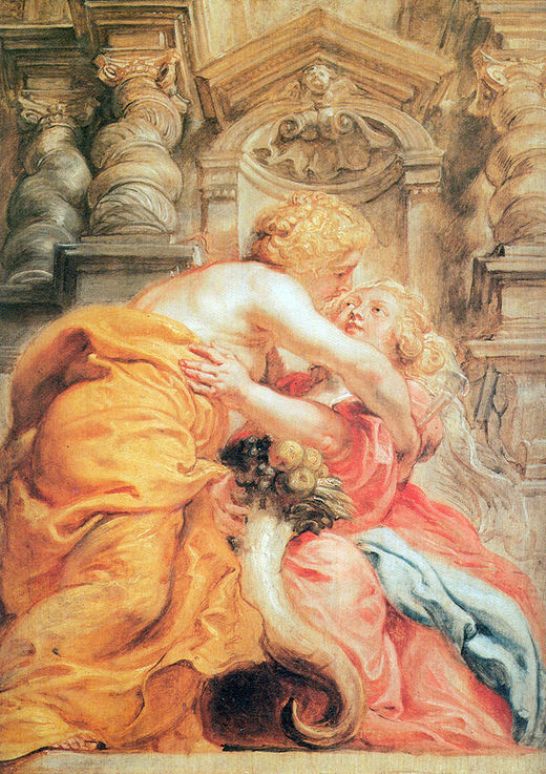
“Peace and Abundance,” painted by Peter Paul Rubens in 1634, is a glowing allegory of harmony, prosperity, and reconciliation. Instead of a crowded historical scene or a thunderous battle, Rubens focuses on two intertwined figures in an intimate embrace, set against a monumental architectural backdrop. Their bodies are wrapped in radiant draperies of gold and rose, and between them spills a cornucopia overflowing with fruits and flowers. Everything in the painting—gesture, color, and setting—works together to suggest that when peace prevails, abundance naturally follows.
This image was not simply an abstract philosophical statement. For Rubens, who spent years acting as a diplomat between warring European powers, the idea of peace carried deep personal and political meaning. The painting transforms a complex political wish into a tender, almost private scene of affection, giving an embodied form to the hope that after years of conflict, Europe might enjoy a new era of prosperity.
Historical and Political Context
The early seventeenth century was dominated by warfare, especially the Thirty Years’ War and related conflicts between Spain, France, and the Dutch Republic. Rubens, besides being one of Europe’s greatest painters, served as an envoy for both the Spanish Habsburgs and, indirectly, for the English crown. He negotiated, wrote letters, and traveled between courts, using his intellect and charm in the service of peace.
In the early 1630s, diplomatic efforts were underway to ease the long-standing hostilities between Spain and the Dutch, as well as the tensions between Spain and France. Rubens repeatedly created allegorical images that praised peace and condemned war, such as “Minerva Protects Pax from Mars” and “The Horrors of War.” “Peace and Abundance” belongs to this group of works and should be read as part of the artist’s visual campaign for concord.
Rather than showing battlefields or ruined cities, Rubens chooses to represent peace on a human scale. The painting suggests that peace is not just a political treaty signed in distant palaces; it is a condition that touches ordinary lives, bringing nourishment, security, and emotional warmth. In that sense, the allegory bridges grand politics and everyday experience.
Composition and Spatial Design
The composition is vertically oriented and tightly focused on two central figures. They occupy almost the entire foreground, pressed close to the viewer, while the architectural backdrop rises behind them like a stone stage. The main diagonal runs from the lower left, where the warm yellow drapery pools, up through the intertwined bodies to the upper right, where the architecture culminates in an arch. This diagonal energy gives the scene a sense of dynamic embrace and upward movement.
The seated female figure on the right leans backward slightly, her body described in soft curves. The more active figure on the left leans toward her, arms around her shoulders in a protective, affectionate gesture. Their faces are close enough that we almost expect a kiss, but the embrace is more about shelter and reassurance than eroticism. The cornucopia curves around the lower center, echoing the curves of their bodies and tying the composition together.
Behind them, twisted Solomonic columns and an elaborate entablature frame a niche. The architecture evokes the interiors of Baroque churches and palaces, with its sense of weight, volume, and decorative richness. Yet it is handled in a sketch-like, painterly way, so that it does not distract from the central figures. Instead, it acts like a monumental halo, suggesting that the union of peace and abundance is as solid and enduring as the stone around them.
Iconography: Peace, Plenty, and the Cornucopia
Rubens’s two figures are personifications: abstract concepts given human bodies. The half-nude figure on the left, wrapped in golden-orange drapery, represents Peace. Her bare upper torso and strong arms suggest openness, vulnerability, and strength combined. Peace is not portrayed as a warrior goddess, but as a protective, nurturing presence.
The figure on the right, robed in soft pink with a blue mantle, represents Abundance or Plenty. She cradles the horn of plenty—a cornucopia—from which fruit and flowers spill. This classical symbol, inherited from Greco-Roman art, stands for endless nourishment and prosperity. Rubens paints the fruits with juicy, tactile immediacy: grapes, apples, and other produce glimmer with life, inviting associations of harvest and plenty.
The embrace between Peace and Abundance expresses a clear allegorical message: peace brings prosperity. It suggests that when violence and discord are banished, the natural world can flourish, providing food and comfort. In the context of war-torn Europe, this statement was both idealistic and practical. Fields left untrodden by armies could yield crops; trade routes unblocked by conflict could bring wealth.
The architectural setting itself may hint at civil order and religious stability. Solid buildings, rather than ruins, surround the figures, implying that peace supports not only material abundance but also the continuity of culture and faith.
Gesture and Emotional Narrative
One of the most compelling aspects of the painting is the emotional warmth of the figures’ interaction. Peace bends toward Abundance with a protective, almost maternal impulse. Her arms wrap around the other woman’s shoulders; her hand presses gently against her back. Abundance responds with a look of trust and slight astonishment, gazing up into Peace’s face. The emotional exchange between their eyes suggests recognition and gratitude.
Their closeness emphasizes interdependence. Peace is not a solitary, aloof ideal; she is intimately engaged with the well-being of Abundance. Likewise, abundance is portrayed not as mindless luxury or excess, but as something cherished and safeguarded. Rubens avoids any hint of greed or frivolity; instead, the mood is tender and serious, as though the figures understand the fragility of what they share.
The tactile quality of their interaction is another hallmark of Rubens’s art. He excels at conveying the sensation of skin against skin, fabric against flesh, and the weight of bodies in contact. Here, the overlapping arms and the way the draperies bunch around the figures make the embrace feel physically convincing. This physicality anchors the allegory in real, human experience.
Color and Light: Warmth as a Symbol of Harmony
Color plays a crucial role in establishing the painting’s mood. The palette is dominated by warm oranges, pinks, and creams, offset by touches of cool blue and neutral stone tones. Peace’s drapery is a radiant golden-orange that glows like sunlight, wrapping her in an aura of warmth. Abundance’s dress, in a soft coral red, harmonizes with this gold while distinguishing her as a separate figure. The blue mantle at her side provides a cool counterpoint, enriching the overall harmony.
Rubens’s handling of light enhances this effect. The figures seem bathed in a diffuse, golden illumination that softens contours and emphasizes the flesh’s natural glow. There are no harsh shadows; instead, light gently models the bodies, making them appear round and alive. This soft light reinforces the theme of harmony and security. Peace, in Rubens’s vision, is not a stark, ascetic state; it is a warm environment in which human bodies and the natural world can thrive.
The architecture behind them is painted in warm, earthy tones, tying it into the overall color scheme. Highlights on the twisted columns and arch underscore the sense of solidity and richness without drawing attention away from the figures. The combination of warm flesh, glowing drapery, and honey-colored stone gives the entire painting a cohesive, inviting feel.
Baroque Style and Painterly Energy
Although the subject is gentle, the painting is full of Baroque energy. The draperies whirl around the figures in swirling folds, especially the orange cloth around Peace’s hips and legs. These sweeping lines create a sense of movement and life, as if a soft breeze were stirring the fabrics. The twisting columns behind the figures echo this dynamism, their spiraling forms reinforcing the sense of upward flow.
Rubens’s brushwork is loose and confident. From a distance, the forms cohere into a harmonious whole; up close, one can see the individual strokes that suggest folds, curls, and textures rather than describing them meticulously. This painterly approach gives the image vitality and immediacy. It feels like a living moment captured in color rather than a static, polished emblem.
The muscular modeling of Peace’s back and arms shows Rubens’s command of anatomy, but he never lets technical display overwhelm the emotional core. The bodies are idealized yet still human, possessing weight and softness. Rubens’s fascination with the sensual quality of flesh, often associated with his mythological scenes, is here channeled into a celebration of healthy, life-giving presence rather than eroticism.
Connections to Other Works by Rubens
“Peace and Abundance” resonates with several other works in Rubens’s oeuvre. In his large canvas “Peace and War” (also known as “The Horrors of War”), he contrasts the blessings of peace—embodied by a cluster of women and children—with the destructive forces of Mars and his followers. In that painting, a cornucopia also plays a central role, spilling fruit as a sign of prosperity protected by peace. Compared to that complex composition, “Peace and Abundance” focuses more closely on the positive aspect, leaving the horrors of war offstage.
The architecture in the background recalls the grand portals and interiors seen in Rubens’s altarpieces and decorative projects. It suggests that the same artistic vocabulary used to glorify religious themes can also be used to praise moral and political virtues like concord and plenty. This blending of sacred and secular visual language is characteristic of Baroque art, where political and spiritual messages often intertwined.
The faces and forms of the two women may also echo models from Rubens’s circle, possibly including his wife Helena for the figure of Abundance. Even if not directly based on her, the soft features and luscious curls reflect the type of beauty Rubens favored in his depictions of goddesses, saints, and allegories.
Emotional and Moral Impact
Beyond its political implications, “Peace and Abundance” speaks on a more universal level about human desires for security, love, and material well-being. The painting suggests that peace is not an abstract treaty but an intimate relationship, something that must be actively embraced and protected. By giving Peace and Abundance human faces and bodies, Rubens invites viewers to empathize with them, to feel the weight of their embrace, and to sense how precious their union is.
The cornucopia, overflowing yet held closely, hints at a balance between enjoyment and responsibility. Abundance is not simply spilled carelessly on the ground; it is gathered and cherished. This nuance may reflect Rubens’s own balanced view of worldly goods. As a successful artist and landowner, he enjoyed comfort and luxury, but he also understood that such blessings were fragile and dependent on broader conditions of stability.
The painting’s intimacy encourages contemplation. Unlike grand public allegories, this image feels almost like a private meditation. The viewer stands close to the figures, almost within the circle of their embrace, as if invited to share their moment of mutual recognition. It is a persuasive visual argument that peace and prosperity are not opposing values but mutually reinforcing ones.
Legacy and Contemporary Relevance
For viewers today, “Peace and Abundance” remains strikingly relevant. The idea that peace fosters prosperity, and that both require active nurturing, feels as urgent now as it did in Rubens’s war-torn Europe. The painting offers a hopeful, human-centered vision of what political and social harmony might look like when translated into everyday life.
Artistically, the work continues to be admired for its color, dynamism, and emotional subtlety. It shows Rubens at ease with allegorical subject matter, translating complex ideas into bodily gesture and sensory experience. The painting illustrates how Baroque art could be both intellectually sophisticated and immediately accessible, appealing to the mind and the senses at once.
In museum contexts or reproductions, “Peace and Abundance” often serves as a gentle counterpoint to more violent or dramatic works from the same period. It reminds viewers that Baroque art is not only about spectacle and tension, but also about warmth, affection, and hope.
Conclusion
“Peace and Abundance” is a compact yet powerful statement by Peter Paul Rubens on the blessings of concord and the deep connection between political stability and human flourishing. Through the tender embrace of two allegorical women, luminous color, and fluid Baroque movement, Rubens visualizes an ideal world where war has ceased, architecture stands firm, and the harvest of the earth overflows in safety.
At once a piece of diplomatic propaganda, a moral allegory, and a deeply felt human image, the painting encapsulates Rubens’s ability to weave personal conviction and public message into a single harmonious work. It invites us to imagine peace not just as the absence of conflict, but as a positive, nurturing presence that enfolds abundance in its arms.
