Image source: wikiart.org
Introduction to “The Abduction of Europa” by Peter Paul Rubens
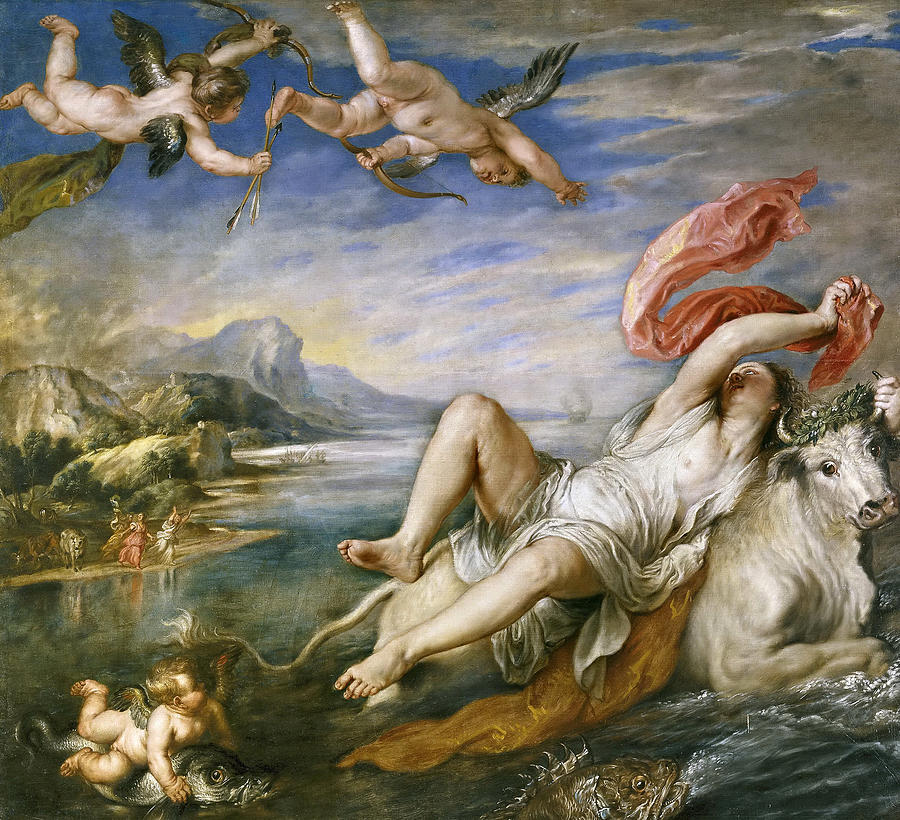
“The Abduction of Europa,” painted around 1630 by Peter Paul Rubens, is a powerful Baroque retelling of one of the most famous myths from antiquity. The canvas captures the very instant when Europa, a Phoenician princess, realizes that the gentle white bull she has climbed upon is in fact Jupiter in disguise, carrying her away across the sea. Rubens condenses this drama into a single, sweeping composition full of motion, swirling drapery, and agitated sky and water.
Unlike many static mythological scenes, this painting feels like a snapshot taken in the middle of a violent change. Europa’s body is twisted and off balance, one hand clutching the bull’s horn while the other waves a crimson cloth that whips in the wind. Putti and sea creatures surround her, and in the distance the shoreline recedes, where her companions stand helplessly watching her escape. The painting unites myth, landscape, and sensual figure painting into a unified, emotionally charged vision.
The Mythological Story Behind the Painting
The story of Europa comes primarily from Greek and Roman sources such as Ovid’s “Metamorphoses.” Jupiter, king of the gods, falls in love with Europa and decides to abduct her. He transforms himself into a magnificent white bull, approaches Europa as she plays with her companions on the shore, and lures her with his gentleness. When she climbs on his back, the bull suddenly dashes into the sea and swims away toward Crete, where Europa will eventually become the ancestor of a royal line.
Rubens chooses the most dramatic moment: not the peaceful encounter on the shore, nor the eventual arrival in Crete, but the terrifying transition between safety and captivity. Europa has just left the land, and the sea rushes beneath her. Behind, her companions are still visible, their gestures expressing shock and desperation. Above and around her, putti and sea creatures emphasize that this is a divine event orchestrated by the gods.
By focusing on this instant, Rubens highlights the myth’s themes of desire, deception, and power. The painting shows not only a physical abduction but also a psychological rupture, as Europa’s carefree play transforms into panic and helplessness.
Composition and the Diagonal of Drama
The composition is anchored by a sweeping diagonal that runs from the lower left, where the shoreline and Europa’s companions appear, up through the tossing bull and Europa’s body, and finally into the upper right where the red drapery billows into the sky. This diagonal gives the scene its tremendous sense of motion, as if the entire canvas were tipping toward the sea along with Europa.
Europa’s body forms an almost serpentine S-curve laid across the back of the bull. Her head is tilted backward, mouth open in a cry, while her legs extend precariously, one foot still grazing the water’s surface. The unstable pose expresses both physical imbalance and emotional shock. The bull surges forward with powerful strokes, its head turned slightly toward the viewer so that we see both its bovine gentleness and the unsettling human intelligence in its eyes.
Above, two winged cupids fly diagonally in the opposite direction, one tumbling downward and the other pulling an arrow from a quiver. Their crossed bodies counterbalance the main diagonal and create a dynamic X-shape that locks the composition together. Below, another putto clings to a fish as it speeds through the water, echoing the main movement on a smaller scale. All of these diagonal lines converge toward Europa, making her the undeniable focal point.
Europa as a Baroque Heroine
Rubens’s Europa is the quintessential Baroque heroine: voluptuous, dynamic, and emotionally expressive. Her body is rendered with the soft, glowing flesh tones for which the artist is famous. The pale white of her skin stands out against the blue of the sea and sky and the creamy hide of the bull, making her figure visually dominant.
Her drapery plays a crucial role. The main garment is a light, almost translucent fabric that clings to her body, revealing its contours while also fluttering in the wind. This combination of clinging and flying fabric increases the sense of movement and vulnerability. The bright red cloak she flings upward becomes a visual shout, a banner of alarm that also symbolizes passion, danger, and divine intervention.
Emotionally, Europa is caught between terror and lingering trust. Her hand wrapped around the horn suggests that she is still clinging to the bull for physical support, even as her upraised arm and open mouth reveal fear. Rubens avoids depicting her as simply passive or unconscious; instead, she is actively struggling, twisting her torso and legs in an attempt to regain balance or resist her fate. This active pose grants her a compelling presence even as she remains a victim of Jupiter’s power.
The Bull as Jupiter in Disguise
The white bull carrying Europa is both naturalistic and symbolic. Rubens paints the animal with careful attention to anatomy: the muscles of the neck and shoulders, the sheen of wet fur, the strain of movement as it slices through the waves. Yet the bull’s expression is tender and almost eerily calm. Its eye, ringed with delicate lashes, looks outward in a way that suggests consciousness beyond that of a simple animal.
This duality underscores Jupiter’s presence. The god’s divine power is disguised beneath the gentle surface of the bull, just as his violent intention lurks beneath the seemingly idyllic encounter that led to the abduction. A wreath of flowers around the bull’s head reinforces the idea that it was originally a charming, harmless creature used to attract Europa’s trust. Now, however, that wreath seems ironic, a decorative crown masking a predator.
Rubens places the bull slightly lower in the composition than Europa’s twisting body, so that the animal functions as both vehicle and stage. Europa’s limbs extend beyond its contours, giving viewers a clear view of her figure while also emphasizing how precariously she is perched. The bull is the engine of the painting’s motion, carrying both Europa and the viewer into the open sea.
Sea, Landscape, and the Sense of Distance
The setting of “The Abduction of Europa” alternates between calm beauty and threatening depth. In the background to the left, Rubens paints a gentle coastline with soft hills and a few trees. Europa’s companions appear here, tiny in scale yet clearly agitated, their arms raised as if calling after her. This landscape provides a sense of place and origin; it is the world she is being torn away from.
The sea around the bull is more turbulent, with choppy waves and swirling foam. The water reflects both the sky and the flesh tones of Europa and the bull, creating a shimmering surface that feels unstable. Beneath the waves lurk sea creatures, including a fish seized by the putto in the foreground and another monstrous head emerging near the bottom edge. These underwater presences suggest the unknown dangers of the ocean and the greater mythological world that lies beyond human control.
The distant sky is luminous, shifting from blue to yellow and gray as it approaches the horizon. This gradation of color increases the sense of depth and distance, emphasizing how far Europa is already moving away from shore. The overall effect is both beautiful and unsettling, mirroring her mixture of initial delight and sudden terror.
Putti, Sea Creatures, and Divine Spectators
The putti and sea creatures surrounding Europa act as both decorative elements and symbolic commentators. In the sky, two cupids hover above the main scene, one reaching for arrows and the other tumbling with outstretched arms. Their presence links the abduction to the realm of love and desire. Cupid’s arrows traditionally inspire passion; here they suggest the divine impulse that has driven Jupiter to his act. At the same time, the cupids’ playful, almost careless behavior contrasts with Europa’s distress, highlighting how the gods treat mortal suffering as part of their games.
The putto riding a fish at the lower left introduces a humorous note. His chubby body and delighted expression make him appear as if he is enjoying a water ride, utterly untroubled by Europa’s plight. This contrast adds complexity to the emotional tone of the painting. It reminds viewers that, within mythological narratives, events that are tragic for individuals can be sources of sport for the divine or symbolic world.
The sea creatures, both realistic and monstrous, emphasize the boundary between the human world and the domain of the gods. They populate the water through which Europa is carried, reinforcing the sense that she is entering a different, more dangerous realm.
Color, Light, and Painterly Technique
Rubens’s color palette in “The Abduction of Europa” is both luminous and dramatic. The dominant tones are cool blues and grays of sky and sea, set against warm flesh tones and the brilliant red of Europa’s fluttering cloak. This contrast creates a vivid focus on the figures while allowing the background to recede.
Light in the painting appears to come from an upper left direction, bathing Europa’s body in a gentle glow. Highlights touch her shoulders, knees, and the side of the bull, emphasizing their three-dimensional form. Shadows are soft but strategically placed to create volume and dynamism, particularly in the folds of her drapery and the ripples of the water.
Rubens’s brushwork is fluid and energetic. In the sky and landscape, he uses broader, more blended strokes that suggest atmospheric softness. In the figures, he tightens his handling just enough to model anatomy while still allowing visible brush marks that convey life and motion. The foam of the sea, the texture of the bull’s fur, and the fluttering fabric are all rendered with animated strokes that seem almost to move as one looks at them.
Emotional and Psychological Interpretation
Beyond its mythological narrative, the painting invites a psychological reading of Europa’s experience. She is depicted at a moment of shock, yet this shock is not simply terror; it carries undertones of erotic awakening and the realization of an overpowering force larger than herself. Her body language, with limbs extended and the torso twisted, expresses vulnerability and exposure. Her face, tilted upward with an open mouth, suggests a cry that could be fear, protest, or a call for help.
The choice to keep the bull’s expression gentle complicates the morality of the scene. Rubens does not paint the abduction as a purely brutal act; instead, there is an uneasy blend of attraction and coercion. This ambiguity echoes the myth itself, which historically has been interpreted as both violent kidnapping and divine seduction. In the Baroque context, such ambiguity allowed viewers to contemplate the power of passion and fate without reducing the narrative to a simple moral lesson.
The painting also reflects broader themes about human helplessness before divine will. Europa, despite her beauty and vitality, cannot resist Jupiter’s plan. The distant companions on the shore, too small and powerless to intervene, underscore this sense of inevitability. At the same time, the lively putti and glowing colors prevent the work from becoming purely tragic; it remains a spectacle of grandeur and beauty, inviting a complex mixture of admiration and unease.
Rubens and the Tradition of Europa in Art
Rubens’s interpretation of the Europa myth stands in dialogue with earlier works, particularly those of Titian. Titian’s own “Rape of Europa” provided a precedent both in subject and in the emphasis on the tumultuous sea crossing. Rubens admired Titian deeply and created copies and variations on his themes, yet his own style is more muscular and dynamically charged.
Compared to Titian’s Europa, Rubens’s figure is more robust and more violently tossed, her limbs more dramatically extended. The sky in Rubens’s version is clearer and more expansive, giving greater emphasis to the airborne cupids. His color is warmer and more saturated, particularly in the red drapery and flesh tones. Where Titian’s sea can feel heavy and stormy, Rubens’s water is a swiftly moving surface full of gleaming reflections.
This dialogue with earlier art underscores Rubens’s role as both inheritor and innovator in the European tradition. He absorbs the Venetian love of color and mythological narrative but infuses it with the Baroque taste for movement, theatricality, and emotional intensity.
Legacy and Lasting Appeal
“The Abduction of Europa” remains one of Rubens’s most compelling mythological paintings because it synthesizes narrative drama, sensual figure painting, and atmospheric landscape into a single, unified statement. Its influence can be seen in later European art, where the Europa theme continues to fascinate artists interested in the intersection of eroticism, power, and myth.
For modern viewers, the painting also prompts critical reflection on stories of abduction and coercion from the past. What earlier ages might have viewed as a glamorous myth of divine love now raises questions about consent and agency. Rubens’s depiction, with its mix of fascination and unease, provides a fertile ground for these discussions while still offering the visual pleasures of his lush color and vigorous brushwork.
The painting’s enduring appeal lies precisely in this combination of beauty and disturbance. It invites viewers to marvel at the virtuosity of its execution, the grace of its figures, and the luminosity of its landscape, even as they grapple with the unsettling narrative it represents.
Conclusion
“The Abduction of Europa” by Peter Paul Rubens is a masterful Baroque exploration of myth, motion, and emotion. Painted around 1630, it captures the decisive moment when Europa is carried away across the sea by Jupiter disguised as a bull. Through a powerful diagonal composition, dynamic figure poses, and a luminous interplay of sky, sea, and flesh, Rubens transforms an ancient story into a vivid, contemporary drama for his time.
Europa’s twisting body, the bull’s determined surge, the swirling red drapery, and the playful yet indifferent putti all contribute to a tightly orchestrated visual symphony. At once sensual and unsettling, the painting invites viewers to contemplate themes of desire, deception, divine power, and human vulnerability. Its richness of color and movement, combined with its psychological depth, continues to captivate audiences, securing its place as one of Rubens’s most memorable mythological works.
