Image source: wikiart.org
Introduction to “The Birth of the Dauphin at Fontainebleau”
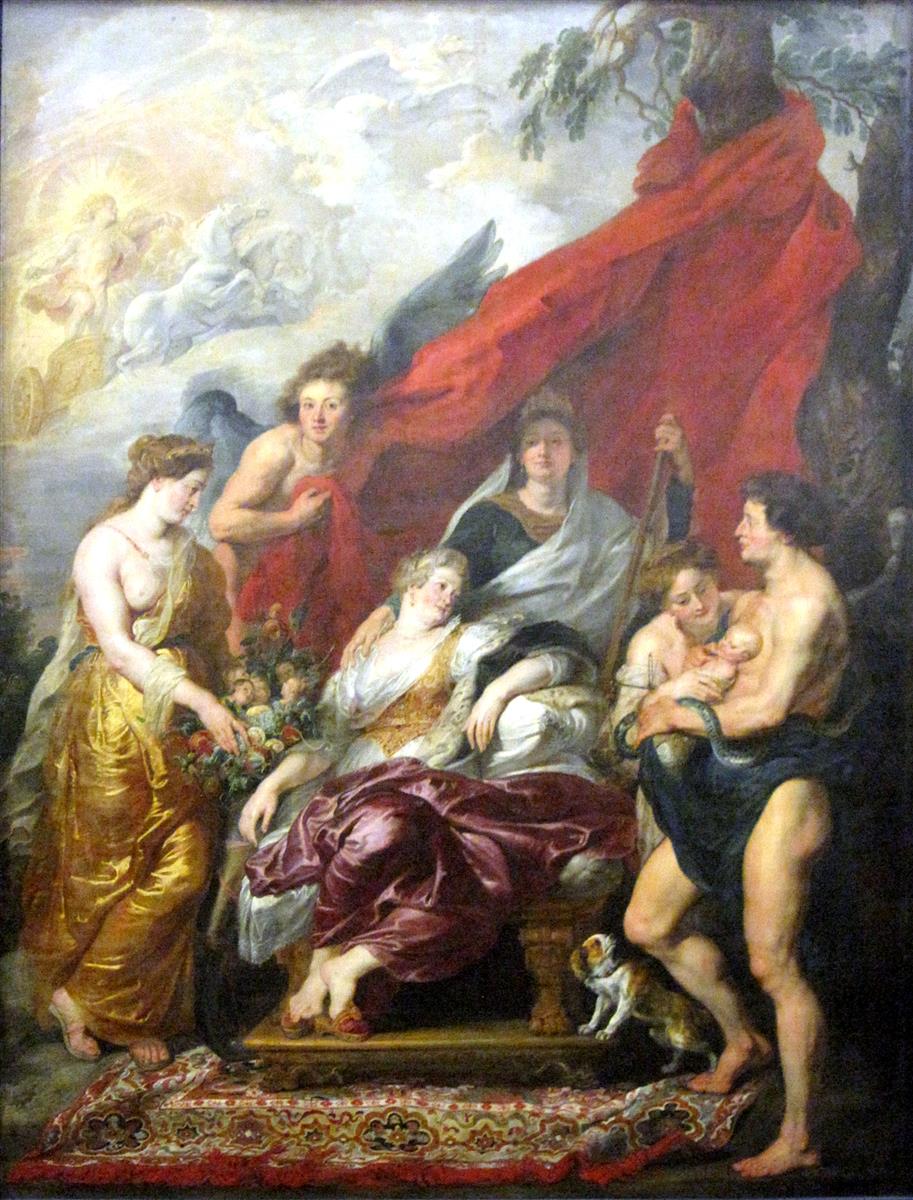
Painted in 1625 for the Luxembourg Palace, “The Birth of the Dauphin at Fontainebleau” belongs to Peter Paul Rubens’s celebrated Medici cycle, where the life of Marie de’ Medici is narrated in a sequence of vast allegories. In this canvas the artist transforms the historical birth of the future Louis XIII at Fontainebleau in 1601 into an operatic tableau of prosperity, dynastic continuity, and cosmic favor. The scene is part court record, part mythic theater: the queen mother at the center, the gods and virtues attending, and the world itself—earth, air, and sky—rearranged to acknowledge the arrival of a royal child.
Historical Moment and Purpose
The birth of a dauphin was not merely a private joy; it secured France’s succession, calmed factions, and promised stability in an age of religious and political fracture. When Rubens undertook the cycle two decades later, Marie de’ Medici had endured regency, exile, and reconciliation. She needed images that affirmed the legitimacy and providential character of her role as mother of the king. Rather than reconstruct the delivery room, Rubens stages the birth as a festival of personifications, letting allegory do the work of politics. The painting thus speaks simultaneously to history and to statecraft: a son is born, and with him the assurance that heaven smiles on France.
Composition That Behaves Like Theater
The eye reads the canvas from left to right in a sweeping arc. At the far left, the sky opens; at the right, a deep red canopy unfurls like a stage curtain. Between these poles, figures cluster in a shallow semicircle around the enthroned queen. Every line—folds of drapery, arms, staffs, and even the slight tilt of the carpet—bends toward Marie de’ Medici, who reclines in a high-backed chair. This centripetal composition creates a palpable sense of arrival. Instead of a crowd pushing inward, we feel allegorical forces converging to acknowledge a single event: the newborn heir.
The Queen as Axis of Meaning
Marie de’ Medici is presented not as a laboring mother but as a regal presence in recuperative repose. Her right hand drops with elegant fatigue, her left steadies the chair, and her posture—half-leaning, half-seated—makes the body read as both human and monumental. Silk glows across her lap in thick, wine-colored folds; white satin cools her sleeves and bodice. Rubens renders the flesh with warmth and restraint, careful to keep the expression serene. The queen’s calm at the center assures viewers that the birth has been safe and divinely approved, and it allows the surrounding allegory to unfold without anxiety.
The Attendants and Their Allegorical Identities
Rubens populates the scene with figures who are more than attendants. At the left, a golden-draped woman, often read as Abundance or Plenty, offers a wealth of flowers and fruit, transforming the queen’s bedside into a harvest. The winged figure just behind her helps to lift the crimson canopy—Fame or Victory unveiling the heroine for the audience of history. To the right, a semi-nude woman and a muscular male figure cradle an infant; their bodies suggest the time-honored types of river gods and nymphs, or the paired personifications of Health and Strength. Their role is to present the child to the world and to guarantee his thriving. A small dog at their feet—emblem of fidelity—adds a domestic note that anchors the myth in household truth.
The Canopy, Tree, and the Architecture of Honor
A Baroque canopy spans the right half of the scene, its fabric tied to a living tree rather than to a palace bedpost. This fusion of court ceremony and nature is deliberate. It proposes that the order of the state aligns with the order of creation; that the rightful birth is as organic as the growth of an oak. The heavy red—Rubens’s favorite sign of public ritual—also plays a technical role: it concentrates warm value near the queen’s face and balances the cool, vaporous sky to the left. The canopy is not mere upholstery; it is architecture in cloth, the portable architecture of sovereignty.
The Sky as Cosmic Commentary
In the upper left, the sky abounds with light. A sun or haloed burst escorts a small chariot of white horses—Apollo’s team, the dawn of a new day, or simply the personified daybreak that accompanies auspicious births. Clouds billow with tender brightness, and a few airborne spirits slip through the vapor. The cosmology is clear: the heavens announce and affirm what happens below. Rubens never lets the sky become a passive backdrop; it thinks with the figures, amplifying their meaning with light and motion.
Textures, Fabrics, and Painterly Sensation
Rubens’s ability to orchestrate textures is on bold display. The crimson canopy reads as thick and wind-holding, the purple silk on Marie’s lap as richly heavy and cool to the touch, the white pages of lace and linen as crisp, the wing-feathers as soft smoke. The marvel of the carpet—a tournament of reds, greens, and creams in an oriental pattern—grounds the composition and provides a platform where the sacred and the domestic meet. He sets matte flesh against gleaming silk, the scratch of dog fur against the gleam of pearls, using contrast to make the eye feel what the hand might.
The Child and the Language of Presentation
The infant, securely held and turned outward, is the essential pivot of the story. Rubens avoids sentimentality; the Dauphin is not swaddled in pathos but in expectation. The figures who present him combine tenderness with ceremony: one steadies the head, another cups the body, both address the queen as if acknowledging that the private gift has public destination. The gesture anticipates the child’s ultimate role. In the rhetoric of the painting, presentation equals vocation.
Light and Color as Moral Weather
The painting’s palette is a system of meaning. Warm golds and reds cluster around the queen, broadcasting the warmth of life and the dignity of office; cooler grays and blues open the heavens and prevent the scene from overheating. Flesh is modeled by a constellation of rose and cream values, untouched by harsh contrasts, embodying health without vulgarity. Rubens lets color track the movement of grace—descending from the light-blown sky, settling on the queen, flowering on Abundance’s armful, and finally resting on the child’s skin.
Movement and Stillness in Baroque Balance
Everything moves, yet the scene never tips into chaos. Draperies billow; hands reach; a wing flutters; a branch lifts; the canopy swings in the wind. But the queen’s body resolves all this motion. Her pose reads like a harbor: energy arrives, turns, and comes to rest. Baroque art thrives on such simultaneous currents—turbulence contained by form—and Rubens, master of the genre, tunes the scene so that dynamic and repose, gesture and gravity, perform their double dance.
Animals, Emblems, and the Vocabulary of Virtue
The small dog has its own line in the picture’s sentence. Dogs, in court portraits, signal fidelity and domestic peace; here it trots toward the queen as if eager to join the congratulation. The bouquet and fruit call up fertility and abundance. The staff and veil borne by the figure beside Marie suggest governance tempered by modesty. None of these emblems are didactic; they work like rhyme in a poem, repeating meanings in new forms so that the message accumulates without monotony.
Space and the Stage of the World
Rubens sets the group on a platform bordered by the carpet, with little viewpoint tricks that make the audience feel invited onto the stage. The depth is shallow—figures crowd the foreground—because this is an event meant for public inspection, not a private reverie. The tree breaking into the canopy and the sky breaking into the upper left prevent the space from becoming boxlike; they open the stage to the world beyond. Fontainebleau itself is not pictured, but the title binds the painting to the palace, and the richness of the setting implies its splendor.
Relation to the Medici Cycle
Within the Medici cycle, the birth scene stands as one of the indispensable proofs of Marie’s historical importance. Earlier canvases dramatize her marriage; later works chronicle the regency and political triumphs. This painting supplies the hinge—motherhood as the source of continuity. Rubens announces that the queen’s greatest service to France was not only negotiation or ceremony but the gift of a legitimate heir. The canvas offers, therefore, both compliment and argument: the realm owes its future to this woman.
Studio Practice and the Master’s Hand
A work of this scale would have engaged Rubens’s workshop for draperies, sky passages, and secondary figures. Yet the unity of light and the special vivacity of faces and hands bear the mark of the master. Flesh is painted with wet-into-wet confidence; highlights catch lace and eye at exactly the right pitch; transitions around wrists and ankles glow with that buttery liquidity only Rubens could keep under control. Assistants may have prepared the carpet or blocked the canopy, but the authoritative finishing, especially in the queen and the presenting figures, is unmistakably his.
How to Read the Picture Slowly
Begin in the sky with the pale blaze and the demure chariot, then let your gaze drift along the canopy’s red arc until it meets the queen’s composed face. From there drop to the silky flood across her lap, follow the line of her relaxed right arm to the carpet’s patterned edge, and cross to the dog, whose upward attention returns you to the infant. Let the curving arms of the two attendants guide you back to the central throne, and then step left again to the cornucopia of fruit and flowers. On a second circuit, track only the lights: the sun, the red highlights on drapery, the flash on pearl and satin, the delicate spark in the child’s cheek. The picture begins to pulse with a single heartbeat—arrival, acknowledgment, repose.
The Emotional Temperature and Human Truth
Despite its allegorical cast, the painting preserves a gentle human temperature. The queen’s half-smile reads as relief and pride; the attendants’ looks are warm without becoming familiar; the infant is both emblem and baby. Rubens’s genius lies in harnessing allegory without allowing it to freeze into cold symbol. He keeps touch, breath, and glance alive. The viewer registers ceremony, but also feels the quiet after joy when the room is full and the body begins to rest.
Legacy and What the Painting Teaches
“The Birth of the Dauphin at Fontainebleau” demonstrates how image-making can stabilize memory. It teaches that the health of a polity depends on rituals that make continuity visible. It also exhibits Rubens’s supreme powers—his orchestration of bodies and fabrics, his command of light, his ability to fuse myth and biography without diminishing either. For modern eyes, the painting remains persuasive because it trusts the viewer’s capacity to read nuances of gesture and color, inviting us to participate in the conversion of private event into public meaning.
Conclusion: A Dynasty Inaugurated by Grace
In this canvas Rubens turns the birth of Louis XIII into an act of grace inhabiting history. He spreads a canopy of red for the law, opens a sky of light for providence, gathers virtues for companionship, and seats the queen where both currents meet. The result is not a delivery scene but a coronation of infancy, the moment when bloodline and blessing converge. Few artists could give such dignity to a domestic truth: a mother holds the future, and the world rejoices in her rest.