Image source: wikiart.org
Introduction
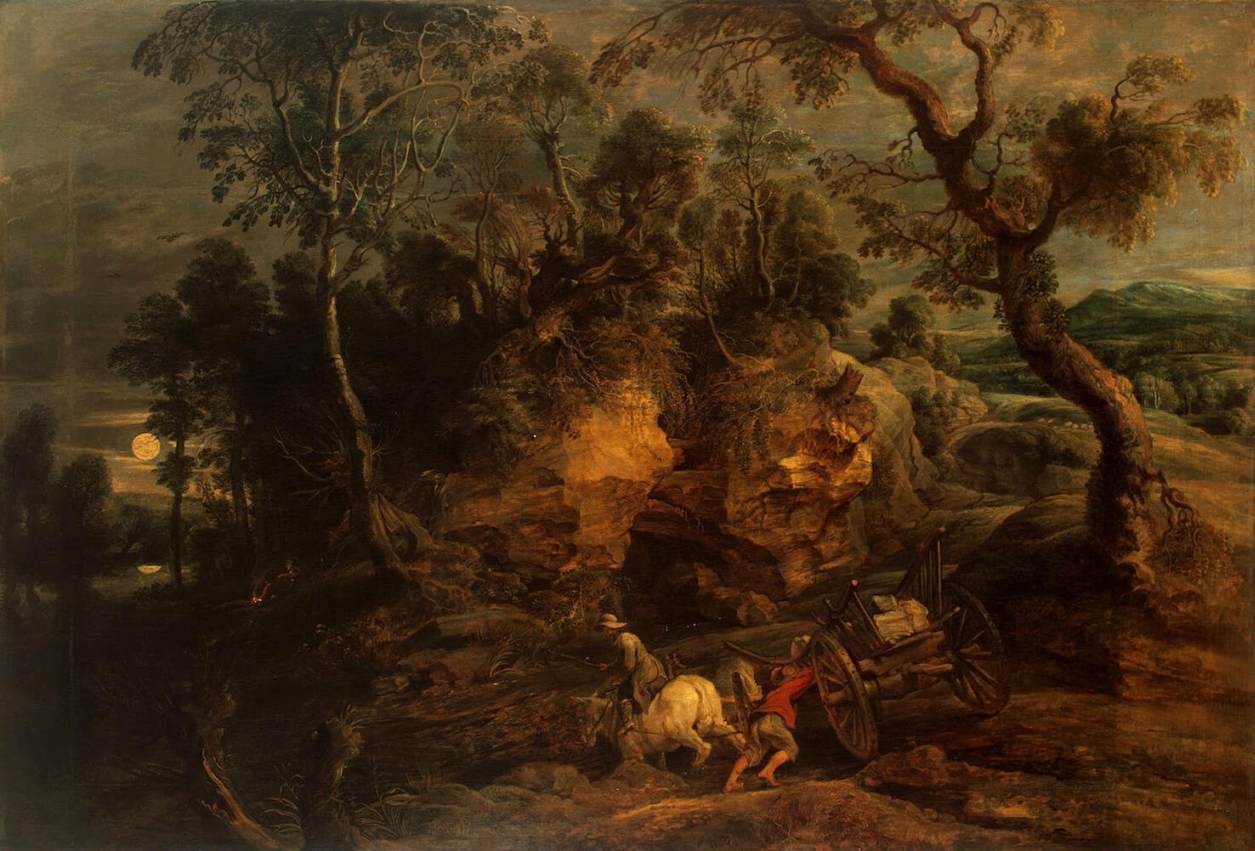
Peter Paul Rubens’s “Landscape with Stone Carriers” imagines the countryside as a living stage where earth, moon, trees, and human labor bind themselves into a single drama. Painted around 1620, the canvas places a team of workers straining to move a stone-laden cart through a rugged ravine. A pale moon opens a secondary theater at the left, its cool disc pooling light in a river, while the center of the painting glows with warm reflections that ignite the rock face and pick out the figures. The result is a nocturne that feels both geologic and human, a landscape of tremendous scale in which work, weight, and weather are visibly measured against one another.
Historical Context
By 1620 Rubens had returned from Italy and become the dominant artistic force of the Southern Netherlands. Alongside grand altarpieces and mythologies, he turned repeatedly to the Flemish landscape, absorbing its low horizons, wooded crests, and capricious weather. His landscapes from this period often carry an epic register: not pastoral idylls but moving atmospheres where ordinary life gains tragic dignity. “Landscape with Stone Carriers” stands within this trajectory, joining an early modern interest in industry and infrastructure to Baroque concerns with movement and emotion. It anticipates later, larger landscapes while keeping the intimacy of direct observation.
Subject and Narrative
The painting’s narrative is compact. Two men struggle with a cart loaded with dressed stone. One strains at the wheel, back bowed and legs braced. Another steadies the donkey, coaxing the animal through a rocky ford. The path rises toward a light-struck cliff whose fractured planes read like opened history. Their destination may be a building site somewhere beyond the ravine; their present is the immediate physics of friction and slope. Rubens does not turn their labor into allegory by adding emblems; instead he lets the landscape itself become the text that explains their exertion. The stone they move appears to be kin to the cliff it was quarried from, emphasizing the cycle by which nature becomes architecture through human effort.
Composition and Spatial Design
The composition hinges on a steep diagonal that runs from the lower right corner up toward the moonlit left. A giant serpentine tree in the right foreground functions as a repoussoir, curving inward so that the eye slides along its trunk and plunges toward the workers and cart. The central massif divides the canvas, organizing space into zones: moon and water at left, woodland crown above, open upland at right, rocky corridor below. The cart and donkey occupy the seam where these zones meet, creating an intersection of energies. Rubens scatters a sequence of trees of different species and ages that climb the escarpment like a chorus, their crowns pushing the dark sky into motion.
Light and Atmosphere
The painting’s atmosphere is built from two distinct light sources. The moon at far left radiates a bluish, silvery light that collects in the river and skims the edges of trunks and branches. Closer to the center, a warmer, golden illumination kindles the face of the rock and the figures, suggesting reflected light from a hidden fire or the moon’s glow refracted by pale stone. This orchestration creates a crosscurrent of temperatures: cool at the periphery, warm at the core. The sky is not a uniform dusk but a layered dome where thin clouds drift, thin enough to reveal the lunar disk yet dense enough to trap and scatter light back onto the land. Rubens relishes nocturnal ambiguity while maintaining narrative clarity, a strategy that lets the eye roam without losing its way.
Color and Material Presence
The palette is a restrained symphony of earthen browns, moss greens, smoky grays, and doses of ember orange. The rock face glows with ochre and raw sienna, the very colors that in paint arise from earth—a material rhyme that tightens the painting’s theme. Greens shift from almost black in deep foliage to olive and celadon in the moon-licked distance. The donkey’s coat and the men’s garments provide quick notes of value contrast, the red shirt in particular acting like a spark amid the brown orchestra. Rubens’s color establishes the sensation of dampness and cold, then warms certain zones to suggest recent human presence. The mixture keeps the painting sensuous even when its subject is hard work.
The Human Scale of Labor
The most compelling human detail is the posture of strain. Rubens sets the worker’s feet wide and wedges his shoulder against the cart, translating load into anatomy through tense calves, bent knees, and a twist that pulls the shirt across his ribs. The companion leans forward to guide the donkey, one hand extended while the other draws on the reins. These bodies do not monumentalize labor in a heroic fantasy; they read as observed gestures honed by repetition. The cart itself becomes a character: tall spoked wheels rattle against stone, shafts jolt the animal, and the stacked blocks ride like sullen passengers. Labor here is neither punished nor sentimentalized; it is treated as a perennial choreography taught by the land.
Trees, Rock, and the Grammar of the Ground
The painting is a masterclass in how to make geology and botany legible. Rubens uses angled planes and taupe shadows to model rock that appears freshly broken, with roots clawing into fissures and saplings sprouting from ledges. Trunks show a range of ages—from smooth, sap-filled young growth to coarse, scarred elders—each described with distinct bark textures. A gigantic tree at right leans like a bellied sail, its twist answering the twist of the path. The ground is neither flat carpet nor casual scribble; it is a layered language of layered brushwork that tells the viewer where traction fails and where water has cut gullies. This fidelity to the ground is crucial because it justifies the stone carriers’ struggle.
Motion, Time, and the Baroque Instant
Rubens captures time at a hinge. The cart is not yet over the obstacle; the donkey has not yet gained purchase; the man’s push has not yet won. The painting suspends this moment before resolution. Moonlight and firelight imply a longer duration—the workday prolonged into night, the return journey delayed. The smoldering ember in the woods to the left, barely visible but present, hints at a camp or watchfire, adding human time to the nocturnal cycle. This Baroque instant puts the viewer’s body on edge; one feels the desire to step in and help heave.
Sound, Smell, and the Senses of Night
Although the canvas is silent, Rubens insinuates sound through gesture and texture. You can almost hear the creak of wood, the crack of harness, the grunt of effort, and the soft clop of the donkey’s hooves in water. The night smells of wet bark and cold stone; smoke from a hidden fire seems to drift into the trees. The painter achieves these sensations through the way paint lies: dry scumbles for bark, slick glazes for water, thick accents for lit stone. In a world before photography, such material strategies were the surest way to deliver multisensory truth.
Influences and Dialogues
“Landscape with Stone Carriers” speaks to several precedents while asserting Rubens’s independence. From Joachim Patinir and Pieter Bruegel the Elder come the layered recession and the moral interest in ordinary labor. From Adam Elsheimer’s nocturnes comes the art of distributing small light sources across a dark field. Italian lessons contribute the sweeping diagonals, muscular trees, and a sense that the whole landscape is a single body flexing under weather. Rubens fuses these threads into a personal idiom where light is thick enough to touch and where the human task is dignified by the very earth it contends with.
Scale and Viewpoint
The viewpoint is slightly elevated, high enough to see the cart’s platform and the crescent of the ravine beyond, but low enough to keep the trees towering. This intermediate vantage engages rather than overwhelms. The figures are small in relation to the frame, reinforcing the grandeur of the setting, yet they are placed close enough to read expressions and stances. Rubens thus maintains a double scale: the sublime of nature and the measurable scale of human effort. The viewer oscillates between those scales, feeling both the immensity of the scene and the intimacy of the labor.
Brushwork and Technique
Rubens paints the trees with a mixture of calligraphic branches and broader leaf masses, wet strokes laced with dry ones so that air passes through the canopy. The rock is built with angular strokes that interlock like plates, then warmed with thin glazes to simulate mineral sheen. The sky is rubbed and feathered to dissolve brush boundaries, creating a breathing dome. The figures, though small, are briskly modeled with strokes that declare muscle and fabric through direction alone. Everywhere the brushwork bears decisions made at speed by an artist who trusted his hand to tell the truth of materials.
Allegory Without Emblems
While the painting avoids overt symbols, it allows allegorical readings to arise from its facts. Stone carriers can stand for any human work that translates raw matter into culture. The moon can act as a clock, measuring the hours of a long day’s extension into night. The ravine can figure adversity, and the path at right can promise eventual release into a gentler upland. Yet none of this is imposed; it grows organically from the observed world. Rubens shows how a landscape achieves meaning by being intensely itself.
Place in Rubens’s Oeuvre
This canvas sits among Rubens’s most evocative landscapes in which he deploys his theatrical sensibility to celebrate the countryside. It is less celebratory than later pastoral fêtes and more elemental than his scenes of harvest or hunt. The theme of labor appears elsewhere in his work—the raising of the cross, peasants at work—but here it is calibrated to the scale of the land rather than to religious drama. The painting also foreshadows his love of storm light and evening weather, a love that comes to full blaze in the landscapes of his later years.
Ways of Looking
A satisfying way to traverse the painting is to begin in the lower right where the worker drives his shoulder against the wheel. From there, follow the shaft to the donkey’s head, then to the rider’s hat, and then up into the shelving rock whose glowing planes lead to the crown of trees. Cross left along the upper canopy to the moon, descend into the river’s reflection, and return along the shadowy undergrowth where the small fire sends a red crease into the darkness. Each turn of this route reveals how Rubens makes the eye labor in sympathy with the figures and how he rewards that labor with discoveries of light.
Contemporary Resonance
“Landscape with Stone Carriers” remains strikingly modern because it refuses to separate environment from economy. It recognizes that the land we admire is also the land we work, and that the drama of the countryside includes the drama of effort. Viewers today, attentive to the ways landscapes are shaped by human hands, can find in the painting a clear-eyed acknowledgment that beauty and toil are entangled. The painting’s nocturnal palette and weathered textures also speak to current tastes for moody atmospheres that are at once immersive and truthful.
Conclusion
Rubens crafts a nocturne where gravity, stone, wood, and moonlight meet human bodies in action. “Landscape with Stone Carriers” dignifies labor not with allegorical laurels but with the honest weight of the world. The composition’s diagonals, the two-source lighting, the sensuous earth colors, and the exact language of trees and rock all serve one aim: to make the viewer feel the cost and the splendor of moving matter through space. In this painting the Baroque desire for motion finds its most grounded expression, and the Flemish landscape becomes a theater where endurance shines.
