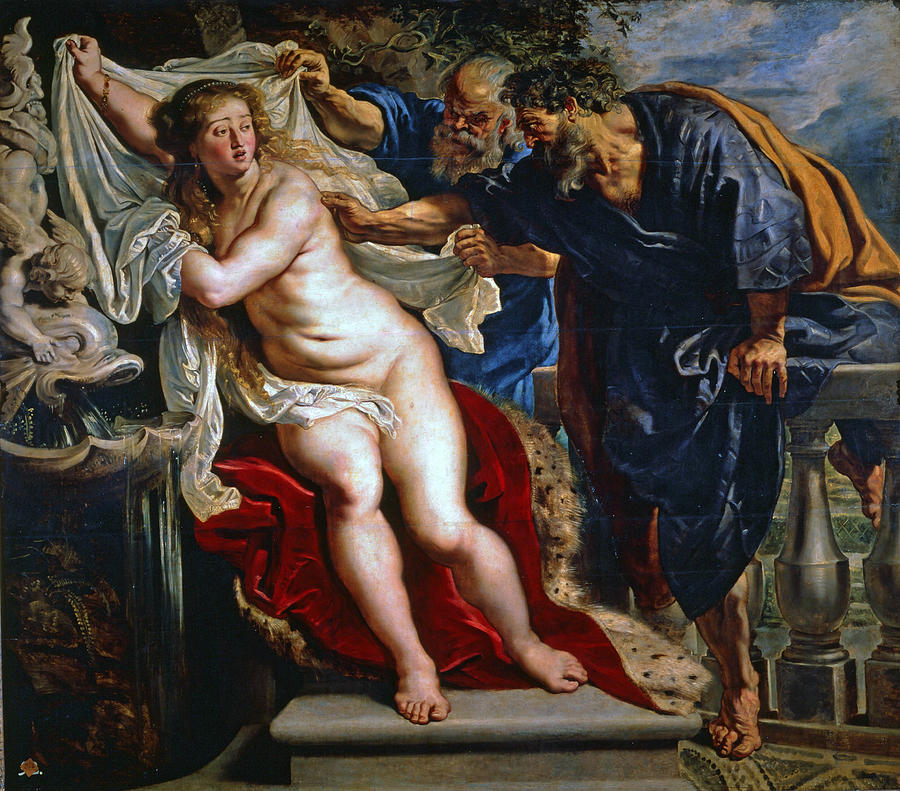
Image source: wikiart.org
Introduction
Peter Paul Rubens’s “Susanna and the Elders” (1610) stages the biblical moment when a virtuous woman, bathing in her garden, is accosted by two judges who demand her compliance. In Rubens’s hands, the story becomes a charged encounter between innocence and abuse of authority, acted out in a compressed space where flesh, drapery, stone, and water collide. Susanna twists in alarm, her body radiant against a crater of red velvet; the elders surge in from the right, one clawing at her linen, the other whispering threats. An antique fountain with a putto pours a ribbon of water that glitters like an accusation. Everything is in motion—arms fling wide, cloth snaps, eyes dart—and yet the scene feels painfully still at its moral core: a woman’s “no” meeting corruption face to face.
The Story and Rubens’s Choice of Instant
The Book of Daniel tells how Susanna, a chaste wife, was spied upon by two elders who, finding her alone at her bath, tried to coerce her. When she refused, they falsely accused her of adultery; only the young Daniel, cross-examining them, exposed their lies and saved her. Artists have long chosen between three instants: the voyeuristic spying, the violent approach, or the public vindication. Rubens selects the second—the approach—and sets it at the split second when the elders’ hands touch the veil and Susanna whirls to resist. His decision disallows distance. We do not observe a crime from comfort; we stand within the radiant, dangerous radius of contact.
Composition and the Theater of Pressure
Rubens composes a triangle of force with Susanna at its luminous apex. She sits on a stone ledge draped in scarlet, her body twisting left as both arms fling up to shield and push away. The elders invade from the right, angled diagonally in a wedge. Their combined mass—dark garments, muscular forearms, bearded heads—forms a counter-triangle that slams into hers. The meeting point is a knot of hands and linen at her shoulder: three skins, one cloth, one crisis. Behind, balusters and a low wall clinch the space like stage flats, preventing escape and driving every line back toward the encounter. The design is Baroque not by ornament but by the geometry of stress.
Light, Color, and the Moral Horizon
Light floods Susanna and licks the elders with a cooler, broken glow. The palette stages the argument. Her skin carries warm creams and rose, the red mantle inflames the seat, and a pearly veil flashes like a second skin. By contrast, the elders wear a storm of blues and browns, with smaller tongues of orange that echo danger rather than joy. A pale sky fights through trees above; stone architecture sours into gray. Rubens learned in Venice to let color carry meaning: here, light is the breath of truth, red is the alarm bell, blue-black is the pressure of malice, and the thin silver of the veil is the fragile line between safety and exposure.
The Body as Testimony
Rubens paints Susanna’s body with frank tenderness, neither idealizing into marble nor sensationalizing harm. The twist at the waist gathers muscles into living spirals; the abdomen flexes; the shoulder lifts under gripped linen; the fingers splay with a reflex that is half modesty, half counterforce. The body becomes testimony: every contour says “resistance.” This corporeal eloquence matters in a story about truth and lies; Susanna’s flesh tells the truth of her refusal even as words are about to be forged against her. Rubens’s famous voluptuousness is thus ethically focused—beauty harnessed to the drama of consent.
The Elders and the Anatomy of Coercion
The aggressors are individualized without being caricatured. The nearer elder leans forward, hand dug into the white cloth, mouth tightened in a hiss of persuasion. His arm is modeled like a rope: a symbol of strength perverted. The older man behind him, hair and beard blown like bracken by the moral wind of the scene, reaches to block or cover, performing complicity under the guise of concern. Their poses echo each other in a rhythm of collusion. Rubens refuses moustache-twirling villainy; he makes the elders credible men who have chosen to misuse status, which is why the picture still reads as modern.
Drapery as a Battlefield
Few painters make cloth speak as Rubens does. The white veil is the focal weapon and wound at once, yanked by one elder, pulled across by Susanna, lifted in a banner of self-defense above her head. Its edges snap with highlights, its folds charge like surf, and its transparency plays perilously against flesh. Beneath, a crimson mantle erupts in volcanic folds, its fur lining visible at the edge—a luxury item that here becomes a soft bastion. The material world takes sides: red and white ally with Susanna’s dignity; the dark robes of the elders surge like storm clouds. Drapery becomes the battlefield upon which ethics is fought.
Stone, Water, and the Garden as Witness
The setting is not generic. A balustrade, a fountain with a small putto spouting water, carved pilasters, and a sliver of sky locate the scene in a cultivated garden—an emblem of privacy and ordered virtue. The fountain is especially eloquent: its ever-falling water tricks into light, a visible measure of time and purity, set against the elders’ corrupt stasis. The stone ledge under Susanna is massive, but the fur and crimson soften it—the domestic extension of the home her integrity guards. Rubens uses architecture and landscape as witnesses who will not forget.
The Gaze and the Ethics of Looking
Where do eyes go? Susanna looks out and slightly up, eyes widened toward an unseen rescuer or the heavens, refusing to meet the men’s gaze. The elders’ eyes fix on her with different temperatures: one calculating, one hungry. The painting thus stages three modes of looking—prayerful appeal, predatory appraisal, and, crucially, our own. Rubens makes viewers participants rather than voyeurs by placing us inside Susanna’s arc. Her gaze vectors past us; we feel the charge to take the role Daniel will soon play: witness, advocate, judge of truth.
Gesture as Language
Hands are the painting’s loudest voices. Susanna’s left hand knots the veil above, her right pulls it across; the nearer elder’s hand grips linen and shoulder; the other elder’s fingers pinch, admonish, and entice. Even the putto on the fountain leans forward with a tiny extended arm, parodying the adults’ reach and quietly accusing it. Rubens’s choreography of hands maps a moral grammar—defend, seize, conspire, call—and the viewer reads the story fluently without a word.
Venetian Color and Roman Muscle, Translated in Antwerp
This 1610 canvas gathers Rubens’s Italian decade into a Northern idiom. Venetian color saturates the scene: the red mantle behaves like liquid light, the blue-black robes carry cool depth, flesh breathes with honeyed glazes. Roman lessons in sculptural anatomy shape the elders’ torsos and Susanna’s twisting back. Yet the tactility—the fur’s nap, the wet sparkle of water, the grain of stone—belongs to Flemish love of the tangible. The synthesis lets mythic grandeur and domestic immediacy occupy the same frame.
Sound and Silence
The painting brims with implied noise: the hiss of cloth tearing from fingers, the slap of a palm on stone, water’s chatter at the fountain, a strangled cry caught in Susanna’s throat, the low, urgent murmur of the elders. But Rubens freezes that sound at the instant before it spills. The stillness is electric—like thunderheads locked in a single frame—so that viewers can supply the next second themselves. That pause places responsibility on us: what will be said next, and by whom?
The Legal Drama Foreshadowed
Daniel’s cross-examination is future history inside the image. Rubens foreshadows it through spatial cues. The balustrade implies a court’s railing; the elders’ proximity to architectural authority contrasts with Susanna’s edge-of-ledge vulnerability; the fountain’s steady measure suggests the patience of truth. This pre-trial scene thus already asks us to interrogate contradictions: the same hands that claim to protect are ravaging; the robe of civic dignity cloaks coercion. By preloading the accusation with evidence, Rubens aligns the viewer with the future Daniel.
The Modernity of Consent
Though clothed in Baroque splendor, the painting speaks with striking contemporaneity about consent and power. Susanna’s body is not a pretext for spectacle but the site of her say. Her refusal has posture, torque, temperature. The elders’ abuse is written in reach and cornering. Rubens works through formal means—light, angle, mass—to dramatize a moral clarity that needs no textual caption. That clarity explains the perennial appeal of the subject for cultures negotiating public conversations about harassment and credibility.
Technique and the Persuasion of Paint
Rubens builds the picture on a warm ground that lends flesh its glow. He blocks big masses fast—crimson, blue, stone—then reenters with wet-into-wet modeling for bodies and with brisk, opaque highlights for the snap of linen and the glisten of water. Edges are carefully varied: knife-sharp where cloth meets light, soft where flesh turns into shadow, frayed where fur peeks out. The surface keeps the energy of the first lay-in while carrying the finish of authority. The effect is urgency with control—a visual analogue of Susanna’s composed alarm.
Comparisons and Rubens’s Innovations
Titian and Tintoretto had painted the theme with lush poetry and slashing drama; Caravaggio had brought a darker, tenebristic psychology to similar close-range scenes. Rubens inherits their strengths and reframes the story with his signature amplitude: bodies generous, color saturated, space legible, narrative immediate. His innovation is the ethical staging. Instead of a voyeur’s vista, we get a prosecution exhibit; instead of a scenic garden, a judicial pressure cooker; instead of sensational shock, sustained moral presence.
The Viewer’s Place and the Call to Witness
Rubens places us at the foot of the ledge, just left of Susanna’s knees. We could reach out and steady her; we cannot unsee the grip on her shoulder. This proximity denies the safe distance of “art appreciation” and recruits the audience into the drama. The story’s resolution—Daniel’s brave cross-examination—now feels like our task. The painting becomes participatory ethics, not passive spectacle.
Symbolic Punctuation: Jewelry, Fur, and the Pearl
Small objects punctuate the moral sentence. The bracelet on Susanna’s arm slides dangerously near the wrist, echoing the precariousness of her situation while insisting on her status and dignity. The fur lining—likely ermine—glances at chastity and lawful love, now enlisted to protect her body. A tiny pearl at the ear or on the headband signals purity; pearls are formed by irritation made precious, just as Susanna’s ordeal will produce vindication. Rubens uses these details not as clutter but as soft-spoken symbols that tighten the story’s emotional net.
From Private Panel to Public Lesson
Made at the beginning of Rubens’s Antwerp maturity, the painting would have resonated in households that sought art capable of both delight and instruction. It is voluptuous—Rubens never suppresses the sensuous life of paint—but its delight serves a moral lesson about justice, truth, and the defense of the innocent. That marriage of pleasure and principle constitutes the Baroque at its best, and it explains why the canvas remains a touchstone for discussions of virtue under pressure.
Legacy and Continuing Resonance
“Susanna and the Elders” continues to provoke because it refuses to be only a myth or only a moral. It is a bodily event in a believable place, a legal case already gathering evidence, an invitation to the viewer to become Daniel. The picture’s heat comes from this threefold identity. As art history has moved from formalism to ethics and back again, Rubens’s painting has stood steady: consonant with both, reducible to neither.
Conclusion
Rubens’s 1610 “Susanna and the Elders” is a masterclass in how composition, color, and touch can conduct a moral drama. The triangular crash of bodies, the white veil snatched and defended, the red mantle erupting beneath, the fountain spilling witness, the balustrade closing ranks, the elders’ hands asserting power, and Susanna’s body turning that power aside—together they build a painting that is as beautiful as it is bracing. It asks viewers not only to marvel at Baroque bravura but to take sides with the truth. In the space between a hand on a shoulder and a cry for help, Rubens has painted the entire argument for justice.