Image source: wikiart.org
Introduction
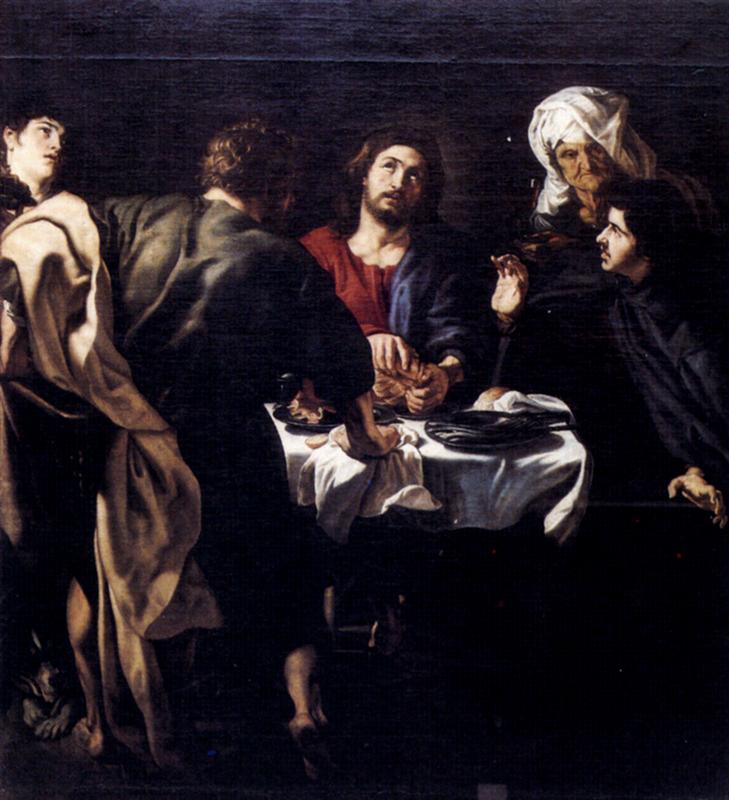
Peter Paul Rubens’s “The Supper at Emmaus” (1610) dramatizes the instant when the risen Christ reveals himself to two disciples in a modest dining room at dusk. The Gospel of Luke tells the story: after the Crucifixion, two followers walk from Jerusalem to Emmaus in grief. A stranger joins, interprets Scripture, and later—when he breaks bread—his identity is suddenly known. Rubens compresses that narrative arc into a single burst of recognition. A wedge of light cuts the dark; bodies gather around a little table; gestures freeze between disbelief and worship. The picture announces Rubens’s Antwerp maturity: Italianate color and anatomy, Caravaggesque chiaroscuro, and a Northern sensitivity to the tactile world of linen, bread, and hands. In one charged interior he stages revelation as something you can see and almost hear.
Historical Moment and Artistic Context
The year 1610 marks Rubens’s first full year back in Antwerp after a decade in Italy. He had studied antiquity in Rome, absorbed the Venetian language of light-drenched color, and witnessed the new naturalism of Caravaggio and the Carracci. Antwerp itself was entering the relative calm of the Twelve Years’ Truce (1609–1621). Churches and private patrons alike were eager for persuasive sacred images aligned with Counter-Reformation aims: art should be clear, immediate, emotionally convincing, and rooted in Scripture and sacrament. “The Supper at Emmaus” fits this agenda perfectly. It visualizes a foundational post-Resurrection episode while foregrounding the Eucharist as the place where Christ is recognized.
Composition: A Stage Built Around a Table
Rubens composes the scene as a compact stage, the table its altar and focal point. Christ sits in the center, turned slightly, his face lifted, a warm lamp of flesh against the deep interior. A triangular weave of bodies closes in around him: the two disciples lean from either side; a servant woman peers from the rear; a youthful attendant on the left registers surprise. Everything funnels toward the breaking of bread—Christ’s hands poised above the loaf, the white cloth a field of light that throws shadows into high relief. The table juts toward us, like a theatrical apron, inviting the viewer to step into the company. By compressing the space and cropping figures at the edge, Rubens heightens urgency: revelation is not comfortable; it presses close.
Chiaroscuro and the Physics of Revelation
Light is the painting’s theology. The room is dusk-dark, close to night, and then an unseen source pour across the table, wraps Christ’s head and hands, and touches every face that turns toward him. This is not an abstract glow but a directional, material light—carrying the grain of linen, the roughness of bread, the polished rim of a plate. Rubens adapts Caravaggio’s dramatic chiaroscuro while warming it with Venetian color: rather than harsh spotlight and pitch-black void, the shadows here breathe; light carries temperature. The effect is incarnational. Revelation does not abolish matter; it clarifies it. Bread, cloth, and skin are the means through which recognition occurs.
The Moment of Recognition
Luke’s account pivots on a simple action—“he took bread, blessed and broke it”—and Rubens captures the second when movement pauses. Christ’s hands hover over the loaf, the disciples’ bodies surge, and silence thickens. One disciple raises a hand in arrested speech; the other pivots from the left with a half-turn that suggests he has just jumped to his feet; the servant woman freezes mid-task, eyes narrowing to see better. Recognition spreads outward like a ring in water, and even the tablecloth seems to lift under the shock. This is how Rubens turns narrative into experience: recognition is visible as the sudden synchronization of light, gesture, and attention.
Christ: Humanity and Majesty in One Face
Rubens paints Christ without idealizing anonymity. The features are specific: a soft beard, heavy lids, a mouth that has just spoken a blessing. The body is solid, the robe a sober red and blue—a color code that nods to tradition while keeping the figure grounded. The head tilts a fraction upward, eyes half-lifted, as if listening and offering simultaneously. This mix of introspection and presence distinguishes Rubens’s Christ from the aloof, sculptural types of late Mannerism. The person at the table is recognizably the teacher who walked the road, the friend who broke bread before, and yet more than either: the risen Lord whose body still bears the weight of the Passion.
The Disciples as Mirrors for the Viewer
Rubens uses the two disciples to choreograph our own response. The figure at Christ’s right raises a hand, palm outward, fingers curling into an involuntary sign of both astonishment and blessing. His face opens in a gasp that becomes prayer. The disciple at left—seen from the back—performs the counterpose: shoulders drive forward, feet shift, and the entire body rotates toward the center. Because we do not see his face, we inhabit his movement; our bodies mimic his turn. Together the pair create a dialectic of recognition: sudden understanding in the mind and a reflex of the body that leans toward the source.
Servants and the Everyday World
Two servants tether the miracle to ordinary life. The older woman, head wrapped, peers with a mix of professional concern and dawning wonder. The younger attendant, entering from the left, looks over his shoulder with eyes widened, as if catching the moment mid-errand. Their inclusion grounds the scene in the household economies where Gospel events often unfold. It also communicates a Counter-Reformation truth Rubens loved: grace enters through the everyday—through bread baked, cloth laundered, tables set—and spreads outward to those who happen to be near.
The Eucharistic Center
Although the painting is a narrative episode, its center of gravity is unmistakably Eucharistic. The white tablecloth could be an altar linen; the loaf in Christ’s hands, the host of a domestic Mass; the humbled gestures of the disciples, a model for devotional posture at Communion. Rubens understood how this scene would resonate in a city of confraternities and processions. The Emmaus meal becomes a template for every liturgy: Christ is recognized “in the breaking of the bread,” and believers are united to him around a table that becomes an altar. The painting’s persuasive power lies in making that doctrine felt, not merely stated.
The Tablecloth: A Theater of Touch
Rubens lavishes attention on the linen’s folds. He drags thick, light strokes across the weave to make edges catch the illumination; he lets shadows pool into creases that look lifted by the disciples’ sudden movement. The cloth’s tactility is not indulgence: it is rhetorical. The senses—especially touch—are the doors through which recognition enters. Viewers can almost feel the coolness of the fabric, the weight of bread pressed against the palm, the friction of a plate sliding an inch. Such “haptic painting” is central to Rubens’s sacramental vision: the spiritual takes body seriously.
Color, Flesh, and the Venetian Lesson
Italian color is everywhere. Christ’s robe carries a brick-red warmed by glazes, the blue cloak a cool counterpoint that recedes into shadow. Flesh tones move from honeyed mid-values to cool, green-gray halftones at the knuckles and jaw, giving bodies bulk without chalkiness. Black—dominant in cloaks and background—is never dead; it is shot with browns and blues so that it behaves like air, not a hole. These chromatic choices build depth and temperature, turning a moral lesson into a living climate.
Perspective and the Viewer’s Seat at the Table
Rubens sets the table at a height that meets our ribcage and thrusts it toward us with a subtle trapezoid. We are close enough to feel the heat of the room. This vantage collapses the time between event and beholder: you are the next person to be recognized and fed. The choice also echoes the liturgical experience of altarpieces, where worshipers look up at a table transformed. Here, however, we do not look up from a nave; we sit inches away, as if having just arrived with dust still on our shoes from the road.
Gesture as Language
Every hand speaks. Christ blesses and breaks with a calm economy. One disciple’s fingers splay in shock; another’s grip the cloth’s edge. The servant woman’s right hand curls around a utensil mid-task, an index of domestic interruption. A coil of rope or napkin rings—objects of modest utility—echo the circular motion of the blessing, linking sacred action with the rhythms of service. Rubens’s hands are never generic; they are characters with their own lines.
Comparisons: Caravaggio and the Carracci
Any Emmaus painted around 1600 stands in conversation with Caravaggio’s celebrated versions. Rubens adopts the tenebrist stagecraft—dark interior, spotlight revelation—but diverges in emphasis. Caravaggio’s disciples leap, their gestures theatrical; Rubens aims for a gentler, psychologically layered recognition. The Carracci influence emerges in the firm anatomy and classical poise of Christ’s figure, as well as in the moral clarity of the scene. The synthesis is distinctly Rubensian: a human-scale drama charged with warmth rather than shock alone.
Antwerp Devotion and Counter-Reformation Rhetoric
The painting’s rhetoric would have landed squarely in 1610 Antwerp. Confraternities of the Blessed Sacrament, processions of Corpus Christi, and renewed catechesis emphasized the Eucharist as the beating heart of Catholic life. Audiences accustomed to altarpieces depicting saints in ecstasy could now contemplate a simpler, domestic miracle: recognition through bread. Rubens’s genius is to make this teaching feel inevitable. Light finds the loaf, and with it the faces; the room brightens; knowledge settles; faith and food converge.
The Soundscape of the Scene
Rubens implies sound with painterly cues: the tiny clink of a plate nudged by a startled elbow; the fricative rustle of linen; the whispered, “Stay with us,” becoming, “Lord!”; the older woman’s breath catching. The painting invites a quiet, almost auditory contemplation: what did the room sound like in the second before speech returned? By courting the ear through the eye, Rubens deepens immersion.
The Ethics of Hospitality
At Emmaus, hospitality is the human precondition for grace—“they pressed him to stay.” Rubens underlines that ethic. The simple tableware, the presence of a servant, the shared meal: revelation enters culture by way of welcome. In an Antwerp still healing from conflict, this ethic resonated. Civic peace requires hospitality; the church’s mission begins at the table.
Technique and Surface
Close looking reveals Rubens’s layered method. Warm imprimatura enriches flesh and shadow; forms are blocked broadly, then refined with wet-into-wet transitions that keep edges soft where needed (cheek, bread), crisp where decisive (fingers, rim of a plate). Highlights are placed late and sparingly so that they sparkle: a bead of light on a knuckle, a slick on the tablecloth, a glint on a utensil. The surface never looks labored; it breathes at the same tempo as the story.
Theological Density Without Didactic Clutter
No halos, no explicit inscriptions, no spinning symbols: Rubens trusts viewers to read Scripture in paint. The painting’s theology is carried by composition and touch—Christ centered at a table, hands breaking, faces turning, light unifying. It is a sermon without words: recognition happens where Scripture is opened on the road and bread is broken in the house; revelation does not cancel hunger but answers it.
Legacy and Contemporary Appeal
“The Supper at Emmaus” remains compelling because it enacts recognition as a human experience rather than an abstract doctrine. Whether one approaches the canvas as believer, art lover, or both, the moment feels true: surprise, dawning warmth, the sensation of time stopping and then moving again. Modern viewers, accustomed to noisy revelations, find here a deeper register—quiet light, ordinary materials, hands that remember work. Rubens’s gift is to let paint carry the weight of that truth.
Conclusion
Rubens’s 1610 “Supper at Emmaus” converts a small room into the theater of revelation. Chiaroscuro intensifies, not sensationalizes; color warms bodies into presence; the table becomes the axis of recognition. The disciples show us how to see; the servants show us how grace touches labor; Christ shows us how the risen life enters a meal. The painting distills the Counter-Reformation conviction that God meets people in their senses—bread broken, light falling, hands moving—and it does so with a tenderness that never dims its dramatic force. In Antwerp’s first year of peace, Rubens offered an image of recognition that is also a promise: light will find the table again.