Image source: wikiart.org
Introduction
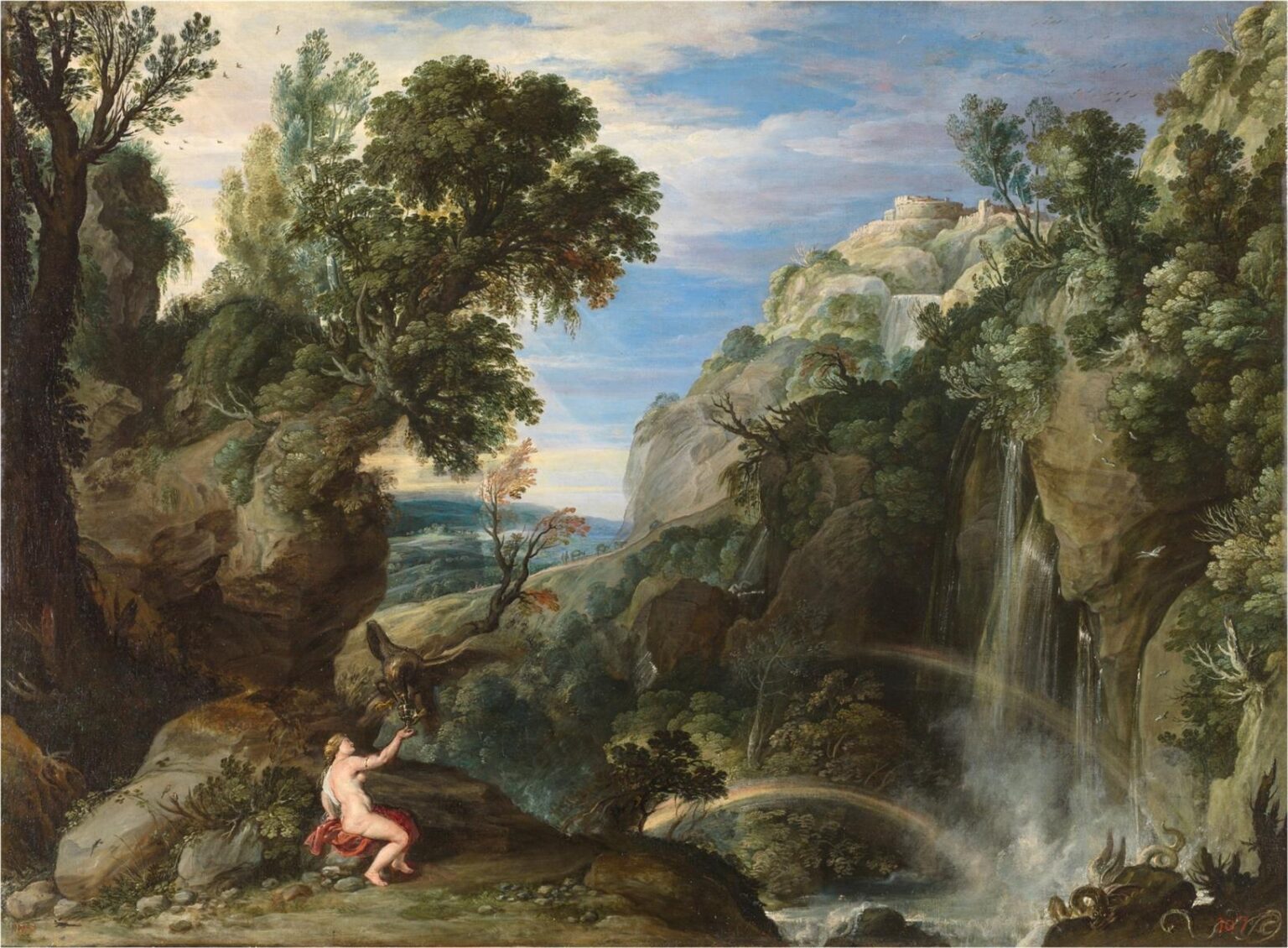
Peter Paul Rubens’s “Landscape with Psyche and Jupiter” (1610) is a sweeping, theatrically lit panorama that fuses myth and nature into a single, surging drama. The eye meets a stage of mountains, cataracts, vapor, bending trees, and a rainbow-struck gorge, then discovers the mythic action scaled almost to a whisper in the foreground: Psyche kneels on a rocky ledge as Jupiter descends in the form of an eagle. The painting’s power lies in that daring inversion. The gods are small; the world around them is immense and alive. Rubens transforms a classical episode into an experience of weather, geology, and botanical sensation, making the landscape itself feel like an instrument of the divine encounter.
The Myth Recast in a Vast World
The story of Psyche, drawn from Apuleius’s “Golden Ass,” tells of a mortal whose beauty provokes the jealousy of Venus and the love of Cupid. After ordeals and separations, Jupiter ultimately sanctions their union. Rubens isolates a moment of petition and favor, but he shifts emphasis away from courtly allegory toward elemental nature. Jupiter’s eagle sweeps in with talons outstretched, a messenger of sovereign power, while Psyche, half-draped, offers a pleading gesture. The rhetorical center is not in their faces but in the choreography of forces around them: the gust moving a tree, the foam that leaps from the cascades, the rays that break through cloud. The myth is made credible because the world itself seems to breathe in sympathy.
Composition and the Architecture of Space
Rubens organizes the composition along a grand diagonal from the weighty foreground boulder at left down toward the tumult of water at the bottom right. This diagonal is countered by a rising sweep of mountain and sky that carries the spectator’s gaze toward a fortified settlement perched on a sunlit ridge in the far distance. The small red accent of Psyche’s drapery anchors the lower left and sets a chromatic counter-impulse to the cool greens and blues that dominate the scene. The eagle’s wings provide a pivot between human and topography, spinning the eye outward to the waterfalls and then back again to the kneeling figure. Spatial depth is achieved through overlapping planes of foliage, the recession of pale atmospheric blues, and the sinuous river threading to the horizon. The result is a landscape that feels navigable, a place where the viewer could walk from ledge to ledge and feel the spray on the skin.
The Orchestration of Light and Weather
Light is the painting’s protagonist. It arrives in slanted bands from the upper left, grazes the top leaves of trees, glitters on the cascade, and sifts into mist at the gorge. Rubens uses a full register of illumination, from brilliant sky to cavernous shadow, to imply weather in motion. The clouds are not a backdrop; they are engines of change, parting just enough to allow a sanctifying ray to find Psyche’s ledge. Rainbows arc in the spray at the lower right, their spectral curve both an optical marvel and a symbol of divine pledge. The alternation of sun and vapor gives the whole scene a felt humidity. One senses the coolness of shadowed rock and the warmth of sunlit slopes, a physical immediacy that binds the myth to the body.
Waterfalls, Rainbows, and the Physics of the Sublime
The right side of the painting is commanded by a cliff face over which water streams in multiple veils. Rubens paints the cataract with feathery vertical strokes that dissolve into mist at the basin, then crowns that mist with the double arc of a rainbow. The inclusion of such optical accuracy signals the artist’s curiosity about nature’s workings. Yet accuracy serves emotion. The roar of the fall, the trembling of spray, and the delicate apparition of prismatic color build a sensation that eighteenth-century viewers would later call the sublime. Here, decades earlier, Rubens already induces awe by yoking empirical observation to theatrical composition.
Trees, Rocks, and the Language of Touch
The landscape is constructed from a chorus of textures: mossy stones that take the fingerprint of light, trunks scarred by age, leaves clustered in variegated masses that swell and thin with the breeze. Rubens often varies his handling within a single tree—firm shadows at the core, quick flicks at the periphery where light breaks into fragments. Rocks are modeled with warm underpainting and cool scumbles that suggest lichen and dampness. In the foreground, the pebbled path and tufts of scrub place Psyche in a tactile world; the bare skin that catches sunlight is answered by the roughness of the ground she kneels upon. The entire painting is a study in how pigment can imitate matter without losing its own luscious identity as paint.
Human Scale and the Grand Stage of Nature
The decision to miniaturize Psyche and Jupiter within such an outsized setting is crucial. Rubens resists the common hierarchy that grants the human figure automatic primacy, proposing instead that the drama of the soul takes place inside a larger theatre of creation. The human is not belittled; it is contextualized. Psyche’s vulnerability reads more movingly because she is dwarfed by cliffs and sky. Jupiter’s authority is heightened because even the weather seems to conspire with his arrival. The landscape turns into an eloquent chorus that echoes the characters’ inner states.
Movement and Directionality
Every element in the painting seems to lean, bend, or flow. Trees bow toward the gorge; rock strata tilt; river paths curve with purpose; even the clouds slide across the sky in long bands. These directions cluster around the central encounter like vectors. The eagle’s descent adds a sudden diagonal flare, opposed by Psyche’s upward-reaching arm. The resulting X-shaped dynamic binds figure and ground tightly together. Nothing is idle. The whole countryside is choreographed, and the viewer’s gaze moves with the same quickness as the brush that established the scene.
Color Structure and Harmonic Balances
Color is organized around a cool-warm dialogue. The cools are expansive—sky blues, watery greens, slate grays of shadowed cliffs—while the warms are strategic: ochres of sunlit rock, coppery browns of bark, and the crimson drapery at Psyche’s hip. That touch of red acts like a sounding note, recurring in smaller keys in patches of earth and autumnal foliage. The rainbows introduce a rare spectrum within the otherwise restrained palette, and Rubens softens their bands so they feel atmospheric rather than diagrammatic. The ensemble achieves a chromatic equilibrium that reads as natural yet composed, as though nature itself had arranged a palette for myth.
The Body of Psyche and the Eagle of Jupiter
Psyche is painted with a cool, pearl-like flesh that absorbs the ambient tone of the sky. Her posture combines modesty and yearning: the spine curves, the chest opens to receive, the arm extends with a blend of fear and welcome. The drapery at her waist wraps backward in a ribbon of red that anchors her to the earth even as her gesture implies spiritual ascent. Jupiter’s eagle is robust and tactile, its wings cut with dark strokes that emphasize structure, its eye a bright point of will. Where Psyche’s modeling is rounded and luminous, the eagle is angular and glossy—a beautiful contrast of human softness and divine ferocity.
Architecture in the Distance and the Geography of Story
High on the right, a fortified complex perches on a crest, just catching sunlight. Its presence enlarges the narrative frame. The world of gods and lovers exists alongside the world of human order and defense. The castle’s tiny scale sharpens the sensation of depth, and its geometry punctuates the organic rhythm of trees and rocks. Farther left, a river valley reaches toward a low horizon. The viewer can imagine journeys between these places, as if the painting mapped a country where mythic visitations interrupt ordinary life.
The Breath of the Baroque
Although the painting predates the most tumultuous Baroque canvases of Rubens’s later career, it already exhibits the Baroque breath: the taste for diagonals, the love of glowing flesh against darkened ground, the use of light as an instrument of revelation, and a preference for scenes that capture the instant before culmination. The eagle has not yet seized Psyche’s offering; the rainbow has just formed; the waterfall is in perpetual plunge. Everything is becoming. This sensation of becoming marks the painting as a modern work in its time, eager to show nature not as a static backdrop but as a living process.
Dialogue with Flemish Landscape Traditions
Rubens’s landscape engages the Flemish legacy of world landscapes that stretch from Joachim Patinir to Pieter Bruegel the Elder. Those earlier panoramas often present tiny biblical episodes within vast, fantastical terrains of crag and river. Rubens inherits the panoramic ambition but suffuses it with warmer light, richer air, and a more sensuous handling of trees and stone. The scene remains imaginative rather than topographically specific, yet its details feel observed. The fusion of learned tradition and fresh looking allows the painting to satisfy both the scholar and the wanderer.
Theological Atmosphere and the Natural Signs of Favor
The picture bathes the myth in a quasi-sacramental atmosphere. Rays break from cloud, water, and prismatic color as though creation itself were attesting to a divine decree. The rainbow possesses long-standing biblical associations with covenant; here it signals approval that will ultimately bless Psyche’s union. The multiplicity of signs—light, mist, arc, flight—creates a chorus of assent. Rubens thus enlists meteorology as iconography, without ever reducing the phenomena to mere symbols. Their beauty persuades first; their meaning arrives through pleasure.
Human Emotion Expressed Through Terrain
Psyche’s emotional trajectory is written into the landscape’s forms. The rocky ledge stands for peril and isolation; the descent of water for purgation and change; the opening of sky for hope; the far-off settlement for future domestication and peace. Even the crooked tree by the ledge, leaf-thin and resolute, reads as a pictorial echo of her own fragile courage. This technique—externalizing psychological states in nature—would become a staple of later landscape painting. Rubens here demonstrates its potency within a mythological narrative.
Material Technique and the Dance of the Brush
Close analysis reveals shifts in handling that correspond to spatial depth and material type. Foreground stones and foliage bear firmer edges and thicker impasto; mid-distance trees are knit with broken strokes that allow ground color to flicker through; distances thin to airy glazes. Water is a tour de force of varied touch: glassy sheets at the lip of the fall, beads of highlight in the plunge, and smoky veils where spray expands. The eagle’s feathers are tightened with linear accents that ride over softer underlayers, and Psyche’s skin is woven from translucent passes that leave the drawing supple but decisive. The painting is not only an image but a demonstration of how matter can be re-created with marks that remain deliciously visible.
Time of Day and Seasonal Register
The light suggests late afternoon, when the sun leans low enough to rake the upper branches and skim the cliff faces in oblique, gilding angles. Some foliage inclines toward autumn, with ochres and russets appearing among the greens. This seasonal register adds melancholy to the scene. Psyche is at the threshold of change; the landscape, too, is on the verge of turning. Rubens uses seasonal nuance to thicken the story’s emotional weather.
Viewers, Scale, and Participation
The viewer stands slightly above Psyche, close enough to witness the encounter yet far enough to perceive its setting. That vantage fosters a double attention: sympathy for the kneeling figure and exhilaration at the prospect of the cliffs and distances. The rainbow and spray at the lower right seem almost within reach, inviting the spectator to imagine the feel of cool mist on the face. The picture thus becomes experiential. It is not only about Psyche; it is about the viewer’s own bodily encounter with grandeur, danger, and grace.
The Painting within Rubens’s Oeuvre
Rubens is often remembered for crowded altarpieces and muscular mythologies, but his landscapes are essential to his achievement. They provide a laboratory for light and atmosphere, for the play between observation and invention, and for a gentler, more contemplative lyricism within his otherwise heroic style. “Landscape with Psyche and Jupiter” stands among the works in which he proves that nature can carry the emotional weight usually assigned to bodies, and that narrative can be entrusted to weather and stone without losing intensity.
Enduring Appeal and Contemporary Relevance
The painting continues to resonate because it speaks in languages that remain legible: the awe of wild places, the vulnerability of the individual before forces larger than the self, and the hope that beauty signals favor. In an era sensitive to ecological grandeur and fragility, Rubens’s vision of a world alive with agency feels surprisingly current. He portrays nature not as stage décor but as an active participant in the myth, a partner to Psyche’s fate. That partnership is what modern viewers instinctively recognize and cherish.
Conclusion
“Landscape with Psyche and Jupiter” expands a classical tale into an epic of air, water, stone, and light. Rubens crafts a panorama where the divine arrives as an eagle and as a rainbow, as a shaft of sun and as the strength of falling water. By reducing the figures to human scale within a boundless world, he makes the myth intimate and the landscape majestic. The painting achieves a rare synthesis: poetic narrative, optical truth, and sensual paintwork fused into a single, convincing breath. Standing before it, one feels the spray, hears the rush, and, like Psyche, looks up.