Image source: wikiart.org
A Portrait of Devotion Turned Toward the Viewer
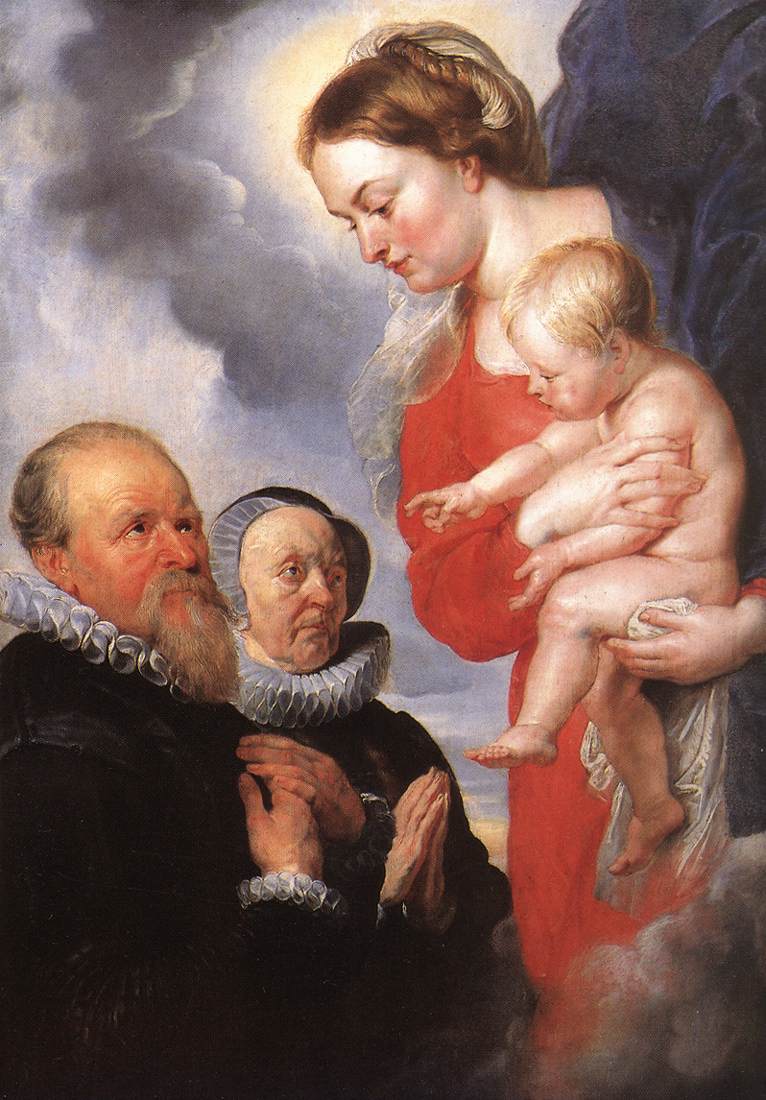
Peter Paul Rubens’s “Madonna and Child with the Donors Alexandre Goubeau and his wife Anne Antoni” (1604) is a luminous fusion of private prayer and public painting. Two Antwerp patrons kneel in crisp black attire and ruffs, hands folded, eyes lifted; the Virgin, robed in deep red, descends on a bank of clouds and bends toward them with maternal calm; the Christ Child leans forward, curious and blessing at once. Rubens sets the celestial and terrestrial courts into a single, intimate conversation. Nothing about the scene is distant or generalized. The donors’ portraits have the particularity of life; the Madonna and Child, though idealized, answer them with a warmth that feels embarrassingly near. The picture is a covenant in paint—between patrons and their heavenly advocates, between art and devotion, and between Baroque splendor and tender human feeling.
Antwerp Patrons and a Painter on the Rise
The names Alexandre Goubeau and Anne Antoni root the canvas in the bustling mercantile and civic culture of early seventeenth-century Antwerp. Such donor portraits were acts of gratitude and petition, offered to churches or private chapels as enduring prayers. In 1604 Rubens was newly returned from his formative Italian years. He had absorbed Venetian color and Roman monumentality, yet he remained a Flemish portraitist of piercing sympathy. This altarpiece memorializes that moment of synthesis. The donors receive the penetrating description typical of Northern art; the Mother and Child float in an Italianate atmosphere of soft light and saturated color. The combination gives the picture authority in both realms—the credible world of people we might meet and the credible world of grace we hope to meet.
Composition as a Meeting of Gazes
Rubens composes the scene as a triangle of attentions. Goubeau, at left, lifts his gaze past the frame to the Virgin’s face; Anne, slightly behind, looks with quieter intensity; the Virgin looks down and slightly forward, not quite at the donors but near them, as if her attention expands to include the viewer; the Child, shifting in Mary’s arm, turns his round, alert face toward the kneeling pair and raises his hand in a tiny gesture that mixes benediction and play. The lines of sight weave together like threads in a single cloth. As our eyes follow those lines, the composition completes the devotional circuit: supplication rises, intercession descends, blessing flows.
The Cloud as Threshold
The Virgin stands on a luminous cloud that curls around her like a low balcony. It is less a platform than a threshold, a place where heaven pauses to meet earth. Rubens paints it not as theatrical smoke but as soft, breathable air lit from within by a pearly radiance. The cloud’s shape echoes the oval of Mary’s nimbus and the curve of the Child’s limbs; its whiteness sets off the red of her mantle and the flesh of the Child. In practical terms the cloud solves a spatial problem, letting the sacred figures approach the donors without clumsy architecture. In theological terms it affirms the Incarnation’s nearness: grace is close enough to touch.
Color as Language of Charity
Color carries expressive punch. Mary’s mantle is a deep, saturated red that reads as charity and love; her under-garments are cooler and silvery, a chromatic humility. The Child’s skin is warm and peachy, with tender blue shadows around the wrists and knees that give blood and breath to the flesh. The donors wear Antwerp black with white ruffs; their costumes restrain the palette and frame their faces and hands—the organs of prayer—so the viewer reads devotion before status. The sky is a mutable blue-gray, opening around Mary’s head into a halo of warm light. Rubens’s Venetian lessons are everywhere, but his Flemish discipline keeps color from dissolving into indulgence. Every hue serves relation: red warms the blessing, black steadies the petition, and the cloud’s white stitches the two together.
The Donors: Portraits with a Moral Temperature
Rubens treats Goubeau and Anne with respectful accuracy. Goubeau’s face is weathered and lucid, the whiskers softly catching light, the eyelids pinked with life. Anne’s bonnet frames features that are strong, not sentimental; the slight pinch around her mouth suggests a temperament practiced in duty. Their hands are individualized—the left hand’s knuckle swell, the right’s subtle twist at prayer. These are not mannequins of piety but people whose characters have been shaped by it. By dignifying their particularity, Rubens affirms that sanctity is not a general gloss applied to humanity but something lived in individual faces.
The Virgin’s Nearness and the Child’s Agency
Mary’s presence is maternal without theatricality. She inclines just enough to communicate attention; her hands hold the Child securely yet generously, giving him the freedom to lean and reach. The Child is not passive. One foot rests against Mary’s robe with plump insistence; one hand gathers fabric at her shoulder; the other extends, tiny fingers poised as if to explore or bless. His gaze directs the painting’s mood—curiosity brightened by compassion. Rubens’s babies are famously alive; here the aliveness is theological, a reminder that the Word become flesh is a child who takes interest in those who pray.
Light as a Form of Speech
Illumination functions like speech in the picture. A soft radiance halos Mary and tickles the Child’s hair; cooler light grazes the donors’ faces. The two beams meet across the small gap between worlds. Highlight sits on Goubeau’s cheekbone and the Child’s wrist, as if the same sentence passes through both. Shadows, warm and accommodating, never threaten to swallow a detail. Rubens orchestrates chiaroscuro as a grammar of welcome—dark enough to give depth, light enough to invite.
Textures That Make Faith Tactile
Baroque painting convinces by texture. The ruffs are crisp as folded paper; the black garments have a deep nap that drinks light; Mary’s mantle gathers in soft, thick folds with a satiny sheen; the Child’s skin gleams with that dampness specific to infants. Rubens differentiates all these surfaces with expert touches: short, broken strokes along the lace edge, longer elastic strokes across fabric ridges, feathered transitions on flesh. Faith, in this painting, is not exhausting ideology but a tactile nearness. The senses are invited to notice, and noticing becomes a devotional act.
The Space Between: How Rubens Stages Prayer
The most eloquent part of the painting may be the small zone of air separating the donors from the sacred pair. That space is charged. It is the distance prayer must cross, and Rubens shows it to be incredibly small. The Child’s foot hovers above the donors’ hands; Mary’s robe falls within arm’s reach; the clouds encroach on the edge of the kneelers’ world like morning mist. This proximity does not erase difference—it makes it comforting. The supernatural is not far, but it is not smothering; it is distinct and gentle, perfectly scaled to human attention.
Gesture and the Practice of Petition
The donors’ clasped hands and lifted eyes are the grammar of petition. Goubeau’s hands press together with a confident firmness; Anne’s fold more tightly, the fingers almost laced, suggesting inwardness. Mary’s hands show the opposite motion—one open to cradle, one supporting the Child—gestures of provision. The Child extends a small blessing. These complementary movements—petition closing toward focus, provision opening toward generosity—compose a catechism of prayer in bodies. Rubens’s rhetoric of gesture makes doctrine wordlessly visible.
The Clouded Sky and the Promise of Weather
The sky behind Mary carries more mood than meteorology. Its cloud banks are not stormy; they are plush and pillowed, receding in cool layers that set off the warmer figures. Above the donors, the atmosphere is grayer; around Mary, it lifts and thins into a lucid glow. The difference is not stark; it is persuasive. It suggests how prayer alters weather, how light concentrates wherever love attends. Rubens lets the heavens behave like people in the painting: responsive.
Theological Economy: What Rubens Chooses to Include
Many donor altarpieces surround the Virgin and Child with saints and architectural splendor. Rubens declines excess. He needs only four figures and a breathing sky to tell the story. The economy focuses attention where it belongs—on the exchange of looks, the nearness of blessing, and the reality of human supplication. The painting thereby becomes adaptable: whether hung in a chapel or a family foundation, it remains immediately legible. The simplicity is not poverty; it is clarity.
Venetian Memory, Flemish Truth
Rubens’s time in Venice taught him to build scenes with air and color rather than line alone. The soft perimeter around Mary’s nimbus, the warm-cool dialogues, the atmospheric depths are Venetian habits. Yet the meticulous description of the donors’ features and clothing, the exactness of their hands and ruffs, recall the Flemish tradition of devotional portraiture. The marriage of the two produces a new intimacy—Italian warmth nested in Northern specificity.
The Painting as Social Document
Beyond devotion, the canvas is a record of social self-understanding. Goubeau and Anne present themselves not as conquerors of fortune but as petitioners. Their wealth is evident in the fineness of dress, but their posture declares that wealth is not the last word. In a city whose prosperity depended on risk and prudence, the donors’ image models civic humility: merchants and magistrates kneel; God descends. Rubens’s art serves a culture that understands public virtue as dependence on grace.
The Child’s Hand and the Frozen Instant
A small masterpiece within the painting is the Child’s right hand, caught mid-gesture as he reaches toward the kneeling man. The fingers are spread, not yet touching, the wrist turning, the palm soft. The moment is poised between contact and restraint—the kind of instant Rubens loved because it keeps the image alive. We feel that the next heartbeat could change everything: a touch bestowed, a blessing made explicit. The suspension of action makes the painting a perpetual present tense of grace.
Flesh and Lace: The Poetics of Contrast
Rubens delights in the juxtaposition of flesh and lace, of infant softness and starched ruff. The donors’ collars form crisp halos of terrestrial order; the Child’s round forms shine with heavenly freedom. Placing these textures side by side lets the viewer feel the compatibility of disciplines: human order and divine life are not rivals. In the meeting of materials the painter articulates a sacramental worldview: God enters a world of seams, stitches, and starch and blesses it.
The Quiet Drama of Age and Youth
Age and youth play across the picture with gentle poignancy. Goubeau’s and Anne’s faces carry the weather of years; the Child is a treasury of beginnings; the Virgin’s youthful calm bridges the two. The arrangement suggests continuity rather than contrast: the old turn to the young for hope, and the young turn to the old for intercession. Rubens does not force sentimentality. He lets the faces tell time, and time itself becomes a collaborator in devotion.
The Work’s Place in Rubens’s Development
This painting announces the domestic tenderness that will saturate Rubens’s mature holy families, while retaining the crisp portraiture that secured him civic patronage. The way Mary leans, the Child’s exploratory blessing, the donors’ sincerity—these motifs will echo, elaborated and recomposed, in later altarpieces and private devotional works. In 1604 Rubens is already the master of the human scale in sacred art, capable of making grand doctrine kneel beside us.
Why the Image Still Moves Viewers
Even stripped of its original chapel context, the painting communicates across time. It stages a meeting—of need and generosity, mortality and new life—that remains universally legible. The absence of ostentation focuses the heart; the nearness of the Child disarms defenses. We recognize ourselves in the donors’ folded hands and find ourselves included in the Virgin’s encompassing glance. The picture is hospitable: it knows why we came and holds the door.
Conclusion: Nearness Made Visible
“Madonna and Child with the Donors Alexandre Goubeau and his wife Anne Antoni” is a concert of nearness. Rubens binds heaven and earth with color and light, joins Venetian softness to Flemish truth, and allows a merchant couple’s prayer to become a public invitation. The painting’s power lies in its refusal to posture: it trusts the human face, the infant hand, the cloud’s glow, and the modest eloquence of folded fingers. Standing before it, we feel that grace travels the shortest distance possible—downward, toward the ones who ask.
