Image source: wikiart.org
Introduction
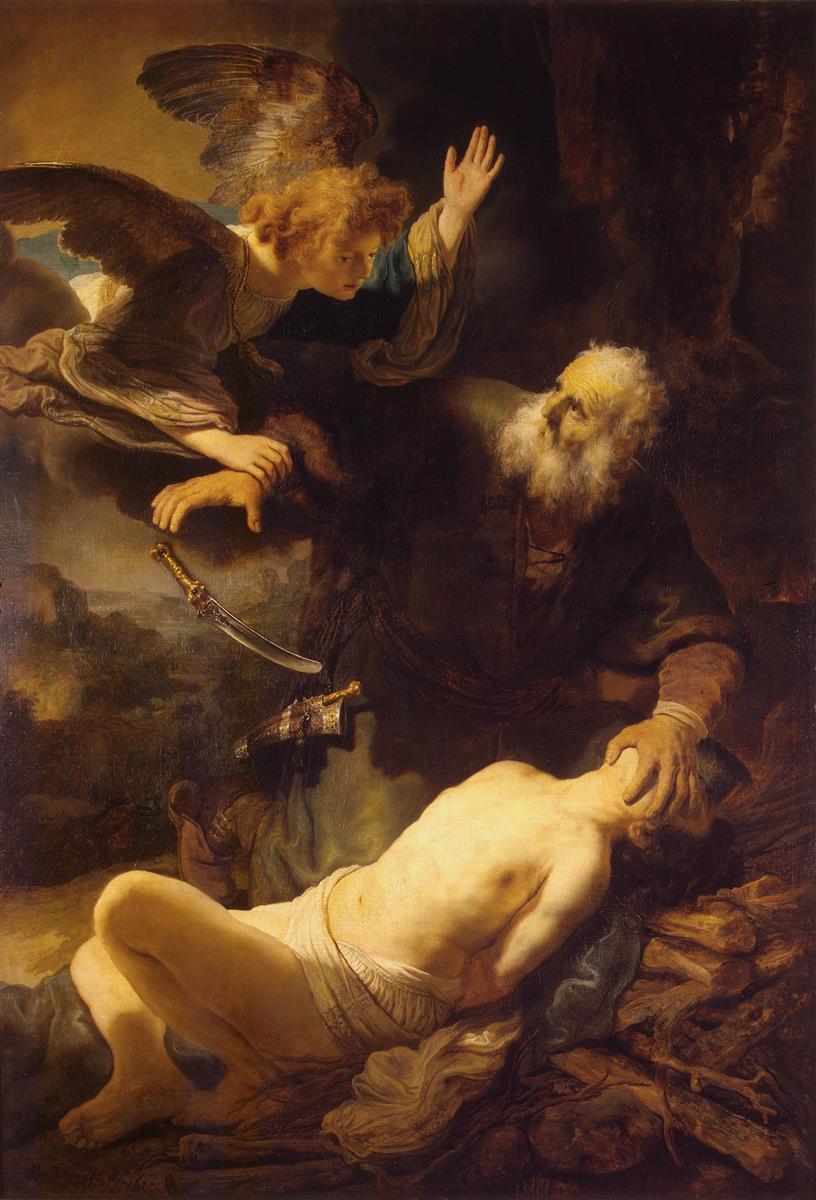
Rembrandt’s “Sacrifice of Isaac” (1635) is a charged meditation on faith, interruption, and the brink of violence. The canvas freezes the biblical story at its most dangerous instant: Abraham, sleeves rolled and body coiled, pins his son to the altar while an angel bursts from the left and arrests the fatal act. Light concentrates on Isaac’s vulnerable torso and on Abraham’s furrowed face; shadow engulfs the landscape and the piled wood; the glinting knife drops midair, its trajectory bent by a divine hand. Rather than narrate the whole episode, Rembrandt chooses the hinge where obedience meets reprieve. In that decision, the painting becomes a study in how paint can hold terror and mercy in the same breath.
The Story And Rembrandt’s Narrative Choice
The Book of Genesis tells that God commanded Abraham to offer Isaac as a burnt offering. At the last moment an angel stayed his hand and provided a ram as substitute. Rembrandt does not show the ram prominently or the aftermath of joy. He isolates the second before release: Isaac bound, neck exposed; Abraham’s hand covering the boy’s eyes; and the angel’s urgent grip on Abraham’s wrist. This timing intensifies the moral stakes. We see the act both happening and being undone. The painting’s meaning arrives not as explanation but as arrest, a divine “enough” that makes visible the obedience already proven.
Composition And The Architecture Of Interruption
The composition is built from intersecting diagonals that collide at the point of intervention. Isaac’s arched body forms a sweeping curve from lower left to upper right, culminating in the twist of his neck. Abraham’s body counters with a heavier diagonal from upper right to lower left, anchoring the boy against the piled wood. The angel’s entry slices across both, a lateral rush from left to right that breaks the mortal geometry. The falling knife, still bright, marks the pivot—the severed line between intent and completion. Rembrandt compresses space so the three principal figures press against each other, making the interruption feel tactile rather than theatrical. Even the scabbard, hanging open and inert, underscores finality postponed.
Light As Theological Speech
Light in this painting is a moral actor. It pours from the left with the angel, striking Isaac’s torso with a blaze that feels both vulnerable and sanctified. It runs down Abraham’s forehead, cheek, and beard, catching the wrinkles where anguish and resolve have dug their lines. The background dims into olive and umber; the wood absorbs illumination; the distant landscape glows faintly as if morning waited for the decision to be reversed. This distribution is not accidental. Light arrives with the messenger and declares his authority. It also converts the scene from sacrifice to revelation: what was about to be consumed becomes illuminated instead.
Gesture, Hands, And The Grammar Of Mercy
Rembrandt builds the drama through hands. The angel’s left hand clamps Abraham’s wrist, veins bulging with urgency; the right hand lifts, palm outward, announcing the divine command to stop. Abraham’s right hand—still knotted into the boy’s hair—shows habit, strength, and a father’s terrible concentration. His left hand, newly arrested, surrenders the knife mid-drop, a triangular glint echoing the triangular pile of wood. Isaac’s hands are bound but alive; the fingers flex, registering the shock of reprieve even as his face remains covered. In this choreography touch does the speaking: divine intervention, human obedience, filial fear, and the conversion of motion into restraint.
Faces And Psychological Depth
The faces carry a range of states within a heartbeat. Abraham’s expression is a weathered ledger—obedience carved into flesh, anguish caught at the corners of the mouth, faith wrestling with instinct. He does not look at the angel; he receives the command through touch and light while his gaze remains lowered, as if still inside the act he had accepted. Isaac’s face, half-hidden by Abraham’s hand, reveals just enough—open mouth, turned chin—to communicate breath, cry, and bewilderment. The angel’s youthful features, intense and compassionate, lean in with the urgency of one who must make himself understood instantly. There is no sentimentality; there is the exact psychology of a moment when life swings on one word.
Costume, Body, And Material Truth
Rembrandt’s material realism anchors the sacred drama. Abraham’s sleeve is rolled to reveal a forearm that is not a heroic cylinder but an old man’s muscle warmed by labor. The fabric of his robe drops in weighty folds and catches small sparks of light that reveal the thickness of the cloth. Isaac’s loincloth, thrown aside to expose the chest for the imagined blade, is rendered with a tactile mixture of soft impasto and delicate scumble; it reads as linen tinged by sweat and dust. The angel’s garment, edged with pale, heavenly light, contrasts with the earthier textures of father and son. Wings are painted as functional anatomy—feathers thick and mottled—rather than as decorative flags. The material specificity makes the interruption credible: grace arrives in a world of weight and fiber.
The Knife, the Scabbard, and the Physics of Reprieve
Few details are as eloquent as the released knife and its empty sheath. Rembrandt suspends the weapon mid-fall, the blade catching light like a crescent of threat already neutralized. The scabbard hangs slightly behind, its mouth open, useless now that the command has changed. These two objects, bright against shadow, operate as visual verbs: to drop and to sheath. Their orientation also choreographs the viewer’s eye, which follows the arc from the angel’s hand to the knife, then down to Isaac’s luminous body and back to Abraham’s stunned face. The weapons speak of the almost-ness of catastrophe and the exactness of the angel’s timing.
Space, Setting, and the Poetics of the Indeterminate
Rembrandt sets the event on a crude altar—stones and wood—and opens the background to a cool landscape that recedes under a veiled sky. The ground is rough, not theatrical; the rocks and wood interlock like sentence and clause. Nothing in the setting distracts from the human conflict. The right side of the canvas is a dark mass that frames Abraham and deepens the drama’s interiority; the left side breathes outward into distance, an open world awaiting the spared son. The setting is therefore both literal and symbolic: the binding place between two futures, one of loss, one of promise.
Color, Temperature, and Tonal Harmony
The palette balances earthy browns and olive blacks with warm yellows and lead whites, creating a tonal orchestra that holds tension without shrillness. Isaac’s flesh is modeled in radiant warm lights tempered by cool shadows, making his body the painting’s living lamp. The angel’s hair bursts with golden curls that share temperature with the light that carries him; greenish blues in his sleeves cool the palette and prevent the warmth from tipping into sentimentality. Abraham’s robe is a deep, almost wine-dark brown that drinks the light, reinforcing the heaviness of his vocation. Throughout, temperature shifts—rather than saturated hues—carry emotion: warmth for life and command, cool for doubt and the world beyond the altar.
Brushwork And The Intelligence Of Paint
Up close, the painting reveals a virtuoso but disciplined surface. Abraham’s beard is built with sticky, lifted strokes that catch actual light; the angel’s wings are a lattice of feathers formed by dragged paint and quick, descriptive marks; Isaac’s torso is a seamless field of blended passages punctuated by micro-impastos at clavicle and rib. The woodpile is scumbled over dark underlayers so that grain and knot feel tactile. The falling knife is executed with crisp precision, a firm edge that contrasts with the more blended flesh and cloth. Rembrandt allows the painting’s materiality to echo the drama: thick where conviction lands, thin where shadow withdraws.
Theological Reading Without Didacticism
The picture refrains from moralizing even as it invites moral reflection. If faith is obedience, it is also receptivity to reprieve; if sacrifice is demanded, it is also transformed by provision. Rembrandt does not paint God; he paints God’s interruption. That emphasis shifts the story from spectacle to relationship. Abraham’s virtue lies not only in his willingness to act but in his willingness to stop when commanded, to let mercy cancel the logic of violence. The painting models a theology of arrested action—obedience that listens again. It also honors the cost to all parties: the father’s horror, the son’s terror, the angel’s strained urgency.
Comparison With Rembrandt’s Earlier and Later Treatments
Rembrandt etched and painted the “Sacrifice of Isaac” more than once. Earlier graphic versions offer different timings—some show Abraham poised with the knife still held. The 1635 oil heightens immediacy by making the knife already loose, the intervention physical, and the angel almost colliding with the patriarch. Compared with Baroque contemporaries who staged the scene with grand architecture or panoramic drama, Rembrandt opts for intimacy and touch. His is less theatrical than Caravaggio’s but perhaps more psychologically concentrated, using the exact pressure of a hand to stop history.
The Viewer’s Choreography And Emotional Arc
The painting conducts the viewer through a loop of alarm and relief. Most eyes hit Isaac’s brilliant torso first, then leap to the source of crisis at his neck. From there you rush to the angel’s hand gripping Abraham’s wrist, slide to the falling knife, and tumble down to the scabbard. The eye then returns to Abraham’s face, where the dawning comprehension holds you. That circuit invites an embodied echo of the story: breath caught, breath released. The painting thus becomes not just a picture of reprieve but an experience of it.
Human Tenderness Inside Terrible Obedience
One of Rembrandt’s boldest choices is Abraham’s hand over Isaac’s eyes. It is a father’s act inside a terrifying duty—a desire to spare the boy the sight of the blade even as he obeys. That tenderness keeps Abraham human and prevents the scene from hardening into abstraction. The hand reads as both complicit and protective, proof that love persists even when belief is tested to the edge. The angel’s touch answers that tenderness with a higher mercy; hand meets hand, and the human gesture is redeemed rather than condemned.
Legacy And Continuing Relevance
The canvas endures because it captures the knife-edge where conviction and compassion meet. Artists and viewers have returned to it for lessons in how light carries meaning, how gesture can replace speech, and how a narrative’s most powerful instant is often the one where action is transformed rather than completed. For contemporary audiences, the painting’s relevance lies in its ethic of interruption: the courage not only to act but to stop, to let new information—new grace—change the course of an already begun deed.
Conclusion
“Sacrifice of Isaac” is a summit of Rembrandt’s early maturity. With diagonals that crash and a light that persuades, with hands that command and release, he renders the moment when a father’s obedience and a son’s future are rescued by a messenger’s grasp. The angel’s arrival is as physical as wind; the knife’s fall is as audible as breath returning to a chest. Paint becomes the medium of mercy, making interruption visible and permanent. In this image, terror and tenderness share the same light, and the story of faith becomes a story of listening again.
