Image source: wikiart.org
Introduction
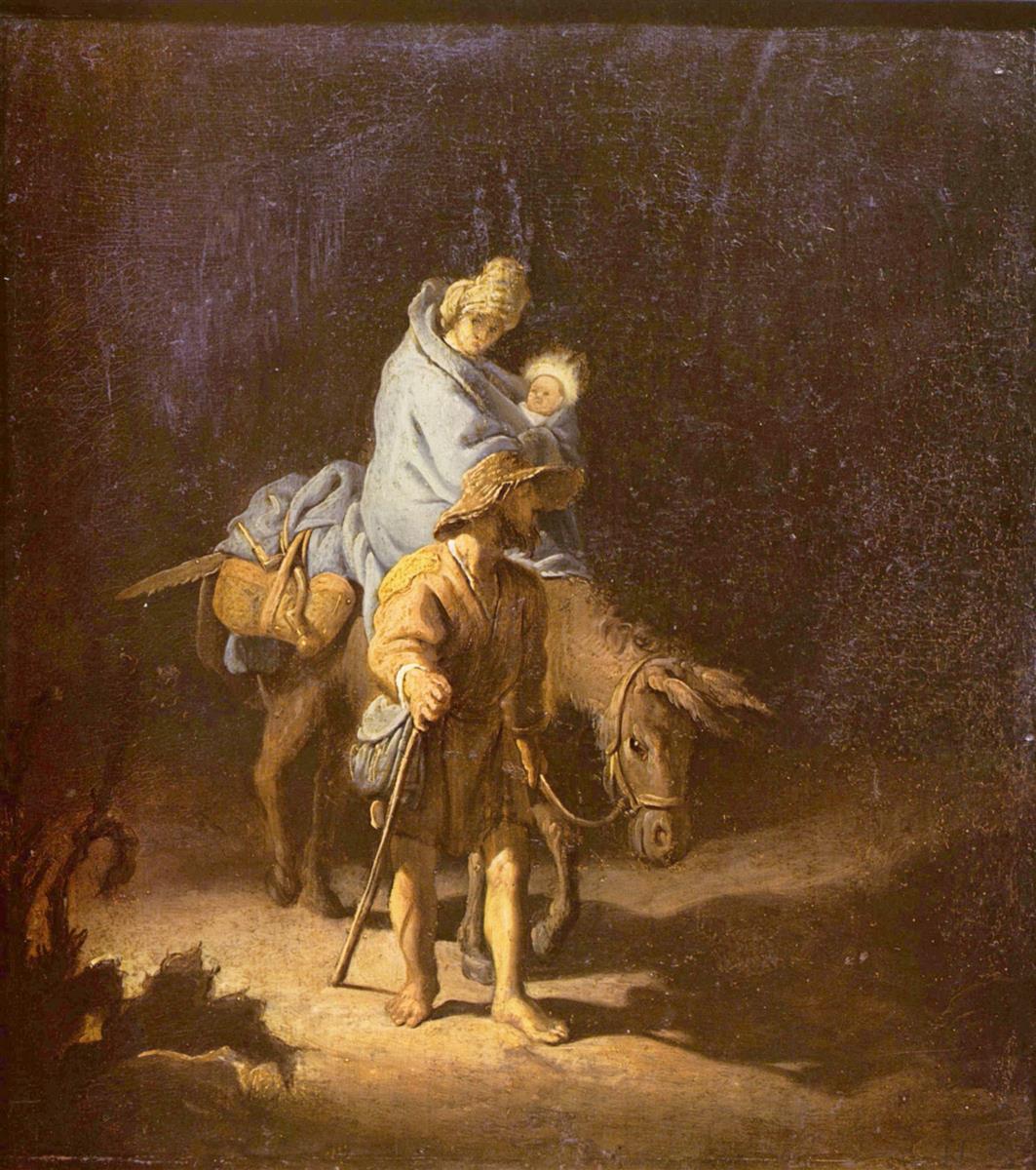
Rembrandt’s “The Flight into Egypt” of 1627 captures the Holy Family at a pivotal moment of danger and devotion, translated into the intimate language of night and light. The small painting stages Joseph leading a donkey across a patch of illuminated ground while Mary, wrapped in a heavy cloak, cradles the infant. The figures move from a shallow foreground into cavernous darkness, their path suggested more by the behavior of light than by any mapped terrain. What might be a straightforward biblical episode becomes a meditation on protection, guidance, and the stubborn tenderness of family. The scene is hushed and concentrated, yet it feels monumental because everything in the image cooperates to express a single idea: survival sustained by care.
Early Career Context
The year 1627 places the work at the outset of Rembrandt’s career, when he was still in Leiden and experimenting boldly with small-scale history scenes. These early nocturnes are laboratories for the techniques that would later define him—selective illumination, compressed spaces, and the psychological storytelling that emerges from gesture rather than spectacle. The subject of the flight was especially suitable for a young painter exploring chiaroscuro. It required both movement and stillness, both fear and trust; it offered a chance to stage multiple light sources and to balance natural darkness with humanly carried radiance. Already in this period Rembrandt sought not to dazzle with crowded narratives, but to distill meaning through light, touch, and the quiet logic of composition.
Composition And The Architecture Of Movement
The composition is anchored by three interlocking diagonals. Joseph’s stride carries a diagonal thrust from lower left toward upper right; the donkey’s bowed head echoes the line in a lower register; and Mary’s cloaked body, turning slightly back toward the infant, bends a diagonal in counterpoint. The group advances across a wedge of pale ground before plunging into enveloping gloom. This geometry creates a sense of momentum comparable to a held breath. The figures do not rush; they press forward steadily, and the eye travels with them, crossing the lit zone, hesitating at the donkey’s foreleg, and slipping into the purple-brown night beyond. Rembrandt leaves the horizon absent and the middle ground undetermined, enlarging the feeling that the family is walking into the uncharted.
The Drama Of Light
Light is the protagonist. A concentrated, low source—perhaps a travel lantern outside the frame—falls from the left and models the figures with surprising clarity. Joseph’s bare feet, the cords of his staff, the donkey’s bony withers, and Mary’s heavy folds all declare themselves under this lamp-like glow. A secondary, cooler halo crowns the Christ child, not as a hard emblem but as a soft concentration of value that keeps the infant legible within Mary’s blue-gray cocoon. The surrounding dark is active rather than empty. It encroaches like weather, lifting here to reveal a tuft of brush or a snag of rock, sinking there to swallow the path. The choreography of light turns a small patch of earth into safe passage and the remainder of the world into a mystery through which one must move with care.
Palette, Temperature, And Tonal Harmony
The palette is limited and beautifully tuned. Warm ochers and umbers shape the figures and ground; cooler blue-grays build Mary’s mantle; touches of lead white and pale yellow strike the highest notes at forehead, cloth edge, and child. Because Rembrandt controls chroma, temperature carries feeling. Warmth puddles under Joseph’s feet and along the donkey’s hide, suggesting body heat and the friction of travel, while cooler notes wrap the mother and infant, making their compact world feel like a pocket of night air. There is a delicate exchange where warm reflections kiss the cool fabric and cool reflections temper the skin. This tonal music makes a small canvas feel deep, and it communicates emotion without resorting to theatrical color.
The Expressiveness Of Gesture
Faces are minimized; gesture tells the truth. Joseph leans into the step, torso slightly twisted as if to check that the animal follows. His staff is planted not ceremonially, but practically, a probe for the ground ahead. Mary turns toward the child with a protective stoop, her shoulders rounding under the weight of care and cloth. The infant is still and alert, a faint, luminous oval tucked against the mother’s chest. Even the donkey participates in the narrative: the lowered head, the careful placing of hooves, and the flick of the ear read as patience and instinct. These interdependent gestures form a triangle of attention—forward to safety, inward to nurture, downward to the path—that makes the painting’s story legible at a glance.
Matter, Touch, And Early Technique
The surface preserves the young Rembrandt’s fascination with how paint itself can become substance. Joseph’s garment is laid with quick, directional strokes that follow the body; Mary’s cloak is built from thicker, opaque passages that catch the light like worn wool; the donkey’s hide is a network of small, rubbed touches that suggest hair and bone. In shadowed areas, the brush scumbles thin color over a darker ground, allowing the weave to breathe through and participate in the dusk. Highlights are sparing and consequential: a gleam on Mary’s head wrap, a nick of light on the donkey’s bridle, a glister along Joseph’s knuckles. These accents are not decoration; they are coordinates that help the eye travel safely across the scene, just as the travelers do.
Space And The Poetics Of The Indeterminate
The space is shallow and immediate, but never claustrophobic. The blank, dark field beyond the figures is not a wall; it is unarticulated distance. A ragged tuft of brush at the lower left opens the foreground like a broken threshold; the path rises and falls in a few soft planes; and then the rest is withheld. By declining to furnish a landscape, Rembrandt prevents anecdote and keeps attention on the ethical drama of care. The world is a darkness that can be traversed with light and companionship. This refusal of scenic detail also universalizes the subject. The flight is not a particular road on a particular night; it is any road and every night when a family must move for the sake of a child.
Sacred History Rendered As Daily Life
What makes this early painting feel modern is its practical honesty. The Holy Family appears as working people: Joseph barefoot, Mary wrapped in a heavy, unfancy cloak, a donkey carrying a bundle along with its human load. There are no angels or palatial ruins. The miracle lies in the quiet bond among the three figures and in the refusal to dramatize peril. Faith is not displayed; it is enacted in the act of walking. This modesty anticipates Rembrandt’s mature approach to sacred narrative, in which divine meanings arrive through human gestures, and revelation is housed in ordinary bodies.
The Child’s Halo And The Question Of Sign
Rembrandt provides a halo for the Christ child, yet he paints it as a soft concentration of light rather than a hard circle. The effect is dual: it acknowledges the child’s sacred identity without breaking the naturalism of the nocturne. The halo also helps solve a technical problem. Wrapped deep within Mary’s mantle, the infant might have disappeared; the nimbus functions as a small lamp that lifts the face and completes the triangular rhythm of light across the group. The painter’s sensitivity to such problems—how sign and realism can serve each other—will govern many of his later biblical scenes.
Comparisons To Later “Flights” And Nocturnes
Seen against Rembrandt’s later treatments of the subject, this 1627 canvas reveals both continuity and growth. The 1640 “Flight into Egypt” expands the landscape and introduces a dual system of moonlight and lantern glow, orchestrated with more atmospheric complexity. The late nocturnes become even more reticent, their surfaces thicker and their light more metaphysical. Yet the essential grammar is already present here: selective illumination, figures bound by a triangle of care, and darkness treated as a hospitable medium rather than a mere threat. The young painter has discovered the stage on which his mature dramas will occur.
The Viewer’s Path And The Dance Of Perception
The painting invites a specific way of looking. From a distance, the group reads as a single knot of light drifting across a sea of purple-brown. At conversational range, the parts separate: Joseph’s foot catches a highlight; the donkey’s eye glows; folds of fabric resolve into planes. Up close, the illusion relaxes into matter—bristle ridges in the cloak, thin scrapes of paint that make the path. Step back, and the image re-forms. This oscillation between matter and likeness is more than a technical pleasure; it mirrors the family’s progress, a series of small, careful steps that add up to passage.
The Ethics Of Attention
One of Rembrandt’s great gifts is an ethic embedded in his seeing. He looks at ordinary things with the gravity usually reserved for monumental subjects. In this painting, the soles of Joseph’s feet receive as much attention as Mary’s face; the donkey’s patient head is as carefully modeled as the infant’s halo. The painter’s attention confers dignity. It proposes that in hardship the most honorable acts may be simple ones: holding a child warmly, leading a tired animal, walking without noise. The painting therefore functions not only as religious history but also as a lesson in how to look at human courage without spectacle.
Symbolic Undercurrents Without Overstatement
Even in its modesty the painting invites layered readings. The illuminated ground can be seen as a figure of providence, a path offered step by step rather than all at once. Joseph’s staff is practical, but it also carries the feel of a pilgrim’s rod, connecting the story to longer lines of exile and return. Mary’s enveloping mantle is shelter, but its blue-gray tonality links her to a long iconographic tradition. Rembrandt refuses to underscore these associations; he allows them to hover like the shadowed space beyond the figures. The result is an image that supports devotion without dictating it.
Material Scale And Intimacy
The small size of the panel is integral to its effect. It demands near viewing—the kind of attention one gives to a keepsake or a cherished miniature—so the drama feels personal rather than public. The close scale also amplifies the sense that light itself is close at hand, a domestic warmth carried into exile. You feel that if you extended a finger you might warm it at the edge of Mary’s cloak or test the smoothness of the donkey’s bridle. The painting does not overwhelm; it draws you near, which is itself a spiritual gesture.
Technique, Layers, And The Time In The Surface
The panel’s stratigraphy hints at Rembrandt’s working sequence. A mid-toned ground provides a unifying dusk. Over this, he blocks in the main masses with broad, warm strokes, reserving the brightest passages for last. Thin glazes deepen the surrounding night; semi-opaque mixtures shape faces and hands; small impastos strike the highest lights at fabric ridge and ankle bone. Pentimenti—softened edges at the donkey’s ear, a reconsidered contour along Joseph’s sleeve—testify that the image was sought and found, not simply transferred from a drawing. Time remains visible in the surface, echoing the time of the journey it depicts.
Resonances For Contemporary Viewers
The image speaks across centuries because it honors experiences that persist: displacement, parental vigilance, nighttime travel, the need to carry a small light and trust it. In a world that often requires movement under pressure, the painting offers a model of courage that is neither noisy nor reckless. It suggests that guidance comes both from within—the haloed child, the inward turn of the mother—and from without—the external light that maps each next step. That double guidance, enacted in humble gestures, remains as persuasive now as it was in Rembrandt’s Leiden studio.
Conclusion
“The Flight into Egypt” of 1627 demonstrates how a young Rembrandt could transform a familiar narrative into a tender meditation by means of light, gesture, and restraint. The painting does not trumpet its subject; it whispers it, and the whisper carries across the dark field with greater authority than a shout. Joseph’s forward lean, Mary’s inward turn, the donkey’s patient step, and the child’s soft glow form a grammar of care legible to any viewer who has ever protected someone fragile on a difficult road. In this small nocturne the seeds of Rembrandt’s mature art are already present: the ethics of attention, the trust in selective illumination, and the conviction that the deepest drama resides where human tenderness meets the mystery of the world.
