Image source: wikiart.org
Introduction
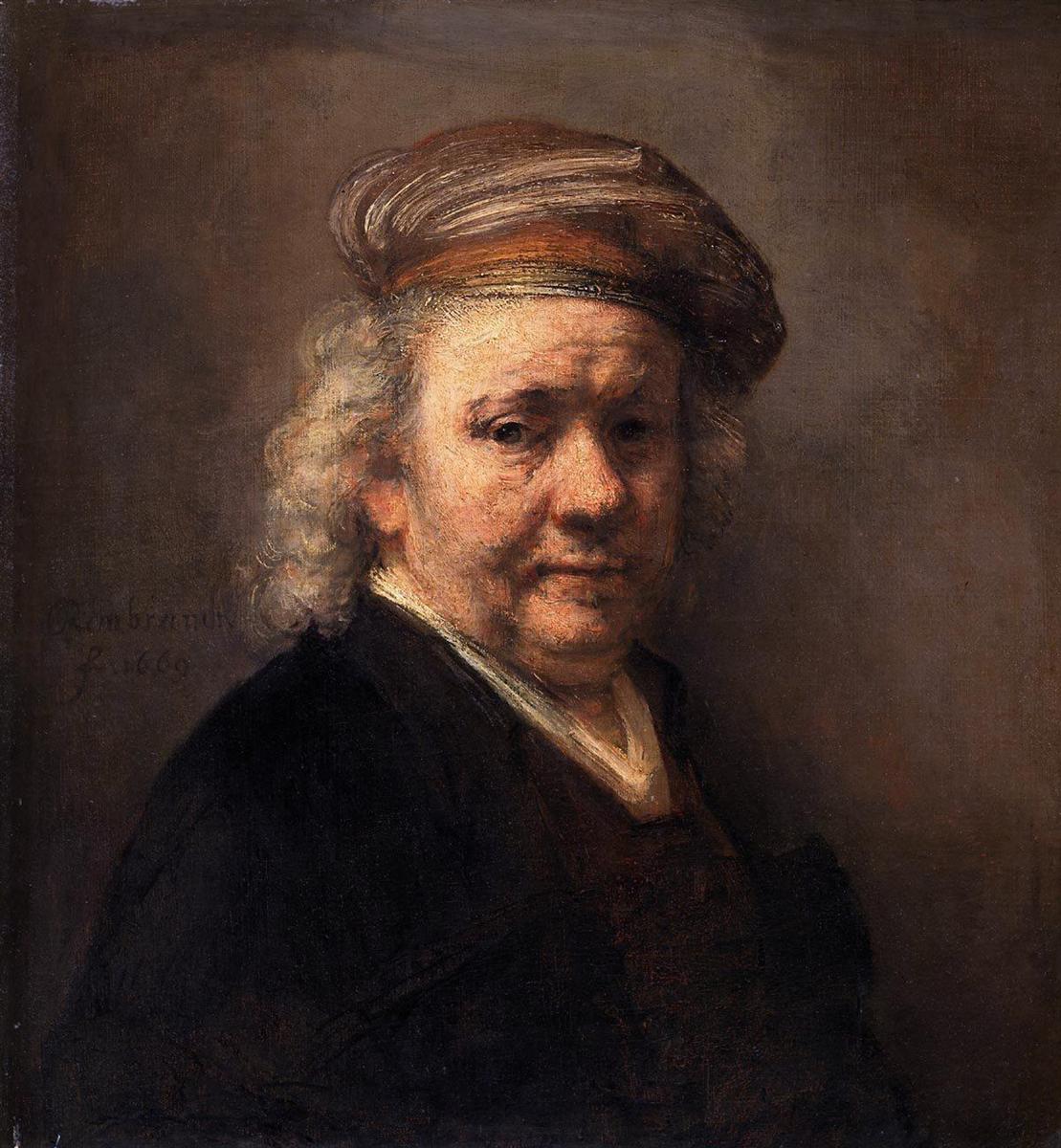
Rembrandt’s “Self-portrait” of 1669 is among the most contemplative images of the artist’s final year. The painting shows a man in a soft brown cap, his gray hair curling from beneath it, turning quietly toward us from a warm, neutral background. Light rests across his forehead, cheeks, and the top of his nose, then dims over the mouth and into the folds of his coat. The surface is tactile and frank, built from a narrow range of earth pigments, layered and worked until paint behaves like living skin. This late self-portrait is neither theatrical nor despondent; it is a steady act of recognition in which the artist grants himself exactly the measure of light he once gave to beggars, scholars, kings, and saints.
A Late-Career Reckoning
By 1669, Rembrandt had crossed decades of glory and hardship: early acclaim, personal losses, bankruptcy, changes in fashion, and the deaths of people he loved. His art answered those experiences with a language of restraint and material courage. The crisp finish of the 1630s had given way to thick, expressive facture; decorative backdrops faded into dark, breathing air; color softened into low, resonant chords. This self-portrait compresses those late choices. There are no grand props, no palette or brushes, no heavy chains broadcasting success. The subject is simply presence—how a human face, studied with patience, can hold a life.
Composition And The Architecture Of Calm
The composition is stable and intimate. The head occupies the upper left quadrant, framed by the soft oval of the cap and a gentle halo of hair. The torso forms a dark, triangular base that anchors the figure and keeps the eye from wandering. The background is a unified brown-gray, slightly warmer on the right, slightly cooler behind the head, so that the silhouette breathes against the field without feeling cut out. Rembrandt offsets the stability with fine asymmetries: the head tilts a degree off vertical; one eye receives a touch more light; the mouth is set with an almost imperceptible twist. These small shifts animate the stillness and keep the portrait from hardening into a mask.
Light As Recognition
The light in this picture behaves less like a spotlight than a hand. It grazes the brow, slides over the cheekbones, and lingers on the planes of the face long enough for us to read structure and mood. It then recedes over the mouth and sinks into the coat. This selective illumination is neither flattery nor exposure; it is recognition. Rembrandt shows the parts of the face that carry character and lets the rest withdraw into privacy. Because the background is neither dark nor bright, the face reads as a warm island, a place where attention belongs.
Palette And Temperature
The color world is a restrained orchestra of earths. Umber, sienna, and bone black generate the deep passages of coat and shadow. Warm ochers, leads, and tiny notes of red lake build the flesh; lead white appears in the highest keys at forehead, cheek, and the moisture of the eye. The cap is a mellow brown with cooler notes that keep it from collapsing into the flesh tones. What gives life is not chroma but temperature. A cooler gray whispers along the temple and under the eye, while a warmer flush occupies the cheek and the bridge of the nose. These micro-shifts read as blood and breath inside skin and are as expressive as any bright hue.
Brushwork And The Material Intelligence Of Paint
Up close, the surface shows how it was made. The face is built in semi-opaque strokes laid wet into wet so transitions remain pliant. Tiny impastos ride along the brow and lower eyelid, catching actual light and giving the gaze a restless spark. The hair is dragged with a loaded brush that leaves bristle tracks like wiry curls. The cap is a field of short, scrubbed strokes whose roughness reads as worn cloth. The coat is blocked broadly, then unified with thin veils that allow underlayers to glow. Rembrandt lets the hand remain visible; he does not polish away his touch. The painting therefore exists simultaneously as matter and likeness—the physical record of looking and the presence of the looked-at.
Expression And Psychological Depth
The expression resists a single reading. At one glance the mouth appears patient, even kindly; at another the set of the lips suggests fatigue. The eyes are attentive rather than confrontational, their lids heavy but not dull, their pupils alive with tiny points of light. The brow carries no theatrical frown and no stage-managed serenity. Instead, the face shifts as our attention shifts. We are not given a pose; we are invited into a state of mind that changes as we look. This mutability is the core of Rembrandt’s psychological realism. He captures not a dramatic sentiment but a field of possibilities—the way a person actually exists in time.
Costume, Headgear, And The Refusal Of Rhetoric
The cap and coat keep us grounded in the seventeenth century without dominating meaning. The cap’s layered folds provide a simple architecture above the forehead; the coat’s dark mass supplies gravity below. Neither garment is described with fetishistic detail. Both are vehicles for light and shadow, not displays of rank. Rembrandt had used lavish costume in earlier self-portraits to explore role and persona; here he chooses clarity over theater. He declares that what matters most about a painter is not his finery but his seeing.
Space, Background, And The Poetics Of The Indeterminate
The background’s warm neutrality is not an afterthought. It is calibrated to hold the head in breathable air and to quiet every distraction. Slight variations of tone—cooler behind the cap, warmer along the right edge—prevent flatness and give an optical cushion around the silhouette. No window, column, or drapery intrudes; there is only enough space for presence. This indeterminacy removes the portrait from the anecdotal world of rooms and furnishings and places it in a timeless field of attention.
Technique, Layers, And The Time Embedded In The Surface
The painting’s layers reveal a process of searching rather than execution of a fixed plan. A warm ground sets the tonal key. Middle values map the head and coat; the flesh is built with opaque mixtures that allow the ground to participate in half-tones. Glazes sink the shadows along the cheek and under the chin; impastos strike highlights at brow, cheek, and nose late in the process. At the edges—especially along the cap and jaw—pentimenti suggest adjustments made as the image found its equilibrium. The surface therefore retains the history of its making: a sediment of decisions that mirrors the remembered time within the sitter’s face.
Relationship To The Self-Portrait Series
Viewed against the arc of Rembrandt’s self-portraits, this 1669 canvas appears both culmination and distillation. The ambitious role-playing of the 1630s gave way to the workman’s declarations of the 1650s; the late decade moves beyond identity into presence. Where the famous “Self-Portrait with Two Circles” offers a thesis about mastery—tools, geometry, and human will—this picture offers a thesis about attention: that the simplest arrangement of light, tone, and touch can carry a life. The paintings are cousins, but this one is closer, softer, more human.
Mortality Without Melodrama
Because this portrait was painted in Rembrandt’s final year, viewers often read mortality into it. The painting accepts that reading while refusing theatrics. There are no vanitas props, no extinguished candles, no skulls. Mortality appears in textures—the slackening around the mouth, the silvering hair, the calmer light in the eyes—and in the chosen tempo of the brush. The picture acknowledges the end not by dramatizing it but by practicing fidelity to what remains: a person still looking, still thinking, still offering his face to the light.
The Signature And Its Meaning
Near the left edge the artist signs and dates. The inscription is modest, tucked into the background, as if to insist that authorship is fact, not flourish. It functions less as a brand than as a witness. The painter marks that he was here, that he saw, that he made. In the context of the late style, even the signature feels like part of the painting’s ethics: clear, unboastful, true.
How To Look At The Painting
Begin at conversational distance, where the face feels solid and present. Let your eye rest on the illuminated cheek, then travel to the small highlight at the lower lid. Step closer and notice the ridge of paint at the brow, the rougher weave where hair meets background, the way thin glazes cool the shadow below the chin. Move to one side so that the impastos along the cheekbone catch and release the light as you shift. Finally, step back again and watch the marks fuse into a single, dignified image. This choreography of distance is built into the work; it lets the painting reveal both its body (paint) and its soul (presence).
Influence And Continuing Relevance
Rembrandt’s late self-portraits taught later painters that facture could be meaning, that limited palettes could be profound, and that psychological depth could be achieved without theatrical narrative. Goya, Courbet, Sargent, and Lucian Freud found in these canvases a license to let paint stay paint while insisting on living human presence. For viewers today, the picture offers a different kind of relevance: it models a way of seeing ourselves that neither flatters nor condemns. It proposes attention as a form of respect—to others and to oneself.
A Portrait Of The Painter’s Creed
Everything in the painting—composition, light, palette, touch—converges on a creed. Painting is not spectacle but a durable form of attention. It is the slow conversion of looking into matter, and of matter back into human presence. The face is not a billboard for emotion but a place where time gathers. This self-portrait says these things without manifesto or motto; it says them by being exactly what it is.
Conclusion
Rembrandt’s 1669 “Self-portrait” is not a farewell performance but a quiet summation. With a subdued range of colors, a modest cap, a neutral field, and a face rendered with unflinching care, the artist gives us a final measure of his art. The painting never demands; it abides. The light recognizes rather than exposes, the brush records rather than displays, and the image rests where it has always mattered most for Rembrandt—in the truthful meeting of a human face and the painter’s patient eye.
