Image source: wikiart.org
Introduction to Rembrandt’s “Homer” (1663)
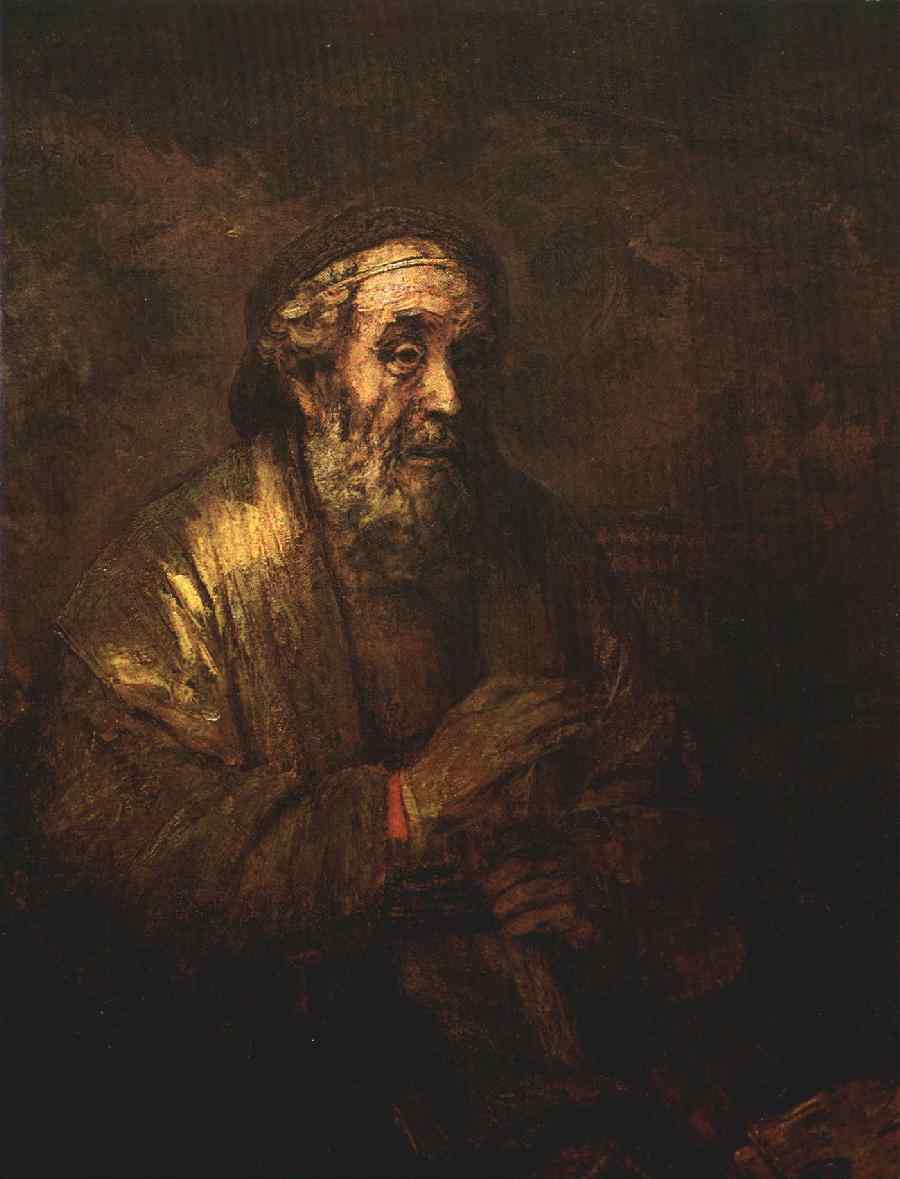
Rembrandt’s “Homer” from 1663 is a late masterpiece that distills the painter’s lifelong fascination with human presence into an image of concentrated intellect and feeling. The legendary Greek poet sits half-turned in a well of shadow, his gaze lowered, his lips faintly parted as if forming a line of verse remembered from the deep. Light pools across his brow, nose, and beard, drifts down the edges of his robe, and dissolves into darkness at the margins. Nothing here clamors; the composition is a study in quiet authority. In one restrained image Rembrandt evokes the endurance of poetry, the frailty of age, and the contemplative weight of memory.
Historical Context and the Late Rembrandt Voice
By the early 1660s Rembrandt had passed through bankruptcy, the deaths of loved ones, and the ebb of fashionable patronage. What remained was an unflinching vision capable of turning paint into a living soul. “Homer” belongs to this late period, when his brushwork thickened and his chiaroscuro deepened, not for spectacle but for insight. Instead of grand narrative flourishes, he favored intimate encounters with figures whose experiences could be felt at a glance—apostles, philosophers, old men and women, and, in this case, the blind poet revered as the fountainhead of Western epic. The subject suited Rembrandt’s interest in consciousness over event. Rather than illustrate scenes from the Iliad or the Odyssey, he gives us the maker of those scenes, wrapped in thought.
Composition and the Architecture of Light
Rembrandt structures the picture with a triangular mass that runs from the illuminated forehead down through the left shoulder and across the forearms. The apex of the triangle is the headbanded brow, where the brightest light falls; from there the illumination attenuates into warm half-tones that describe cheek, beard, and robe. The right side of the panel is largely unarticulated shadow, an abyss against which the figure glows like an ember. This asymmetry is crucial. By allowing darkness to swallow so much space, Rembrandt gives Homer an elemental force, as if the poet were rising from the void with poetry as his only lantern.
The Psychology of Presence
Homer’s expression is not theatrical. The eyelids are heavy; the corners of the mouth are relaxed; there is a vulnerable crease where thought and exhaustion meet. Rembrandt understands that genius need not advertise itself. The hands, clasping what appears to be a staff or bound sheaf, add a secondary focus. Their position suggests both habitual support and a ritual of concentration. One senses that the poet is listening—to an inner current of remembered lines, to the murmur of a scribe, or to the ancient sea inside the mind. The portrait thus becomes a drama of cognition. We do not watch someone acting wise; we witness the slow, luminous work of remembrance.
Materials, Brushwork, and the Tactile Illusion
Rembrandt’s paint handling amplifies the theme. Thick, buttery strokes model the forehead and cheekbones, catching light like the rough surface of limestone; scumbled, dry-brushed passes articulate the beard; long, dragging strokes lay down the robe with the authority of a calligrapher. These varied touches are not mere display. They generate the sense that skin, hair, and fabric occupy the same reality as the viewer. The robe’s edges appear worn and soft; the headband feels slightly frayed; the fingers read with a fragile hardness appropriate to age. Pigment becomes biography.
Chiaroscuro as a Metaphor for Memory
The light in “Homer” is not purely descriptive. Rembrandt uses chiaroscuro to stage memory itself. Brilliance concentrates where insight lives—on the brow and the total surface of the face—while the surrounding world recedes into near-nothingness. What is not essential to thought evaporates. In this way the painter invents a visual logic for poetic recollection: facts blur, faces and landscapes vanish, but the inner eye brightens. The painting therefore reads as both portrait and diagram of remembering, a rendering of how epic might survive in a mind that can no longer see.
Gesture, Prop, and the Symbolic Vocabulary
Rembrandt avoids heavy-handed emblematic clutter but permits a few eloquent signs. The headband identifies the figure within classical conventions. The staff or rolled manuscript acts as a double sign—support for the body and repository for verse. The robe, rendered with dignified restraint, evokes a timeless scholar’s mantle rather than any archaeological costume. Each element contributes to a meaning that remains supple rather than didactic: knowledge carried in the body, art as a stay against darkness, and dignity earned through endurance.
Color, Temperature, and the Breath of Life
The palette is reduced to earthy browns, umbers, and ochres, relieved by pale bone tones and glints of warm gold where light kisses the fabric. At first glance the scheme appears monochrome; prolonged looking reveals a microclimate of temperatures. The cool umber in deep shadow keeps the warm planes of the face alive; a faint, reddish warmth in the wristband flickers like a human pulse. Such chromatic restraint intensifies the painting’s meditative tempo. Noise would disrupt it; harmony sustains it.
The Body’s Architecture and the Weight of Age
Homer’s torso leans slightly forward, shoulders rounded in a curve that reads as both fatigue and attention. The neck pushes subtly ahead of the chest, a posture familiar to those who depend on hearing more than sight. The hands, though competent, seem slower than the mind they serve. Rembrandt never sentimentalizes frailty, but he acknowledges it. The physical facts—slumping shoulder, hollowed cheek, heavy lids—collect into an image of mortality dignified by use. The poet’s body has been spent in the making of poems. That knowledge turns age into a credential rather than a liability.
Space, Silence, and the Studio Theater
The background carries only the gentlest hints of setting—vague cloudings of tone that might be wall, air, or curtain. This minimalism creates a room made of silence. The viewer, placed close, becomes a confidant rather than a distant observer. Rembrandt’s studio becomes a theater of one actor and one audience, with light as the single spotlight. The effect is intimate but not intrusive; it invites reverence, not curiosity. The lack of anecdotal furniture ensures that we do not wander away from the face where meaning resides.
Comparison with Rembrandt’s Philosophers and Apostles
“Homer” belongs to a family of late works—images of Saint Paul, the apostles, philosophers, and scholars—where age and thought form a paired theme. In these pictures Rembrandt avoids external narrative in favor of inward drama. What sets “Homer” apart is its cultural halo: this is not merely a wise elder but the archetypal Poet. Yet Rembrandt refuses to mythologize. He paints the same humidity of skin, the same fallible hands, the same breath of fatigue he gives to saints and ordinary elders. In doing so he collapses the distance between genius and humanity. The greatest poet is one of us.
The Poetics of Imperfection
Look closely and you will find passages that feel almost unfinished—softly indicated contours, abrupt dissolves of fabric into shadow, streaks where a brush skimmed a dry surface and left an open trail of undercolor. These so-called imperfections are Rembrandt’s poetry. They allow light to mingle with air, letting the painting breathe. They also acknowledge the limits of depiction. To render everything would be to lie about the way we actually see. Vision is selective and time-bound; Rembrandt’s surfaces record that truth.
Time Suspended: The Narrative You Supply
No explicit story unfolds in the panel, yet the painting opens a narrative space. Is a scribe present outside the frame? Has a listener just asked the poet to repeat a line? Has Homer paused to retrieve a name of a hero, a river, a god? The hand’s light pressure on the staff, the shift of weight forward, the parted lips—all these details cue us to supply a moment before and after. The painting is less a single instant than a hinge in time, a threshold where one line of verse ends and the next begins.
Empathy As Method
Rembrandt’s portraits persuade because he paints as if he were inside the sitter’s skin. In “Homer” empathy is visible in the moderation of expression, in the refusal to caricature age, and in the tender modeling of features usually treated as harsh—the glistening eye, the heavy lid, the labyrinth of wrinkles in the brow. He paints age not as erosion but as inscription. Where other artists might have embellished the scene with laurel crowns and marble tablets, Rembrandt chooses proximity. We come away not with a catalog of antiquity but with the sensation of having met someone living.
The Audience in the Picture
The direction of Homer’s glance and the angle of his head suggest an interlocutor near our position. This subtle orientation makes the viewer the addressee of the poet’s thought. We are the ones to whom the verse is about to be spoken, the ones responsible for carrying it forward. The painting thus becomes a compact between past and present: Rembrandt offers the ancient author to a modern eye, and that eye, by looking, promises remembrance.
The Ethics of Portraying Genius
There is a humility in the way Rembrandt represents greatness. Rather than building a pedestal, he cultivates proximity. Greatness, the painting suggests, is not a matter of glittering attributes but of sustained attention and hard-won memory. The dim room and plain robe become ethical choices—a reminder that lasting art often grows in quiet places. The gold that matters is the glow of thought across a forehead, not the gilt of a crown.
Technique as Thought
Everything about the picture’s making echoes its subject. The layered glazes act like sedimented memory; the scraped passages expose earlier decisions the way reflection exposes earlier life; the highlights arrive in sparing, decisive touches like the exact words that complete a line. In this sense Rembrandt paints thinking with paint. The medium becomes a parallel language that speaks where words would fail, a kind of visual hexameter pulsing in light and shadow.
Resonance for Modern Viewers
Modern eyes, trained to expect speed and bright detail, may at first read “Homer” as dark. But the longer we look, the more it clarifies. The painting rewards patience with the sensation of presence that is rare in any era. It affirms that attention is an art form—one we share with the poet and the painter. In a world of restless images, this late Rembrandt feels almost radical: a quiet room, a seated figure, and the promise that sustained looking will reveal more than display ever could.
Legacy and Influence
“Homer” aligns Rembrandt with a lineage of artists who honored thinkers and makers rather than merely warriors and rulers. It anticipates the eighteenth and nineteenth centuries’ interest in writers and philosophers as worthy subjects for grand painting. More specifically, the picture influenced later portrayals of poets that seek psychological truth over mythic décor. One can trace its spirit in the intimate portrayals of creators by artists from Goya to Courbet and beyond.
Conclusion: A Monument Made of Light
In “Homer,” Rembrandt forges a monument without stone or pomp. Light builds the figure; darkness carves the dignity around him; paint records the trembling fact of age and the steady flame of intellect. We recognize the poet not by laurel but by the labor of a mind still at work. The portrait becomes a meditation on what lasts—memory carried in a living body, words passing from breath to breath, and the generous attention that keeps them both alive. Few images honor the act of thinking with such quiet splendor.