Image source: wikiart.org
Introduction: Grace, Intimacy, and the Theatre of Touch
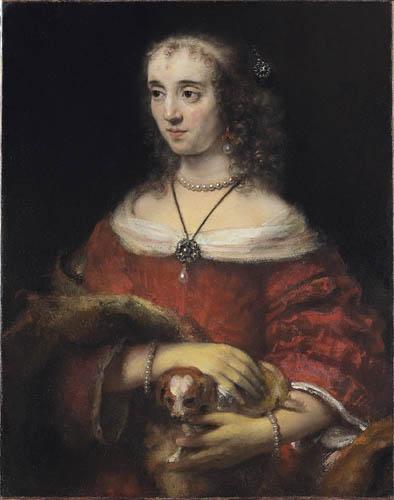
Rembrandt’s “Portrait of a Woman with a Lapdog” (1662) invites the viewer into a chamber of warmth and tactility, where social elegance and human tenderness meet. The sitter, richly dressed in a glowing red gown and pearls, cradles a small spaniel at her forearms. Light grazes skin, silk, fur, and gemstone so that each material registers with persuasive truth, yet the painting never collapses into mere inventory. It is, instead, a meditation on presence—on how a face, a gesture, and a living creature can transform formal portraiture into an intimate encounter.
Late Rembrandt: A Studio of Earth and Ember
By the early 1660s Rembrandt had embraced a late style marked by deep browns, amber atmospheres, and thick, descriptive highlights. The market around him leaned toward polished finish and urbane sparkle; his response was to double down on psychological resonance and the haptic truth of paint. This portrait exemplifies the turn. The background is a breathable dusk; the dress radiates with reds tempered by earth; the brightest notes—pearls, lace, the glint on a brooch, the wet shine of the dog’s eyes—are sparingly placed, acting like visual punctuation in a sentence of warm tones. It is a worldly picture that feels unhurried and humane.
Composition: A Pyramid Framed by Arms and Animal
The sitter’s head forms the apex of a classical pyramid. Her forearms, one crossing the other, establish the base and also create a secure cradle for the lapdog. That triangular design stabilizes the body while the diagonal of her gaze—slightly to our left—opens the composition toward unseen space. The dog’s compact body functions as a compositional counterweight to the black void at right; its soft curve echoes the shallow arc of the woman’s décolletage and the oval sweep of her pearl necklace. The result is an interplay of circles and triangles, softness and structure, intimacy and decorum.
Chiaroscuro: A Stage of Moral Light
Rembrandt’s light falls from the upper left, articulating forehead, nose, and lips before rolling across the exposed shoulder and the rounded forearms that embrace the pet. The background yields nothing in the shadows; instead, it withdraws to honor the figure. This chiaroscuro is not theatrical for its own sake. It serves character. The sitter’s face is illuminated with a quiet clarity that suggests attentiveness rather than display, while the lapdog shares a sympathetic glow, signaling its role as companion rather than mere accessory.
The Gaze and the Poise of the Mouth
The sitter’s eyes are clear and reflective, with catchlights that bring moisture and immediacy. She looks slightly past us, as if preparing to speak or to listen. The mouth is shaped by a subtle press of the lips—neither smile nor severity, but poised moderation. Late Rembrandt often places identity in this understated territory between expressions. We register thought without theatrics, dignity without stiffness. The sitter is not performing for a mirror; she is present for a conversation.
Costume: Scarlet, Lace, and the Architecture of Ornament
The dress is a symphony of reds—cochineal lakes mixed with earths—thickened in the highlights and dragged thin where shadow overtakes fold. Rembrandt does not delineate every seam; he allows paint to mimic cloth, letting the brush describe the way silk collapses and catches light. Lace at the neckline and sleeves is indicated by brisk, opaque touches that sit high on the surface, catching real light in the gallery and creating a living sparkle. A dark fur wrap provides tonal ballast and a tactile foil for skin and silk. The costume announces status, yet in Rembrandt’s hands it becomes a vehicle for touch and temperature.
Jewels and Pearls: Punctuation, Not Pageantry
Pearls encircle the neck, droop from the ears, and reappear as a bracelet—each a small, cool globe set against warm flesh. The brooch at the breast is mapped with just enough structure to catch and scatter light; the hair ornament repeats the motif on a smaller scale. Rembrandt’s restraint is crucial: jewelry punctuates the painting’s sentences rather than overwhelming its meaning. These bright accents emphasize the geometry of collarbone and shoulder while leading the eye toward the face—the true gem of the composition.
The Lapdog: Companion, Emblem, and Compositional Anchor
The small spaniel nestled in the sitter’s arms is more than a fashionable prop. In seventeenth-century portraiture, lapdogs often signaled fidelity, domestic virtue, and cultivated leisure. Rembrandt sharpenes those associations by giving the animal independent presence: alert eyes, a wet nose, a damp edge to the tongue, a soft fall of ears. Its mottled fur is built with broken strokes that blur at the edges, like breathing. The dog’s gentle lean into the sitter’s wrist animates the bond between them. It’s a tactile knot that also anchors the lower half of the canvas, keeping the large field of red dress from drifting into abstraction.
Hands and Gesture: The Grammar of Care
Rembrandt is one of painting’s greatest writers of hands. Here the left hand cups the dog’s chest with relaxed assurance, while the right hand supports its flank, thumb tracing fur as if without thinking. These gestures compose a grammar of care—protective but not possessive, poised yet affectionate. Veins and knuckles are not fussily described; rather, the hands are modeled with warm half-tones and small, buttery highlights that record the feel of living skin. The arms form a cradle that is both architecture and emotion.
Surface and Touch: Paint that Thinks
Seen up close, the canvas is a terrain of decisions. Thick impastos sit along the crest of the lace and on the jewel highlights; thinner glazes create the wine-dark depths in folds of the gown. Rembrandt’s brush toggles between precise notation—the glint on a pearl—and open suggestion—the fur wrap suggested by dragging a loaded brush across a darker underlayer. Pentimenti (small shifts of contour) near the sleeve and wrap are not mistakes but the visible record of thought. The portrait feels made, not manufactured—its truth arising from the dialogue between vision and touch.
Palette: Warm Realm with Cool Accents
The painting inhabits a warm realm: reds, umbers, and golden ochres carry most of the weight. Against these Rembrandt adds cool accents—the small blueish shadow along the jaw, a gray note in the pearls, a greenish echo near the hair ornament—to prevent the harmony from overheating. Flesh tones are layered: a restrained pink on the cheek; a calmer, milkier note on the forearms where light bounces from the dress; a tiny, more saturated touch at the lower lip. Because chroma is controlled, value and temperature become the expressive levers, guiding our eyes from face to jewel to animal and back again.
Space and Atmosphere: A Room Made of Darkness
There is little elaboration of furniture or setting, yet the portrait breathes as a real room. The background’s warm darkness is varied enough to suggest air, not flatness, and to imply distance without distracting detail. Within that atmospheric envelope, the figure feels sculpted—projecting forward like a relief lit from the side. Rembrandt’s restraint in staging keeps focus on the human exchange taking place at our distance.
Identity, Status, and the Poetics of Restraint
The sitter’s identity may be suggested by her costume and adornments, but Rembrandt refuses to let status eclipse personhood. The lapdog humanizes station; the pearls dignify affection. Social rank becomes the frame within which character shines. The portrait honors the Dutch preference for measured display while offering a quiet challenge: wealth is most persuasive when it behaves like light—clarifying rather than blinding.
Iconography Without Program: Virtues in Plain Sight
Dogs in portraiture conventionally connote loyalty. Pearls traditionally whisper purity. Red garments can suggest love and vitality. Rembrandt arranges these motifs without forcing an allegory. Virtue arrives as demeanor and gesture, not as coded message. The sitter’s composed gaze, the protective hold on the animal, the modesty of ornament—together they sketch a portrait of constancy that needs no inscription.
Dialogue with Earlier Works and Contemporaries
Compared with Rembrandt’s brilliant society portraits of the 1630s, this painting is more introspective. The setting is darker; the paint is thicker; the psychology is deeper. In contrast with fashionable contemporaries who polished surfaces to enamel sheen, Rembrandt trusts the grain of paint to carry sensation and memory. One might place this portrait beside his late images of Hendrickje Stoffels to see the evolution of intimacy—from personal muse to generalized empathy for the human condition, here filtered through the decorum of a commissioned likeness.
Viewer Experience: Nearness Without Intrusion
The canvas chooses a humane scale and a courteous distance. We are close enough to appreciate the damp shine on the lapdog’s nose and the feathery transitions on the sitter’s cheek, yet far enough to respect her space. The portrait centers on encounter, not inspection. It asks the viewer to match Rembrandt’s pace—to let the eyes adjust, to feel the weight of the dog, to sense the warmth of the room, and to recognize the person before the persona.
Conservation Glimpses: The Life of a Surface
As with many late Rembrandts, the darks may have sunk or the varnish may have warmed over time, enriching the amber atmosphere. Far from diminishing effect, such patina often aligns with the painter’s intention: a world lit from within rather than from without. Small abrasions or softened edges typically harmonize with his broad handling, reinforcing the sense that the picture is not a frozen image but a living surface with a history.
Why the Portrait Endures
“Portrait of a Woman with a Lapdog” endures because it reconciles polish with presence, luxury with tenderness. It is a portrait of status that remembers feeling, a study of materials that remains faithful to a person. The lapdog is not an ornament but a hinge, joining the sitter’s world of obligation to a private sphere of affection. Rembrandt’s late brush turns that hinge into a small miracle of paint—fur, flesh, and silk exchanging warmth beneath a light that feels earned.
Conclusion: A Chamber of Warmth and Thought
In a century that prized display, Rembrandt quietly made intimacy the measure of greatness. This portrait shows how. The sitter’s thoughtful gaze, the gentle hold on her companion, the pearls that gleam without shouting, the red gown that glows like ember—each element is composed with an artist’s fidelity to life as it is lived, not posed. The result is a painting that meets the viewer halfway: elegant enough to honor the commission, human enough to remain unforgettable.
