Image source: wikiart.org
Introduction: Covenant Written in Light
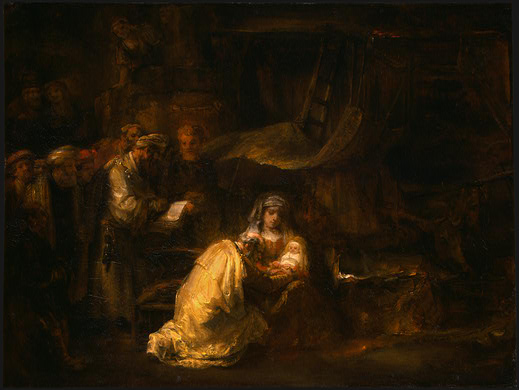
Rembrandt’s “The Circumcision” (1661) distills a sacred rite into an intimate drama of light and touch. In a dim interior, Mary cradles the newborn Christ while a priest bends over a text, attendants crowd the background, and a small, steady glow settles on cloth, faces, and the infant’s skin. Instead of theatrical spectacle, the painting offers a carefully staged whisper: a community gathered in shadow, a mother anchored to the ground by weighty folds of linen, and a ritual that inaugurates a life destined to bear far heavier vows. The scene is at once domestic and cosmic; its quietness becomes the measure of its significance.
Historical Moment: Late Rembrandt’s Humane Devotion
By 1661 Rembrandt had entered the candor of his late period—bankruptcy endured, patrons thinned, surface polish abandoned in favor of earth pigments, breathable shadow, and tactile paint that keeps the record of touch. His religious pictures from these years treat biblical events as credible human encounters rather than staged pageants. “The Circumcision” belongs to this late ethic. The picture does not argue with doctrinal emblems; it simply imagines the rite of the eighth day with the compassionate gravity that defines Rembrandt’s final decade.
Subject and Theology: The First Shedding of Blood
In Christian iconography, the circumcision of Jesus marks the first shedding of his blood and his entry into Israel’s covenant, anticipating the Passion while affirming the continuity of law and grace. Rembrandt folds this theology into materials and gesture. The priest’s text signals tradition. Mary’s white-gold garment collects light as if hospitality itself had become visible. The baby’s body—small, vulnerable, luminously present—reminds the viewer that salvation, in Rembrandt’s vision, is not an abstraction but a human life borne by a mother among witnesses. The painting’s hush is not reticence; it is reverence for the mystery of a vow.
Composition: Constellations of Attention
The scene organizes itself around three centers: the infant, the mother, and the priest. Mary forms the lower anchor, her body a sweeping triangle of cloth that spreads across the floor. The priest stands at the left, his torso forming a vertical pillar that supports the event’s authority. Between them the child gathers the brightest light, creating a visual and spiritual hinge. A curved canopy or drapery descends from above, sheltering the scene like a tent of meeting. In the far left, a semicircle of onlookers builds a low relief of faces—curious, concerned, devout—whose pale notes echo the infant’s light while never stealing it.
Chiaroscuro: Light as Covenant, Shadow as Mercy
Rembrandt’s late chiaroscuro behaves ethically. Light is offered as a kind of covenant, touching what matters and leaving private what may remain unspoken. Here a warm, golden source seems to fall from above and slightly to the right, illuminating Mary’s dress and the child’s body, flickering across the priest’s scroll, and finding small rests on hands and faces in the crowd. Darkness is not empty; it is a hospitable room, a climate that shelters concentration. The strongest contrast occurs at the meeting of infant flesh and Mary’s sleeve—where tenderness and ritual converge. The glow suggests candle or lamp but functions symbolically as well: revelation as gentle seeing.
Space and Setting: A Tent Within a Room
Rembrandt often chooses liminal interiors—neither fully domestic nor architecturally specific. The heavy drape and stacked objects behind Mary create a feeling of a temporary, makeshift sanctum. Stairs, barrels, or chests dissolve into umber masses, lending the space a workaday credibility. We are not in a jewel-box temple; we are in the kind of room where families gather and rites are carried out with gravity rather than grandeur. This decision aligns with Rembrandt’s devotion to the everyday: the holy made legible by existing between objects and tasks, among people who must still live after the picture ends.
Costume and Material: Cloth That Carries Meaning
Mary’s garment is the painting’s luminous engine. Thick, cream-toned linen is built up in ridged impasto and bright glazes, catching actual light and reflecting it onto the child’s face. Its weight pins the mother to the ground, turning her into the visual foundation of the ritual. The priest’s darker robes absorb light, as if tradition were a reservoir rather than a mirror. The onlookers wear earth colors that knit them to the room’s warmth. No jewel declares status; material speaks through weight and use. Rembrandt translates wealth into gravity, solemnity into texture.
The Faces: Witnesses in Half-Tone
Late Rembrandt is master of the half-tone where psychology lives. Mary’s expression is not ecstatic; it is concentrated care. The priest’s brow furrows over the text; he reads not theatrically to the crowd but inwardly, as if confirming the words he already knows. The bystanders carry varied temperatures of attention—leaning, whispering, waiting. Their features are not caricatures; they are softened not to generalize but to suggest sound and breath in the dim room. The only fully articulated face is the baby’s, which needs little to speak—a pale oval multiplied by the tiny highlight of mouth and the warm shadow at the eye.
Gesture and Hands: The Liturgy of Touch
Hands tell the story. Mary’s hands cradle, adjust, and shield; they enact a maternal liturgy. The priest’s hands hold text and tool—the scroll that frames the covenant’s words and the instrument that will mark the flesh. A helper’s hand hovers in readiness; another reaches forward with cloth or basin. Rembrandt stages these hands like a progression: shelter, authority, assistance. None is dramatic; all are sufficient. This is the humility of late Rembrandt: action is strong when it is exact.
The Book and the Scroll: Language in the Room
The priest’s open text glows with small planes of light. It does not demand legibility; it proposes continuity. In Rembrandt’s religious pictures the written word appears as a practical object, used rather than paraded. Pages curl; edges fray; the scroll bends under gravity. The effect binds the rite to lived time and to memory: the covenant travels in paper before it travels in flesh. Light loves the book because light loves what ties speech to life.
Palette: Embers of Brown, Honeyed Whites, Quiet Reds
The color orchestration is a Rembrandtian dusk. Umber and near-black make the air; raw sienna and olive brown build the crowd; Mary’s whites carry touches of honey and straw that warm to gold in the highlights; small reds live in the shadows of cheeks and hands. Because chroma is restrained, temperature runs the narrative. Warm light lands on the infant and Mary; cooler browns hold the onlookers back; a tawny stripe at the drape’s edge keeps the upper composition alive. These measured hues make the painting readable in low light—exactly the conditions it imagines.
Surface and Brushwork: The Record of Touch
The surface is a biography of making. Mary’s dress is laid with thick, lifted strokes that catch real light like woven threads. Faces are built with alternating veils and assertive touches—enough to model planes, never enough to harden them. Background objects are rubbed and scumbled, letting underlayers speak so the space breathes. In the brightest patches Rembrandt leaves small peaks of paint; in the deepest shadow he thins to stains; between them he cross-hatches with soft brushes that blur edges just where the eye would blur them at this distance. The picture feels looked-into rather than looked-at.
Rhythm and Time: The Pause Before the Mark
Rembrandt suspends the narrative at the moment just before incision. The priest bends to read; Mary adjusts her hold; the baby, luminous, rests in the cradle of cloth. The suspense is not sensational; it is moral. The image honors the weight of a decision repeated across generations: the bodily sign of belonging. That pause allows the viewer to enter not as voyeur but as participant—someone who knows the gravity of rites that bind the living to the living God.
Comparisons in the Oeuvre: From Early Spark to Late Ember
Rembrandt painted circumcisions and presentations earlier in his career with sharper contrasts and crisper finishes. By 1661 he has traded youthful brilliance for embered glow. Compare this work with the late apostle series: the same warm dusk, the same priority on hands and faces, the same refusal to dramatize what is already dear. The small lights—Mary’s garment, the child’s skin, the priest’s page—repeat a late motif: illumination as mercy, not conquest.
Process and Revisions: Edges That Think
Close looking suggests pentimenti—visible changes that are part of the truth. The canopy’s lower edge is softened where Rembrandt rethought its curve to shelter rather than dominate. The mass of onlookers at left shows half-erased faces and recomposed shoulders, evidence of the painter’s search for the right pressure of crowd without clutter. Highlights on Mary’s dress sit atop cooler undercolor, likely added late to re-center attention on mother and child. These revisions feel like pastoral decisions, calibrating care.
Iconography Without Extravagance: Covenant Made Human
No halo decorates the infant. No angel tears the fabric of the ceiling. Rembrandt trusts the rite to bear itself. Theologically, the painting affirms the Incarnation by refusing ornament: God’s promise arrives in cloth, skin, and reading; glory expresses itself as tenderness among people with names. Even the architectonics—tent-like drape, barrels, stairs—suggest journey and provision, not marble permanence. The painting argues quietly that fidelity is daily and communal.
The Viewer’s Place: Witness at the Doorway
We stand slightly apart, as if the crowd has opened just enough to let us see. Our view is lower than the priest’s eye line and close to the level of Mary’s lap, so the baby meets us as equals. Because the scene is not aimed at us, our presence feels permissive rather than intrusive. The composition’s arcs—canopy, Mary’s dress, the ring of onlookers—curve around the center, as if to say: this is a circle of care; step inside if you mean to keep it.
Modern Resonance: Rituals that Bind, Light that Guides
Contemporary viewers find in “The Circumcision” a model for any rite that joins body and belonging—baptisms, namings, initiations, vows. The painting’s refusal of spectacle offers a counterimage to performative culture: here meaning is made by attention, not display. Its atmosphere—brown air, small lights, tactful hands—has influenced generations of painters and photographers who learn that a single warm source, precisely placed, can carry immense narrative weight.
Lessons for Painters and Viewers
For painters, the work demonstrates how a limited palette can bloom when values are tuned; how to make fabric luminous without whitening it; how to turn a crowd into tone rather than noise; how to let revisions remain so the surface stays alive. For viewers, it teaches a slow way of seeing: follow the light from Mary’s sleeve to the child’s face; notice how the priest’s page echoes that glow; count the hands arranged like a litany; observe the canopy’s shadow that keeps the miracle human-sized. The more patiently one looks, the more the picture returns.
Why the Painting Endures
“The Circumcision” endures because it makes the sublime legible in the modest. Its light is scaled to faces, not monuments; its hero is a child; its theology is felt through a mother’s lap and a priest’s page. Nothing is excitable, yet everything is urgent. The painting convinces by the same means the rite does: continuity, community, and consent. It is late Rembrandt at full strength—ethical chiaroscuro, tactile brushwork, earth harmonies—serving a story that does not need shouting.
Conclusion: A Small Light for a Large Promise
In 1661 Rembrandt gathered earth pigments and a merciful beam to describe a covenant as a circle of care. Mary’s garment gathers the light, the priest’s page confirms the word, the child receives the sign, and the community leans in. Darkness makes room; light explains. The picture leaves us with a better sense of what great art can do at small scale: turn a quiet ritual into a durable image of belonging.
