Image source: wikiart.org
A Fragment That Still Cuts to the Nerve
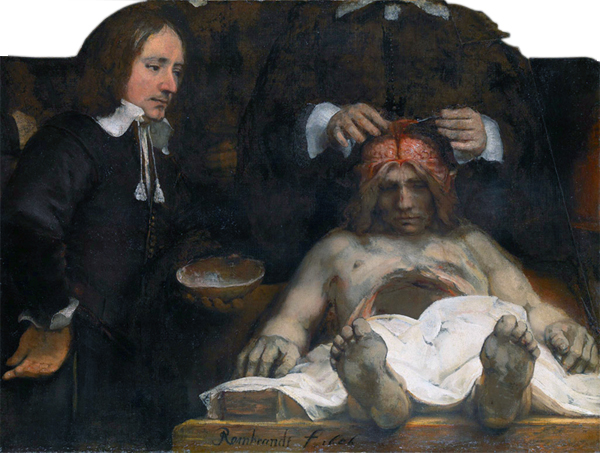
Rembrandt’s “Anatomy of Doctor Deyman” survives as a fragment, yet the remaining portion is so fiercely composed that it feels complete. A cadaver lies foreshortened on the dissecting table, feet toward us, while the anatomist lifts the scalp to expose the skull and brain. At the left, an assistant concentrates, a shallow bowl cradled in his hand. The rest of the original group—spectators, architecture, additional figures—was lost in a later fire, but the surviving panel compresses everything essential: the choreography of hands, the tunnel of light, and the ethical gravity of looking at a body opened for knowledge.
A Composition Built on Foreshortening and Hands
The picture’s force begins with the foreshortened corpse. Rembrandt drives the cadaver toward the viewer so that the soles of the feet act like blunt punctuation marks at the front edge of the painting. The body then recedes in a quick climb—shins, knees, belly, chest, head—until it reaches the high plane where Doctor Deyman’s hands perform their careful work. This steep perspective compresses space and concentrates attention on the head, the site of inquiry. Because the anatomist’s torso is cropped by the upper edge, his presence registers primarily through the dexterity of his fingers and the glint of the instrument. The scene becomes a drama of hands: the surgeon’s hands that act, the assistant’s hands that steady and receive, and the lifeless hands of the cadaver that fall inert at the sides of the sheet.
Chiaroscuro as Surgical Spotlight
Rembrandt molds the room into darkness and pours a hard, cool light over the table. The cadaver’s pallor blooms against that gloom; the lifted scalp glows a startling red; the assistant’s face is edged by a thin halo; and everything else retreats. The lighting is not decorative—it is operational. It behaves like the focused illumination used in a theater or, more aptly, like a surgeon’s lamp before electricity, isolating the task at hand. Deep browns and blacks gather in the background so the eye will not wander; even the anatomist’s robe is kept in shadow, the better to emphasize the working hands and the open head.
Color, Flesh, and the Physics of Paint
The palette is restricted—ocher flesh, cool grays, earth reds, and a heavy, resinous black—but within those limits Rembrandt finds an astonishing range. The cadaver’s skin is modeled with gray-green undertones and bluish hints that read as cooling blood beneath the surface. The lifted scalp is built with thick, oily reds that catch the light and create a tactile sense of dampness. The white sheet is not a sterile modern white but a layered, dirty cream that bears the weight of handling, painted with broken strokes so it wrinkles and reflects. Paint here behaves like matter: thick where tissue is thick, thinned where touch must be delicate, and scumbled where cloth abrades the light.
The Anatomist’s Thought Made Visible
Because Deyman’s head and torso are cropped, his intention must be read through gesture. His hands are precise, the instrument held with poised economy. He does not claw or stab; he lifts and separates. The assistant’s gaze confirms the seriousness of the action—no theatrical astonishment, only concentration. Rembrandt thus translates an intellectual act into a choreography of small movements. What the anatomist knows is dramatized not by a speech or a book but by the way fingers measure, pull, and reveal.
A Studio Master of Human Texture
Rembrandt’s late manner, with its heavy impastos and abrupt transitions, is acutely suited to the scene. He can describe fatty tissue with dragged paint, bone with cool, tight planes, hair with springing flicks of the brush, and the soft collapse of the abdomen with veiled, gray-brown tones. The assistant’s face is worked more thinly, allowing the ground to breathe through and giving the flesh a living translucency set against the corpse’s cool opacity. The table’s plank shows the artist’s delight in the resistance of wood: long strokes score its surface, carrying the eye toward the sheet and the body beyond.
The History Behind the Fragment
Commissioned for the Amsterdam Surgeons’ Guild, the work originally included a lecture demonstration with gathered viewers, a civic ritual that marked the scientific and public meaning of anatomy in the city. A later fire reduced the composition, leaving only the core section with Deyman, his assistant, and the cadaver. The loss is tragic historically, but artistically the fragment is ruthless and exemplary: by stripping away spectators and architectural frame, it leaves us alone with the procedure. What remains is the essence of the anatomy lesson—the body, the teacher’s hands, the student’s attention, and the viewer’s own moral response.
A Dialogue with Rembrandt’s Earlier Anatomy Lesson
Comparisons to Rembrandt’s “Anatomy Lesson of Dr. Tulp” are unavoidable and illuminating. In the earlier painting, the drama is social: a group of surgeons, elegantly posed, attend a lecture on the flexor tendons of the forearm. In “Anatomy of Doctor Deyman,” the drama is surgical and existential. There is no proud group portrait, no theatrical gaze back at the viewer. The corpse is not a prop for a lesson in status; it is a presence in its own right, opened at the most intimate site of personhood. The shift suggests changes in both Rembrandt’s art and the culture around him: more interest in the immediacy of scientific work, and a late style that favors concentrated experience over rhetorical display.
The Ethics of Looking and the Anatomy of Seeing
To look at this painting is to confront one’s role as a witness. The foreshortening places us at the end of the table with the soles of the feet almost in our lap. We cannot remain neutral; we have been ushered into proximity. Rembrandt does not sensationalize the scene. He neither prettifies nor revels in gore. He asks whether we can hold two truths at once: that the body on the table once housed a person whose life is over, and that the opening of that body now serves the living by advancing knowledge. The painting’s calm insists that respect and curiosity can coexist—difficult, uneasy, but necessary companions.
A Vanitas Without Emblems
Dutch vanitas pictures traditionally pack a table with skulls, extinguished candles, and timepieces to remind viewers of mortality. Here, mortality is the subject itself. The cadaver’s foreshortened head, swaddled in lifted scalp, performs the work of an entire still life. The white sheet stands in for a shroud; the instrument in Deyman’s hand replaces memento symbols with the clinical precision of a tool. The painting offers no hourglass; it offers the body as the measure of time. Knowledge and death are bound together not as opposites but as partners in the human condition.
Civic Science and the Dutch Republic
The seventeenth-century Netherlands prized practical knowledge—navigation, engineering, mapping, finance, medicine—and the surgeons’ public anatomy was part of this culture of applied learning. Rembrandt’s fragment honors that civic science without turning it into propaganda. There is no banner, no guild emblem looming over the scene. Instead, the dignity of the work is projected through the disciplined handling of light, the measured gestures of the practitioners, and the sober stillness of the composition. We sense a society that takes the body seriously—as a site of law, labor, illness, and learning.
The Cadaver as Both Object and Subject
Rembrandt refuses to erase the personhood of the cadaver. Though lifeless, the body remains portrait-like in specificity: the roughness of the soles, the soft swell of the belly, the slight asymmetry of the mouth, the heavy fall of the arms. The face, shaded by the lifted scalp, is still a face. We are not allowed to forget that anatomy’s object was once a subject with a name. This balance prevents the picture from hardening into sterile demonstration. It remains a human event.
The Assistant’s Role and the Economy of Attention
The assistant—silent, self-contained, and focused—anchors the left of the composition. His bearing teaches the viewer how to behave: steady, alert, without theatrics. The bowl in his hand is an instrument of care as much as of collection, catching what must not be lost or simply providing saline or cloths. His presence prevents the scene from becoming a duet between painter and dead body. Instead, it is a trio: teacher, student, and subject. Attention flows between them and then out toward us.
The Sheet as Stage and Shroud
The white cloth draped over the lower abdomen performs two pictorial tasks. It protects modesty and makes a stage. Against its bright field, the hands, instrument, and exposed tissue read with clarity. Its folds are modeled with the same loving intelligence that Rembrandt brings to lace and linen in his portraits, but here the beauty is in service of seeing. The sheet is neither pristine nor careless. It bears the accumulated story of the procedure—stains, wrinkles, disruptions—like a page that has been written upon during the lecture.
Cropping as a Tool of Modernity
The truncation of Deyman’s torso and the close cropping of the scene feel startlingly modern, akin to a photographic frame. This cut isolates the operative moment; it also implicates the viewer, who must complete the surrounding space in imagination. Such cropping intensifies the sense that we have arrived mid-procedure, not at a ceremonial beginning. The painting anticipates later realist strategies: show the work, not the ritual; let the frame be as ruthless as the act.
A Liturgy of Work Instead of a Pageant
Rembrandt’s earlier public portraits often deliver pageantry—fur-lined coats, gilt buttons, coordinated gazes. Here he gives a liturgy of work. Sleeves are rolled; collars are simple; the anatomist’s robe reads as practical black. The image pauses at the exact scale of hands and instrument, where knowledge is enacted rather than proclaimed. Even the signature, tucked at the table’s front, feels part of the apparatus: the artist signs not as a celebrity but as a witness who has taken his place among the workers.
The Brain as the Last Frontier
The choice to show the head rather than the more conventional arm or abdomen is radical. In opening the skull, the painting trespasses on the seat of identity. Seventeenth-century medicine was still discovering the brain’s structure and pathways; Rembrandt’s image records that inquisitive boldness without sensationalizing it. The scalp is lifted like a curtain; the mind’s chamber is implied rather than displayed in lurid detail. The painting asks a question that remains contemporary: how do we examine the organ that enables examination itself?
The Viewer’s Body as a Measure
Foreshortening causes the viewer to feel their own body’s echo: soles, shins, knees, and the implicit weight of a head. That identification is not a trick; it is the vehicle by which the painting delivers its instruction. We recognize ourselves in the cadaver and thus align, however briefly, with both the vulnerability under the sheet and the curiosity above it. The picture turns spectators into participants, ethically and physically.
Style, Substance, and the Authority of the Late Rembrandt
By the mid-1650s Rembrandt’s surfaces had grown rougher and more eloquent. He trusted thick paint to stand for thick flesh, abrupt tonal leaps to stand for sudden light, and conspicuous brushwork to stand for the pressure of vision itself. In this painting, that late style carries unusual authority: the subject is not polite; the facture must not be polite. The result is a unity of matter and meaning. The paint feels true because the scene is true—difficult, necessary, and sober.
Why This Fragment Still Compels
Even reduced, “Anatomy of Doctor Deyman” compels because it keeps faith with essentials: the dignity of work, the reality of death, the pursuit of knowledge, and the ethic of attention. It neither flatters the practitioners nor moralizes over the corpse. Instead, it places them together under a candid light and asks us to see. The fragment’s severity is its strength. It leaves no space for distraction and gives us art as witness—paint and light organized so that truth can be borne with steadiness.