Image source: wikiart.org
A Quiet Blaze of Attention
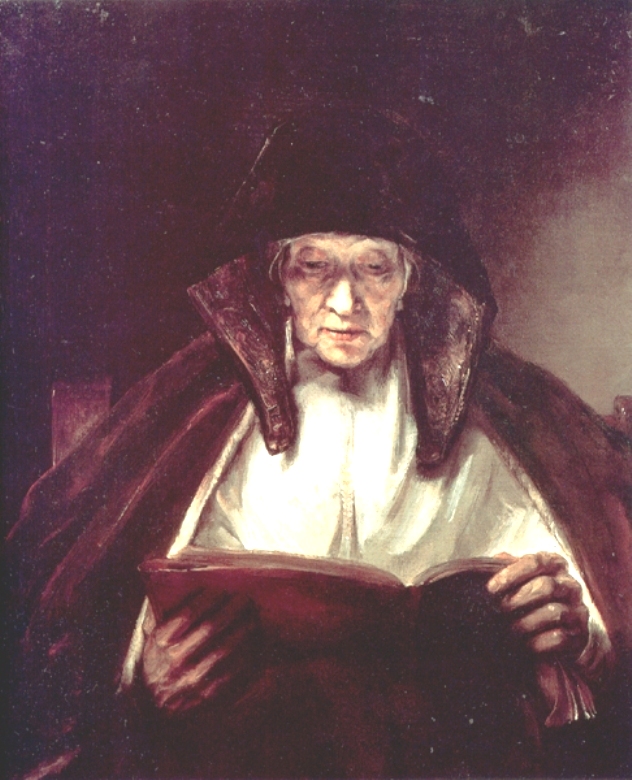
Rembrandt’s “Old Woman Reading” offers a vision of concentration so intense that it seems to warm the air around it. The sitter, cocooned in a thick mantle and hood, bends over a large book whose open pages lift a pale light toward her face. Nothing moves and yet everything advances: the slow march of time in the creases of skin, the progress of the eye across a line of text, the gradual ignition of meaning. The painting’s serenity is not passivity; it is focused life. Rembrandt transforms a private act into a public image of dignity, placing the labor of reading at the center of the picture and asking the viewer to meet it with equal attention.
Composition Shaped Like a Hearth
The composition gathers its forces around a triangular arrangement formed by the hood, shoulders, and the sloping edges of the book. This triangular “hearth” contains the fire of attention. The broad, dark field behind the sitter functions like a protective wall, pushing her gently forward. Rembrandt keeps the figure frontal and slightly elevated, so that the book’s arc sits just above the picture’s lower edge and the hands become architectural pillars that support the central act. The design denies distraction. There is no window, no table clutter, no anecdotal props—only reader, book, and an atmosphere thick with silence.
Chiaroscuro as a Moral Climate
Light in this painting behaves like character. It does not fall in a theatrical beam but gathers where it is wanted most: on the face, the fold of the collar, the knuckles, and the lifted lip of the book. Dark passages are never empty; they are saturated with slow, smoky tones that feel lived-in, like the interior of a familiar room. The book appears to emit its own quiet radiance, a visual metaphor for understanding. As light travels from page to face, it stages the movement of meaning from text to mind. This choreography of illumination is classic Rembrandt: chiaroscuro not as spectacle but as ethics, revealing what the picture values.
The Palette of Warm Restraint
The color world is built from umbers, deep wines, and velvety blacks, relieved by the soft whites of collar and page and by the tender flesh tones of face and hands. Within these limits Rembrandt discovers abundance. The mantle’s brown is not a single note but a chord of browns, mottled with submerged reds and softened by thin glazes. The flesh is modeled with grays and pinks so that the translucence of aging skin—the way blood seems closer to the surface—is felt rather than announced. Against the relative austerity of the background, these warmer notes read as human presence at its most durable.
Brushwork that Breathes and Binds
Close looking reveals a surface that lives. On the mantle and background, Rembrandt lays paint in broad, confident sweeps that create a plush, habitable darkness. In the face and hands he modulates his touch, moving to firmer, smaller strokes; a thin line defines a crease; a thicker dab rounds a knuckle; a feathery suggestion softens the edge of the lips. The book’s pages are wonderfully economical—thin veils of pale pigment pulled over darker underpaint, then broken by a few flexing lines to suggest the gentle undulation of paper. The varieties of touch are purposeful: roughness for cloth and shadow, refinement for thinking flesh.
The Book as Object and Metaphor
The book is large, bound in dark leather, and weighted by age. Its heft matters. It anchors the composition physically and conceptually, making reading a bodily act that requires support from both hands. The scale implies Scripture or a devotional volume, but Rembrandt refuses to name it with legible text or decoration. By not specifying content, he universalizes the scene: the book could be sacred or secular, prayer or history, household account or letter. What matters is the posture of attention, the generous meeting between mind and page. The book’s pages, luminous and slightly worn, become a mirror of the woman’s life—creased, resilient, luminous from within.
Age as a Landscape of Knowledge
Rembrandt’s understanding of old age is not sentimental. The eyes sink slightly, lids heavy; the cheeks fall soft; the mouth tightens where teeth have gone. Yet nothing in the description humiliates. The face reads like a landscape weathered by years—valleys of shadow, ridges of light—beautiful because it is true. The painting honors what time brings: patience, steadiness, the ability to dwell with long texts and longer memories. In the cupped hands we sense the strength of habits formed over decades, hands that have cooked, washed, mended, and now hold knowledge like a vessel.
Clothing as Architecture for a Life
The hood and mantle are substantial, almost architectural. Their weight does not oppress; it shelters. The raised fur or velvet edging around the hood frames the face like a shallow niche, creating a sanctum for concentration. The white collar is a small clearing of light within this dark architecture, a passage by which the page’s glow reaches the face. The garment’s plainness resists fashion and status games. If this is a portrait of a particular woman, it is also a type: the reader who finds her dignity in work, piety, or both, clothed not in ornament but in purpose.
The Identity Question and the Power of Not Knowing
Tradition sometimes identifies the sitter as Rembrandt’s mother, though scholars have long debated the attribution. Whether or not the likeness is familial, the painting certainly feels personal. The nearness, the lack of theatrical distance, the generosity of the modeling—they all suggest the painter knew this face well and loved it. Yet there is advantage in uncertainty. Not knowing precisely who she is frees the viewer from biographical gossip and directs attention to the universals the image embodies: reading as vocation, age as a bearer of meaning, solitude as a way to be with others through text.
Time Measured in Pages
The painting is saturated with temporality. The act of reading is time-consuming by nature; the book promises hours of companionship; the face records years; the coat suggests a season. Rembrandt compresses these time scales into a single stillness. The viewer feels the present tense—the line being read now—but also the before and after, the pages already turned and the pages waiting. In this sense the image is almost musical: a sustained note held within a larger composition of life.
Silence as a Subject
The picture listens. Its silence is palpable, a thick medium in which the act of reading can occur. The background is not filled with furniture for a reason; the fewer distractions, the deeper the quiet. Rembrandt knows that silence is not absence but condition. It has temperature and tone; it holds the warmth that the figure generates and reflects it back. The viewer who lingers feels invited to share that silence, to let the noise of the world drop, if only for the length of the gaze.
Hands as Instruments of Mind
Much of the painting’s emotion emanates from the hands. The left hand steadies the lower edge of the book; the right pinches and supports the upper corner, poised to turn a page. The knuckles are swollen slightly, the nails simple and unadorned, the skin thin. These hands have memory. They carry traces of labor and care, and they now serve the intellect with the same competence. The gesture is firm but tender, an embodied intelligence. Rembrandt always painted hands as if they could think; here they practically do the reading.
The Face as a Workshop of Attention
The tilt of the head is minimal but decisive, bringing the text into the sweet spot of focus. The brow is softly furrowed; the mouth rests in a line of quiet effort. The eyes do not sparkle; they work. Rembrandt does not polish them with gem-like highlights because he is not courting glamor. He wants the viewer to feel the muscle of concentration, the way thought gathers behind the eyes and moves forward, syllable by syllable. This is portraiture as cognitive realism.
The Space Around the Figure
The room is more felt than described, its far wall dissolved into sables and browns. A faint block at the left hints at a chair back; a warm vapor rises behind the right shoulder. This vagueness is not neglect but strategy. By blurring the periphery, Rembrandt intensifies the core. The boundaries of the world contract to the radius of the book’s light, as happens when anyone reads deeply. The painting enacts on us what it depicts: the focusing and narrowing that make attention possible.
Comparisons Across Rembrandt’s Oeuvre
Rembrandt returned again and again to the figure absorbed in text—young scholars, Apostles, his son Titus, and anonymous readers. “Old Woman Reading” stands out for its union of monumentality and intimacy. It is monumental because the figure fills the frame and the act carries ethical weight. It is intimate because the modeling is tender and the distance to the sitter feels as close as a small room. Compared with the sometimes theatrical light of earlier works, the glow here is gentler, more interior, as if produced by the reader’s steadfastness as much as by any external source.
Material Presence and the Pleasure of Paint
While the content is serious, the painting offers sensual pleasures: the soft drag of a brush over the mantle’s nap; the buttery edge where white collar meets brown coat; the slightly raised ridge that defines a wrinkle. Rembrandt never separates idea from matter. The truth of the scene is carried by the truth of the material—the physical stuff of oil and pigment behaving like cloth, skin, paper, and air. This integrity of facture convinces more deeply than any narrative could.
Devotion Without Insistence
If the book is Scripture, the painting is devotional, but quietly so. There are no overt symbols—no candle, rosary, or halo—only the disciplined act of reading. That restraint feels modern. It respects the privacy of belief and trusts viewers to recognize sanctity in attention itself. If the book is not Scripture, the devotion remains: to learning, to memory, to the civilizing force of literacy. The painting allows both readings to coexist, doubling its reach.
The Ethics of Looking
The picture teaches its audience how to behave. It asks for patience, modesty, and a willingness to let another’s concentration set the pace. By keeping our distance—no intrusive details, no voyeuristic clutter—it models respect. Portraiture can flatter or invade; this one honors. The viewer participates not as a consumer of the sitter’s image but as a companion at the edge of her work.
Contemporary Resonance
In a culture of skimming and scrolling, “Old Woman Reading” argues for deep reading as a sustaining human act. The work reminds us that attention does not belong only to youth or to professionals; it is a resource that can ripen with age. The painting encourages the sense that elders carry libraries within them, and that the simple act of turning a page can still be revolutionary in its quiet way.
A Lasting Image of Human Dignity
The greatness of this painting lies in its modesty. There is no spectacle, no dramatic gesture, only the steadfast coupling of a mind and a book. Rembrandt enlarges the everyday until it becomes exemplary. The mantle is heavy, but the moment is light. The hands are worn, but the face is luminous. Time has passed, but meaning continues to arrive line by line. Viewers leave the image with a strengthened respect for the ordinary rituals that make a life intelligible.
