Image source: wikiart.org
A Portrait That Feels Like a Pause Between Thoughts
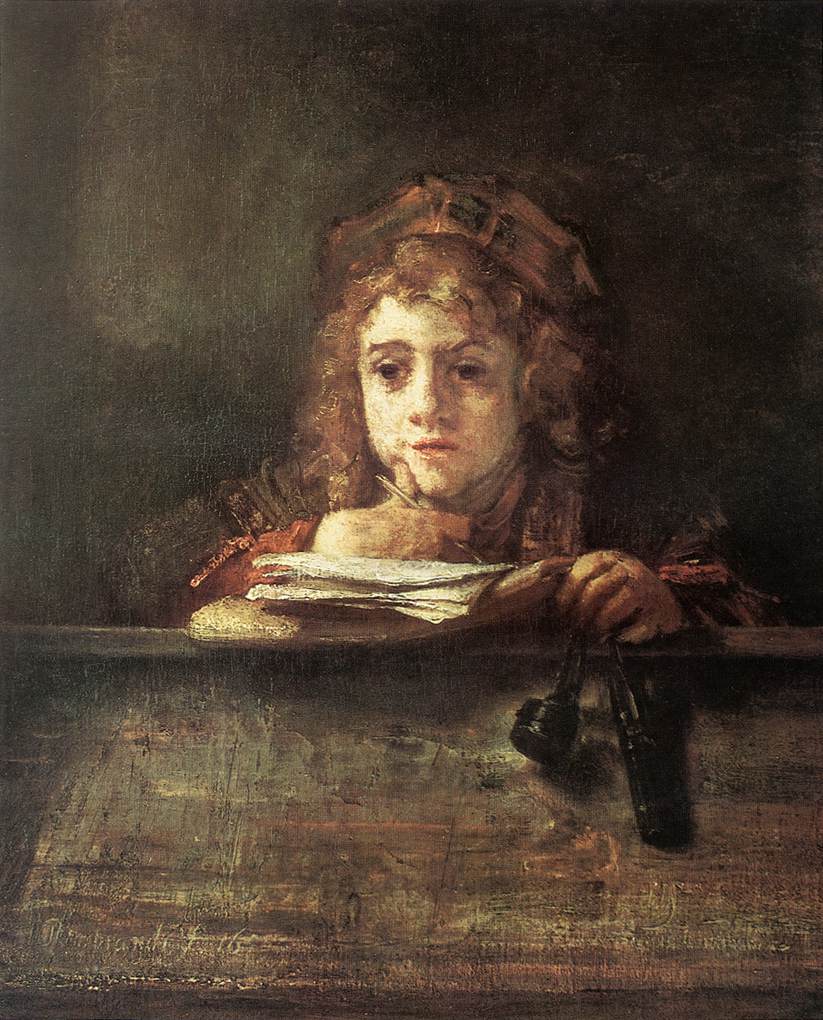
Rembrandt’s “Titus” presents the artist’s son as if caught between breaths, a quill hovering in one hand while the other idly toys with a small black inkpot suspended by cords. The boy leans over the worn edge of a desk or reading ledge, a cushion propping the papers under his forearms. Nothing theatrically occurs, yet everything important is happening: attention gathers, wanes, and re-forms; the face calibrates a mood that is neither diligence nor idleness but the saturated middle where thinking actually happens. The image persuades because it respects this fragile psychological interval. It shows what portraiture rarely has time for—the moment in which a mind turns.
Historical Context and a Family Story
The date situates the portrait at a charged moment in Rembrandt’s life. Titus, born in 1641 to Rembrandt and Saskia van Uylenburgh, would have been about fourteen. Saskia had died in 1642, and the household had since weathered grief, lawsuits, and social strain. Within a year of this painting, Rembrandt’s finances collapsed, and the family reorganized its business affairs in ways that placed unusual responsibilities on the adolescent Titus. Knowing this history, the portrait’s sober quiet acquires pathos. Titus is not simply a charming boy in fancy dress; he is a son poised on the threshold of adult cares, already drafted into the practical and emotional economy of the studio-home.
Composition as a Theater of Concentration
The composition is audacious in its simplicity. Nearly the entire lower half is a plank of desk—scratched, abraded, streaked with subtle glazes and scumbles—pushing the figure high into the frame. This vast foreground behaves like silence in music: it creates room for a small, intense voice to be heard. The boy’s head, hands, and papers form a contained cluster near the upper center-left; the rest is a soft dark that deepens as it rises. Rembrandt sets up a diagonal from the dangling inkpot at the right margin, up through the hand that holds its cords, across the papers, and into the face. The eye follows this path the way a thought passes from instrument to page to mind. The edge of the desk, described with stubborn horizontality, counterbalances the diagonal sweep and grounds the image with the authority of a work surface.
Chiaroscuro That Breathes Rather Than Shouts
Light enters like a patient visitation, not a blaze. The background is a brown-green dusk, mottled by thin veils of paint. From this dusk the visage uncurls—a cheek catching warmth, a nose side-lit, the brow socketed in soft shadow. The papers are patches of pale matter, nothing like theatrical white; they glow gently, as if they have absorbed daylight and now return it. The dangling inkpot swings into a darker pocket, almost disappearing, so that the viewer feels its presence as weight before seeing it as shape. This atmospheric approach to light turns the painting into a climate rather than an arrangement of spotlit objects. Titus is not merely illuminated; he is breathing air that has color and thickness.
A Palette Tuned to Human Warmth
Rembrandt organizes the color around earths and umbers moderated by olive and smoke. Against this warmth, small infusions of rose and cream model the face, which is neither porcelain nor ruddy but human—thin, mobile skin over bone and muscle. Accents of brick red in the garment, and a bronze note in the cap, knit the figure to the richer browns of the desk. The palette resists glamor so that the flush of life in the cheeks, the moist highlight along the lower lip, and the slight pallor under the eyes feel credible. Color, here, is empathy made material.
Brushwork that Thinks Out Loud
The surface bears Rembrandt’s late confidence in letting paint declare itself. Hair is built with loaded, fast strokes that ride over darker underlayers, creating curls that are less drawn than discovered. The face, by contrast, is negotiated slowly: thin, translucent films are worked into each other, with sharper touches for the eyelids and the nostril edge. The papers are a few purposeful sweeps, their edges irregular, with slight scrapes that suggest wear. The desk’s plane is a marvel of restrained invention—skids of the brush, scored lines, hints of knots—like a biography of use. This differentiation of facture across zones makes looking feel like touching: hair springy; skin soft; paper dry; wood resistant.
The Psychology of the Gaze
Titus does not meet the viewer. His eyes drift downward and sideways, as if reading a thought that has not yet been written. The mouth rests in an undecided line, neither tightened with effort nor glossed with a smile. The overall expression is moderated, but one senses interior alertness: the quill poised near the chin acts like a conductor’s baton about to start the measure. This indirect gaze avoids the vanity common to youthful portraits. We are not invited to assess social charm; we are asked to share attention. Few portraits make the viewer feel so much like a collaborator in the sitter’s mental process.
Objects as Quiet Emblems of Labor
The accoutrements are minimal: folded papers, quill, inkpot, and cushion. Each has been seen a thousand times in the studio; none is treated as prop. The cushion’s pale bulk tells a story about long hours—a pragmatic adaptation to make the hard lip of the desk bearable. The corded inkpot hints at the mobility of the writer’s task; it can be moved, lifted, borrowed, shared. The papers are thick enough to hold the scratch of the quill, their corners slightly buckled. These details communicate a moral argument without preaching: meaningful work dignifies a life, and craft begins in the hands long before grand achievement arrives.
Costume and the Question of Identity
Titus often appears in Rembrandt’s work in fancy or historical dress—caps, chains, or exotic fabrics—especially in studies that doubled as workshop demonstrations. Here the clothing is restrained: a mantle with dull red notes, a cap whose structure is sketched more than detailed. The relative modesty prevents role-playing from overwhelming character. If there is an element of masquerade, it is gentle and domestic, more like a boy trying on studio garments than a prince asserting rank. Identity emerges not from display but from demeanor.
Space, Silence, and the Intimacy of Scale
The painting’s space is shallow but not cramped. The background is a vaporous envelope; the desk thrusts forward; between them floats the boy’s attentive head. The untouched expanse below is not empty; it is a felt presence, like quiet in a study room or a chapel’s nave before the service begins. Because so much of the panel is low-contrast darkness, small fluctuations—a rubbed patch, a scuffed diagonal—assume importance. The viewer’s eye slows, learns patience, and in that slowness the portrait’s intimacy grows.
The Edge as Narrative Line
Edges in Rembrandt are never merely separations; they are events. The contour where the boy’s forearms cross the desk wobbles with tiny changes of temperature and value, giving the impression of living pressure. The edge of the paper against the wood is softened so that light seems to seep from sheet to desk. The inkpot’s silhouette, dark against darker ground, is emphasized by a sheen on its rounded belly. These edges suggest micro-stories: the boy shifts his weight; the paper slides; the inkpot sways. Narrative is compressed to seconds, then entrusted to boundaries.
A Meditation on Fatherhood
Knowing that the painter is the sitter’s father intensifies the painting’s tenderness. The vantage point is slightly lower than the boy’s eyes, as if the viewer—who is also the father—were standing just below and to the right, not wanting to interrupt. Light caresses rather than interrogates; the mouth is painted with particular delicacy, as one might study the face of someone loved in a moment of unguarded absorption. The big desk becomes a symbolic threshold between generations: on one side the accumulated labor of the parent, on the other the beginnings of the child’s work. Without sentimentality, the painting acknowledges a private bond.
Workshop, Business, and the Burdens Ahead
By 1655 the studio was also a household business. Titus would soon be enlisted to help manage sales and legal arrangements, particularly after the financial disaster of 1656. The inkpot and papers therefore carry a hint of future duty: the boy who writes verses and doodles may also be the clerk who signs inventory lists or contracts. The portrait does not dramatize this knowledge, but a faint gravity enters the face that feels older than fourteen. Portraiture here becomes an ethical document, recording the weight that time is about to place on a young person’s shoulders.
Comparisons with Other Portraits of Titus
Rembrandt painted Titus several times. In later works the son appears with a book or illuminated by a raking light that isolates his features against deep shadow. Compared with those, this version is quieter and more provisional. The later images sometimes read as emblematic types—scholar, monk-like youth—whereas this one reads as a boy in a room. The distinction matters. Where emblem seeks the timeless, this panel seeks the time-bound: a particular dusk, a particular desk with specific scratches, a particular pause while a thought gathers.
The Desk as a Landscape of Work
Spend time with the lower half of the painting and it begins to behave like a lowland landscape: scuffs become roads, warm patches like fields, darker ruts like canals. The analogy is not fanciful. The Dutch landscape—a humanly managed ground—is the cultural backdrop of Rembrandt’s world. By painting the desk as a terrain of marks, he equates intellectual labor with the tilling and channeling of fields. It is an affectionate conceit: the boy will cultivate his page the way farmers cultivate land.
The Face as a Map of Possibility
The physiognomy is unresolved in the best sense. The nose is still a child’s, rounding at the tip; the eye sockets suggest the bone structure to come. The mouth holds both softness and determination. Rembrandt avoids the flattering glosses that fix a youthful face into a polished emblem. He prefers an in-process truth, full of possibility. This approach dignifies the subject not by declaring his final form but by honoring his becoming.
Time, Temporality, and the Quill’s Hover
The quill hovering near the chin is a temporal device. It holds the present open—neither upstroke nor downstroke, neither sentence begun nor concluded. Many portraits depict the result of action: a musician mid-performance, a scholar midway through reading. Here the action is preparatory. That is why the image lingers in memory. It stages the instant before commitment, reminding viewers of their own countless beginnings, the drafts they have not yet written, the letters they postponed and finally sent.
Paint as Memory
The painting’s surface carries a sense of recollection. Passages are rubbed, thinned, or reopened and repainted. It is as if Rembrandt wanted the panel to remember the artist’s own thinking process the way Titus remembers a line before writing it down. The texture of the desk, especially, feels like palimpsest—a record of earlier uses layered beneath current ones. The whole picture thus becomes a meditation on memory’s role in identity. We are, like the desk, worked upon by time; we carry marks of tasks done and deferred; and yet we still present a clear surface upon which to write the next line.
The Viewer’s Share in the Picture
Because Titus never looks directly out, the viewer’s participation is voluntary. We decide to step up to the desk, lean in, and read the face. Our eye drops to the inkpot, then rises to the mouth and eyes, then back to the papers. In this small choreography the painting teaches attentive looking. It rewards patience with the discovery of ever subtler modulations—a softening at the inner corner of the eye, a tender highlight on the wet lower lip, a tiny kink in the cord. Few works are so generous to a slow viewer.
Enduring Relevance
Modern audiences recognize themselves in this portrait. The desk has become a laptop screen; the quill an index finger hesitant over a keyboard; the hovering pause is the same. The painting validates the dignity of thinking before acting, of letting a thought ripen. In an age that often treats attention as a commodity to be harvested, “Titus” defends attention as a moral resource to be protected. The lesson feels both intimate and public: the world improves when we learn to pause like this boy.
A Quiet Masterpiece of Affection and Craft
Everything about the painting is modest—format, palette, event—yet it achieves grandeur through concentration. The face’s tender modeling, the resonant emptiness of the desk, the quill that refuses to hurry, the inkpot that swings in a pocket of shadow: together they create a portrait that is less about a likeness than about a way of being in the world. It shows a young person keeping company with his own thoughts, and a father keeping company with that quiet. Viewers are invited to join them. The invitation has not expired across the centuries.