Image source: wikiart.org
Introduction
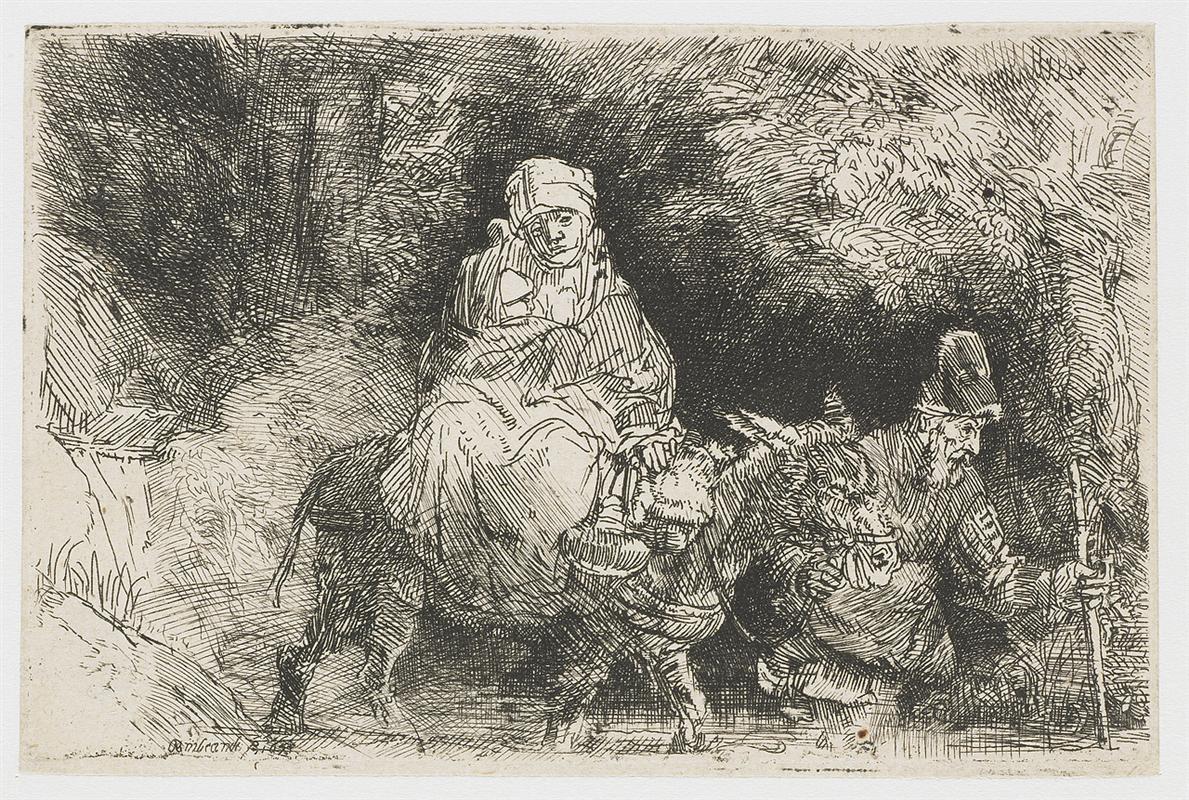
Rembrandt’s “The Flight into Egypt: Crossing a Brook” (1654) is a compact miracle of narrative drawing. In this late etching the Holy Family negotiates a shallow stream on their nocturnal escape, the donkey’s legs splayed for balance while Joseph wades ahead with a staff and Mary rides sidesaddle, wrapped in heavy garments. The scene is intensely physical—water under hoof, branches pressing from above, stones underfoot—and yet the emotional weather is quiet, even tender. Rather than staging an epic crossing, Rembrandt isolates a single, humble problem on the journey: how to get a tired mother and infant across a trickle of water in the dark. By narrowing the moment, he expands its humanity. The sheet becomes a study of care under strain, of movement slowed by responsibility, and of how light and line can turn ordinary difficulty into an image of steadfast love.
The Subject and Rembrandt’s Choice of the “Small Moment”
Painters of the Flight into Egypt often prefer large gestures—angelic guides, perilous ravines, or moonlit vistas. Rembrandt favors the unspectacular heartbeat of travel. His Holy Family does not triumph over catastrophe; they pick their way through a brook. That choice belongs to his lifelong practice of finding revelation in ordinary acts: a baby nursed in a corner, a prayer whispered over bread, a body lowered by friends with workmanlike care. Here the smallness of the obstacle underlines the largeness of the task. The infant’s safety makes even a stream into a test, and Joseph’s competence becomes a form of devotion. This is theology at human scale.
Composition and the Architecture of Movement
The composition organizes motion along a diagonal that runs from the lower right, where Joseph plants his staff in the water, up through the donkey’s head and ears to Mary’s downcast face, then back along the curve of the animal’s back to the left. The path is countered by a second, darker diagonal: the mass of foliage that presses from the upper right toward the center, forming a canopy of shadow over the travelers. These opposed vectors—forward motion and downward pressure—create a feeling of quiet struggle. The streambed, etched with short, horizontal strokes, settles the lower edge; trees and bushy leaves, built from clustered arcs and hatching, fill the upper field. The donkey’s legs splay into a tense X at mid-sheet, fixing the composition and signaling the difficulty of the footing. Everything is arranged to make the problem legible and the solution credible.
Light, Darkness, and the Weather of the Night
Rembrandt rarely uses light to describe confusion; he uses it to locate attention. In this etching the world is largely dusk, with a concentrated glow reserved for the faces and for small planes of cloth. The background wall dissolves into dark mesh; the foliage overhang turns nearly black; the stream reads as pale ribbons left by sparing wiping of the plate. On Mary’s headscarf and cheek the light grows thin and tender, as if reflected up from water or delayed in folds of cloth. Joseph’s profile receives a brighter edge that announces alertness. The donkey’s muzzle catches a sliver of highlight so that we feel the animal’s thinking—ears forward, head low, ready to choose its next step. Light here is a moral technology. It keeps the family visible to itself and to us without pretending the road is easy.
Mary’s Weight and the Dignity of Care
Mary sits with the posture of a person who has ridden far: shoulders slightly hunched, legs gathered, hands steadying the infant under her cloak. Rembrandt builds her mass from broad, directional strokes that collect like ripples in heavy cloth. She is not presented as a floating Madonna but as a young mother who has learned how to hold a child on a moving animal. The gravity of her body becomes part of the donkey’s problem and Joseph’s responsibility. Without heroicizing anyone, the etching pays respect to weight—of fabric, of fatigue, of the life carried under the cloak. The image’s pathos grows not from sentiment but from the believable physics of care.
Joseph as Guide and Worker
Joseph moves at the animal’s head with his staff angled upstream, a trick any traveler would use to steady a crossing. His cap and coat are treated with wiry, brisk marks that suggest rough wool and the resilience of a craftsman on the road. The face is briskly drawn—nose hooked forward, mouth set, brow slightly knit—so that alertness reads instantly. He is not a dramatic hero; he is a reliable man in bad light. Rembrandt’s Josephs often behave this way. They make places, solve problems, and stand near without asking for speech. In this print that steadiness supplies the emotional center. If Mary carries the child, Joseph carries the path.
The Donkey as Partner in the Journey
Rembrandt almost never treats animals as props. This donkey is a character with its own competence and anxiety. The short legs brace; the shoulder dips; the head presses forward. Dark hatchings model the furry hide; sharp, quick cuts articulate the ears and the tense nostrils. A strap and halter line run to Joseph’s hand, but the animal is not dragged; it collaborates. In this triangular company—mother, child, and beast—Rembrandt locates a rural truth: travel depends on partnerships across species, and patience is the universal currency.
Landscape as Intimate Theater
Though the print suggests a larger world—a path curving away, tree masses enclosing space—its scale is intimate. The brook is not a roaring stream but a ribbon of water. The foliage is pressed close, producing a tunnel effect that heightens the sense of passage. At the far left a small retaining wall or cut bank slips into view, a few straight lines that give the organic world something to push against. Everything is close enough to touch. The landscape does not generalize “wilderness”; it builds a room of trees and stones in which the family moves carefully.
The Language of Line and the Late Etcher’s Hand
Technically the sheet is a late-Rembrandt marvel of economy. The sky is nearly untouched, leaving raw paper to glow as night mist. Deep black is achieved not by crosshatching alone but by compact swarms of hatch and scribble that swell into foliage. Fabric is rendered with long, directional strokes that ride over each other, producing a sense of weight. The brook’s surface is a series of brief horizontal flicks, a few left unprinted where Rembrandt wiped the plate more cleanly. He saves descriptive density for places where the viewer needs help—the tilt of Mary’s head, the shovel shape of the donkey’s ears, the bite of Joseph’s gaze—and allows other areas to hover. The result is a page that breathes.
Speed, Revision, and the Feeling of Event
Rembrandt’s etched line here feels both fast and assured. You can sense the artist searching at the donkey’s hocks, then committing; testing the shadow mass behind Joseph, then deepening it; laying a few trial lines for a branch, then letting them stand. That visible process gives the sheet a temporal dimension: the crossing is happening, and the drawing participates in its happening. The scene is not a posed tableau but a quick record of a moving interval, which is precisely what a journey consists of—minutes strung together by intention.
Iconography Translated into Human Terms
Traditional “Flight into Egypt” imagery carries strong typological overtones: the exodus replayed, pagan statues falling, demons routed. Rembrandt pares away such emblems. He keeps only what the humans would have known: fatigue, darkness, rough ground, and the need to cross water. That reduction is not secularizing; it is devotional. It invites empathy before interpretation. The viewer recognizes the posture of care and the caution of night, and only then remembers the larger story. In this order—human recognition first, theology second—the print achieves unusual tenderness.
Motion, Balance, and the Micro-Drama of the Step
The entire sheet concentrates on the micro-drama of a single step. The donkey’s foreleg lifts, the hoof about to test the next stone. Joseph leans fractionally forward, ready to brace. Mary’s hand gathers her robe so the fabric clears the water. The viewer can almost feel the small lurch that will follow when weight transfers, and the relief when footing holds. By anatomizing this small physics, Rembrandt universalizes the scene. Anyone who has carried a child down a slippery bank knows this choreography. It is the grammar of responsibility.
The Role of Silence
There is no angel, no speech scroll, no heraldic light. The print’s soundscape is the hush of night travel: water licking stones, breath, a strap creaking, the knock of a staff. Rembrandt specializes in images you can hear that way. The absence of loud iconography preserves that auditory world. As viewers we lower our voices and walk alongside them, eyes adjusting to the same dark.
Parallels Across the 1654 Prints
The year 1654 yielded a cluster of prints on the infancy of Christ—“The Circumcision in the Stable,” “Nativity,” “Presentation in the Temple,” and nocturnes like “The Descent from the Cross by Torchlight.” All are marked by intimacy, angled light, and the dignity of ordinary labor. “Crossing a Brook” adds locomotion to that group. Where the others are domestic or ritual pauses, this sheet records a hinge of travel: between towns, between threats, between known and unknown. It completes a cycle of human acts that sustain a life—bearing, nursing, presenting, protecting, and, here, simply getting from one side of water to the other.
Mary’s Face and the Ethics of Privacy
Rembrandt gives Mary a readable but private expression. Her eyes are downcast, not in theatrical sorrow but in concentration; her mouth is set with the firmness of someone balancing weight. The headscarf’s edge catches a thin light that separates face from cloak without advertising it. Such restraint is ethical as well as aesthetic. The print refuses to exploit her for sentiment. It respects the privacy of a difficult minute and asks the viewer to honor it with similarly modest attention.
Joseph’s Staff and the Imagery of Guidance
The staff, angled like a surveyor’s rod into the current, is a practical tool and a small emblem. It touches both water and ground, a bridge between uncertainty and support. In many Rembrandt prints a beam, ladder, or staff anchors the action—a line along which bodies coordinate. Here the staff becomes the visual spine of care, the thing around which motion organizes. Its blunt tip, dug into the streambed, is a tiny signature of competence.
The Donkey’s Ears and the Direction of Looking
One of the print’s most sensitive details is the donkey’s ears, pricked forward precisely in the line of travel. Their angle mimics Joseph’s nose and Mary’s downward gaze, setting up a trio of vectors that converge on the path ahead. Across species, attention aligns. That alignment is the image’s quiet miracle. A family and their animal make one intent, careful organism.
Landscape and the Dutch Eye
Though set in biblical time, the scene’s vegetation and terrain owe much to Dutch observation: scrubby growth along a path, a dirt bank cut by foot traffic, a tangle of low branches. Rembrandt does not chase Mediterranean local color; he imports what he knows. This transposition allows the story to live in the viewer’s own countryside. The brook could be any ditch that cuts across a field on the outskirts of Amsterdam. The effect is not anachronism but empathy: the Holy Family becomes neighbors.
The Brook as Threshold and Metaphor
A brook is a literal obstacle, but it is also a symbolic threshold between dangers and possibilities. Crossing it marks progress toward safety, yet water always carries risk. Rembrandt’s stream is neither threatening nor trivial; it is exactly troublesome enough to require care. That precision is the print’s virtue. The world presents us with such thresholds daily—narrow, negotiable, significant because of who is crossing with us.
The Viewer’s Position and the Ethics of Witness
Our vantage is level with the travelers, close enough to see the donkey’s muscle and the texture of Joseph’s sleeve. We are not elevated judges; we are path companions. The composition pulls us toward the animal’s shoulder, where we might reach to steady the load. Rembrandt consistently uses such vantage to convert spectatorship into neighborliness. The image offers not spectacle but company.
Technique as Theology
Etching and drypoint are media of incision, of scratches that hold ink. In “Crossing a Brook,” those scars become the visual equivalent of effort. The line digs and releases, just as feet do on slippery stones. Where burr throws a soft shadow along a contour, the resulting fuzz reads like the world’s resistance—the air’s moisture, the brush’s drag, the animal’s fur. The making of the picture thus mirrors the act it depicts: progress through a material world by means of touch.
Conclusion
“The Flight into Egypt: Crossing a Brook” is one of Rembrandt’s most humane inventions. By selecting a minor hurdle on a long road and by recording it with a few hundred purposeful lines, he converts myth into companionship. Mary’s weight is honored, Joseph’s competence is blessed, and the donkey’s intelligence is enlisted. Light does not glamorize; it assists. Landscape is not stage decoration; it is a room the family must pass through together. The print’s enduring strength lies in its recognition that love is a series of small crossings managed in poor light with steady hands. Viewers leave the image quietly heartened, reminded that attention, patience, and collaboration are the ordinary means by which we ferry what matters from one bank to the next.
