Image source: wikiart.org
Introduction
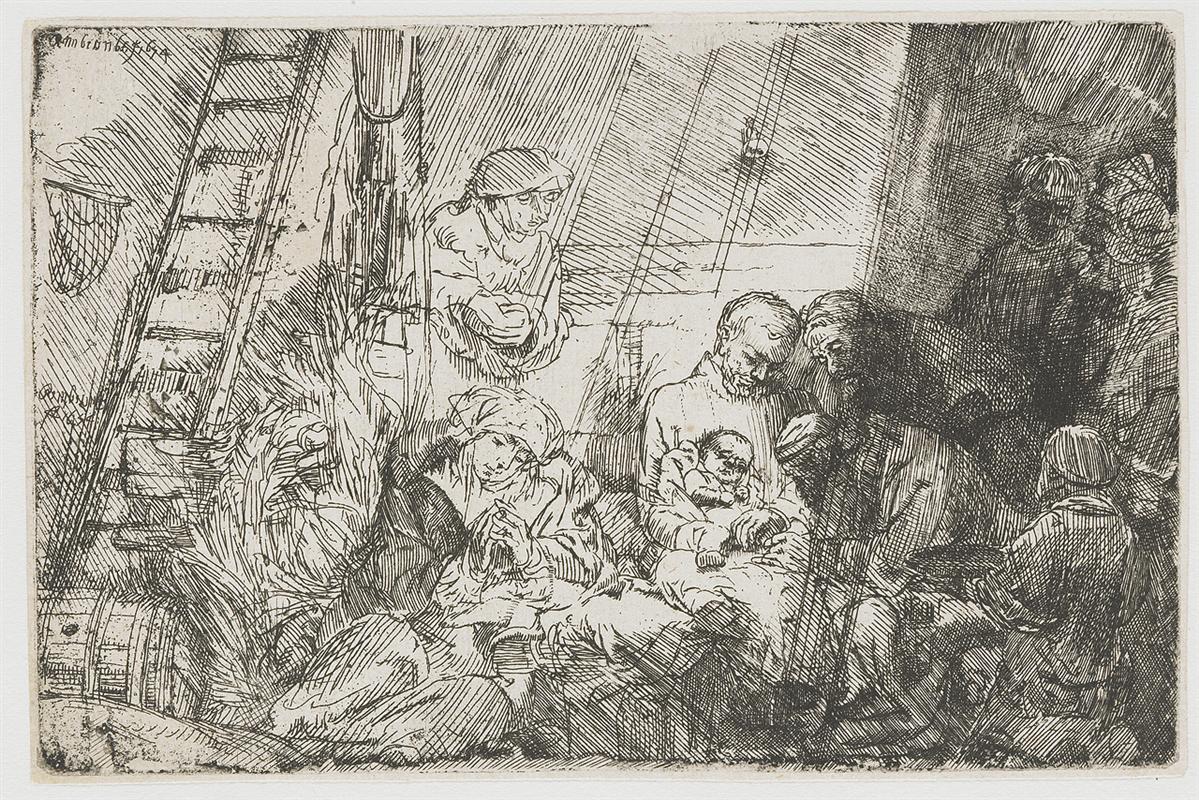
Rembrandt’s “The Circumcision in the Stable” (1654) is a small etching with the emotional range of a large painting. Instead of staging the covenantal ritual in a temple or a formal interior, Rembrandt places it among the hay, beams, ladders, and tools of a rustic shelter. The decision relocates a sacred moment to the most ordinary of spaces and, in doing so, fuses two strands that run through his late art: the gravity of biblical narrative and the tactile truth of daily life. Light falls across the sheet in a skewed trapezoid, pushing the eye toward a compact knot of figures gathered around the child. The rest of the print is a murmuring half-dark where straw and faces, barrels and garments, keep company without demanding attention. This is a drama of hands and breath, carried by line rather than spectacle, in which covenant arrives in a place that still smells of animals and work.
The Biblical Episode and Rembrandt’s Choice of Setting
The circumcision of Jesus, observed on the eighth day according to Jewish law, is usually pictured in European art as a temple rite attended by priests. Rembrandt departs from that convention. He returns to Bethlehem—to the family’s improvised quarters—and lets neighbors, midwives, and elders serve as witnesses. The shift is not historical pedantry but theological emphasis: the covenant that marks an infant as part of a people is here enacted in the room where the child has lived his first days, amid the objects that sustain life. By keeping the scene in the stable, Rembrandt underscores continuity between birth and belonging, between the manger’s humility and the law’s dignity. It is also a profoundly Amsterdam choice. In his city, Jewish ritual life was visible within domestic spaces; Rembrandt’s neighbors were not abstractions but households, faces, and customs. The print honors that reality by granting the ceremony the scale and intimacy of a home.
Composition as a Circle of Care
The etching’s composition builds an oval of attention around the baby. Near the center Mary bends, hands together in a posture that can be read as prayer or steadying concentration. An elder, perhaps a mohel, leans in from the right, his head and shoulders in shadow so that the light strikes his hands more clearly than his face. Joseph hovers close by, his body forming a warm wall of presence behind mother and child. Two or three attendants form an outer ring—one to the right with cap and cloak, another at the left edge clutching a bowl or cloth, and a figure in the background silhouetted against the window. The stable’s architecture frames this human choreography: a steep ladder rises like a second spine; ropes and a hoist drop vertical lines through the beam-lit air; a barrel and bundles of straw ground the lower left. Everything leans toward the center, yet nothing screams for attention. The geometry is domestic, a circle that breathes.
Light, Tone, and the Weather of the Room
The entire right third of the print is a dense field of crosshatching that reads as shadowed wall and crowd. From the upper center a pale wedge of daylight descends, perhaps filtered through a loft opening or a patched window. That daylight is not celestial brilliance; it is the honest gray of winter. Rembrandt uses it as a carpenter uses a square, aligning the figures within its angle so that the ritual happens inside a beam of recognition. Highlights are sparing: the baby’s swaddling, Mary’s cheek and hands, the brow of the elder who officiates. Plate tone—thin films of un-wiped ink—softens the sky of the interior and makes the air visible. The darkness is not menace; it is privacy. The light reveals just enough for the viewer to join the witnesses without violating the room’s quiet.
The Ladder, the Barrel, and the Theology of Tools
Few artists grant tools such dignity. At the left a tall ladder climbs toward a loft; below it a barrel lies half in shadow; to the right, ropes and a pulley hang from the beam. None of these objects is symbolic in the allegorical sense, yet together they assert a theology of means. Life requires apparatus—things that lift, store, and carry—and those things, in turn, bear witness to the covenant enacted among them. The wood’s grain, the barrel’s hoops, the rough weave of sacks are etched with brisk, varied strokes that keep them specific without fuss. Rembrandt’s world is never an abstract stage. It is a room in which every object has a memory of touch.
Gesture, Touch, and the Craft of the Ritual
The print’s drama resides in hands rather than faces. The officiant’s fingers, compact and practiced, manage the child with a professional economy that never feels cold. Mary’s hands meet in a clasp that is halfway between prayer and restraint, the pressure of a mother holding herself still so a necessary pain can be endured. Joseph’s hand, barely legible, appears as a supporting plane behind them, the posture of a man whose task is to make space. Even the onlookers speak with their hands: a woman lifts a bowl; a neighbor grips a cloak; a figure at the rear presses palms together in a quiet echo of Mary’s stance. Rembrandt’s etched line is perfectly suited to such choreography, its quick inflections turning finger-joints and knuckles into legible verbs.
Faces in Half-Light
Rembrandt rarely treats faces as diagrams of emotion. Here expressions are understated, participants seen in the intervals between feeling and action. Mary’s brow lowers; the officiant’s features are concentrated but not severe; Joseph’s head inclines with practical attention. The onlookers at the right recede into a matrix of crosshatching, their identities more communal than individual. The anonymity is intentional. The ceremony belongs to a people; the witnesses are less characters than carriers of tradition. Yet within that collectivity each face holds its privacy, an effect achieved by allowing the pen to hesitate slightly at eyes and mouth before hurrying on.
The Stable as Covenant Space
By keeping the ritual in the stable, Rembrandt collapses the distance between sacred and ordinary. The place of feeding becomes the place of naming, the site of birth the site of belonging. Light slices across both straw and skin without distinguishing between noble and base materials. The covenant is not embarrassed by its setting; it dignifies it. In Protestant Amsterdam, where household devotion replaced lavish church display, such an image would read as a confirmation: holiness happens where families gather, and ritual can be as close as a lamp and a ladder.
The Language of Line
Technically the sheet is a virtuoso exhibition of line doing many jobs at once. Long, nearly parallel strokes rake the upper field to imply angled light; short, jostling marks mass straw; round, huddled loops build clothing and blankets; dense crosshatching deepens the right-hand gloom. Rembrandt alternates blunt and sharp points so the line sometimes slips like wire and sometimes drags like a twig. He leaves raw paper around the baby’s head and swaddling, allowing whiteness itself to perform as glow. The line never becomes decorative. It keeps faith with the modesty of the room, spending flourish only where the eye needs help.
Sound and the Imagined Sensorium
Though etched, the scene invites listening. One hears the scrape of a stool, the quiet whisper of cloth, the low voices of neighbors, a child’s brief cry, the muted thud of someone’s footstep on wood. The ladder and pulley conjure the faint creak of a loft door. Rembrandt’s ability to summon such sound through mark and spacing is one of his late style’s marvels. The print feels inhabited. It is not an illustration to be scanned but a room to be entered.
Proximity and the Viewer’s Role
We stand very close to the bed. The cropping at the bottom edge suggests that the viewer is nearly touching the blankets. That proximity matters. It turns spectatorship into witness. Rembrandt refuses the cool distance of many sacred scenes; he chooses the human distance of neighborliness. The sense of being present is intensified by the ladder on the left and the dark cluster on the right, which hem us in as if we have slipped into the only open space at the bedside.
Continuities with Rembrandt’s Nativity Prints
The sheet belongs to a constellation of small prints from 1654 that treat the early life of Jesus with domestic tenderness: the “Nativity,” “Adoration by Shepherds,” and “Presentation in the Temple.” Each relocates the sacred into rooms where carpentry, animal breath, and familiar bodies set the climate. Compared with the shimmering darkness of “Presentation,” the “Circumcision in the Stable” is lighter, sketched with an almost conversational speed. Yet the theology is consistent. Recognition and covenant are social facts enacted in spaces people already share.
The Ethics of Looking
The child’s body is largely occluded by swaddling and by the focus of the elder’s hands. The print never turns the infant into spectacle. Mary’s modesty and the ceremony’s solemnity teach the viewer how to look: not as a collector of arresting details but as a respectful participant who pays attention to process. The etching’s modest scale reinforces that ethic. To see it well you must approach, lower your voice, and let your eyes adjust to the room’s mixed light.
The Role of Ambiguity
Rembrandt keeps several elements quietly ambiguous—the exact boundary of wall and shadow at right, the identity of some attendants, the precise mechanism of the pulley and hoist. Ambiguity here is not sloppiness; it is hospitality. By leaving certain passages open, he lets the viewer supply memory and inference. The result is a scene that feels more real, because real rooms are never fully legible at a glance.
Human Particularity and Communal Tradition
The sheet honors two truths at once: the event is singular, and the rite is shared across generations. The singularity resides in the particular angles of these bodies in this stable on this winter day. The communal lies in the gestures repeated countless times by a people. Rembrandt’s etching holds both by refusing pomp. He gives the moment the dignity of work well done, of neighbors gathered, of light falling in the only way it can through this roof at this hour.
A Contemporary Reading
Viewed today, the image carries renewed resonance. It depicts a community stewarding a child through a rite that precedes him, a ritual neither exoticized nor suppressed but treated with respect in the heart of domestic life. It insists that identity is woven from practiced gestures and shared rooms. In a world where sacred traditions are often either sensationalized or hidden, Rembrandt’s print suggests a third way: show the ritual as work of love conducted with steady hands and surrounded by things that last.
Conclusion
“The Circumcision in the Stable” is Rembrandt at his most humane. With a handful of lines and a pocket of light he turns a stable into a sanctuary and a legal act into a circle of care. The ladder rises, the barrel waits, the small window pours its winter wedge, and around the baby a town’s worth of hands and faces gather to do what must be done. The print’s beauty is not the beauty of spectacle but of truth: that covenant can live in straw-scented air, that holiness can share a bench with tools, and that a viewer, if willing to draw close, can become a witness rather than a tourist. In that intimacy lies its enduring power.
