Image source: wikiart.org
Introduction
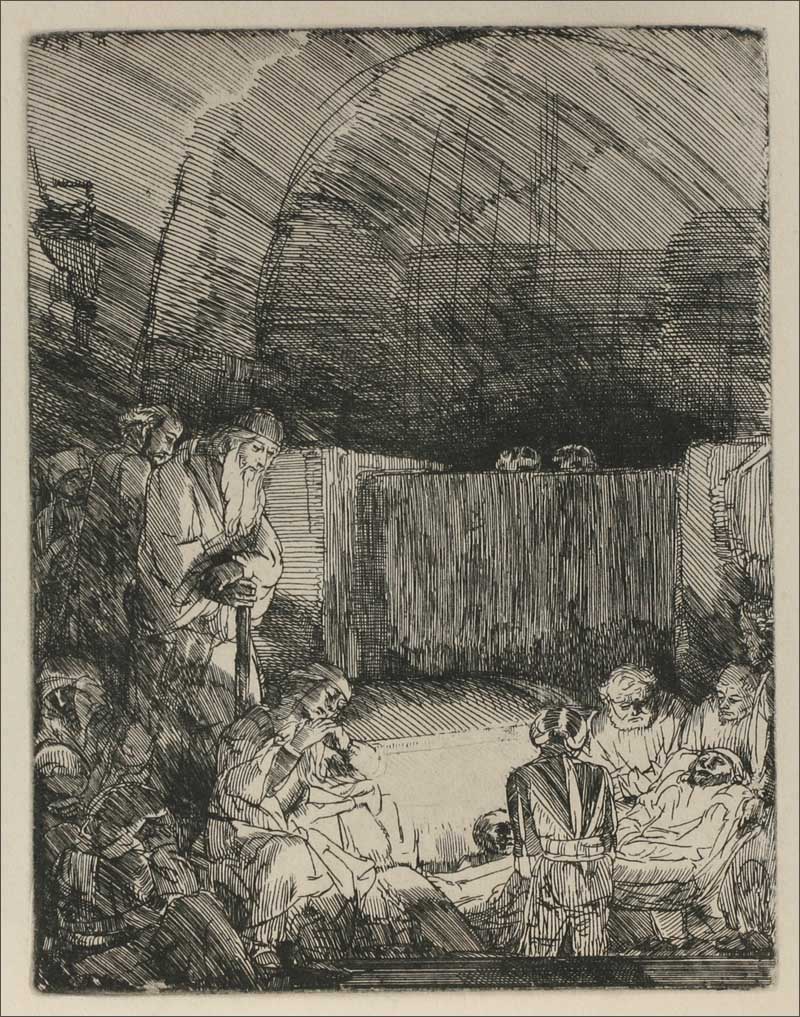
“Jesus Christ Entombed” (1654) is a concentrated meditation on grief, ritual, and the weight of finality. In this late etching, Rembrandt compresses the Gospel scene of the burial into a chamber-like space where figures bend and gather around the body with a choreography of hands and backs, while a vault of darkness presses down from above. The artist eliminates spectacle to focus on the labor of mourning—lifting, arranging, wrapping, and witnessing. The plate is small, the subject immense. What makes the image unforgettable is how Rembrandt lets line and tone become the language of exhaustion and devotion: parallel hatchings fall like a heavy rain; cross-strokes thicken into a felt dusk; and every contour around the bier reads like breath held and released.
The Moment in the Passion Narrative
After the Crucifixion, Joseph of Arimathea and Nicodemus receive permission to bury Christ before the Sabbath. They wrap the body in linen and place it in a new tomb hewn from rock. Painters across centuries have favored the pathos of the Deposition or the theatricality of the Lamentation. Rembrandt chooses the sober middle: the practical work of burial. The body is present not as a tableau for tears but as a responsibility to be tended. That decision defines the entire print. Emotion is everywhere, but it is expressed through action and posture rather than dramatic faces. Grief becomes craft.
Composition as Enclosure
The composition is built around enclosure. A great arcing vault swallows the upper half of the plate, its curve traced by firm, widely spaced lines that lean left to right like descending rain. Beneath this canopy a massive vertical rectangle—perhaps the sealed niche or doorway of the tomb—rises like a wall of scored wood. These two large abstract shapes form, together, a cavern where the human group gathers. At the bottom, a slanted plane of stone receives the body. The entire design tightens the world until nothing exists but light, darkness, and the labor of hands. By compressing space this way, Rembrandt turns a historical event into a chamber drama of weight and touch.
Light, Tone, and the Atmosphere of Finality
Light falls low in this image. There is no spotlight from on high, no celestial breach. Instead, a quiet luminosity glows from the ground plane and from the bright linen that wraps the body. The rest of the plate is a study in dark gradations: the dome above, the rough-hewn side walls, the thick shadows draped over figures who sit back from the bier. Rembrandt’s hatching creates a palpable air—dense, cool, and stone-scented. That air is more than background; it expresses the hush of the tomb and the Sabbath urgency that attends the burial. Where light touches linen, it feels earned, like the last clarity before the stone is rolled.
The Body and the Grammar of Weight
Christ’s body lies along the lower right, its head supported, legs extended, torso carefully managed by the attendants. Rembrandt doesn’t idealize the anatomy. The limbs are heavy, the neck slack, the cheeks slightly sunken. But tenderness governs every contact. Hands cup the skull; forearms cradle shoulder and thigh; linen is folded with the mindfulness of a shroud rather than merely a sheet. Through a handful of concise lines he conveys both the inert weight of death and the living strength of those who carry. In this contrast the print’s theology resides: mortality presses down, love replies by lifting and arranging.
The Cast of Mourners and the Choreography of Grief
Around the bier sits a ring of figures, each assigned a task or posture. At left, a bearded elder leans on a staff, eyes lowered, his long vertical silhouette rhyming with the scored wall behind him. Next to him, a figure with hands raised to the face half-prays, half-shields tears, the bent elbows tying emotion to the labor in progress. Across the center, two attendants kneel at the body’s midline—one adjusting the wrappings, the other steadying the torso. On the right, a man bends close to the feet while another supports the legs. A figure in a tight, back-turned jacket stands at the foot like a small sentinel, anchoring the scene with a posture that reads as readiness to help or to close the ritual. Each body answers the others; the group becomes an organism of care.
The Vault and the Theology of Silence
The most daring feature is the enormous, almost abstract vault that fills the upper field. Its arcing hatch lines create a dome of silence. The curve gathers and focuses attention downward, while the darks at the outer edges compress the space like a slow breath. The vault is not just architecture; it is time made visible—the last hours before Sabbath rest, the pause between death and the unexpected morning. Rembrandt’s lines are neither neat nor mechanical; they vibrate with the slight irregularities of handwork, adding to the sense that silence is alive, not empty.
The Doorway and the Liminal Threshold
At the center back stands a tall rectangle—a door, curtain, or freestanding slab. Its vertical hatching is tighter, darker, and more even than the vault above, which makes it read as a solid barrier. Yet the upper rim appears interrupted by three rounded shapes that peer just over the top, like heads or stones. This ambiguity deepens the drama. The barrier represents the limit that all mourners face: the stone to be sealed, the end to be acknowledged. But the suggestion of forms beyond it hints at witness, perhaps those keeping watch or the sense of the world continuing outside. The image holds both truths—the boundary of the tomb and the reality of the world still turning.
Line as Gesture and Breath
Rembrandt’s etching line here is at once economical and expressive. Long, parallel strokes sweep the vault; short, quick marks knit garments and hair; scalloped, rippling lines create the rough texture of rock. In the linen, he switches to lighter strokes and leaves more paper untouched, letting the white read as fabric’s cool sheen. Because the marks are never mechanical, they feel like thought made visible. One can sense the artist breathing with the mourners—the line accelerates where hands work, relaxes where figures watch, deepens where the space demands gravity.
Proximity and the Ethics of Care
The print is intimate. The viewer stands at the edge of the scene, close enough to see the folds of cloth and the tilt of a wrist. This proximity is moral: it makes us participants. We are not distant historians cataloging a burial; we are quiet witnesses pressed against the stone with the others. Rembrandt eliminates the temptation toward voyeuristic drama and replaces it with the invitation to attentiveness. The message is not shouted; it is practiced by example. Care is a craft learned by watching hands do their work.
Dialogue with Earlier Passion Scenes
Rembrandt’s earlier Crucifixion images are filled with diagonal beams of light, surging crowds, and theatrical contrasts. “Jesus Christ Entombed” belongs to the quieter end of his Passion cycle, along with intimate prints of the Holy Family and nightly journeys. He shifts from public spectacle to domestic tenderness. In doing so he complements the drama of the cross with the sobriety of burial, recognizing that the story’s power includes not only the moment of sacrifice but also the community’s response—the discipline of honoring the dead.
Time Suspended Before Closure
A special tension animates the image: it is the moment before enclosure. The body has been lowered; the shroud gathers; the attendants ready themselves for the next step. Rembrandt suspends this instant like a held note. Because the stone has not yet been rolled, the viewer remains within a window where touch and sight are still possible. That suspension is crucial to the print’s devotional power. It gives us time to enter compassion rather than rush past it, and to understand grief as a practice that mingles reverence with work.
Human Particularity Over Emblem
No halos hang in the air. No inscribed motto explains the doctrine. Rembrandt trusts the human particular—the angle of a bent back, the careful lift of a head, the dull glow of linen—to carry the meaning. By refusing emblematic shorthand, he anchors the sacred in the recognizably human. It is precisely because the scene could belong to any family burying a loved one that it belongs to this one. Universality enters through likeness, not through ornament.
The Servants of Night and the Politics of Love
One of the striking features of the composition is how democratic it feels. Elders and attendants share the frame without hierarchy. The learned men hold silence; the workers do the lifting; and the scene dignifies both roles equally. In a culture where status often structures depiction, Rembrandt’s organization says something about love: when it attends the dead, it assigns honor to those who act. The man with the staff, the small figure at the feet, the stooped bodies that shift weight—these are the heroes of the hour.
Materiality and Memory
The etching is a memory machine. Every mark conjures a texture that we have known—grainy stone, cool linen, the roughness of a staff, the soft collapse of hair. By activating our tactile memory, Rembrandt brings the remote past into the body’s present. The burial ceases to be an abstract “then” and becomes a felt “now.” That immediacy is why his Passion prints continue to persuade across centuries; they are not illustrations but invitations to remember with the senses.
The Arc from Dusk to Dawn
Although the image is full of darkness, it is not despairing. The low light along the shroud, the breathing space around the body, and the faint “open” at the upper left where the vault’s curve thins—all guide the eye toward quiet hope without violating the scene’s gravity. Rembrandt plants no prophecy; he merely refuses to crush the air. The arc of lines that press from upper left to lower right can be read as the movement of dusk, but dusk implies dawn somewhere off-frame. The etching thus holds sorrow and expectancy in a humane balance.
Printmaking as Devotional Practice
Technically, the plate demonstrates Rembrandt’s late mastery of etching as a medium for meditation. The varied pressures of the needle, the strategic retention of plate tone, the layering of hatch directions to produce density without monotony—all serve a contemplative purpose. Looking becomes a slow act, like prayer. The viewer traces the lines and discovers, in their patience, a mirror for the patience of those burying the body. This is art as discipline: not a thrill but a schooling of attention.
A Contemporary Reading
Viewed today, the scene speaks beyond its theological frame. It honors communities who do the work of tending the dead, whether in hospitals, homes, or improvised shelters. It recognizes the dignity of those who hold and wash and wrap, whose names rarely enter headlines. The print instructs without sentimentality: grief is labor shared; love is a series of small, precise acts carried out under a low sky. In times when loss is public and frequent, this image offers a model of how to be serious and kind.
Conclusion
“Jesus Christ Entombed” is one of Rembrandt’s most moving achievements in the art of less. With simple architecture, a choir of working hands, and a sky of hatched silence, he renders the burial not as spectacle but as duty suffused with tenderness. The print asks nothing more of us than to stand nearby, to watch how love manages weight, and to feel the heavy air of finality that is not yet final. In that nearness, the scene discloses its deepest claim: that the sacred hides in the precise acts we perform for one another when grand gestures are impossible—lifting, wrapping, watching, and, at last, closing the door with a hand that knows what it is doing.
