Image source: wikiart.org
Introduction
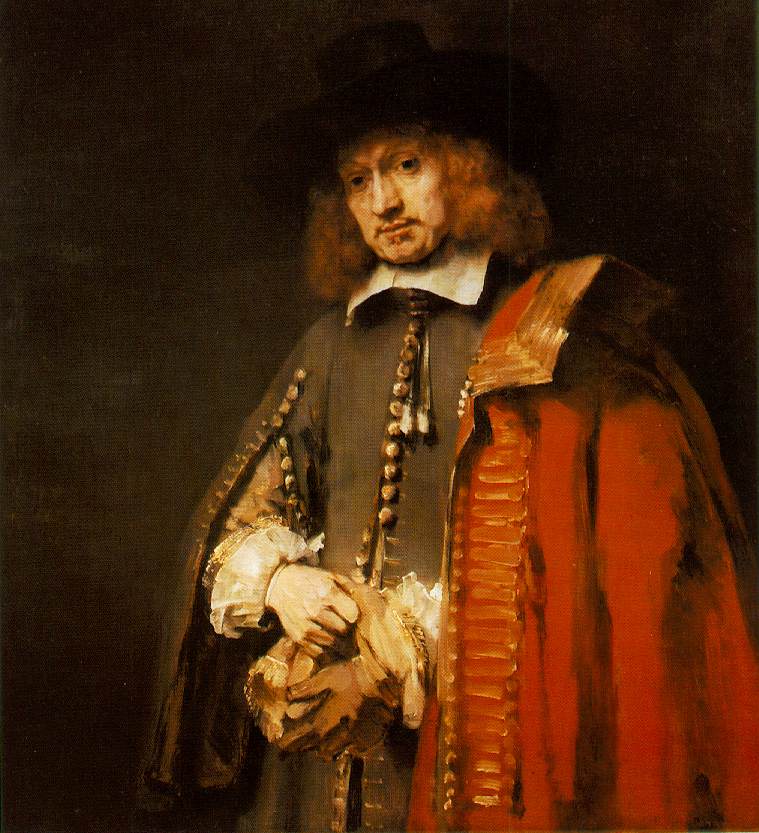
Rembrandt’s “Jan Six” (1654) is among the most eloquent portraits of the Dutch Golden Age—a painting that turns a momentary gesture into a lifelong character study. Rather than staging his sitter in heraldic grandeur, Rembrandt interrupts him mid-action, as Jan Six slips on a glove before stepping out. The background is a veiled darkness; the costume is sumptuous but handled with a painter’s immediacy; and the face, illuminated with a delicate, living light, carries the full weight of personality. The work distills Rembrandt’s late manner: economical setting, daring brushwork, and a psychological presence that feels observed rather than arranged. It also refreshes the portrait genre by treating time itself—the single beat between private stillness and public duties—as the true subject.
The Man Behind the Portrait
Jan Six (1618–1700) was no ordinary client. Scion of a wealthy textile family, he was a collector, connoisseur, playwright, and later a high-ranking Amsterdam regent. He owned works by Titian and Rubens, wrote popular dramas such as “Medea,” and possessed keen judgment about the arts. Rembrandt and Six belonged to the same cultural ecosystem of poets, scholars, and patrons. The artist had etched Six’s likeness years earlier; the two exchanged gifts and favors; and the present painting is often read as a dialogue between equals. Because Six understood painting, Rembrandt could be bold. Because Rembrandt understood people, he could compress Six’s intellect, taste, and civic poise into an image that feels both informal and monumental.
The Famous Glove and the Invention of Time
An oft-told anecdote claims that Rembrandt painted Six while the sitter waited for his carriage, catching him in the instant he drew on a glove. Whether apocryphal or not, the story captures a truth about the picture: it is the portrait of a pause. Six’s left hand pushes into the right glove while a gathered clump of buttery paint records the soft resistance of leather against lace. The head tilts slightly forward; the gaze is inquisitive rather than confrontational; the mouth rests in a thoughtful downturn. We meet a man suspended between interior reflection and outward engagement. In this way Rembrandt replaces the freeze of representation with the breath of lived time.
Composition and the Architecture of Asymmetry
The composition is cunningly simple. A large, dark ground swallows the left and upper portions of the canvas, allowing only a faint vibration of brown to register as space. The figure rises in a gentle diagonal—from the brim of the black hat through the ovoid of the head, down the gray coat laced with beadlike buttons, and into the warm blaze of the red mantle draped over the right shoulder. The hands occupy the lowest center, forming a knot that anchors the whole design. That asymmetry—cool gray to the left, incandescent red to the right—creates momentum without noise. The portrait reads like an opening curtain: shadow parts, a figure advances, and the next act is about to begin.
Color, Fabric, and the Drama of Red
Rembrandt’s color language is both restrained and theatrical. The grundton is a concert of blacks, umbers, and silvery grays, against which the mantle’s vermilion flares like an ember. The red is not flat; streaks of orange, brick, and lake build a living weave. Gold trimming moves in a staccato pattern down the mantle’s edge, catching light along the raised ridges of impasto. By underplaying the rest of the palette, Rembrandt makes the red do double duty: it signals wealth and public role while also serving as an emotional temperature—the warmth of cultivated sociability, the energy of a mind in motion.
Brushwork and the Evidence of Making
Few portraits stage their own facture as eloquently. The face and hands are tenderly modeled in thin, semi-opaque passages; low chroma flesh tones are warmed by minute pinks at the lip and knuckle, with cool grays holding the hollows of the cheek. By contrast, the garments are painted with bravura. The cuffs explode into calligraphic dabs; the mantle rides in big, dragging strokes that leave ridges like woven ribbing; the gold braid is struck with thick, bright touches laid wet over wet. Edges dissolve and reappear—what painters call “lost and found”—so fabric seems to move as the eye moves. The overall effect is a hierarchy of attention: the mind (face) is nuanced and patient, the social theater (costume) is quick and performative.
Light and the Psychology of the Gaze
Rembrandt’s light falls from the left, bathing the forehead, nose, and cheek, and then slipping down the throat to dissolve in the collar. The eyes sit partly in shade under the hat’s brim, yet glint with tiny highlights that fix attention. This is not the dazzling chiaroscuro of Rembrandt’s youth but a late, orchestral light capable of describing mood. Six’s gaze does not pin the viewer; it glances slightly aside, the look of someone anticipating conversation rather than commanding it. Light becomes a social instrument: it makes his features legible while preserving the reserve appropriate to a man of standing.
Costume as Character
Every element of dress carries meaning. The broad-brimmed hat projects gravitas without ostentation. The gray coat, enriched by the vertical comma-beads, speaks to urbane taste rather than military swagger. Lace at the cuffs and the linen collar demonstrates wealth but is rendered with quick touches that keep luxury from becoming stiffness. The glowing mantle—often understood as a cloak worn for travel or ceremony—announces readiness for public appearance. Gloves, the period’s emblem of civility, define the painting’s action: Six arms himself with etiquette. When these parts are assembled, we meet not just a rich man in finery but a cultured magistrate and writer preparing to step into the civic stage he helped shape.
The Face as a Thinking Landscape
Rembrandt’s genius concentrates in the face. Subtle asymmetries animate the expression: the left eyelid droops slightly more than the right; the corners of the mouth soften differently; the mustache sits with a delicate unevenness that refuses the rigidity of idealization. The skin is not polished but living, traversed by quiet shifts of temperature and micro-modulations. A thin glimmer of moisture on the lower lip, the soft fold under the eye, the gentle separation of strands in the reddish hair—these are the signs of observant compassion. The painter is not extracting a type; he is sitting with a person.
Space, Silence, and the Stage of the Mind
The background’s breadth of darkness is not mere absence. It is an active silence that contrasts with the mantle’s public fervor. The void wraps the figure like a pause, allowing the viewer to concentrate on transition rather than destination. This blankness is also a device that isolates the sitter from paraphernalia. No desk, no column, no curtain insists on significance. Meaning is carried by the man alone. In a city devoted to commerce and civic pride, Rembrandt’s restraint functions like a moral: identity is not a collage of props but the sum of temperament and action.
Friendship, Patronage, and Artistic Freedom
Because Jan Six was a discerning patron, Rembrandt was free to paint riskily. Few clients would tolerate the virtuosic looseness of the mantle or the nonchalant economy with which large swaths of the canvas are left hovering near the ground layer. Six did. He prized the immediacy that only a master could sustain—brushwork that looks tossed and is yet perfectly calibrated. The mutual respect reads in the picture’s tone: it is neither flattery nor defiance but conversation. Rembrandt offers Six the theatre of himself; Six allows Rembrandt the theatre of paint.
Comparison with Rembrandt’s Other Portraits
Earlier portraits—“The Night Watch” officers, the sober merchant sitters—often locate identity within collective or occupational frames. In “Jan Six,” Rembrandt moves inward. The closest kin are the late self-portraits, where the artist takes stock of time and reputation with a similar mix of candor and ceremony. What differs is the temperature: the self-portraits are stoic; this painting is warmly social. Six stands at the doorway between salon and street, and Rembrandt delights in balancing introspection with sociability.
The Poetics of Edge and Interval
One can trace the painting’s sophistication at its edges. The hat’s brim dissolves into the dark, softly vibrating rather than cut; the mantle’s hem crumbles into painterly shorthand; the near hand, though drawn with Resolute precision, is partially swallowed by glove and shadow. These lost contours invite the mind to finish what the eye begins—an invitation that makes the portrait feel alive. Equally important are the intervals: the slice of darkness between face and mantle, the triangular wedge of shadow beneath the cuff, the pause of bare background beside the hat. Each gap is a rest in the music, a place for breath.
Materials and the Tactility of Wealth
Rembrandt’s paint not only depicts but reenacts material. Lace is flicked into being with whipped cream strokes; leather is dragged and pressed until it buckles like worked hide; wool and velvet emerge from broad, opaque sweeps that leave a physical nap on the surface. This tactile theater translates wealth into painterly action. We sense not abstract prosperity but the granular pleasures of garment and accessory as they meet touch, light, and motion. In a portrait of a man connected to the textile trade, that translation is especially apt.
The Portrait as Theater and the Playwright Sitter
Six was a playwright; the painting knows it. The angle of the hat, the swing of the mantle, the pause over the glove feel like stage directions—“He prepares to exit, considering.” Rembrandt’s light operates as a house spotlight: the face and hands glow against a dark scrim while costume cues the role. Yet the performance remains intimate, a rehearsal more than a show. We are in the wing rather than the stage, allowed to watch the interval when a public man recollects himself before he steps into view.
Reception, Legacy, and the Standard it Set
“Jan Six” has long been held as a pinnacle of portraiture because it sets a demanding standard: can a likeness carry motion, class, vocation, temperament, and friendship without sacrificing simplicity? Many tried to imitate its casual grandeur; few matched its truthfulness. The painting revealed a way forward for European portraiture—one that foregrounded moment and mind over emblem and architecture—and it continues to teach by example that the most persuasive symbols are the ones life supplies: a glove being drawn on, a gaze turned inward, a cloak about to swing.
Conclusion
Rembrandt’s 1654 portrait of Jan Six is a masterclass in how to let a life speak through a single instant. With the fewest props and the freest brush, he creates a person who can still persuade us across centuries: cultured yet unpretentious, wealthy yet thoughtful, poised to enter the city’s public rooms but still dwelling for a heartbeat in his private one. The painting honors Six’s refinement by answering it with painterly refinement, turning color, light, and gesture into a language as cultivated as the sitter’s mind. Above all, it proves that a portrait can be both candid and ceremonious—a theater of truth where a man, his glove, and a turning thought become sufficient drama.
